The Great War: A–M · Story 34
Albert James Manning (1892-1919)
We have seen in this series of biographies that, from the late Nineteenth Century, many Ringstead men had left the farm or the shoe factory to work in the local quarries and blast furnaces at Islip. James Manning was one of these Ringstead men, whose father had been a farm labourer but had become an industrial worker.. He had married Emma Maria Warr from Little Addington in 1887 and by the 1901 Census they had five children: Emily (13), Gertrude (11), Albert (9), Florence (6) and Alec (4).
By 1911 Emily was an Army Boot Closer, Gertrude was a School Teacher, Florence a Monitress (in a school) and Alec a Baker’s Assistant. It would have been seen as an “upwardly mobile” family. Only Albert James, aged 17, whose story we are following here, had become an Ironstone Labourer like his father.
When war came in 1914 Albert did not enlist with the usual infantry regiments but joined the Royal Engineers. In his work at the Islip Iron Company he had become a shunter on the ironworks site. His employers had applied for him to be exempted from service because of his work but the appeal was rejected.
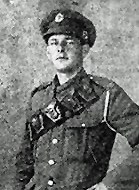
On 13th December 1915 Albert enlisted with the Royal Engineers whose work was an essential support to the fighting units. It maintained the railways, roads, bridges and water supply. It often had to improvise new structures quickly, to replace ones destroyed by the enemy. It also had specialist tunnelling companies and built frontline fortifications. The list could go on.
Albert joined another branch of the Engineers which dealt with the communication systems in the warzones and the chain of command. At the beginning of the war the telegraph was the most important means of military communication. Brian Hall in a paper for the University of Salford, explained what this entailed in terms of engineering work.
The army utilised two types of line: “Airline” and “Cable.” The former referred to bare wire fixed to poles, buildings or trees, while the latter consisted of gutta-percha or rubber-insulated wire laid along the ground. Airline was the prominent feature of the telegraph and telephone system to the rear of divisional headquarters, beyond the range of enemy artillery fire. Lines forward of divisional headquarters were laid on short poles or stakes, along the sides or the bottom of trenches, or simply along the ground. However, the closer to the frontline the more susceptible to faults and breakages from enemy shellfire these lines became, not to mention their vulnerability to enemy interception. Throughout the war, the British Army implemented numerous measures to combat these problems, including twisting the cable to reduce “leakage,” duplicating the number of lines laid and burying them to ever-greater depths to protect them from shellfire. By the summer of 1915, the standardised depth of lines forward of divisional headquarters was 2 feet 6 inches. By the end of the year this had been deepened to 5 feet and by the start of the Somme offensive in July 1916, all lines up to battalion headquarters were laid to a depth of 6 feet.
It is clear that this was often difficult, dangerous work and an obvious target for snipers and artillery.
The telephone became the main system of communication as the war progressed but, like the telegraph, the lines were very vulnerable to shellfire and were difficult to maintain in a moving situation. The early systems were also unreliable over distance and vulnerable to interception. Wireless technology (radio) was in its infancy and its range was very limited. It is therefore not surprising that human runners and carrier pigeons still had an important place in the army’s communications.
Albert Manning joined the 24th Airline Company GY Cable Section (the Sections were numbered alphabetically, usually with two letters) and given the Regimental No. 32672. He went with the 24th to Salonika in April 1916. The Macedonian Campaign had begun in October 1915 and initially the Greek government, which was trying to remain neutral, was very ambivalent about the British presence. As a result, the army was not allowed to use the existing civil telecommunication network and had to try to create their own with very limited skilled manpower and resources. A couple of months after Albert arrived, the Allies formally took control of the civil telegraph offices and things improved. There was also more skilled labour and supplies of cable sent to the region.
In the Medal Rolls, Albert was described as a “driver” but he was also described as a “Pioneer” which was a term for a Private who was allocated to general duties in the Royal Engineers. Without his service record we cannot see the chronology of these descriptions.
We have seen in the story of Stuart Dimbleby Bates, who left the Salonika area at about the time that Albert arrived there, that much of the fighting was in a region of marshes and stagnant pools where malaria was endemic. Albert was treated twice for the disease in his time in Macedonia. Malaria was rarely fatal but it caused extreme fatigue and vomiting and would often recur. We know now that “Plasmodium”, the parasite responsible for malaria, also impairs the ability of key cells of the immune system to trigger an efficient immune response. As a result the men who had contracted malaria were susceptible to a wide range of other infections.
Certainly, this was the case for Albert and he was to suffer illnesses from this point on. In September 1917 he crossed the Mediterranean as part of XX Corps of the British Egyptian Force. The army had originally been sent to Egypt to defend the Suez Canal but it later also moved north into the Palestine area. Albert was with this force but contracted diphtheria there and had to return to Egypt for treatment before returning again to Palestine in September 1918.
With the end of the war the Royal Engineers began to move back through Europe for demobilisation. Albert had been away from home for three years and must have been looking forward to home and good health. Unfortunately “Spanish Flu” and Pneumonia were rife in Europe at the time. We know that he was taken to the 1st Rest Camp Hospital at Tourlaville, just outside Cherbourg, suffering from Lobar Pneumonia. He died there on 3rd February 1919. An amount of £20 19s 10d was authorised to be paid to Albert’s father. He was also entitled to the British War and Victory Medals.
He was buried near the hospital in the Tourlaville Communal Cemetery Grave C.6. He was twenty-seven years old. The text his parents selected for his gravestone was the refrain from a popular hymn, Now the labourer’s task is o’er, by John Ellerton:
Father in thy Gracious Keeping
Leave we now our loved one sleeping.