The Great War: A–M · Story 19
William Davis (1897-?)
The life of William Davis, including his army service, is more difficult to uncover than for most of the men we have written about. We know that he finished the war in the Royal Army Ordnance Corps, which is generally not so well documented as the Regimental Battalions. There also happens to be a number of men called William Davis in the Ordnance Corps, and in the Northamptonshire area, of about the right age. His military records have been destroyed but further research and the publication of the 1921 Census may solve some of these problems.
We do know that William was the son of Silas Davis who had been born in North Crawley in Buckinghamshire. Silas’s father had been a sawyer there but, at some point, he moved up to Northamptonshire for in 1895 he married Edith Emma Ellen Bradshaw, the daughter of Frederick, the Ringstead village blacksmith. Silas became the village blacksmith like his father-in-law.
The couple had a daughter, Mahala, born on the 11th May 1896, and William followed a year later. In the 1911 Census, we see the family were living in Chapel Road in Ringstead. William was thirteen years old and still in school.
We do not know when William enlisted or even if he went first to another Regiment before joining the Army Ordnance Corps (AOC). There are a number of men named William Davis who were in the AOC, (the “Royal” was added in 1918) but from the Absent Voters’ Lists for Ringstead we know that his Service Number was 8145.
The Western Front Association on its website describes the Calais A.O.C. Base:
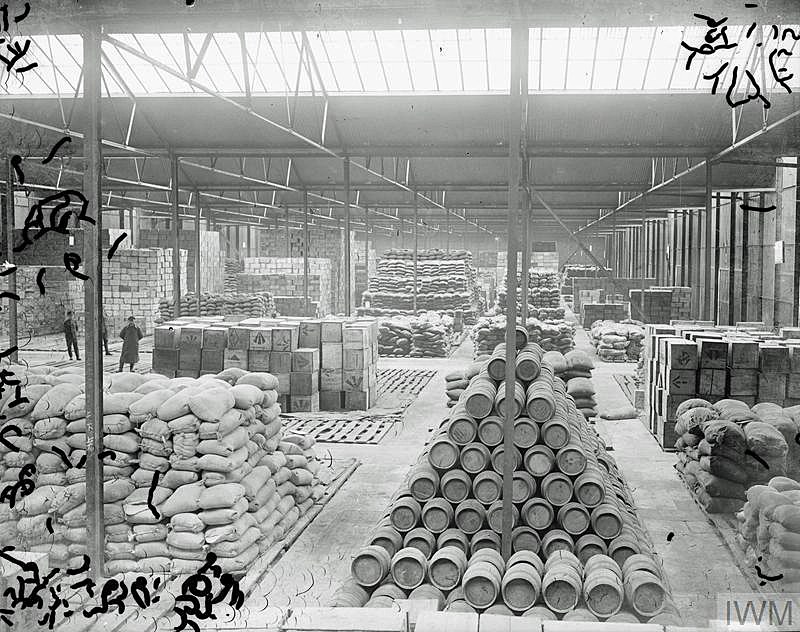
The AOC issued immense quantities of ammunition for anything from a rifle to a monster siege gun. Some idea of the range and scale of other items supplied can be gained from the following issues made by the Calais Base Ordnance Depot . . . during the first ten months of 1916: 11,000 compasses, 7000 watches, 40,000 miles of cable, 40,000 torches, 3,5000,000 yards of flannelette, 1,250,000 yards of rot-proof canvas, 26,000 tents, 1,500,000 waterproof sheets, 12,8000 cycles, 20,000 wheels, 5,000,000 ant-gas helmets, 4,000,000 pairs of horse and mule shoes, 447,000 Lewis gun magazines and 2,250,000 bars of soap. There was, of course, much else besides including weapons, clothing, footwear and blankets.
The Ringstead Roll of Honour records that William served in both France and Italy. The AOC had to store and supply the Front Line with weapons, armoured vehicles, ammunition but also it was given responsibility for other supplies such as clothing and mobile baths. During the course of the war it had to become a much larger and more complex organisation to keep pace with the new industrialised warfare. One of the major home bases was Weedon Bec in Northamptonshire. The march tune of the RAOC was “The Village Blacksmith”.
It was not an easy posting and the AOC soldiers were often a target for enemy artillery fire. William would have first served in France and then moved on to Italy. The Italian Campaign is one of the most neglected aspects of the hostilities. The Italians had been allied with the Germans and Austrians but never fought with them and changed sides in 1915. In October 1917 French and British troops were sent to Italy after the German-Austrian Army had broken through the Italian Front at Caporetto. They began to close in on Venice but the Allies first defended against and then, finally, defeated the Austrian Army, although it was the Italians, against expectations, who rallied and were the major force in the action.
We know that William was in Italy in September 1918 for, on the 25th, he was admitted to No, 39 Casualty Clearing Station (CCS) when he had suffered a sprained right thumb. At this time 39 CCS was in a village school building at Dueville, a few miles north of Vicenza. William was discharged back to duty five days later.
William was still serving when the Ringstead Roll of Honour was published in mid-1919 but we see from the Electoral Register that he was back in Ringstead by 1920 and was recorded there until the mid-1920s. In 1939, his father, Silas, was still a “Master Blacksmith”, living with his wife Edith, in Chapel Lane Ringstead.
Unfortunately, I have not been able to find William, with any confidence, after that. I had thought that he might be the William Davis who married Raunds girl, Emily Maud Stringer, in 1917 and, after she died in 1924, married her youngest sister, Rose in 1927. The Marriage Certificates show, however, that his father was George and the 1939 Register of England & Wales shows that he was a younger man. There are many other possibilities but we must leave his story there for the present.