The Great War: N–Z · Story 3
The Peacock Family
The name Peacock has been in Ringstead at least since the Seventeenth Century, and first appeared in the Parish Registers with the christening of John Peacocke, son of John and Anne, on May 10th, 1629. We pick up the family with another John, christened on November 11th 1832. He married Jane Bates on 25th July 1856 and they had at least seven children: Eliza Jane, William, Sarah Ann, John Thomas, Sarah Ann again, Arthur Henry and Agnes, Both Sarah Anns died in infancy. Childhood was a dangerous time and between 1846 and 1865, nine children with the surname Peacock were buried in Ringstead Churchyard before their nineteenth birthday.
It is the two younger sons, John Thomas and Arthur Henry, whose own sons we will be looking at in this chapter. John Thomas had been baptised on 24th August 1864 with his seven-year-old brother William, and Arthur was baptised on 25th March 1867.
John Peacock ----------- Jane Bates
1832 – 1892 1837 – 1892
I
---------------------------------
I                                             I
Martha Ellen Bellamy --------John Thomas Peacock      Arthur Henry Peacock ------Eliza Emma S. Bugby
         1864 – 1928                           1864 – 1896                       1867 – 1957                      1868 – 1956
                      I                                 I                       I                                                          I
          Thomas Cyril            Horace        John Thomas                        Arthur E Raymond
A very simplified family tree to show the relationship of the four Peacock men, with the name they were usually known by, highlighted.
John Peacock, the father was a shoemaker and he and his wife, Jane were living in Church Street in 1871 with children William, aged 14 and an apprentice shoemaker, Eliza 10, [John] Thomas 8, Arthur 4 and youngest child Agnes two years old. By 1881 John Thomas had followed his father and become an apprentice shoemaker. Also living in Church Street was an army shoemaker called Michael Bellamy. He had been born in Sudborough but had married Ringstead girl Charlotte Childs and by 1881 there were seven children. Martha Ellen, the eldest, was seventeen years old and was a shoe stitcher. She like John Thomas preferred to use her second name.
The two obviously got to know each other because they married, both aged 20, on the 4th October 1883 in the local church. Perhaps surprisingly, at this late date, when John Thomas would have attended the village school, he made his mark on the Marriage Register although Martha Ellen signed her name in a clear hand. By 1891 the couple had four equally spaced children with Albert, the eldest seven and the youngest Oris (Horace) just one month old.
There was another dangerous incident prior to this, although we cannot be sure which John Peacock was involved. The Northampton Mercury of 6th August 1887 reported:
On Saturday morning, last week, an accident happened that might have resulted fatally. It appears that Mr Samuel Lockie went into the shop of a shoemaker named John Peacock. While there he took hold of a revolver and began to finger it about, not knowing it was loaded, when it went off and shot Mr Peacock in the thigh. Surgical aid was as soon as possible obtained and the ball extracted, and we understand that Peacock is progressing favourably
Th couple had one more child, called Thomas, but a terrible tragedy struck the family before his birth. Ellen, pregnant with Thomas went to bed at about 11 o’clock on the 15th January 1896. She left her husband sitting by the fire reading by the light of a paraffin oil lamp. A few minutes later, he finished reading and started up the stairs to bed, carrying the lamp to light his way. Ellen heard a shout and then the crash of the lamp falling. She rushed out of their bedroom to see what had happened.
She saw Thomas enveloped in flames and ran back into her bedroom and opened the window and screamed for help. Amos Weekley, a neighbour, heard her screams and forced the door open. He found John Thomas in flames and running about the house. Amos helped put out the flames and Thomas told him that that he had trod on his long shoemaker’s apron on the stairs and fell forward on the lamp which at once caught fire and ignited his clothes.
A doctor was fetched and Thomas was taken to Northampton Infirmary suffering from severe burns to his right thigh and both hands. He survived for some six weeks but died on 27th February from “the shock to his system and the burns”. His long survival may indicate that it was an infection which finally killed him, for this was still the most usual cause of death in burns cases.
At the inquest the jury returned a verdict of accidental death and the coroner, in summing up:
. . . commented on the regrettably large number of accidents caused through people using improper and unsafe lamps. He did not wish to praise any particular lamps but it was a grave misfortune that so many people had common lamps which easily caught fire, while there were so many kinds which did not allow the oil to escape into the flames.
Ellen was left a widow with a young family and by 1901 she was living at 30 High Street in Ringstead with her five children aged from seventeen to four. Her younger sister, Ethel, a boot closer, was staying with her, perhaps also helping with the children. A year later, Ellen married widower Benjamin Phillips, a shoe worker in a local factory. In 1911 Benjamin and Ellen were living with Bert, Benjamin’s young son from his first marriage and four of Ellen’s children. Bessie aged 21 was a heel builder and Thomas, at fourteen, a “factory lad”. Horace, aged 20, was working on a farm but it is Cyril, a year older, whose occupation is something of a surprise, for he was a hairdresser.
It was Cyril, Horace and John Thomas who fought in the Great War and it is their stories that we will first look at here.
Thomas Cyril Peacock (1887-1964)
In telling of the life of John Thomas Peacock Senior and his tragic death, after he had been badly burnt by an upset oil lamp, we briefly mentioned his second son Cyril, born on the 1st November 1886. Cyril first followed his father into the shoe trade and was shown as such in the 1901 Census. His father died in 1896 and his mother, left a widow with a young family, had married widower Benjamin Phillips in 1902.
Cyril had been baptised Thomas Cyril but he was known by his middle name, probably to distinguish him from his father, who also tended to use his own second name. At some time after the death of his father, perhaps because of difficult times in the military boot trade, he had become a hairdresser. The 1911 Census showed him living with his mother and stepfather but a year later, on August 12th 1912, he married Rose Brayfield in Raunds Parish Church.
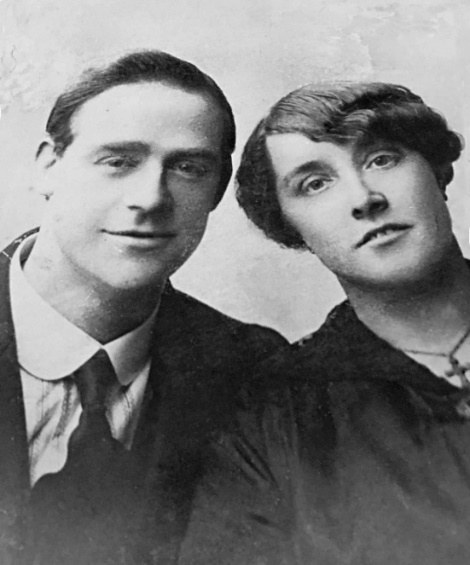
Cyril joined up on 10th December 1915 and became part of an Army Reserve Battalion. At this time the army was made up of regulars and volunteers with single men being used first from the latter group. In the following month Parliament introduced conscription. It was a controversial measure and some ministers resigned but the carnage on the Western Front meant that the need for new men was urgent. Cyril had expressed an interest on his Attestation Form that he would like to be considered for the Royal Flying Corps which had only been formed some three years earlier and consisted of balloons and aircraft. It seems from his later career that Cyril may have been looking to be in the ground crew but what mechanical background he had is unclear.
When he took his army medical in 1915, Cyril was 29 years old. He was 5 feet 5 inches tall with blue eyes. He had a chest size of 33¼ inches and a “range of expansion” of 1¾ inches (this was later changed to 3 inches). The minimum height for conscription was 5ft. 3 inches but even this was reduced in the so-called “Bantam Regiments” as men died in their thousands. It was the revelation of the poor health and small size of many recruits in the First World War that stimulated the movement towards the Welfare State.
We know that, at first, he stayed in Ringstead and ran his own hairdressing shop in the High Street. In April 1916 he was summoned before the Thrapston Magistrates’ Court for not having subdued the lighting of his shop.
He was mobilised on 9th December 1916 and posted twelve days later to an Infantry Reserve, or Training, Battalion. On the 8th February 1917 he joined the Machine Gun Corps (Motors). This was potentially one of the most dangerous postings, as the machine gunners were a vital target for snipers as well as other artillery. It looks, however, as if Cyril did not see front line fighting and served the rest of the war in England.
On the formation of the Machine Gun Corps in October 1915 the Motor Machine Gun Services was absorbed into it and became the Machine Gun Corps (Motors). It had machine guns mounted on motorcycles, cars, armoured vehicles and even trains. The real industry of war had begun.
Cyril joined the No.6 Battalion of the Machine Gun Corps which was based at Belton Park and Harrowby Camp in Grantham. On one official form (B103) it calls it, No. 6 Dominion Battalion which seems to imply that it was composed of soldiers from Canada and perhaps also from Australia and New Zealand. Cyril remained a Private or Gunner throughout his army career and it is not clear what role kept him away from the fighting. He had gained a “Machine Gunner First Class” qualification so perhaps he was an instructor or demonstrator to the new troops. It is also a possibility that he was a driving or motorcycle instructor. There is also the nagging thought that he was the dreaded man who gave the troops their “regulation” haircuts. On his discharge there is no indication of a new skill that he could take into civilian life so it may be that he was a military instructor of some sort but we cannot be sure as his army records give no clue.
On 26th July 1917 he was posted to the newly formed Heavy Brigade of the Machine Gun Corps soon to become the Tanks Corps and then the Tank Brigade. It was based at Bovington near Wareham in Dorset and Cyril became part of the Central Schools of Instruction. Originally Cyril had asked to be in the Royal Flying Corps and tanks were the other great innovation of the First World War.
The tank was based on ideas from before the war but the stalemate and terrible slaughter of the Flanders trench warfare had once more ignited interest among the military and political leaders. The tank was under development in all the main warring nations but the prototypes, often based on tracked agricultural machinery, had many problems and research and progress was top secret. The name “tank” itself was part of this secrecy, designed to give the idea that water tanks were being built. Some of the first British production tanks were marked with Russian lettering and the rumour was propagated that they were snow ploughs intended for Russia. It was designed as a weapon to cross the rough terrain between the opposing trenches, the “killing field”, and break into the enemy defences. Many designs were tried and failed. Eventually, on the 15th September 1916, tanks were used but it was only late in the war that they played a major role in the Allied victory.
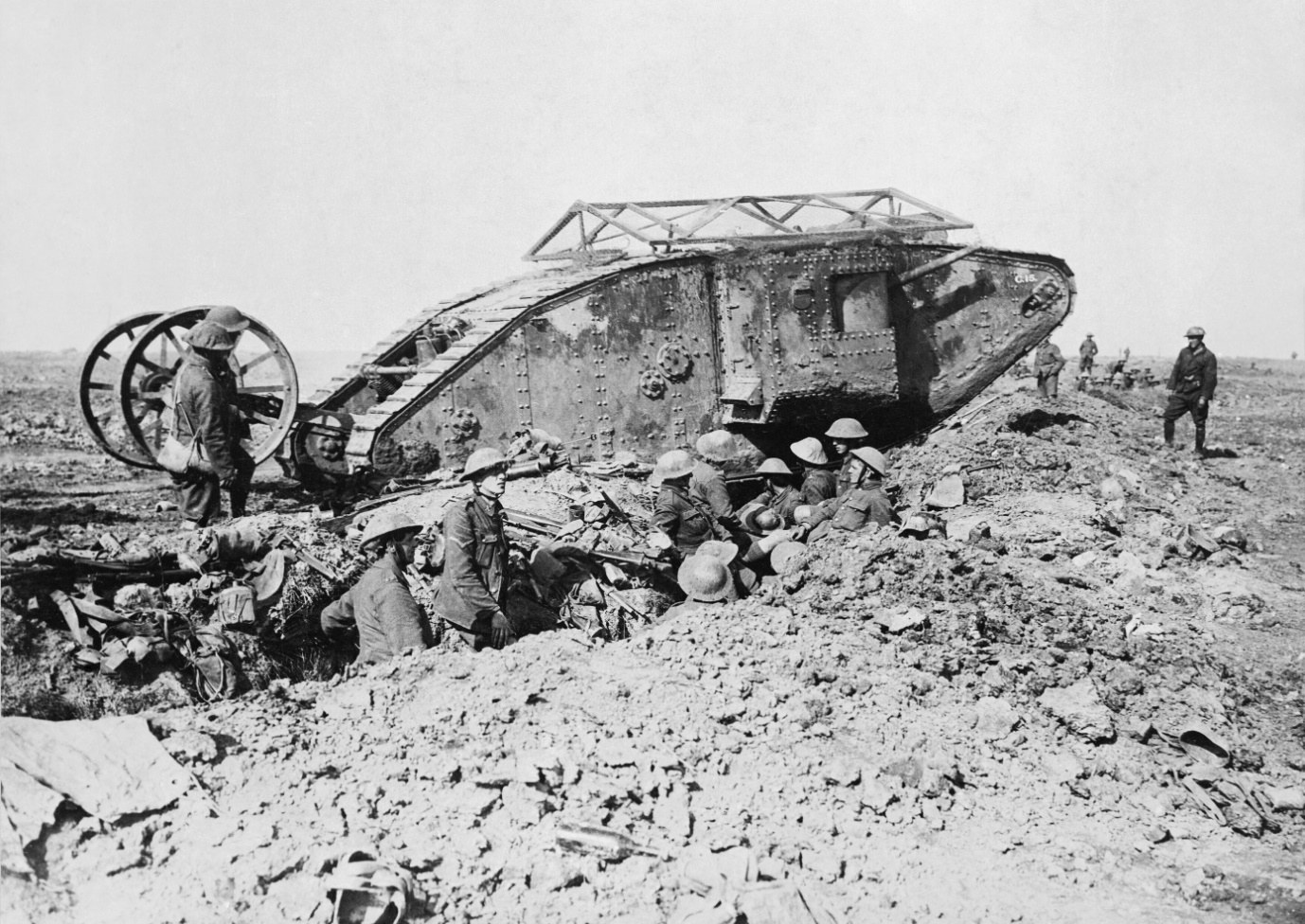
Photograph by Ernest Brooks. Imperial War Museum. Wikipedia Commons (Public Domain).
Cyril had a good army record and his only offence was to overstay his leave pass from Grantham by 12½ hours in April 1917. As his daughter Ellen Louisa had been born on the 16th March there was some excuse and the four days’ pay, that he initially had deducted, was reduced to one. His only injury seems to have been a dislocated elbow on 20th October 1920 which kept him in Wool Military Hospital, near the Bovington Camp for thirty-two days. As we can see from this date Cyril had been retained at the end of the war, first for six months and then for a further three and he was finally demobbed on 12th December 1920.
He stated on his discharge papers that he wanted to be a publican when he returned to civilian life. Cyril did fulfil his ambition. The Electoral Register for 1920 records that he was at the Red Lion, Winfrith in Dorset. The 1939 England and Wales Register confirms Thomas Cyril Peacock is the “proprietor” of the Red Lion. Living with him is wife Rose, who is doing “General Hotel Work” and daughter Ellen Louise (born 17th March 1917). There is one closed entry (which could be daughter Rita Julia). I am sure that we have the correct man but there is one anomaly. When he was baptised in Ringstead on 6th April 1900 it stated that he was born on 5th November 1887 but here and in his death certificate in the USA he is said to have been born on 1st November 1886. However, the Civil Registration shows his birth was in the last quarter of 1886 so it seems certain that this was a clerical error.
He seems to have been successful for, on the 12th October 1949, Cyril and Rose with their unmarried daughter, Ellen Louise, sailed into New York harbour on the Queen Mary.
The family were bound for Texas and we know that Ellen, aged thirty-two arrived in El Paso after having crossed the border from Mexico. She was bound for Alpine in Texas and it seems that it was here that her parents had settled.
It may be that Alpine was chosen because they were hoping to improve the health of Rose. She died on 1st August 1956 after having lived there for seven years. The causes of death included a chronic peptic ulcer which she had also had for seven years. She had suffered, as well, from Hypertension for six months and was killed finally by a “Massive Coronary Occlusion”. She was sixty-nine years old and obviously had been unwell for some time.
Thomas Cyril Peacock died eight years later, on 6th February 1964, of lung cancer aged seventy-seven and was buried in Elm Grove Cemetery, nearly half a century after many of his former comrades
Horace Peacock (1890-1922)
Horace Peacock, son of John Thomas and Martha Ellen was born in 1890 but not baptised in Ringstead Church until September 22nd 1901. This baptism was some five years after the tragic death of his shoemaker father, from burns, and just a year before his widowed mother married Benjamin Phillips. By 1911 Horace was 20 years old and working on a farm, still living in Gladstone Street with his mother and her new husband.
In the Spring of 1913 Horace married Rose Hannah Taylor. She had been born on 14th October 1891 in Bidford-on-Avon in Warwickshire but had moved with her parents to Raunds in the mid-1890s. Her father, Frederick, had been appointed the manager of one of the new Co-operative grocery shops in Raunds but he died on 11th June 1907, aged 49, after a short illness. By 1911 the family were living in 3, Spencer Street in Raunds and Rose was working as a machinist in a shoe factory.
The young couple possibly moved to Ringstead after their marriage, and certainly they were living in Gladstone Street in 1918. Before then, of course, there had been the Great War, and Horace had been in France on the Western Front.
He joined the 6th (Service) Battalion of the Buffs (East Kent Regiment) which spent all the war, from June 1915, fighting on the Western Front. At some point Horace was transferred to the 1st Battalion of the Buffs. It seems likely that it was with the 1st that he was wounded near the end of the war. The report date was the 13th November 1918 just two days after the signing of the Armistice but it was likely that the incident was weeks or even months before this publication. He was entitled, under the Army Order of 6th July 1916, to wear a wound stripe on his uniform.
He was probably ferried back to England for treatment and, on recovery, became a part of the 3rd Battalion of the Buffs. This had remained in England throughout the war, and by this time was based in Dover. At the end of the war the 3rd Battalion were sent to Ireland to help with the policing there, following the 1916 Easter Rising and were, I believe, based in the Cork area.
We cannot be sure but it seems possible that the “wound” had actually been Trench Fever, and it became clear that he had not recovered from it. Trench Fever was a debilitating illness transmitted in the faeces of body lice. Symptoms included high fever, severe headaches, pains in the eyeballs, soreness of muscles in the legs, back pain and pain in the shins. It became a scourge of the Western Front with some one million casualties among the soldiers of all combatants. It was rarely lethal but, in severe cases, could lead to heart and other problems.
From his pension records, we see that he was finally discharged from the army on 9th October 1919 because of his illness. He returned to Rose in Ringstead and they continued with their family life. The couple had four children although Thomas, born in 1913, had died as an infant. Irene was born in 1915 and twins Alma and Horace in 1920.
He received a small pension but Horace died on 8th March 1922 aged 32 as a result of complications following his Trench Fever and his widow received a funeral grant. Horace was one of the unseen casualties of war not found on any memorial.
The 1939 Register of England and Wales records that Rose Hannah Peacock was a “Boot and Shoe Hot Wax Shoe Machinist living at 32 Cantrell Street in Raunds with her widowed mother, Ada Taylor. Rose died in 1974 aged 82, so she was nearly fifty years a widow.
John Thomas Peacock (1896-1956)
John Thomas Peacock was baptised in Ringstead Church on 19th July 1896, the youngest child of John Thomas and Martha Ellen. Only his mother was at the christening for John Thomas had died some five months earlier from burns.
It would have been a difficult time for John Thomas’s widowed mother. In 1901 he was living with her and his siblings at 30 High Street. Ellen remarried, to Benjamin Phillips and in 1911 Thomas, as he was usually known, was living in Gladstone Street in the new Tilcroft Estate, with her and his stepfather. He was fourteen years old and he had left school and was “a factory lad”
As always in these biographies, war came to call him from the small village world. In the 1918 Absent Voters’ List for Ringstead he is shown as a rifleman in the 25th Rifle Brigade with Regimental Number 50313. The Ringstead Roll of Honour shows that he had been in the 1st Battalion of the London Rifle Brigade and, having served in France, was demobilised.
Although having similarities in their names these are two separate Regiments and he would have had a second Regimental Number. Unfortunately, and unusually, there appears to be no other military records for John Thomas Peacock, not even a Medal Card. This may be due to clerical errors but it makes it impossible to make any sensible record of his army service.
It seems unlikely that he was sent to France before 1916 and possibly he was first posted to the London Rifle Brigade and served with them on the Western Front. Andy (stiletto_33853) has posted on the Great War Forum that large numbers of the London Rifle Brigade were placed in the 25th Rifle Brigade at the end of the war prior to demobilisation. The 25th Rifle Brigade was actually the 25th (Reserve) Garrison Battalion and was stationed at Falmouth for the whole of the war.
Thomas was included in the Spring 1919 Absent Voters’ List, although without any military unit shown, so we must presume that it was later in 1919 or even 1920 that he was demobilised and returned to Ringstead. It may be that he lived with his mother and stepfather for they are all listed in Gladstone Street in the 1920 to 1929 Electoral Rolls. In 1929 Thomas married Rushden woman, Elsie Lilian Dickens, and they moved to Pierce’s (or Pearce’s) Yard which was down a narrow lane beside the police house opposite Ringstead House.
Thomas worked in a local shoe factory and, in 1939, his occupation was shown as “Boot and Shoe Trade, Stitching Operator, Government Work”. Ellen had the usual “Unpaid Domestic Duties” and living with them was Ellen Bessie Peacock, Thomas’s unmarried older sister who had “occasional work” as a fitter in the boot and shoe trade. I do not think that Thomas and Elsie had any children.
John Thomas Peacock died on 12th December 1956. He was sixty years of age and at the time of his death he was living at White Cottage in Ringstead High Street. He was still working as a boot operative. Elsie died in 1970, aged seventy-three.
There was another Peacock, a cousin of the men we have so far considered who had a short but tragic army career.
Arthur Edward Raymond Peacock (1890-1914)
Throughout the Nineteenth Century, especially when agriculture or shoemaking were suffering hard times, some young men from Ringstead left to join the army, marines or navy. Some returned to their home village but many settled elsewhere or died in service.
Arthur Henry Peacock was the son of John and Jane (nee Bates) Peacock and the grandson of Thomas and Sarah. He was born on the 18th August 1866 and baptised on 23rd March 1867 in the Parish Church. John had become a shoemaker and the 1871 Census finds the family living in Church Street with their five surviving children. Two girls called Sarah had died in infancy.
Arthur was the youngest son and by 1881, aged 14, he had also started work as military boot maker. He probably married Eliza Emma Sophia Bugby from Raunds sometime around 1890. It is a little unclear because, perhaps due to a bureaucratic anomaly, the marriage of Arthur and Emma, (as she was usually known), is not on the National Register of Marriages. On 3rd May 1890 their first child, Arthur Edward Raymond Peacock, was born. The couple only had a further two children, both sons, Leslie Montrose, baptised on 15th May 1903 and Harold William, who was born on the 14th February 1908. This would normally have meant that other children had died in infancy but the 1911 Census makes clear that they only had three children, and none of them had died. There may have been early miscarriages but, as, increasingly, most children survived infancy, and there was greater access to contraception, the large Victorian families began to decline and the small modern unit began to emerge.
Arthur Edward Raymond was always known to his family as Raymond, perhaps to distinguish him from his father. The military boot industry was going through one of its periods of depression and Arthur signed up with the Northamptonshire Regiment. After the Boer War a recruit could sign up for twelve years but opt to be on active service only for the first three years. He then would have nine years in the Reservists but, in time of war, would have an obligation to return to the “Colours”. I have sought advice on the Great War Forum website and Stebieg173 has advised that that Raymond was almost certainly a Special Reservist who had signed up for a “Six Year Special Reserve” term.
His Regimental Number 3/8607 was a Special Reserve number dating from January 1909 and the first letter we have of his, is from “The Barracks”, which was the Gibraltar Barracks in Northampton, and dated January 1909. This starts:
Dear Mother and Father
I hope that you are in the best of health as it leaves me the same. I received your letter with love and was very pleased with it. The reason I have not written before was because I thought I would wait till I could send something. I went to the football match on Saturday, but I could not see Dad, and when he came down to the barracks with the other chaps it fair made me jump I was so glad.
This affectionate letter assures his mother that he is getting enough to eat and he is sorry that his baby brother is not well. He signs off with nine kisses and:
PS. Tell Ralph the barber his fags were alright and thank him for them.
PPS. Give my love to Rose and the others [and another seven kisses]
His letters tend to follow this pattern but with glimpses of his army life. In April he remarks:
While I am writing this I am very near asleep for we are digging trenches this morning. I think I shall get a job in the sewer when I come home.
This time he fills half of the page after signing off with kisses for his younger brother, Leslie and Larry [Harold].
Raymond would have served a five-month training period and in May he tells his parents that he has paid 2s 10d to get his boots repaired. He also fills in a little more detail about army life:
We have to get up at half-past five in the morning, and we are done for the day at 1 o’clock. But I shan’t have much more of it as we only have about a month to do.
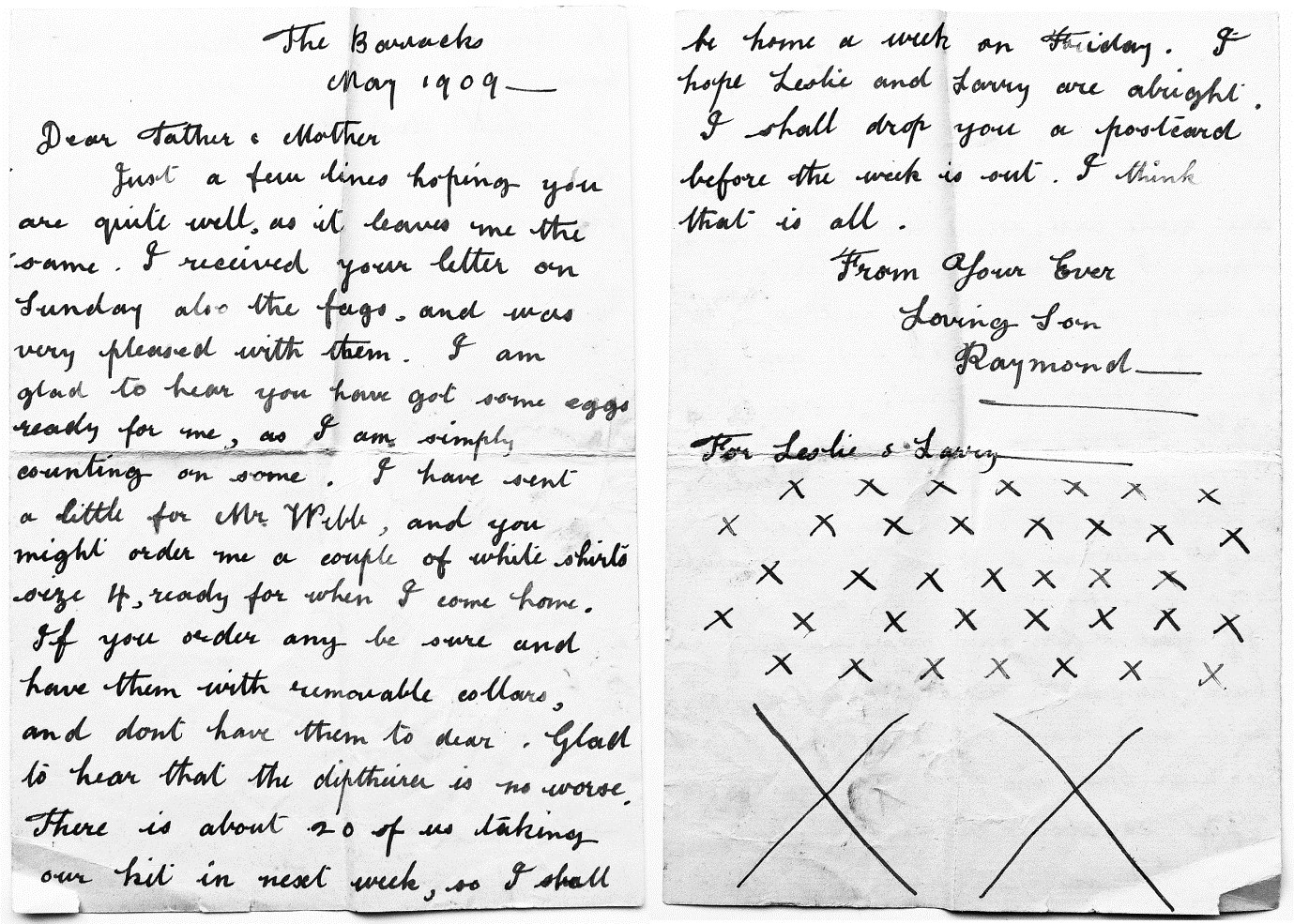
A second letter in May tells how he is “counting the time” to when he comes home. He adds:
I have sent a little for Mr. Webb*, and you might order me a couple of white shirts size 4, ready for when I come home. If you order any be sure and have them with removable collars, and don’t have them too dear. Glad to hear that the diptheria [sic] is no worse. There is about 20 of us taking our kit in next week, so I shall be home a week on Friday.
*This may refer to Alfred Webb, a draper in Denford.
He would have attended a trainee’s musketry course from the 18th June until the 11th July 1914 followed by a summer training camp at Landguard, near Felixstowe in Suffolk until the end of the month. He was obviously looking forward to getting home for he wrote:
We shall be home a week today, so you need not trouble about that. We start from here about half-past six in the morning, and get to Northampton about half-past twelve, so that I reckon I shall be home for tea on Saturday.
He also adds:
I am sorry to here [sic] about J. Scholes little girl,* and I hope that you will mind and not let Leslie go out to [sic] much. I hope that he is alright, and the Baby better. I have sent 7/6 more, so that I think I shall have a little for August. I think that is all.
From Your Ever
Loving son
Raymond
*This refers to the local baker’s daughter, Rita Mary Scholes, who had died aged ten years old.
Below are four rows of kisses for his young brothers. Leslie and Larry
That was the end of his initial full-time training and he would have been a part-time soldier from then on, rather as in the Territorial Army today. He would still have continued with his full-time job and by the 1911 Census he was back in Ringstead working in a local factory as an “Army Boot Stitcher”. The days of the home-based hand-sewn army boot makers were numbered and his father, now 45, was unemployed.
There is a letter written in 1912 although the date is rather ambiguous. In it, Raymond tells his parents:
They gave us our own insurance cards yesterday, and they are going to put two stamps on it, and they stop us 8d. Dad might ask Joe Smith, about me going in the Trade, so when you write let me know what he says. I hope Leslie and Larry are alright. I am sending another order for 5/- as that is better than losing it. I am glad Dad done alright at Thrapston.
It is possible that this letter was, like the others from the army while he was doing the compulsory annual training, but it may be that Raymond was working away from home in a factory, perhaps in Northampton.
The 1911 National Insurance Act introduced the idea of benefits based on contributions paid by the employed persons and the employer. Stamps were put onto a card and if a person lost their job they were “given their cards” to pass on to the next employer. At first this was for unemployment benefit only and a scheme ran alongside it administered by “approved societies” which could include trade unions. I think that the “trade” that Raymond mentions in his letter means trade union and we know that he joined the National Union of Boot and Shoe Operatives and his card for 1913/1914 is filled in until the end of December 1913 but from January 10th 1914 it appears that he did not pay his eight pence weekly contribution. The collector seems to have signed each week across the Sick Pay and Unemployed Pay columns. Was Raymond out of work or taking part in the military training exercises of 1913?
On 8th August 1914 the Special Reservists were called up and Raymond would have reported to the Depot at the Gibraltar Barracks in Northampton. He did not go with the main force of the 1st Battalion of the Northamptonshire Regiment to France. They had sailed on the S.S. Galeka, on the 12th August 1914 arriving at Le Havre on the following morning. Raymond would probably been on the second draft which was sent after the first major casualties were suffered by the Regiment. It consisted of some seventy men under the command of Lieutenant Ralph Davison. Raymond’s medal card shows that the arrived in the “Theatre of War” on 12th September 1914, although it was not until the 21st that the draft finally joined up with the 1st Battalion in the field.
There is a tantalising note which seems to have been written by Raymond as he waited ready to go to France. Unfortunately, it was scribbled on rough grey card in soft pencil and time and wear has made much of it is difficult to decipher. It appears to say:
Southampton [?]
Dear Dad [?] & Mother
Just a line hoping you are all well, as it leaves me the same.
I am writing this in the train [?] while it is in the dock [?]
We sail [?] in the morning [Rest completely undecipherable].
With Love
Ray
X X
This lack of clarity was also apparent in the official record of Raymond’s movements at the time and his mother, Emma, after his letters stopped, tried to find out what had happened to him. She received formal letters from the Infantry Record Office, the local Member of Parliament, Stopford Sackville, and the War Office assuring her that Raymond was not on any casualty list. This continued into 1915. Even as late as 31st March 1916 the Northampton Mercury was reporting that he was “Missing”. We are not sure when Arthur and Emma were told that their son had died just a few weeks after he had arrived in France.
Raymond would not have taken part in the early engagement with the Germans at the sugar refinery at Troyan. At the beginning of the war, the battles were far more open with only scrapes for the soldiers to lie in. It was often close quarters hand-to-hand fighting rather than the grinding stalemate of trench warfare that quickly developed. The Northamptonshires had been relieved and were resting behind the lines from 19th September and it is there that Raymond‘s draft probably joined them. There had been heavy rain and the trenches then being built were filling with mud. The terrible nature of trench warfare was beginning to dawn on the soldiers.
The 1st Battalion returned to the Front on the 29th September and remained there until mid-October. We can only guess at how a sensitive young man was affected by entering this terrible world of mud with the constant noise of the artillery and the sight and fear of death. Raymond was killed on the 16th October 1914. He was buried at Vendresse British War Cemetery, the neat white stone concealing the confusions of his death. Most of the bodies had been buried elsewhere on the Front and were re-buried in the ordered ranks at Vendresse.
Raymond was awarded the Victory Medal, the British Medal and the 1914 Star and Clasp. His mother received the back pay due to Raymond and a small pension, as the War ended, in 1918. Emma died on 2nd February 1956 aged 87 and Arthur Peacock died of heart failure and old age, aged 90, in Glapthorne Road Hospital, Oundle on 12th March 1957. They were buried together in Ringstead Cemetery.
.