The Great War: A–M · Story 30
Sidney William Hunt (1893-1962)
Arthur James Hunt had been born in Brington in Huntingdonshire, the son of Joseph, an agricultural labourer, and his wife, Elizabeth. Arthur married Charlotte Furnell in 1890 and in the 1891 Census the couple were living next to the White Hart in Bythorn, another village a few miles away. During the second half of the Nineteenth Century these villages lost population; Brington from 172 in 1851 to 86 in 1901 and Bythorn from 294 to 108.
There was a general drift from the land to the towns and cities as mechanisation and foreign imports led to agricultural depression and men and women left the countryside in the hope of better lives. Ringstead was different to many in that it had the shoe-making industry and also, later, the ironstone pits and blast furnaces within walking (or cycling) distance. These took men away from the land and Arthur was one of the men who came in. The family moved to Ringstead in about 1892/3. Their eldest son, Ernest Arthur was nine years old in 1901 and born in Bythorn, but Sidney William was seven and born on 18th December 1893 in Ringstead.
Arthur was working as a horsekeeper on a local farm and they were living at No. 1 Station Road Lodges. By 1911 the address was given as Agutter’s Farm Cottages but may have been the same house. The couple had been married twenty years and had had four children, three of whom were still living. Emily Mabel Hyacinth had been born in 1896 and buried early the following year. Their youngest living child, [Violet] Mildred May, had been born in 1904. Both sons had followed their father into agriculture: Ernest, aged 19 was a shepherd and Sidney a horseman on a farm.
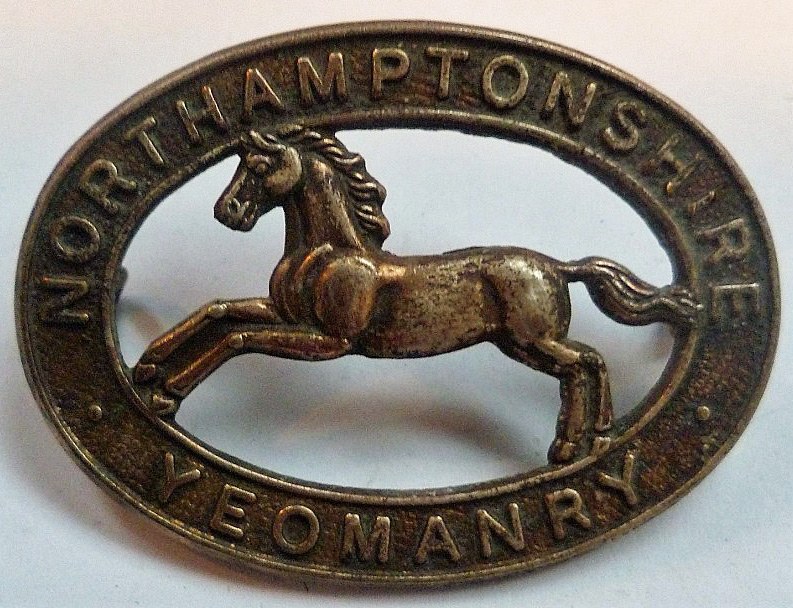
When war came, Sidney’s work was to define his army career. He joined “C” Squadron of the Northamptonshire Yeomanry and was given the Regimental Number 1932. The Headquarters of the Northamptonshire Yeomanry was in Northampton but “C” Squadron was based in Kettering. Chris (CLK) on the Great War Forum has compared Sidney’s number with other soldiers in the Yeomanry whose records have survived which show that Sidney enlisted between the 24th and 31st May 1915.
We now associate the “Squadron” with the RAF but originally it was a subunit of the cavalry and is still used to refer to units in the Royal Armoured Corps. The Yeomanry were volunteer cavalry regiments and the Northamptonshire Yeomanry originated in 1794 but, because of its voluntary nature, it had been formed and disbanded over the years as conflicts came and went. The Territorial and Reserve Forces Act of 1907 established the part-time Territorial Force which initially was only for home defence in the case of war. When war did come in 1914 so many members of the force volunteered to serve abroad that a 2nd line had to be instituted for home defence for those unwilling or unable to serve overseas. Finally a third, reserve line was established to provide trained replacements to the other two lines.
As we would expect, there is no sign of eligibility for a 14/15 Star on Sidney’s medal records. It may be that he joined the 2nd Battalion and, after training was later sent to France to join the “C” Squadron of the 1st line. We cannot be sure. We do know, however, that he fought in France and Italy with the “C” Squadron.
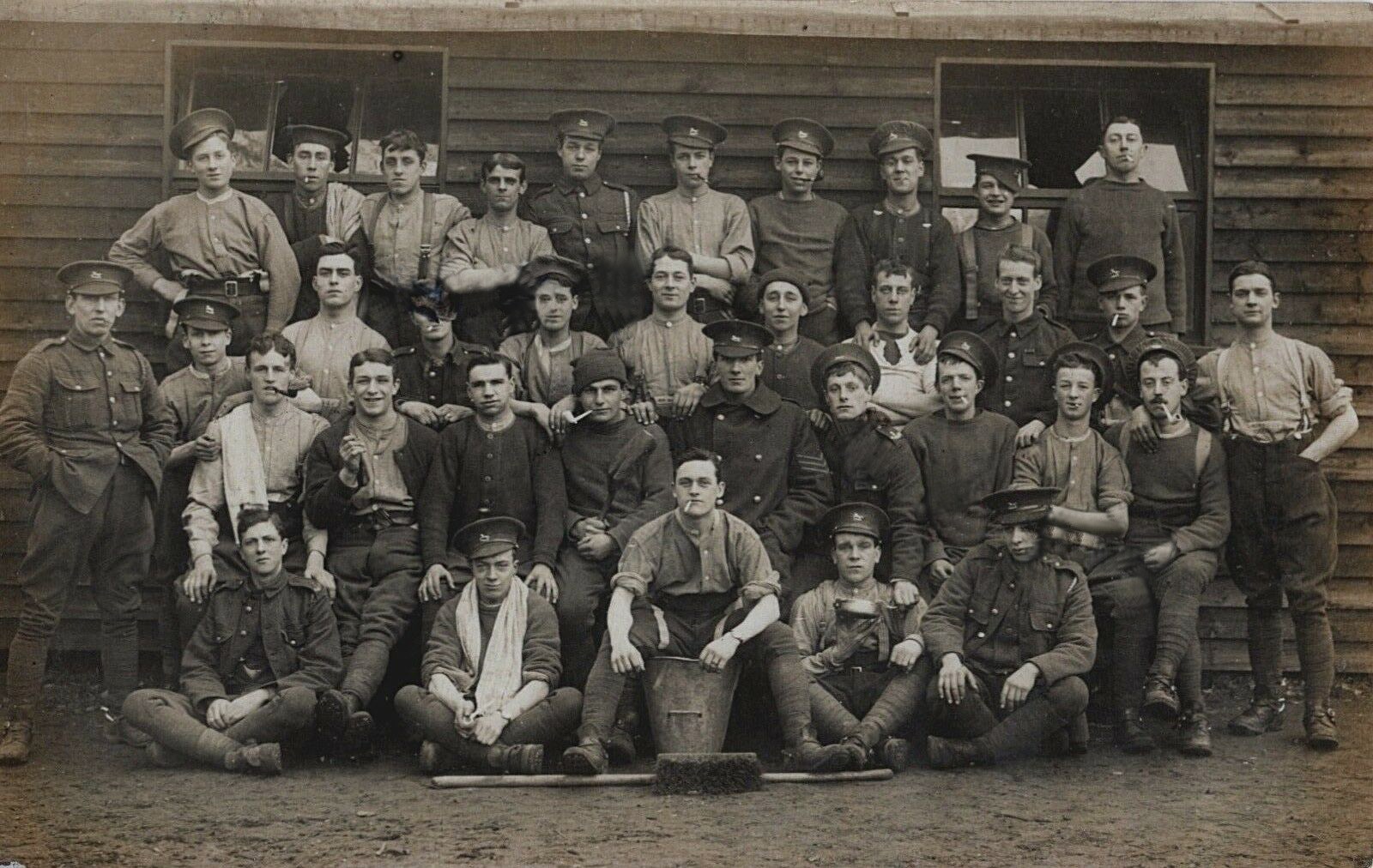
The Northamptonshire Yeomanry had first landed in France on 4th November 1914 and in May 1916 it had become the VI Corps Cavalry Regiment. Fred Lawrence, a London-born man living in Wellingborough joined the Yeomanry in May 1915, like Sidney, and was given Regimental Number 1965. His records do still exist and he sailed from Southampton on the 4th July 1916 and arrived in Rouen on the 5th. He did not join the Yeomanry in the field until 11th December 1916. It may be that that Sidney’s service followed a similar pattern.
At this time, the Northamptonshire Yeomanry were stationed in the Arras area of the Western Front. The troopers usually acted as a mounted infantry rather than the traditional cavalry. It was clear, although still sometimes ignored, that the cavalry charge was suicidal in the face of modern weaponry and trench warfare. Often the Yeomanry were used as a relief for the infantry in the line.
All the Territorial soldiers were renumbered from April 1st 1917, mainly with six-figures (and some five-figure numbers). The Northamptonshire Yeomanry were allocated the number range 145001-150000 and Sidney was given the new Regimental Number 145994.
Steve (Stebie 9173) on the Great War Forum website has researched the Northamptonshire Yeomanry and tells how, in May 1916, the three Squadrons of the Yeomanry had come together after being support cavalry in different Divisions (C Squadron in the 5th). They were then attached to the army at Corps level.
On 11th April 1917 they were involved in the infamous battle of Monchy le Preux which we have covered in the story of Archibald Dicks. The Northamptonshire Yeomanry, who followed the Essex Yeomanry and the 10th Hussars, were trying to reach the village of Monchy le Preux and occupy the village to save it falling into German hands. As the support cavalry, the Northamptonshire Yeomanry are sometimes missed out of accounts of this action but they were under intense fire and lost a dozen men and had about 50 wounded or shell shocked. Sixty-five horses were either killed or wounded. You get a real sense of the troopers’ view of the battle from a report from “a gentleman serving in the Yeomanry” that appeared in the Northampton Independent on the 28th April 1917. For once I think it is worth quoting at length.
We passed behind a ridge for the night with no cover save the sky and it snowed like the deuce. We kept our saddles on all night and in the morning you couldn’t distinguish the saddle from the horse, the snow was so thick. At (the next) night we had to perch again and believe me, the snow and the cold were far harder to stick than the shells which came pretty often. At daybreak next morning we dug our saddles out of the mud and saddled up, thinking that we were going back owing to the weather being unfit for cavalry work. But we were mistaken and not a trifle disappointed. Not one of us could hold a limb still, we were so cold and we only had biscuits and bully.
Then the colonel told us that we were going to take Monchy le Preux, which the Germans were still holding. About 10.30 the Brigadier General came up and said that the village was clear, but that the infantry were weakened by losses, the cavalry were to charge and hold it. We lined up across a huge field, with 2000 brigade cavalry on the left flank, my regiment in the centre and about 2000 cavalry on the left flank. From right to left was only half a mile.
The left flank went over first and they had such a reception. They cantered along in massed formation and before they had gone 200 yards the Bosche artillery opened fire. There were soon 200 empty saddles. Horses were hopping back over the ridge wounded, another galloping with the trooper hanging in the stirrup. We were standing on the ridge . We were getting men knocked out right and left. Then the Colonel said, “Mount!” and we were off. “A” Squadron leading.
As we galloped down Orange Hill to the village, the infantry in support who had dug themselves in, jumped up and cheered, shouting, “Give em hell boys.”
I have never seen such a bombardment. As we galloped down the hill men and horses were blown up by high explosives. I should say 400 cavalrymen and horses lay dead or dying on that field. There was not a piece of ground 10 feet square without a shell hole. When we entered the village, what a sight met our eyes. All the way up the main street were dead horses and men, fellows groaning, horses whinnying and kicking, one licking his dead master’s face; and infantry galore all dead. We had to ride over our own dead to get through and when we were there we were subjected to a heavier shelling than before and had to stand in Monchy for an hour and a half and hold the village until the division came up.
In November 1917 the Northamptonshire Yeomanry left the Western Front and moved to Italy and became the 14th Corps Cavalry. They arrived on 5th November.
Italy had, eventually, joined the Allied side in the First World War and had declared war on Austria on 23rd May 1915. At first, the Italians had made good progress in the mountainous area of northern Italy where it bordered Austria. In 1917, however, the tide seemed to have turned and, at Caporetto, on 24th October 1917 the Italians were badly defeated and forced to rapidly retreat. British and French troops were rushed to Italy but, in the event, largely acted in a reserve capacity. The Italians, contrary to some accounts, managed to turn the tide by the efforts of their own troops. The Northamptonshire Yeomanry, however, as a last hurrah to the past, did fight as cavalry, pursuing the retreating Austrians in the closing actions of the war in October 1918.
The British lost 2,000 men but the Italians lost 460,000 and had a further 960,000 wounded, including some half a million who were disabled for the rest of their lives.
It may also be, that Sidney like many of the British soldiers, unused to wine, suffered by their first encounter with it.
Sidney was in the Absent Voters’ List for 1918 but was shown as demobilised by the time that the Ringstead Roll of Honour was compiled and by Spring 1919 was in the Register of Electors. It seems likely therefore that he was demobbed in late 1918 or early 1919. He was entitled to the Victory and British War Medals.
In the summer of 1920 he married Ellen Ann Furnell. Ellen,like Sidney’s mother, was a Furnell from the Bythorn area so it seems likely that husband and wife were distantly related. At first the couple lived with his parents in Carlow. Ellen would not have been qualified to vote but in 1928, ten years after her husband, she was enfranchised.
We do not know if Sidney ever returned to farm work but at some point he became a blast furnaceman, probably at Islip. In the 1939 Register of England and Wales this was his trade. They were now living in Carlow Street and had had two children, Benjamin born in 1921 and Kathleen in 1923.
Ellen died in 1951, aged 56, and Sidney, aged 68, in April-June 1962.