The Great War: A–M · Story 31
William Henry Jackson (1891-1919)
Two young people, John Henry Jackson and Susan Roberts, married in Ringstead Parish Church on 14th September 1891. On the 4th of the following month their son, William Henry was baptised in the same church. At the time, the family was living across the river in Woodford. He had been born on 15th September just one day after the marriage.
John Henry was originally from Brigstock, although the family had moved to Woodford, but Susan was a local Ringstead girl. By 1901 the family were living at No. 3 Barritt’s Yard, (a yard beside the present Post Office), and William, now nine, had a sister Gertrude Mary who was just four years old. John was a shoe finisher in a local factory. By 1911 John and Susan and daughter Gertrude were still living in Ringstead High Street. John had continued as a shoe finisher and Gertrude was a “lift packer”, making leather heels. Shoe finishing was usually done by men and, as the name implies, was a series of operations to make the boots or shoes ready for sale. In the Art of Boot and Shoemaking, A Practical Guide, published in 1885, John Bedford Leno explains one process:
With a little spittle applied to a piece of rag clean the upper and wipe dry, pull out the tack from the block and remove the last, and scrape away the pegs from the inside.
Good preparation for the spit and polish of army life. But where was William? He was staying with his father’s youngest brother, Charles Jackson, born in Woodford, and his wife Lillian. The couple were only 29 years old so were only nine years older than their nephew. Charles and William were also both working as shoe finishers. They were living at Lilley Terrace in Irthlingborough.
Unfortunately, once again, like many others, William Jackson’s records were destroyed in the Second World War. We know from the Ringstead Roll of Honour and 1918 Absent Voters’ List that he was in the 5th Battalion of the Royal Inniskilling Fusiliers and had been given the Regimental Number 30048. The Roll of Honour also noted that he had fought in Salonika and France.
When we look at William’s entry in the Roll of Awards and Medals we find six other soldiers of the 5th and 6th Battalions of the Inniskillings. Further research shows that Henry Kennell (30050) from Rushden who had died in Egypt on 6th March 1918 and Archibald Hollingsworth (30047) from Thaxted in Essex who had been killed in France on 17th October 1918 had been in the Northamptonshire Regiment prior to being transferred to the 5th (Service) Battalion. It seems likely that William followed a similar path. He would have enlisted with the Northamptonshires and, after training, been transferred to the Inniskillings.
The 5th Battalion had been formed from volunteers, in August 1914, as part of Kitchener’s First New Army. In April 1915 it moved to Basingstoke for final training. In August 1915 it was part of the Gallipoli Campaign against the Turks (Ottoman Empire), allies of the Germans. In late September 1915 they then moved on to Salonika (or Salonica).
Before he was posted abroad William married Edith Neville from Irthlingborough in the third quarter of 1916. It seems likely, therefore, as Salonika was the first warzone mentioned on the Roll of Honour, that it was late in 1916 that he joined the 5th Inniskillings in Salonica.
The 5th saw service on the Macedonian Front (the area north of Greece, part of the troublesome Balkans). An officer of the 5th at this time was Henry Lamb who was a doctor and artist (and became part of the Bloomsbury Set). His story is told by “Inniskilling” on the Inniskilling Museum website. It tells how the 5th were in the Stuma Valley, a marshy area, where there was little action but where malaria was endemic. This debilitating disease quickly reduced a soldier’s fighting capability.
In September 1917 the 5th were posted to Egypt. They were based near Rafa where they trained for the campaign in Palestine. The Battalion joined the Expeditionary Force led by General Edmond Allenby. There had been major setbacks previously but this time progress was swift and Jerusalem was captured in December 1917.
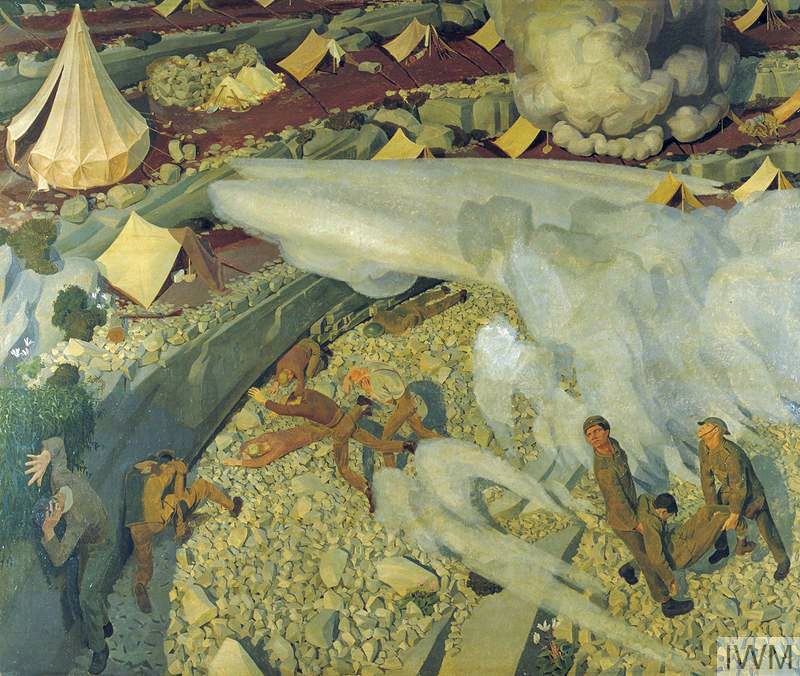
The campaign against the Turks (Ottoman Empire) was far from over. We have seen that Henry Kennell, of the 5th, from Rushden was killed in March and in early May 1918 they were caught by a surprise Turkish bombardment. Four soldiers were killed and eight wounded. When Henry Lamb was asked to do a large commemorative painting of the war for the Irish Hall of Remembrance, it was this incident at Jiljila in the Judaean Hills that he chose as his subject. Was William one of the figures desperately running for shelter?
Between April and June 1918 Indian units replaced the British in the area, and the 5th Battalion of the Inniskilling Fusiliers were posted to France. The German offensive of Spring 1918 was threatening to win the war before the American forces could bolster the Allied cause. The Battalion was part of these troops brought back to the Western Front to help resist this onslaught. They joined the 198th Brigade, 66th (2nd East Lancashire) Division on 19th July 1918.
The following months were part of the final phase of the war as the Allies pushed the Germans back but the progress was still hard won and there were many casualties. The 5th Battalion fought in the Second Battle of Cambrai (8th to 10th October 1918), The Pursuit of the Selle and the Battle of the Selle (17th to 26th October).
On 31st October 1918 the Division was withdrawn from the Front Line and moved to the Serain area, south-east of Cambrai, but, on the 2nd November, they quickly returned to the action and were part of the advance through Le Cateau and fought up to the Armistice on 11th November 1918.
We get some idea of the intensity of the fighting the 5th endured from the local casualties in this period. On 10th October Charles Henry Spriggs from Wellingborough was killed, and Frederick Bridgement from Chelveston on the 8th November.
For these men to die so close to the end of the war seems even sadder and, when we look at the family around William Jackson, we see the heartaches felt by many back home. William’s uncle, Samuel Jackson, had been killed on 23rd March 1918 and the May 3rd edition of the Northampton Mercury reported that Charles Jackson, the uncle, who William had been staying with, was reported missing. Fortunately, although I have not discovered any later report, Charles did return to his family in Irthlingborough.
William also returned to his family and he was in the Electoral Registers for 1918 and 1919, living in the Ringstead High Street. On 11th August 1921 the couple had a daughter, Dorothy Jackson. In the 1939 Register of England and Wales, William and Edith, with daughter Dorothy, were living at 20 Cherry Street in Irthlingborough. It was part of a row of semi-detached Council Houses. William was still a boot and shoe finisher and Dorothy worked in a boot and shoe packing department.
Edith died in the third quarter of 1972 and William, aged 81, in the April to June quarter of the following year. Their daughter Dorothy, who had married George Hingle, had predeceased them in 1968.