The Great War: A–M · Story 11
Sons of Arthur and Louisa Baxter
The Baxters had originally come from Tansor but by 1881 were living in Oundle where Joseph, aged 36, was a house painter. Their son, Arthur, had been born in Tansor in 1868 and in 1881 the couple had five other children.
By 1891 Arthur had become a labourer on the railways and, aged 23, was lodging near the station in Woodford. In the same 1891 Census, Louisa Braybrook was a servant in Kingsthorpe in Northampton, but, somewhere, their paths crossed and, on 30th September 1895, they were married in a church at Louisa’s home village of Keyston, just over the border in Huntingdonshire.
Soon after their marriage they moved to Ringstead and, in 1901, were living at 19 Church Street with two sons, Percy William aged four and Herbert aged two. Arthur was a platelayer on the railways. By 1911 they had moved to Spencer Street in Ringstead and Arthur, aged 14, was working as a “heel fettler”. Herbert was 12 and still at school and Louisa’s widowed father, James Braybrook, a farm labourer, was living with them in their six-room cottage.
Percy William Baxter (1896-1917)
It must have seemed that the world was a settled place but, over the Channel, national ambitions were beginning to create turmoil. Suddenly, in 1914 war exploded in Europe and initially the Government sent the Regular Army under the title “British Expeditionary Force” to assist the French against the German invasion. The British Army was far too small in this man-eating war and were soon in rapid retreat. Then came the jingoistic slogans and rallies to raise a new volunteer army from the civilian population. This new army began in optimism but soon the fighting ground to a halt and the battles continued to use up men like shells. Finally, against much opposition, conscription was brought in, in January 1916. If the soldier was not entitled to the 1914 or 1914/15-Star Medals it almost certainly meant that he was a conscript.
This was the case with Percy Baxter who, probably, was posted to France some time in 1916. At first he had enlisted with the Northamptonshire Regiment but because most of his military records have been lost we would usually only be able to guess that he had gone to a base camp and was then transferred to the 2nd Battalion of the Inniskilling Fusiliers.
In fact, because of the clever research done by Stebie9173 on the Great War Forum, we can be more definite. By looking at the Regimental Numbers, he was able to compare a number of soldiers, including Percy Baxter, with Horace Allen of Irthlingborough. Horace enlisted in Northampton on 16th November 1916 and was posted to the 3rd Battalion of the Northamptonshire Regiment with Regimental Number 30909. Percy was given the number 31925. Horace went to France on 1st February 1917 and was sent to Base Camp No. 17 at Étaples. On arrival in France he was posted to the 1st Battalion of the Northamptonshires but he never joined them and instead became part of the 2nd Battalion of the Royal Inniskilling Fusiliers on 16th February 1917 and renumbered 40712. Percy was given the number 40724, just twelve numbers later.
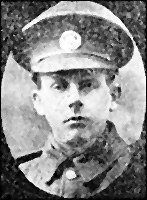
It seems certain that the career path of Percy followed that of Horace Allen’s very closely and he arrived at the front in mid-February 1917.
The 2nd Inniskilling Fusiliers were part of the 96th Brigade which included the 16th Battalion of the Northumberland Regiment and the 15th Lancashires. In the fighting around Savy Wood Percy Baxter was wounded and died from his wounds on April 2nd 1917. He was twenty years old and had probably been in France for less than two months. His grave is in the Foreste Communal Cemetery in Aisne. This is a local cemetery with some ninety-five Commonwealth war graves. On Percy’s grave the inscription at the bottom, chosen by his family, simply says:
“ONE OF THE DEAREST ONE OF THE BEST”
Herbert Baxter (1899-1918)
Percy’s younger brother Herbert, usually known as Bert, had been working for Adam’s Brothers, Boot Manufacturers of Raunds. He too was conscripted, at Kettering, and joined the 1st Battalion of the East Kent Regiment (“The Buffs”) and was given the Regimental Number G/24815. Again, few of his military records remain but we do know that, like his brother, he remained a Private.
Operation Michael, which was the German offensive planned to finish the war before the American fire and manpower could tip the balance for the Allies, started with the Battle of St Quentin on 21st March 1918. It was announced by an overwhelming artillery barrage along a forty-mile front. The Germans used trench mortars, Mustard Gas, Chlorine gas and smoke canisters and three-and-a half million shells were fired in five hours. After this the German troops broke through and the Allies were forced to withdraw. This continued on the second day among thick fog with the Allies trying to keep the integrity of the line so that the Germans could not get in behind them. This meant that small groups of soldiers had to fight delaying actions in order to allow all the troops to fall back in an orderly retreat.
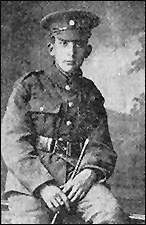
It was on this second day that Herbert died of wounds on 22nd March 1918. He was not to know that, although the German offensive continued to make progress, they were running out of supplies and men and eventually the tide would turn. Herbert is commemorated at Favreuil British Cemetery, north of Bapaume. The inscription reads:
“STILL OURS IN MEMORY THOUGHT AND LOVE. MOTHER & DAD”
Arthur and Louisa Baxter received the official letter telling them that Herbert had also been killed. They had lost both of their children and, when the celebrations came later in 1918, they must have left a bitter taste. To make sure there was some remembrance of their two sons, Arthur and Louisa donated a brass lectern to the Ringstead Parish Church. It now stands on the floor beside the pulpit.
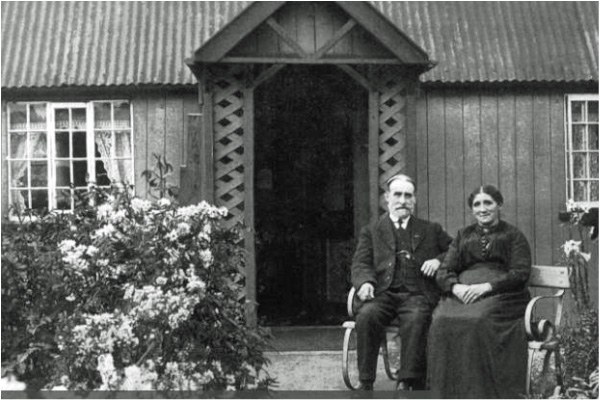
Above is a photograph of Arthur and Louisa outside their neat wood and corrugated iron bungalow some time after the deaths of their sons. It seems a place of sadness.