The Great War: A–M · Story 6
The Ball Family
Thomas Ball (1879-1918)
Thomas Ball was born in Ringstead in about 1879, the third child of John and Susannah. In 1891 he was shown with his widowed mother, living in Findings Terrace, Raunds. Their father, John Ball, had been killed in a quarry accident in islip while they were living in Ringstead. His mother was an “army boot closer” and his older brother George (13) an errand boy but Thomas (12), although, it seems, attends part time at school, was also a boot riveter. By 1901 the family were at Hill Street in Raunds. Susan, at 46, was still an army boot closer, as was daughter Eliza (26). Her son, George (23), was now a clicker, as was younger brother John (19). Thomas (22) remained a riveter. All seem to have been working at home although George may have been employed in a local factory.
Thomas married Charlotte Cade on the 1st January 1902 in Keystone. Charlotte had been born in Bythorn in Huntingdonshire in 1880, the daughter of a farm labourer. By 1901, aged 20, she was working as a “general domestic servant” for Alfred Williams, a Wesleyan Minister, and his wife at Berrister House, Vicarage Place, Raunds.
Thomas and Charlotte had two children, Harold in 1902 and Leonard in the third quarter of 1905. At some stage, soon after the birth of Leonard, the family moved to Wollaston where they lived with his younger brother John and his family in York Cottages. Thomas was working as a “Bottom Stuff Rivetter “in a local factory and Charlotte was working at home as a hand boot closer. Leonard (5) was with his parents but Harold (9) was staying with unmarried Uncle George (33), Aunt Eliza (36) and grandmother Susan Ball (56) in Hill Street, Raunds. A further child Roland was born on 20th September 1912.
Soon after this, brother John and his family returned to Raunds but Thomas and Charlotte stayed in Wollaston and took over a fish shop in the village. He was also a well-known local Rechabite (a temperance organisation). He was 37 with a young family and establishing his own small fish and chip business. He did not wish to join the army and stated that he wanted to continue to supply fish to the area and also cited the threat to his business if he was called up. He was granted two temporary exemptions but finally, in 1916, the Tribunal decided that his business was not “of national importance”, and his appeal was dismissed.
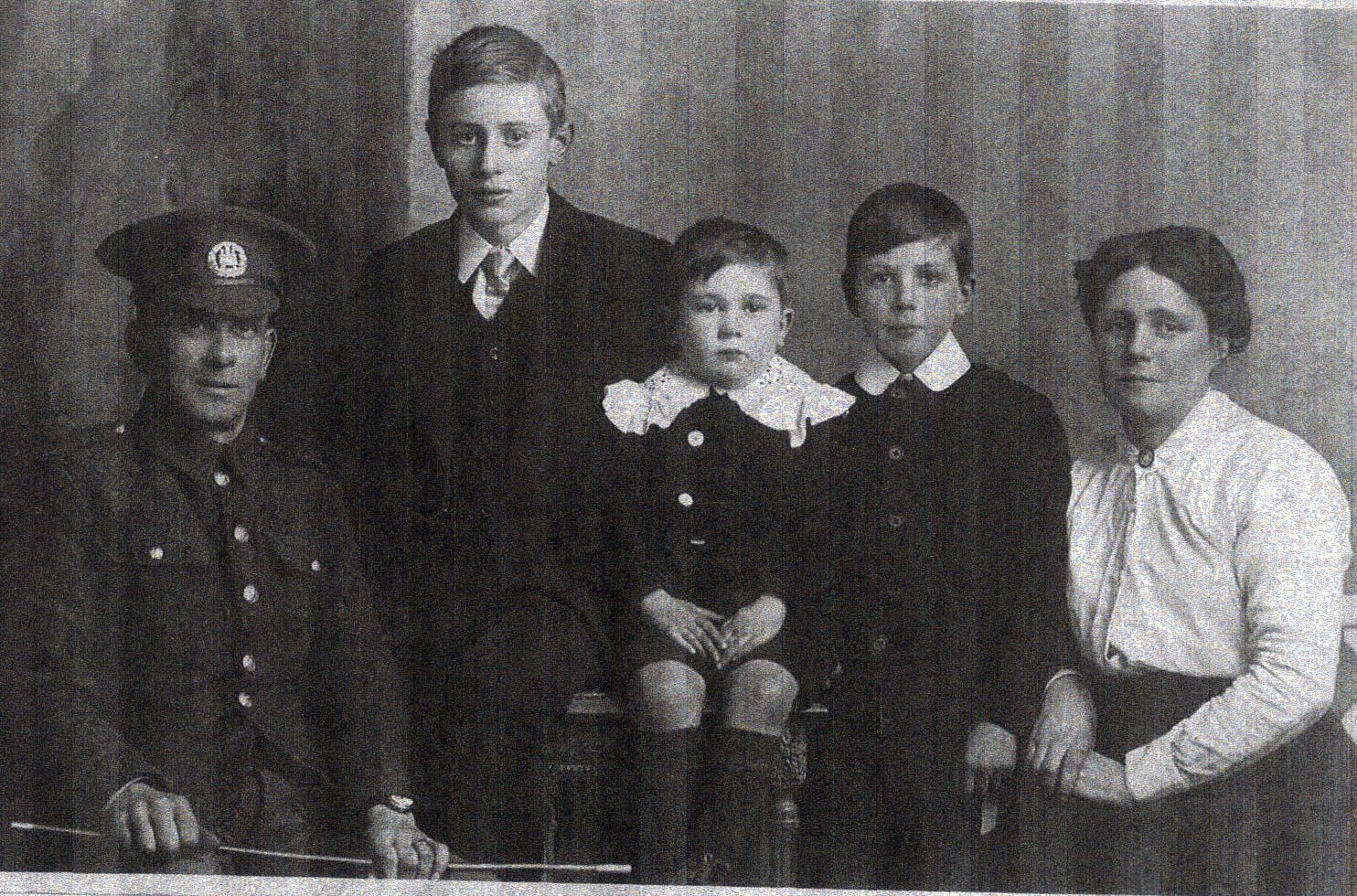
He was forced to enlist in Wollaston and initially joined the Northamptonshire Regiment (30339). He transferred to the 15th Battalion of the Royal Irish Rifles as Rifleman 41592. I have a copy of a picture from Gillian Jolley (daughter of Ronald Ball) which is said to be Thomas (in uniform) with son Harold. If this is the case it was probably taken about 1911/12 and means that Thomas was almost certainly in the Northamptonshire Regiment Territorials before the war. This may be one reason why his appeal was dismissed.
The 15th Battalion was engaged in the Battle of Courtrai on the Western Front in Belgium. This was part of the Allies final advance in Flanders. On 15th October 1918, it was in reserve in Gullinghem near Courtrai, after being in action on the 13th. The Kettering Leader of 29th November reported:
Rifleman Ball was with a party that was in a farmhouse some miles away from the fighting line when a shell came and killed three of them (including Thomas Ball) and wounded several including the padre. The chaplain wrote to Charlotte, paying a high tribute to his “character as a soldier”.
Thomas had been acting as a servant to the Chaplain and he wrote to Charlotte:
I was very fond of your husband and he was very good to me. He was a most upright man, and a man of good principles. We were good friends and he went with me everywhere I went. One day . . . we got into a very tight corner, where there was a lot of heavy shelling; we got out safely in the end, but during it all Tom never lost his nerve and was as brave and steady as he could be. That incident showed me his worth.
It must have been a terrible blow to the family, especially being so close to the end of the war. The Armistice was signed on the 11th November 1918. Thomas is on the Wollaston War Memorial. Charlotte died in the Wellingborough District in March 1964 aged 83, nearly 46 years later.
My memory of the family is of the cycle shop. L. & H. Ball, in Cambridge Street, Wellingborough that Harold and Leonard ran in the 1950s. In 1956, when I passed the 11+, my parents bought me my first brand-new bicycle. It was one of the first breed of “teenage” bikes by Triumph, electric blue with straight handlebars, white plastic mudguards, cable brakes, and whitewall tyres. It came from Harold and Leonard’s shop and my mother paid a weekly amount.
John Ball (1882-1953)
John, or Jack as he was usually known, was the third “John Ball” in a direct line, only separated by his grandfather Thomas. They span the years from 1783 to 1953 and he was the only one that I touched, in his old age. I did not know him well, for I was only seven when he died.
John was born in Ringstead, the fourth child of John and Susannah, (or Susan), Ball, on 11th February 1882. He followed Eliza, George Henry and Thomas. In 1881 his parents and his siblings had been living in Carlow Street, Ringstead. His father, an ironstone labourer in the Islip quarries, had been buried in a fall of earth in the limestone pit, on the 21st September 1886 and killed. John junior was only some three years old at the time.
We do not know how Susannah coped with four young children on her own but by 1891 she had moved back to her home town of Raunds. She had not been able to write her signature at her marriage in 1874 so opportunities must have been limited for her. She became an army boot closer, sewing the uppers, and her children also worked to help keep the family from the workhouse. Eliza was away from home, also working as a boot closer and the two older boys were ‘Errand boy’ and ‘Riveter and School’. At nine years old, John was still a ‘Scholar’.
By 1901 the whole family, including Eliza was living in Hill Street and all were engaged in the army boot trade. Susan, the widowed mother, and Eliza, her daughter, were both closers and Thomas was a riveter but John had followed his older brother George and was a clicker. It appears that all the family were working at home, except George and John who were probably in a local factory. This is what we would expect because ’clicking’ was considered the most skilled work and the one which cost or saved the employer the most money. The ability to match parts of the leather and cut the maximum from a hide were valued abilities. It was also true that it required room and was for all these reasons was often centralised into a factory before the other shoeworking crafts. All around them in Hill Street were people in the boot and shoe industry, mostly working at home.
So, by 1911, the industry had changed. George Henry and Eliza appear to be working in a factory, George a boot clicker and Eliza a boot closer, although Susan, now 56, continued to work at home. They still lived in Hill Street. Two of the sons have left the nest. John had married Ringstead girl, Eunice Andrews, on 23rdDecember 1905, some five months before the birth of their first child. They were now living in Highfields Cottages, Marshalls Road, at the time of his birth. Thomas had married earlier, in 1902 to Charlotte Cade and the two couples have moved to Wollaston where they share York Cottages which had six rooms, excluding the scullery and any outbuildings. Thomas was now a ‘Bottom Stuff Riveter’ and John a clicker. Both work in the local factory but the two wives are ‘Hand Boot Closers’ at home.
By 1914 Jack and Eunice and the family were back in Raunds, living at 63 Marshalls Road which was in Nene Cottages, built for workers of R. Coggins and Sons whose factory was on the opposite side of the road alongside Highfield cottages, an almost identical row. In the 1914 Raunds Directory almost all the “Heads” of houses were shoehands.
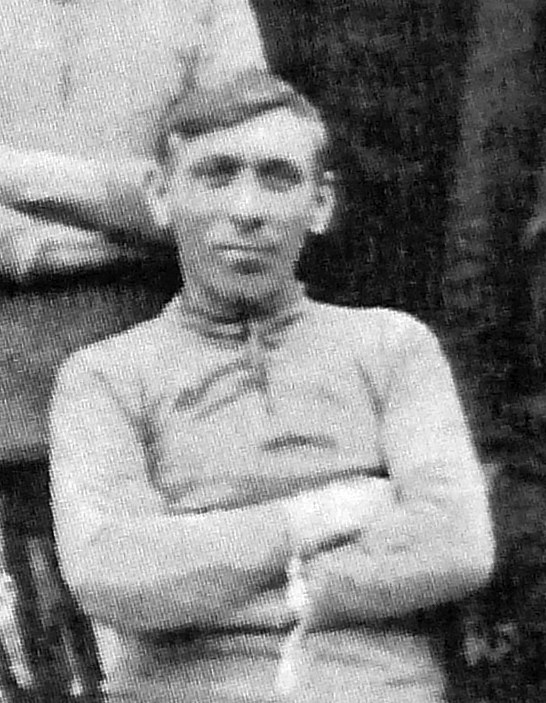
John and Eunice already had three children, the older two, Aubrey (4) and Sydney (3), born in Raunds and Ronald (5 months) born in Wollaston. John and Eunice moved back to Raunds but Thomas and his wife stayed in Wollaston and ran a fish shop. I know this because Aubrey went to stay with them for a time to help in the shop and was, he believed, treated badly by Thomas.
The two rows of cottages were locally known as ‘The Colony’. My father said they were cheaply built and always cold but they are still there today. Before central heating and insulation most terraced houses were freezing cold in winter with one coal-fired room sucking icy draughts from the rest of the house.
John, like his older brother, was conscripted. He enlisted on 24th June 1916 but was not called for service until 17th September 1917. He put his preferred option to be the Essex Regiment but he became a Gunner in the Royal Field Artillery with Regimental Number 236994 and was posted to the 4a Reserve Brigade of the 56th Reserve Battery. This was based at Woolwich and as far as I have found, did not go to any war zone. We know from the army records that John was 5ft 7 inches tall with a 37-inch chest when he enlisted. He was discharged on 27th November 1918 as being “surplus to military requirements”. His character was described as “good”.
John returned home and carried on with his life. It appears that some time near the end of the war he was awarded a “silver badge” which carried the legend, “ For King and Empire – Services Rendered”, which was given to those who were discharged as a result of sickness or wounds contracted during the war whether abroad or at home. He had a 20% pension for a time after discharge for a disability which was not attributable to his service years. He had been diagnosed with “neuralgia of the testicle”. It seems the pension was cancelled in March 1919.
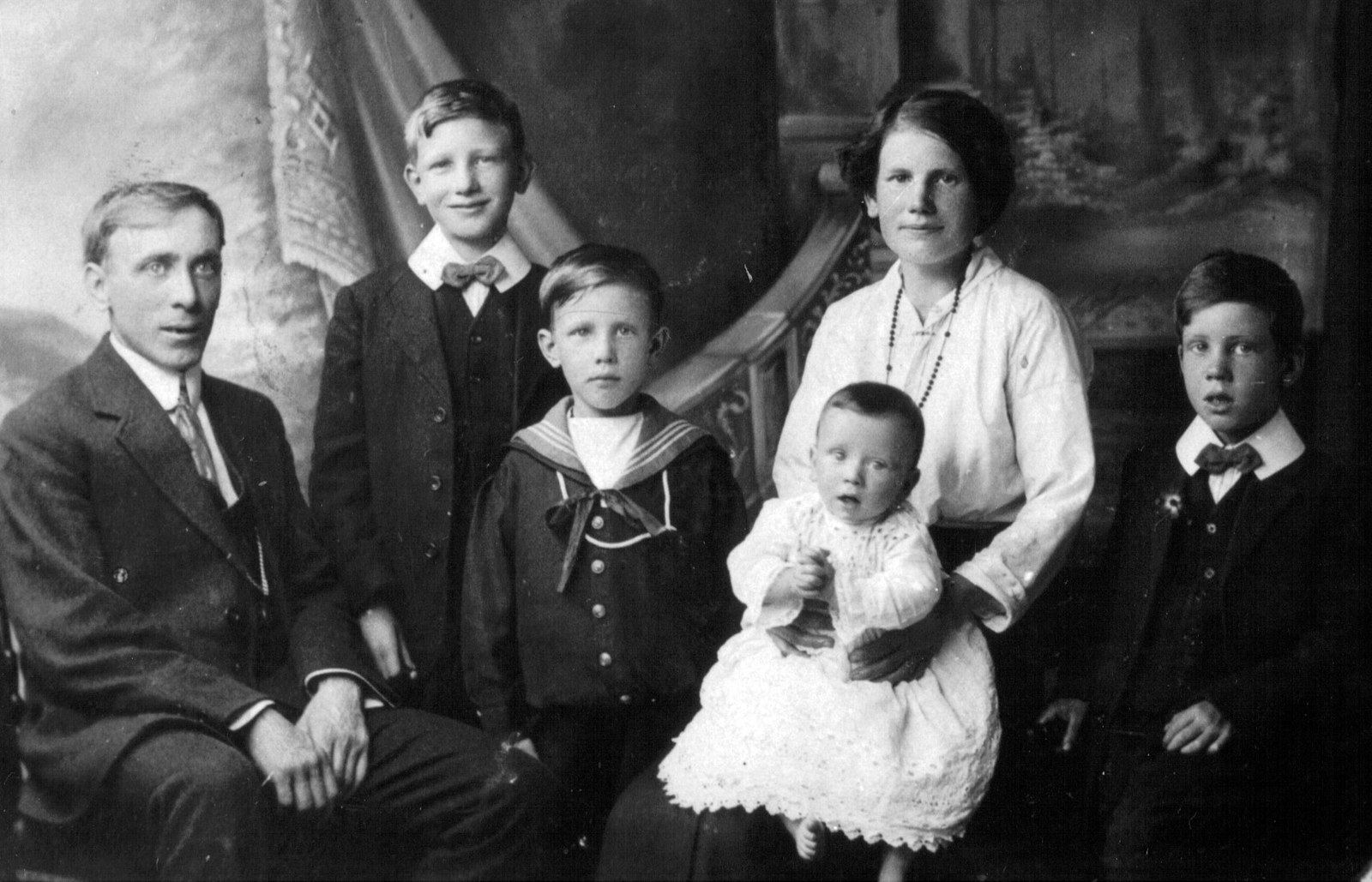
As we have seen John played football but he had also been a talented local runner and won many prizes over the years. After his own career as a runner was over he trained some local athletes including his youngest son Dennis who was born in 1917 and whose middle name was Verdun, after the First World War battle, and his nephews, Harold and Len. These athletic competitions also reveal a weakness that he shared with many shoemakers. He was an inveterate gambler. Amateur race meetings were organised but there would be a line of bookies also at the meets.
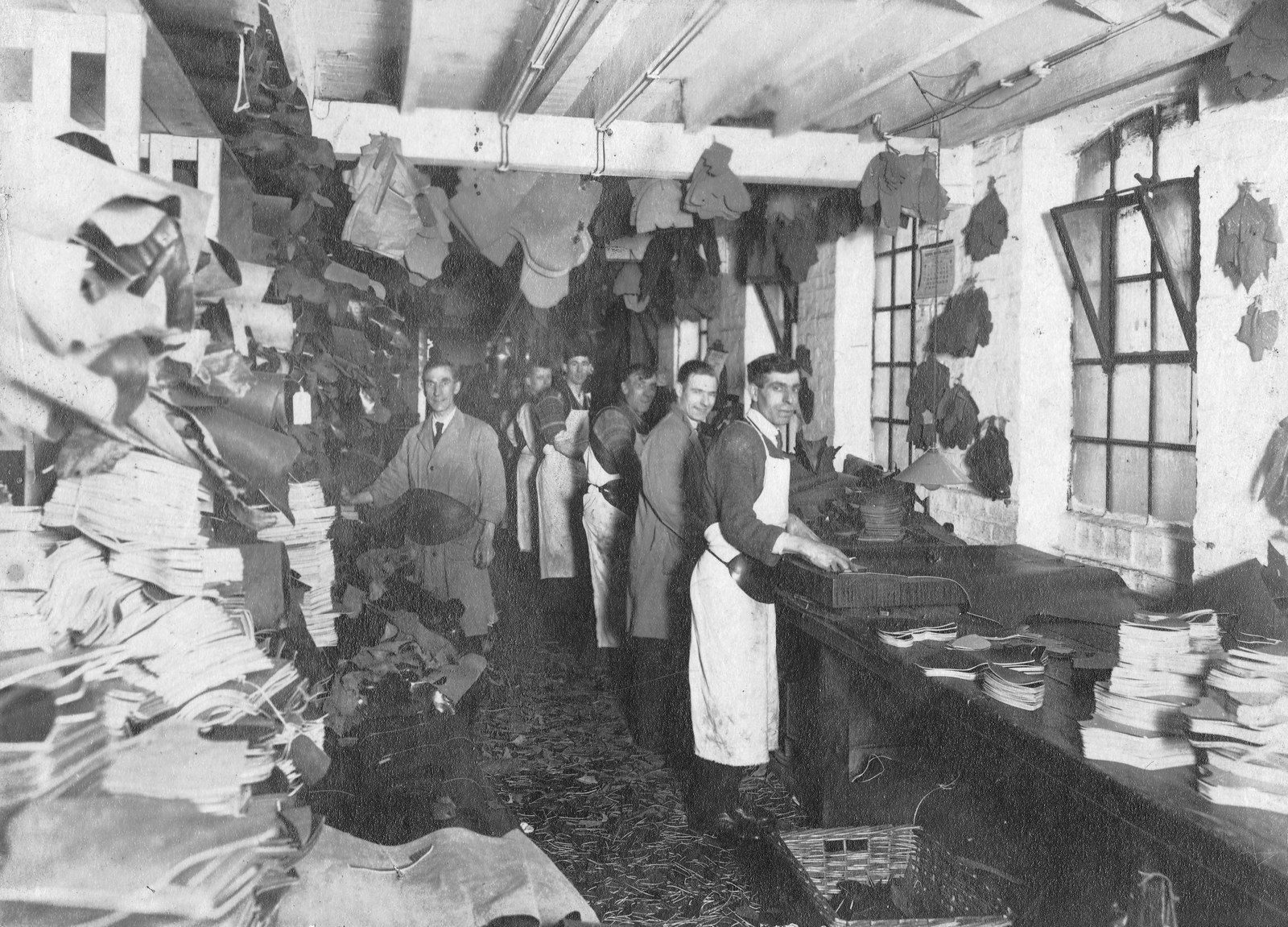
I have an original copy of a photograph which fills in a little more of John’s history. It shows him standing in a clicking room. The same photograph is in Raunds, Picturing the Past and it tells us that it was taken in 1929 to celebrate the fortieth anniversary of John Horrell and Son Ltd of Wellington Hill, Raunds.
The next glimpse of John came to me when I saw a copy of the Rance Revisited magazine in the local library. To my surprise I saw a piece on Adams Brothers by Paul Roberts. He movingly describes the clickers breaking into song as they worked. They would sing in harmony, with descant, songs from Nellie Dean to Abide with Me and Crimond, which was known locally as the ‘Ringstead Hymn’ because of its Dissenting associations. He goes on to tell of an incident involving Jack Ball (which seems to imply that he was working at Adams at the time).
They credited Jack Ball with causing Labour to lose the seat in the 1935 General Election. Wing Commander James, the Conservative candidate, had as his agent a Finedon man called Chapman, nicknamed ‘Sugar Chapman’. They always introduced him at political meetings as a ‘Conservative Working Man’. His presence at political meetings was like a red rag to some of the Raunds’ Radical shoemakers. No one can recall hearing Sugar Chapman speak because of the uproar that his presence caused. As Wing Commander James left his Eve of Poll meeting in Raunds, Jack kicked his backside for bringing ‘Sugar Chapman’. ‘CONSERVATIVE CANDIDATE ASSAULTED AT RAUNDS,’ said the headlines in the next day’s Evening Telegraph.
I first encountered John when I was a young child and I went on the bus from Wellingborough to Raunds to visit my grandparents. I remember my grandmother a little. She was a proud woman who kept a neat house with polished brass jugs, full of coloured wooden spills, in the fireplace. I can remember using these spills to make pictures and roads for toy cars on the mat in front of the fireplace. She had a special tiered plate for cakes and was mortified when I discovered a fly in my Tizer. Of my grandfather I have only two memories. One is of him standing in the workshop in his son Ronald’s garden where he was still doing outwork. He did the old clickers’ trick for me of taking a circle of leather, sticking it to the bench with a small curved knife and then pulling to make a shoelace. Magic and shoemakers are often associated. The other memory is of him sitting silently in the corner in Marshalls Road, as the grandfather clock beside him ticked the seconds slowly away.
He died on the 8th February 1953 aged 70 years to be followed by his ‘beloved wife’ Eunice on 21stAugust 1956. They are buried together in Raunds Cemetery. In 1919 The Shoe and Leather News Illustrated Biographic Dictionary of British Shoe and Leather Traders listed six boot and shoe firms in Raunds: Adams Bros.; R. Coggins and Sons; Tebbutt and Hall Bros Ltd.; The St. Crispin's Productive Society Ltd.; Regulation Boot Co. (Raunds) Ltd. and John Horrell and Son. All have fallen silent and many have been demolished. Most of the backyard workshops have also disappeared. What was once the vibrant lifeblood of the Nene valley communities is now archaeology.
Sons of Thomas Samuel and Harriett Ball
This is another story of two brothers. Their grandfather was James Ball, born in Ringstead in about 1831. He was the son of Daniel and Phoebe Ball and most of the large family joined the military or looked for their fortunes in the New World. James was one of the few who stayed close to home.
James, together with his brothers Thomas, Samuel and Elisha, was baptised in Ringstead Church on September 12th 1841. He is aged 9 in the Census which preceded the baptism by a few months so he was born in about 1831/2. He left home early and I believe that he might be wrongly entered as John Ball, aged 19, born in Ringstead, a shepherd living in at Wold Lodges in Tansor which is downstream on the Nene, on the other side of Oundle.
James married Emma Storks (or Stocks) from Riseley, some ten miles south, in Ringstead Church on 17th October 1855. Like his siblings, James had to leave Ringstead to find work, but he did not have to travel far, and was by 1861 a shepherd, like his father, living in Titchmarsh. He was with his wife Emma and their two children Phoebe and John who had both been born in Denford. The family had returned to Ringstead by 1871 and two further children Thomas and George have been born (all children now shown as born n Ringstead).
It is Thomas whose sons we are following here. He was born on 29th December 1865 and had a Methodist baptism on 6th May 1866. It seems that his middle name was Samuel and he was sometimes known by this name. In the 1881 Census he is Samuel, aged 16, still living at home in the Ringstead High Street and working as a farm labourer. By 22nd April 1889 when he married Harriett Christiana Wright at Islip he had become a bootmaker.
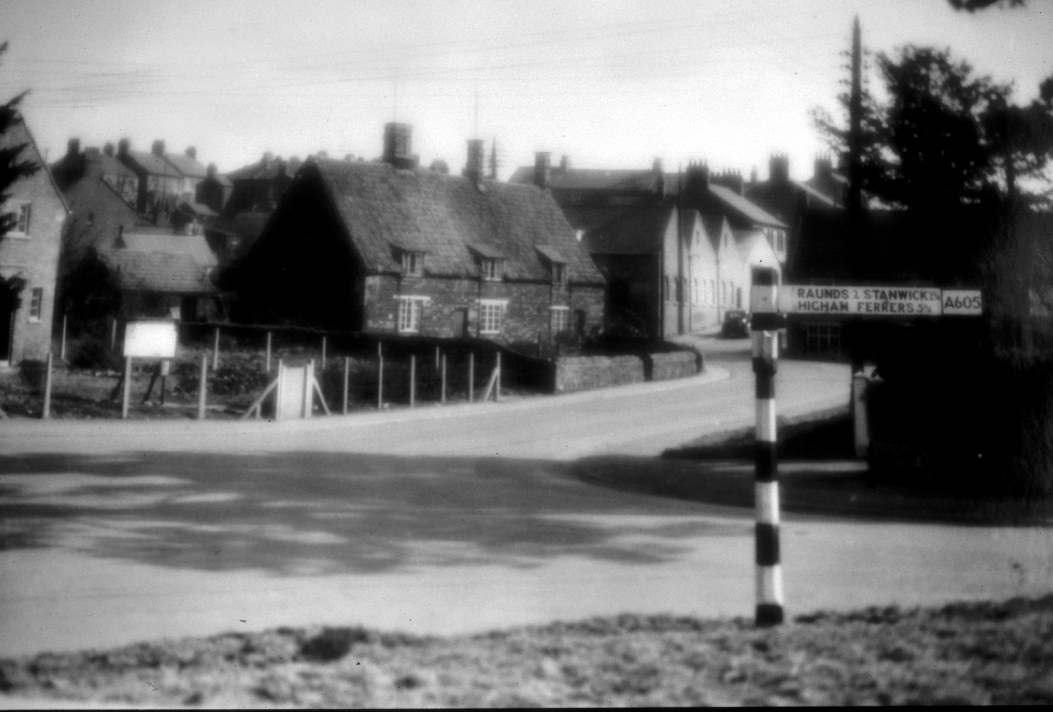
The couple moved to Pearce’s Row, Church Street, in Ringstead and by the 1891 Census they already had two children, Thomas Horace (1) and George James who was just one month old. By 1901 the family had moved to High Street in Moulton where Thomas was an army boot maker. There were two further children, Leonard who was born on 28th February 1893 and Emma born about 1897. The couple moved back nearer to home and in 1911 were living in Francis Street in the Westfields area of Raunds. Only their youngest children, Leonard who was 17 and unemployed and Emma (15) who was a “shoewoman girl”, were still at home.
George James Ball (1891-?)
Thomas junior and his younger brother, George James Ball, had already left home. It is George who we are following first. His story after the 1901 Census is a murky one and much of it I have found in retrospect as it is referred to in reports of later crimes.
In the Northampton Mercury of 12th April 1912, Inspector Dunn, who was a witness in a reported case against George, states:
He was a native of Ringstead and had on several occasions enlisted, each time deserting and taking with him valuable property. The Witness [Inspector Dunn] held a warrant for his arrest in connection with the robbery of £50 worth of silver from the barracks of the Loyal Lancashire Regiment.
George was travelling the country trying to get money wherever he could and, it seems, usually by criminal means. We know that he had returned to Northamptonshire because the case which revealed his past wrongdoing was held at Northampton. George was charged with a jewellery robbery at the Corby warehouse of Leslie Ansell between the 16th and 19th of December 1911. The list of jewellery stolen was extensive:
. . . 247 gold rings, six long gold guards, eight gold bracelets, one rolled gold bracelet, eight gold chains, three gold pendants, one silver cigarette case, three silver matchboxes, eight long silver guards, 12 silver curb chains, 25 gold pins, nine silver brooches, and 16 watches.
George, as seems to have been his habit, pleaded guilty and was sentenced to 15 months with hard labour.
After being released, George must have made his way down to Portsmouth, and enlisted again, this time in the Royal Navy. George James Ball born in Ringstead in Northamptonshire signed up for the Royal Navy on 25th November 1913. He had a union jack with “Unity” tattooed on his left forearm and a scar on the back of his left hand and a white scar on his chest. We know that he was 5ft 8¾ inches with a chest size of 38¾inches with brown hair, grey eyes and a fresh complexion. (nearly all the military had grey eyes). He first served on Victory ll. This was the name given to the barracks and administrative base in Portsmouth.
He was given a “very good” character and ability rating on 31st December 1913 and moved to serve on a light cruiser, the HMS Liverpool on 7th May 1914 as a storekeeper.
It was at this point that something went wrong for he was discharged with “Services No Longer Required” (D.S.N.L.R.) on 27th May just a few weeks after his move. His record also notes the "Recovery of his GCB" [Good Conduct Badge]. He was sentenced to Confinement to Barracks (C.B.). There is some confusion because his official military service records give his date of birth as 26th March 1893 rather than 1891 but this is either a typographical error or perhaps part of George’s subterfuge.
Under The Prevention of Crimes Act of 1871 habitual criminals were recorded in detail in a register. These records are now online and in them we find “George James Ball, alias Thompson and George Ball”. His rank is now given as Stoker in the Royal Navy. He is shown as being born in Ringstead and to have a “flag, flower and UNITY” tattooed on his forearm and that at the end of his sentence he intended to live at 40 Pratt Road in Rushden, Northamptonshire.
From the Calendar of Prisoners tried at the Portsmouth Quarter Sessions of July 1914 we learn of the two thefts of which he had been accused. They both took place in May 1914 and included a suit of clothes, a vest, a cigarette case, a tie and a Post Office Savings Book. He had been arrested on 29th May and as we have seen confined to barracks. He was charged on the 9th June and pleaded guilty at his trial on 9th July when he was sentenced to two concurrent terms of six months with hard labour.
Great Britain had entered the First World War on 4th August 1914 when George would have still been serving his sentence. He was released on 10th December 1914 so what happened to him after that? Did he sign up again or was he the George Ball from Peterborough Co-op who was appealing against being called up in 1917. Without another lead we may never know.
Leonard Ball (1893 – 1917)
His brother, Leonard had a very different military career. When we left him in 1911 he was seventeen years old (but I think actually 18) and an unemployed shoehand living in Raunds. Late in the previous year Leonard had signed up for the Northamptonshire Regiment Special Reserve. He was 5ft 5¼ inches high, weighing 113 lbs. (8 st 1Ib). He had scars on both knees and one wonders if this was from his shoe work. He received a reference from Mr. Lawson from Adams Brothers who said he had worked there for three years but had had to be laid off because of “slackness of trade”. He was a private in the Special Reserve from 31st October 1910 until 30th March 1911 when he left to join the Royal Navy.
Like his brother, he started his training at Portsmouth (Victory ll) before joining various ships for periods of service, returning to Portsmouth in between ships. He was a Stoker Second Class on the Renown (30/04/1911-23/06/1911); Hecla (22/09/1911-30/04/1912; Topaze (01/05/1912-31/12/1912) where he was made a Stoker First Class on 1st June 1912; and Princess Royal (14/11/1912-14/07/1916).
As we can see, Leonard served on the Princess Royal from the start of the war until 14th July 1916. During this time, he had taken part in the Battles of Dogger Bank, Heligoland, Bight and the great Battle of Jutland. The Princess Royal went on to have a comparatively action free war but Leonard moved to the 10th Destroyer Flotilla of the Harwich Force He was first briefly on HMS Dido (09/09/1916 – 10/10/1916) which was the Depot Ship of the Flotilla and then HMS Myngs (11/10/1916 – 16/02/1917), before joining HMS Torrent (17/02/1917 – 23/12/1917).
HMS Torrent was part of the 10th Destroyer Flotilla of the Harwich Force. The Torrent was a brand new R Class destroyer and was the best type that the Royal Navy possessed. Leonard must have been pleased to be working in the most modern engine room.
On the 4th June 1917, the Dover Patrol had bombarded the port of Ostend and Torrent along with other light cruisers destroyed and damaged German torpedo boats. Leonard was made an Acting Leading Stoker on 11th November 1917.
In the summer of 1917 Leonard had married Bertha Mary Skevington from Harrold, just across the border in Bedfordshire. He then went back to HMS Torrent which along with sister ships HMS Tornado and HMS Surprise sailed as part of a convoy.
The Harwich Force destroyers formed part of the “Beef Run” convoys to and from the Netherlands. On this occasion they escorted the convoy to the Hook of Holland and waited near the Maas Light Buoy for it to return. At about 2pm on the morning of 23rd December they ran into a German minefield set to protect the port of Rotterdam and Torrent struck a mine and three other destroyers went to her aid. She struck another mine, however, and her sister ships Surprise and Tornado, trying to rescue the crew from the water also struck mines and sank. Radiant was undamaged and picked up men from the sea. 252 sailors died but only three men from the Torrent survived.
Among those lost was Leonard Ball. His body was never found and he is commemorated on the Portsmouth Naval Memorial. He was twenty-four years old and had been in the Royal Navy for eight years.
Leonard’s parents Thomas and Harriett had moved sometime after 1911 to 92 Queen Street in Rushden and it was there that they received the death of their son Leonard. It seems that Leonard had been living in Pratt Street in Rushden but his new wife moved back to Harrold, perhaps to be with her family after Leonard’s death. They had only been married five months but had spent little of this time together.
It was not surprising, therefore, that Bertha remarried to John Drage in the summer of 1922 and moved to Bozeat and lived to be eighty-one years old.
Thomas Horace Ball (1889-1963)
I ought to add, briefly, that the oldest brother, Thomas Horace Ball, born on the 14th October1889 in Ringstead, was also a soldier in the First World War. In 1911 a Horrice [sic] Ball, aged 21, was a boarder with Jonathan and Miriam Ellis at 6 Woburn Place in Rushden. He was single and a shoemaker. I believe that later that year he married Ada Ward, who had been born in Northampton in 1893.
It seems likely that he was the T. H. Ball, a “Nailer on Army Work”, who came before the Northamptonshire Military Tribunal on the 1st April 1917. He was 27 years old at the time and he was probably enlisted within the next few months.
There is some uncertainty about Thomas’s army career but the Medal Roll shows that he served abroad with the 5th Royal West Surrey Regiment (Regimental No. 60528) and the 9th Middlesex Regiment, sometimes known as the Duke of Cambridge's Own (Middlesex) Regiment with Regimental No.57010. Another local man, Herbert Brawn had been given the number G/60532 with the Royal West Surreys (RWS) and transferred to the Middlesex with number G/57009 so would have followed a similar path to Thomas Ball. Both may have progressed from the RWS to the Middlesex but were then “attached” back to them when the former suffered heavy casualties. According to his Medal Card, it was with the Middlesex that he ended the war but we know that Brawn was killed on the 25th May 1919 in Kurdistan while attached to the West Surreys.
With extra wartime units being demobilised after the Armistices there was often more fluidity between Regiments to maintain a fighting force. The Medal Card shows that he was entitled to the British and Victory Medals but, unusually, also the General Service Medal (1918). This had been instituted for those who had served in minor operations for which no separate medal was intended. He also received the Kurdistan Clasp which clarifies where he had fought.
The 9th Middlesex had been fighting against the Ottoman Empire in Mesopotamia and were in the area of Tikrit when the Turks surrendered. Demobilisation began but then some companies were ordered to join a punitive column into Kurdistan, The Kurds had rebelled several times against the Turks and were promised a small “homeland” but this plan was later abandoned by the Allied Powers.
In the 5th Battalion Royal West Surreys’ War Diary, we see that, on the 13th March 1919, 5 British Officers and 194 Other Ranks arrived from the 9th Middlesex and were played into camp at Baiji and given breakfast. Other units had also arrived over the last few days. The Kurdish warlord Sheyk Mahmud Barzani had risen against the British Mandate in Kurdish Iraq He gathered together troops from different disaffected groups in the region and ambushed a British military column. The rising was eventually, temporarily defeated, and Sheyk Mahmud was sent for a year in exile in India. That was not the end of the story but conscripted men like Thomas would have only wanted demobilisation and a return home. Herbert Brawn had been denied that choice.
Thomas returned to Rushden and he and Ada were together at 14 Sartoris Road in Rushden in the 1925 Electoral Register. They were also there in 1939 when he was described as a “Motor Lorry Driver”. He possibly died in 1963.