The Great War: A–M · Story 22
Hubert Archibald Edwards (1889-1931)
The Ringstead Roll of Honour could miss men who were born of local families and spent their childhoods in the village. It could also include soldiers whose time in the village was brief.
The grandparents of Hubert Edwards, William and Hepzibah (née Smith) Edwards were from Irchester and moved to Raunds soon after their marriage in 1857. Their son, John Henry, was baptised there on 28th February 1864 and he married local girl, Mary Ellen Coles, on 19th November 1885.
John was a shoe riveter in a local factory and Mary Ellen, a dressmaker. Their children were all born in Raunds. Hubert Archibald Edwards, their third child was born in 1889 and baptised in Raunds Church on the 18th August of the same year. In 1901 he was living with his parents in Grove Street. By 1911 Hubert and his older brother, James William, had followed their father into the shoe trade. His parents had been married 25 years and had had six children, all of them still living. The family were living in Highfield Cottages, next to the Coggins factory in Marshalls Road.
They would have been unaware that the Great War was only a few years away. Hubert’s older brother, James, enlisted with the 1/4th Battalion of the Northamptonshire Regiment as a very early volunteer, on 24th November 1914. He survived the war and rose to become an Acting Lance Sergeant. Hubert enlisted a year later on 26th November 1915, a few months before conscription was introduced.
He enlisted at Raunds and was put on the Army Reserve List. He was 26 years 4 months old, 5 foot 8 inches in height with a 35 inch chest. He was working as a pressman in a local boot and shoe factory. Just a few months before, on 12th June 1915, he had married Florence Mary Hodson and they had set up home in Church Street in Ringstead.
His records are a little confusing but it appears that he was posted to the 4th (Reserve) Battalion of the Norfolk Regiment. The confusion is that written around the top of the Attestation Form are a number of notes, including Norfolk County T.F.[Territorial Force] Association 387, Kettering and Group 32. Just what connection these notes have to Hubert’s enlistment is unclear. He was not mobilized until the 1st March 1917 and possibly joined the 1st Norfolks with Regimental Number 203705, on 23rd May 1917 and travelled with them to Infantry Base Depot (IBD) 17 in France.
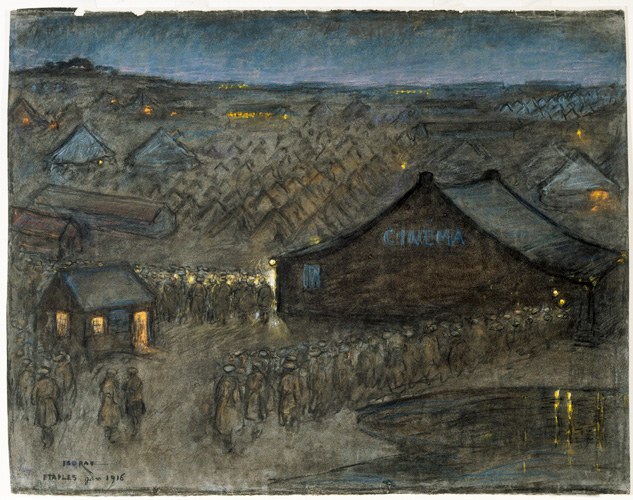
The IBDs were holding camps, situated in Europe, within easy distance of one the Channel ports They received men on arrival from England and kept them in training while they were awaiting posting to a unit. Depot 17, like many others, was based at Étaples, south of Boulogne. These Depots were hubs where both supplies and soldiers were kept and then transported to the Front as needed. Later in the year, in September and October a number of mutinies took place there, fuelled by the harsh regime which the New Zealand troops especially took exception to.
It was from here that Hubert would have been posted to the 10th Battalion of the Essex Regiment on the 14th June and given the Regimental Number 203038. The 10th had been fighting in the Battle of the Scarpe as part of the British Offensive known as the 2nd Battle of Arras. They had then been moved to the Flanders region and it seems likely that Hubert joined them there.
The first significant engagement was the Battle of Pilckem Ridge which started on 31st July 1917, a French and British attack. On the 31st rain began to fall and the shell blasted ground became a quagmire for which the campaign, often known as the Battle of Passchendaele is now remembered.
It appears that, on 10th November 1917, Hubert returned home. It may be that the army found Hubert a less than sturdy soldier but if this was the case we begin to see a possible reason. On 20th November he was admitted to the East Suffolk and Ipswich Hospital and from there to the Military Hospital at Purfleet. He was granted a furlough from there from 24th January to 2nd February 1918 at which time he was still part of the 10th Battalion of the Essex Regiment. His medical category was B2. This was defined as, able to walk 5 miles and to see and hear sufficiently for ordinary purposes.
He was again transferred, on the 3rd February 1918, to the 4th (Reserve) Battalion of the Essex Regiment The furlough entry also has a Labour Corps stamp so perhaps this was the point at which he was immediately transferred to them. The note on his records states, “Re-transferred having been retired as unsuitable for duties with above unit”.
His transfer to the Labour Corps was “permanent and compulsory”. He joined the 576 Home Employment Company of the Corps and I think that it is unlikely that he saw any further action. He was absent without leave from 10.30 pm on 10th March 1918 until 12 pm on the 11th March for which he forfeited two days’ pay.
There is some confusion here, for the Essex Territorial Force Association wrote to the 4th Essex on the 5th September 1918, to inform them that Hubert’s wife had moved to Strood Lodge in Buxted, Sussex. Could it be with his continued absence she had been forced to take a job in service? This Memorandum also has the Labour Corps stamp so it may be that the local man had not been aware of Hubert’s transfer and it was forwarded on to them.
Hubert was not finally demobilised until 25th February 1919 (although still six months before his brother James). He was entitled to the British War and Victory Medals. We see that he was also due for an Army Pension because of a 40% disablement, becoming 30%. He was to receive eleven shillings for 26 weeks and then eight shillings and threepence for a further 26 weeks. After that it was conditional. We now see that the diagnosis for his illness was V.H.D.. These initials stood for Valvular Disease of the Heart and this indicated a serious organic disease or heart malfunction. It was stated that this had been “aggravated” by his army service. It was no surprise that Hubert may have struggled as a soldier.
After the war Hubert lived first in Rotton Row and then in North Street in Raunds. Florence had returned home and the couple had two children, John in 1920 and Mary in 1922. Perhaps surprisingly, Florence died first, aged 40, in 1930 but Hubert soon followed her, aged 42, in 1931. In the 1939 Register of England and Wales, on the eve of another World War, daughter Mary, a coat machinist at a clothiers was living with her grandparents John and Mary Ellen Edwards at 46 Marshalls Road in Raunds.
Hubert Edwards was a man who survived the war but his army service probably hastened his death. Really a Raunds man, his brief time in Ringstead during the war has written him into the Ringstead Roll of Honour.