The Great War: A–M · Story 24
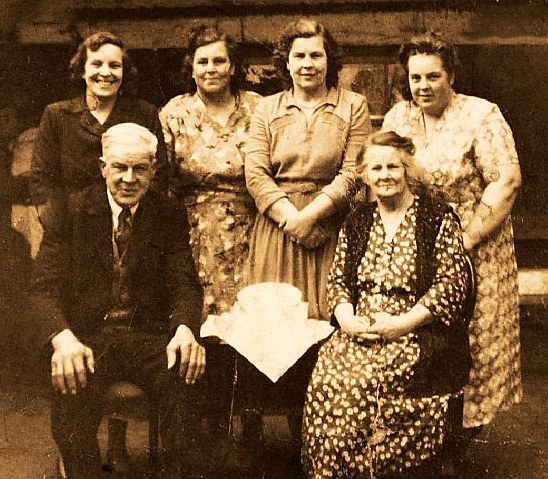
George Robert Feary (1884-1969)
The Feary family had originally come from across the meadows to Ringstead, in the Addingtons. James Feary had been born in 1834 in Great Addington. His first wife May Chapman, who he had married on 13th April 1857, died in 1863. He had married again, less than a year later, to Hannah Sharpe from Little Addington. She was some ten years his junior.
James spent much of his early working life in Burton Latimer working as a foreman on a farm. He returned with his wife and family to Great Addington in about 1882 where he worked as a miller and farm labourer. In all, he had had at least ten children, but it is the youngest child of James and Hannah whose story we are telling here.
George Robert Feary (and the surname has many variations) was born on 11th April 1884, although put as 1885 in the 1939 Register, and baptised at Great Addington on 17th August 1884. By 1901 James was 67 years old and his occupation was now “Ordinary Agricultural Labourer”. Hannah was 56, and only Mary (26), an “Army Boot and Shoe Top Closer” and George (17), a shoemaker, were still at home.
James died in 1906, aged 72, and in 1909 George Robert Feary married Gertrude Sophia Taylor, originally from Bidford-on-Avon in Warwickshire, but living with her family in Raunds. Her father Frederick had died too on 10th June 1907. He had moved to the area to become the Manager of one of the Raunds Distributive Co-operative shops when it first opened in the 1890s.
In the 1911 Census for Great Addington George Feary, aged 26, was with Gertrude and their daughter, Hannah, who was one year old. George was working as a farm labourer and he had described his house as a “2 up 2 down”, although the Census officer had crossed this out and substituted “4” [rooms].
The couple had two further daughters, Maud in 1912, and Ada in 1914. But war was threatening to break up the young family.
At some point after 1911 George had moved to Ringstead, probably in order to change his occupation. He found work as an edge setter at C.E. Nicholls’ Boot and Shoe Factory in Raunds. Edge-setting was basically the neatening of the sole around the front of the boot. This could be done with a special knife but there were, from the late Eighteenth Century, simple edge cutting machines in the factories which is probably what George used.
The workers in the boot and shoe industry had some exemption from conscription because, despite what Napoleon may have said, an army marched on its feet. The army did use trains and motor vehicles to move troops about but marching was still a vital part of getting battalions from A to B. But, as the casualties mounted, and more and more men were needed the Military Tribunals began to turn down more appeals from shoemakers and their bosses for exemption.
On 1st April 1917, George was 32 with a young family but the local Military Tribunal decided that he could not resist conscription any longer and the appeal by the Nicholls’ Factory was dismissed. The Ringstead Roll of Honour, compiled at the end of the war, tells us that George served with the 1st Battalion of the Norfolk Regiment in Italy. France and Belgium. The Medal Roll and Card add that he remained a Private and was given the Regimental Number 205451.
Unfortunately, few of George’s military records survive so we do not have any dates for his call-up, or dates of service abroad. We do have, however, a later Hospital Admission Form for the 5th October 1918 which states that he had been one year six months in service and ten months with the field force. This would indicate that he was first enlisted in April 1917 and joined the 1st Battalion of the Norfolks in December 1917.
This ties in with the Ringstead Roll of Honour which gives Italy as the first country in which he served. George joined the Norfolks when they had been posted from the Western Front to Italy. In the First World War the Italians, after first being part of the Axis Powers decided to join the Allies and fought against the Austro-Hungarian Empire. The Italians were gaining the upper hand but the Emperor of the Austro-Hungarians appealed for help from the Germans. At the Battle of Caporetto on 21st November 1917, near the town of Kobarid (now in Slovenia), the enemy onslaught used everything, including poison gas, mines, artillery and machine guns. The Italians, who were trying to fight uphill, were badly defeated and forced to retreat. They fell back, finally to the Piave River, and their position looked precarious.
In December 1917 the British sent five and the French six divisions to reinforce the Italians. The 1st Norfolks, probably including John Feary, were part of the 5th Division and travelled by train from Versailles through Lyon, Avignon, Marseilles, Nice, Savona and Mantua to Montagnana near Padua, where they were billeted in a church. They did not move to the Front at St Andrea until January 25th 1918 and remained there until February 2nd with only an occasional bomb dropped by enemy aircraft to show that they were in a war zone. It seemed almost a holiday to many of the soldiers after the Western Front, despite the many casualties.
The 1st Norfolks finally moved to a position on the River Piave near the destroyed bridges of Ponte Priula. There was little enemy activity and the weather was generally sunny. On 17th March there was some heavy shelling from the enemy but at about this time the Norfolks were relieved by an Italian Regiment and they went back to near Padua. Their Italian campaign was over. The Italians had proved more resolute and capable than had been thought by the other Allies and it was its troops who led the defeat of the Austrians.
The 1st Norfolks returned to France in early April 1918, travelling in two “half battalions” and after another long journey arrived in Doullens in the Somme battle area on April 8th. On the way the War Diary records that at Mordane, just over the border from Italy:
. . . all watches were put back one hour to agree with French time.
The Germans, following the withdrawal of Russia from the war after the 1917 Revolution, brought all their troops together for one great assault and against the British lines near Ypres and Hazebrouck. The first phase of the German “Operation Michael on the Somme had started on March 21st had ended as the Norfolks arrived back. The second phase was against the British in the low-lying Lys River area. The Germans were steamrolling forward and had driven the Portuguese back to near Neuve Chapelle. It was her, as part of the 5th Division that the Battalion was sent on 11th April. They first occupied the Forest of Nieppe and were ordered to retake the nearby village of Merville. In fact, the artillery had not had time to move up, so the attack was aborted. From April and right into August the Front around Nieppe remained stationary.
The Norfolks suffered badly from enemy mustard gas attacks which were odourless and often soldiers only became aware of them when, inhaled, it blistered the lungs and throat. Unfortunately the gas mask was little protection because it would soak into the soldiers’ woollen uniforms and produced terrible, painful blisters all over the body. Contaminated uniforms had to be stripped off as fast as possible and man and uniform washed. Imagine this when under fire.
The Germans began to run out of men and supplies and their morale started to wane. From August 21st the Norfolks, as part of the 5th Division, began to drive the enemy back and by the 3rd September had moved some 14 miles although with the loss of 4,300 casualties. We see a pattern of almost continuous advance , slowed by the need of the artillery to keep pace, but still, sometimes, met by enemy bombardments of high explosive and gas shells.
On November 5th , the Battalion led the attack at Jolimetz which met little resistance. it was here, while resting after a further Allied attack that, on November 11th they learnt that hostilities were to cease at 11 am that day. The 1st Norfolks, like most Battalions, received the news with relief rather than wild rejoicing. The Battalion’s War Diary records:
Puissance Farm 10/11/18 11.00. The battalion moved via AULNOYE – LA GRAND CARRIERE to JOLIMETZ where the battalion was accommodated in billets.
17.00. Battalion reported in billets
Jolimetz 11/11/18 09.00. Reorganisation and general cleaning of billets and surroundings.
10.05 [minutes not clear]. Notice received of termination suspension of hostilities
12/11/18 Reorganisation and cleaning continues
13/11/18 The battalion moved to LE QUESNOY where billets were taken over from MG Corps
Le Quesnoy 14/11/18 Delousing started.
It is possible that George missed these last few weeks for, on the 5th October 1918, he was admitted to the 14th Field Ambulance with “Pyrexia of unknown origin” which was usually known as Trench Fever, caused by lice droppings infecting a wound or graze. He was moved up the chain to the 43rd Casualty Clearing Station. We do not know if he was discharged back to service from there. Trench Fever, like Covid 19, was a very variable disease in its effects on people.
The rest of November was spent by the Norfolks at Le Quesnoy and then the Battalion moved gradually into Belgium to arrive at Grand Leez on 23rd December where they remained until the end of the year.
We do not have the date of George’s return to England but it is possible that he was unlucky in that the 1st Norfolks were a Regular Army Battalion, although the personnel were much changed. They would not have been quickly demobilised and would have contained soldiers who would continue to serve after the war. From the War Diary it appears that the Battalion spent most of the next three months at Grand Leez, a village now part of the city of Gembloux, in Belgium. Here, every day was filled with route marches, P.T., parades, bathing and de-lousing. It was not until April 1919 that they proceeded to embarkation camp at Antwerp. The War Diary ends on 20th April 1919 and it is likely that this was about the time that they embarked for England
George Feary finally returned to England and was demobilised. We know from the Register of England and Wales that by the Spring of 1920 he was with wife, Gertrude, in Church Street in Ringstead. The Registers show us that they remained there until 1929 and that they then moved to Carlow Street. They were there in 1931 when daughter Hannah was also shown as being entitled to vote.
It is often overlooked that, for many working-class couples, the woman and the man both gained the right to vote in the Representation of the People Act of 1918. This gave 5.2 million men and 8.5 million women the right to vote. Previously the property requirement had excluded most working-class men.
The couple had at least two further children, Ivy, born on 28th February 1920 and Harold who was born in 1923 but died the following year.
Jon Abbott has written, on the Ringstead Heritage Group website, that electricity came to Ringstead in 1927, with the first substation built in Church Street, opposite the Carlow Road junction. He also reports that George Feary was one of those people who refused have it in his house and preferred instead to rely on oil lamps.
In the 1939 Register of England and Wales, George was working as a bricklayer’s labourer and Gertrude carried out the usual “Unpaid Domestic Duties”.
Gertrude died in 1965 and George Robert Feary died, aged 84 in 1969. For him, his time in the 1st Norfolks had been less than two years in a long family life.