The Great War: A–M · Story 20
The Dicks Family
A Simplified Family Tree
William Dicks (Dix) 1762 – 1846 -------------------Sarah Wyman 1787 – 1871
I
-----------------------------------------------------------
I                                                                              I
 Korah Dicks -------------------Sarah Attley        Henry Dicks -------- Mary Bates
1812 -1873                I           1815 -1871         1813 – 1890    I         1817-1859
                                   I                              ---------------------------------------
                                     I                             I                                                   I
Sarah A. Harris - Hod Dicks   Joseph Dicks --- Sarah A Major  Wm  Dicks --- Mary A Manning
1851-1915   1851-1886   1851-1911          1851-1915      1853-1913       1857-1907
           I                                                               I                                                    I
Frederick A Dicks                             Albert Dicks -Elizabeth Mullett   Fred Dicks--Margery Allen
1893 – 1913            1888 - ?                                          1894 – 1977
The wrong Fred!
Albert Dicks (1885-?)
Joseph Dicks was a local man who, in the 1881 Census was living with his wife Sarah Ann in Church Street in Ringstead. He was an army shoemaker, born in about 1851. Living with the couple are their children Mary J. (9). Emily (8), Thomas H. (5), Ellen (3) and Charles E. (1), all born in the village. By 1891 Sarah and Albert had been added to the family which was now living in Carlow Street.
Albert, who had been born on 27th October 1885 was, in 1911, staying at 84 King Street, Ramsgate, in Kent. The house belonged to Harold Hughes who was a hairdresser. Albert was one of three hairdressers classified as “visitors” and there were also three other young men who were apprenticed to the trade.
It is not clear if Albert was working in Ramsgate but, if so, he moved back initially to 13 Orchard Place, Rushden and then to 60 Irthlingborough Road in Finedon. This information comes from his military records for he had volunteered and attested with the Royal Army Medical Corps (RAMC) on 13th September 1915 at Rushden. He was given the Regimental Number 65718. At the time of enlistment he had been working as a hairdresser with Arthur Smith at 130 High Street in Rushden.
He would have first undergone basic training. Before the war this would have been at Aldershot but, between 1914 and 1918, the number of men in the ranks of the RAMC rose from 9000 to 154,000. It had been necessary to open up many other training centres with Blackpool being the headquarters. The training would have been part medical and part military but would have been of a basic standard: First Aid together with instruction in the correct carrying and loading of stretchers etc. He seems to have been awarded a 5th Rate C.P. on 23rd October 1915. A C.P. was a Collecting Post in a war zone and although I have not found a definition of this award, it seems likely that it was a basic training qualification for attending to, and carrying, casualties.
On 11th January 1916 Albert went with the British Expeditionary Force to France. He was not to return to England until 24th April 1918.
The new mechanized warfare was producing casualties on a huge scale week after week, month after month. The RAMC evolved a system for dealing with this carnage called the “Chain of Evacuation”. Lt/Col. T.B. Nicholls of the RAMC wrote:
All through the chain of Medical Units from the Front to the Base the wounded man is kept the very minimum of time to attend to his wounds, and then he is moved on, and kept on moving, until he reached either the Base or Home. . . The reason for rapid evacuation is twofold. Firstly, it is very bad for morale if troops see wounded men lying about in large numbers; and secondly, unless Medical Units are cleared they lose their mobility, and also cannot deal with a fresh influx of wounded that might come in quite unexpectedly – e.g. from a surprise counter attack.
As the soldier was moved further from the Front Line, the more sophisticated the facilities for treatment became. A casualty would be looked at first at a Regimental Aid Post (RAP) within the trench area by a Battalion Medical Officer and his orderlies and stretcher bearers. If necessary, he was then moved to an Advanced Dressing Station, still close to the Front Line manned by members of the RAMC Field Ambulance. If further treatment was required, he would have been taken to a Casualty Clearing Station, usually a tented camp behind the lines. From there he was moved to a Base Hospital, mostly situated near a railway station and the coast. If further treatment was then needed, he would be taken by one of the converted hospital ships to Britain. Here, hospitals began to specialise in certain types of injuries which is why some men seem to have been taken to a more distant hospital than expected. Finally, he might end up in a convalescent hospital run by voluntary organisations.
At each stage along the way, those deemed “cured” were returned to duty because one aim of the system was to put men back into service as quickly as possible.
It seems most likely that Albert was one of the RAMC men working near the Front Line. He was wounded on 19th March 1918 when, during an attack, he was struck by a bullet (or shrapnel – records vary). The track of the bullet passed through his triceps but seems to have lodged because he was said later to also have an “extraction wound”. The 19th of March was just two days before the massive bombardment heralding the German “Michael Offensive” which, for a time, seemed might win them the war.
So, Albert himself had to pass through the system from the Casualty Clearing Station to the Base Hospital. In Albert’s case he was taken to 54 General Hospital, known as “London General”, in Wimereux, on the coast just a few miles north of Boulogne. From Calais a hospital ship took him back to England and on to the East General Hospital in Cambridge. This was on a huge eight-acre site, now occupied by Cambridge University Library and part of Clare College Memorial Court. At one point it had 1,700 beds and treated some 70,000 casualties during the war.
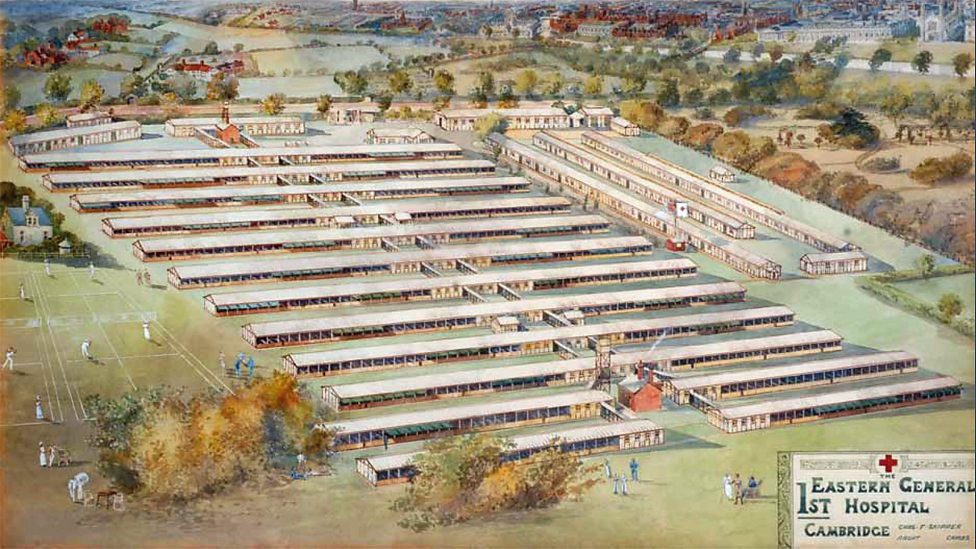
He was at Cambridge for just a week before being transferred to the V.A.D. Hospital in Abbots Ripton. This was one of the hundreds of convalescent hospitals set up in large houses, halls and chapels which were run by voluntary organisations. This one was set up in Abbots Ripton Hall, now the home of Lord de Ramsey. Albert would have worn a blue uniform and red tie to show that he was being treated and to prevent him being abused as a “shirker”. It was not until 5th June 1918 that it was published that he was entitled to wear a “Wound Stripe” above the left cuff of his uniform.
He was diagnosed with, or developed, anaemia in July 1918 and, at his later Disability Board, it was reported that “Mucous membranes of the face, pale” and that he “always feels run down”. It did add that he “may improve”. It is possible that the poor diet of the soldiers’ life, or intestinal parasites such as hookworms, or even the continual exposure to mild doses of mustard gas may have been the cause.
Albert never returned to France and was demobilised on 23rd July 1919. He was later assessed as having a 20% disablement and was granted a small pension. At first it was eight shillings a week from 24th January 1921 for a year and then seven shillings and sixpence for a further seventy weeks. He was entitled to the British War and Victory Medals.
During his convalescence he probably met Elizabeth Mullett (an interesting name for a barber’s partner) and married her on the 1st March 1919 at St George Hanover Square, in London. He was still in the RAMC and his address was given as 43 Yorkshire Street in Blackpool.
Albert took up his trade again and at some point he moved to St Ives (now in Cambridgeshire) where he had a barber’s shop at 42 The Broadway. St Ives is only some seven miles away from Abbots Ripton so perhaps he had decided that he liked the place during his convalescence. In the 1939 Register of England & Wales we find Albert and Elizabeth living there with their two children Joseph L., born on 7th March 1920, and Joan, born of 8th February 1923. It is at the start of another World War and Albert is in the A.R.P. (Air Raid Precautions) who supervised the observance of the blackouts and he was also a First Aider.
Albert’s son, Joseph, remained in the St Ives area until his death in 1983 but I have not yet found Albert or Elizabeth’s deaths so it may be that they moved elsewhere for their retirement.
Fred Dicks (1894 -1977)
The life story of Fred Dicks was one that was difficult to trace, partly because most of his military records have been lost but also because it took some time to work out which, of two possible Fred Dicks, he actually was.
Looking back to the early Nineteenth Century, William Dicks (or Dix) and his much younger wife, Sarah (née Wyman), produced a large family including Korah born in Leicester St. Margaret’s, possibly in the Workhouse, in 1812 and, a year later, Henry, born in Ringstead. Korah was an unpleasant, rascally man who I have written about elsewhere. He married Sarah Attley and they too had a large family in Ringstead including one son called Hod (or sometimes Odd) in about 1851.
Hod, who seems to have inherited some of his father’s characteristics, married Sarah Harris on 25th December 1873, the year his father died. Hod, too, died young, at the beginning of 1886, when he was only thirty-five years old, leaving Sarah a young widow. In the 1891 Census she, and her three children, were living in Church Street with Hod’s older brother, John Dicks. By the 1901 census Sarah had had another son, Fred, born in about 1894, some eight years after her husband’s death. Was bachelor, John Dicks, the father?
The Civil Birth Registration was in the 2nd Quarter of 1893 with the mother’s maiden name given as Harris. It is the Ringstead Baptismal Register, however, which reveals that Fred was actually christened Frederick Arthur, the son of Sarah Dicks on 5th February 1894. It is the full name plus the birth date which allows us to identify this Fred and to say that he is the Frederick Arthur Dicks who died, aged twenty, in the Thrapston District, in the third quarter of 1913.
This Fred was a second cousin of Albert whose story is given above. There was another cousin however, the son of William, a brother of Joseph (the father of Albert). In the 1901 and 1911 Censuses for Ringstead there are two children called Fred Dicks. who were seven and seventeen respectively. We have just looked at one, son of Sarah (widow of Hod). The other Fred was also a great grandson of William and Sarah Dicks (nee Wyman).
William and Mary Ann’s son, Henry had a son also called William, baptised on 8th February 1853. William junior married Mary Ann Manning and had a son on 26th April 1894 who appears to have been given the shortened name, “Fred”. It was this Fred who was in the First World War.
His mother, Mary Ann (née Manning) had died in 1907 and in the 1911 Census, his widowed father, William was an army boot maker living with his two sons, Archie and Fred in Carlow Street. Fred, aged sixteen, was working as a boot riveter but his father and older brother were both unemployed. His father died in 1913 and a year later, the temporary saviour of the army boot trade, the Great War, began.
Unfortunately, as we have indicated earlier, there are few military records for Fred, and none tie them to a home address, so there is a lack of certainty about any of them.
The Ringstead Roll of Honour shows Frederick Dicks in the 17th Mountain Battery of the Royal Garrison Artillery and, in late 1918, he was part of the Army of Occupation there. The 1918 and 1919 Absent Voters’ Lists for Ringstead also reveal that his Service Number was 168710. His few military records put him in the 11th Mountain Battery. Could this be a simple clerical error? It is possible he was posted to a different unit but as both the 11th and 17th were in Egypt at this time it does not alter our account.
It is possible, however, that he had served in another Regiment or Corps prior to this. He would have been in a protected trade as army boots needed to be made in increasing numbers. He was, however, a single man of the right age so it is almost certain that this protection would not save him from conscription for the whole war.
The Royal Garrison Artillery (RGA) had been formed in 1899 as an arm of the Royal Regiment of Artillery, alongside the Royal Field Artillery (RFA) and the Royal Horse Artillery (RHA). Its main role had been seen as the manning of the guns of the forts and coastal batteries of the Empire but it also it also became responsible for the heavy gun batteries attached to each Infantry Division.
The Mountain Batteries were the part of the Royal Garrison Artillery tasked with working in mountainous areas and places with difficult terrain, even behind the Western Front. There were seventeen Mountain Batteries, including some manned almost exclusively by Indian troops. There were also a number of Territorial Units.
Mountain Batteries 10 to 17 were sent to be part of the Egyptian Expeditionary Force (EEF) in 1917. The war against the Ottoman Empire, allies of the Germans, and by this time known as the “Sick Man of Europe” was around the Eastern Mediterranean. The EEF had been sent to Egypt initially to protect the Suez Canal but by 1917 operations had extended into southern Palestine. In April 1917 the British lost the 2nd Battle of Gaza, with 6,444 casualties in a humiliating defeat. The Commander of the Force was replaced and after extensive reinforcing and re-fitting the next campaign pushed the Turks back to Jerusalem. In 1918 the Ottomans were forced back further, to Damascus and Northern Palestine, and on 31st October 1918 an Armistice was signed which signalled the end of the once great Ottoman Empire.
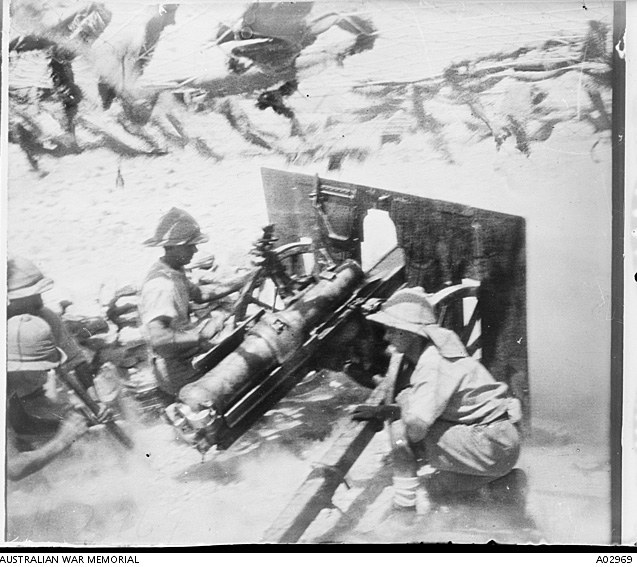
After the Armistice the EEF had to remain in Egypt and Palestine as an unpopular Army of Occupation. In March and April 1919 it had to suppress with force an Egyptian Rising. The occupation was also unpopular with the conscripted and volunteer soldiers because it delayed their demobilisation, long after most of their fellow soldiers were home with their families.
The men were finally demobilised and Fred was entitled to the British War and Victory Medals. He returned to Ringstead and in 1919 was in the Electoral Register, living in London End in Denford Road. He married Margery Gwendoline Allen from Woodford in 1926. In the 1911 Census she had been living with her sister and widowed mother in Denford and it appears that all three were working for Wallis and Linnell, clothiers, who had a factory there.
At some point the couple, who do not appear to have had any children, moved to 10 Church Street in Hatfield in Hertfordshire and were there in the 1939 Register of England and Wales. Fred was still a boot and shoe maker and Margery was doing, as was the norm, “unpaid domestic duties”.
I believe that the couple did move back to Northamptonshire, living at 4 Grove Road in Thrapston. Fred died on 29th October 1977 aged 83 and Margery followed him on 20th January 1982.
Archibald William Dicks (1889-1917)
After posting the stories of Fred and Albert Dicks on my website I received an e-mail from Brenda Hazel telling of an older brother of Fred called Archibald William Dicks. He had been born in Ringstead in 1890, the son of William and Mary Ann. The 1891 and 1901 Censuses show him living with his family in Carlow Street. His mother, Mary Ann, died in 1907 and in 1911 “Archie” was living with his widowed father, William, and brother Fred.
His father died too in 1913 and it may have been at this time that he left Ringstead for factory work in Irthlingborough. Both he and his father had been out of work in the 1911 Census so it is possible that he had left the Ringstead handsewn men even earlier.
Certainly, he was living in Addington Road, Irthlingborough and working as a Shoe Machine Operator when he married Florence Andrews Botterell (various spellings) in Wellingborough Register Office on 13th November 1915. Florence (or Florrie) had been living with her widowed mother in Hudson’s Cottages in Irthlingborough. Her mother had been forced to work as a laundress after the early death of her postman husband.
The couple set up home in Hudson Cottages, probably in Florence’s family home. Archibald was working for boot manufacturer John Spencer in Station Road in Irthlingborough. Florence gave birth to their first child, William Reginald Dicks, on 22nd May 1916, so Archie would have seen his son before he enlisted in the following July. The army boot trade was one which could give some exemption from conscription but this carried less weight as the war progressed, and increasingly men had to enlist.
It appears that he was first enlisted with the Suffolk Regiment and given the Regimental Number 35092, but it likely that when he was sent to France in November 1916, he was transferred to the 1st Battalion of the Essex Regiment with new number 32961 (sometimes 32931). Unfortunately, few of Archie’s military records survive so we can only assume some of his service. At the end of November the 1st Battalion were in the Trones Wood bivouacs, resting between tours of duties in the Front Line. The, now desultory, warfare following the long campaign known as the Battle of the Somme was drawing to a close.
With the new year the German High Command were planning to withdraw their troops to the strong defensive positions they had constructed known as the Hindenburg Line. This withdrawal began on 21st February 1917. The new French Commander-in-Chief of the Allies, General Nivelle, planned to make a grand assault on the enemy, hoping to bring the war to a swift end. The French assembled a million troops to launch an attack in the Second Battle of the Aisne. The British were to launch a diversionary attack a week before to draw German troops away. This campaign was called the Battle of Arras.
The British offensive began with the First Battle of the Scarpe which ran from the 9th to the 14th April. The Essex Regiment’s part in this battle was focussed around the village of Monchy-le-Preux. The battle is remembered partly for the terrible losses sustained by the cavalry of the Essex Yeomanry in holding the village after its capture. They were ordered to advance from the village against the enemy but were forced back by machine gun and artillery fire. The men had to dismount and seek cover in the cellars, but the horses could not escape and the streets were soon littered with the bodies of dead animals, and it was said that the gutters ran with their blood.
The weather was very cold with sleet and snow but the 1st Battalion was directed to carry out a follow up attack, together with the Canadian Newfoundland Regiment, to take the strategically important, but vulnerable, Infantry Hill. The terrible weather and the blocked streets delayed the attack for a couple of days giving the Germans time to reorganise. The attack had also been planned to be by the 87th and 88th Brigades but, when it was realised that the 87th would not be ready in time, it was hurriedly decided to attack with only the Essex 1st Battalion and the Newfoundland Regiment.
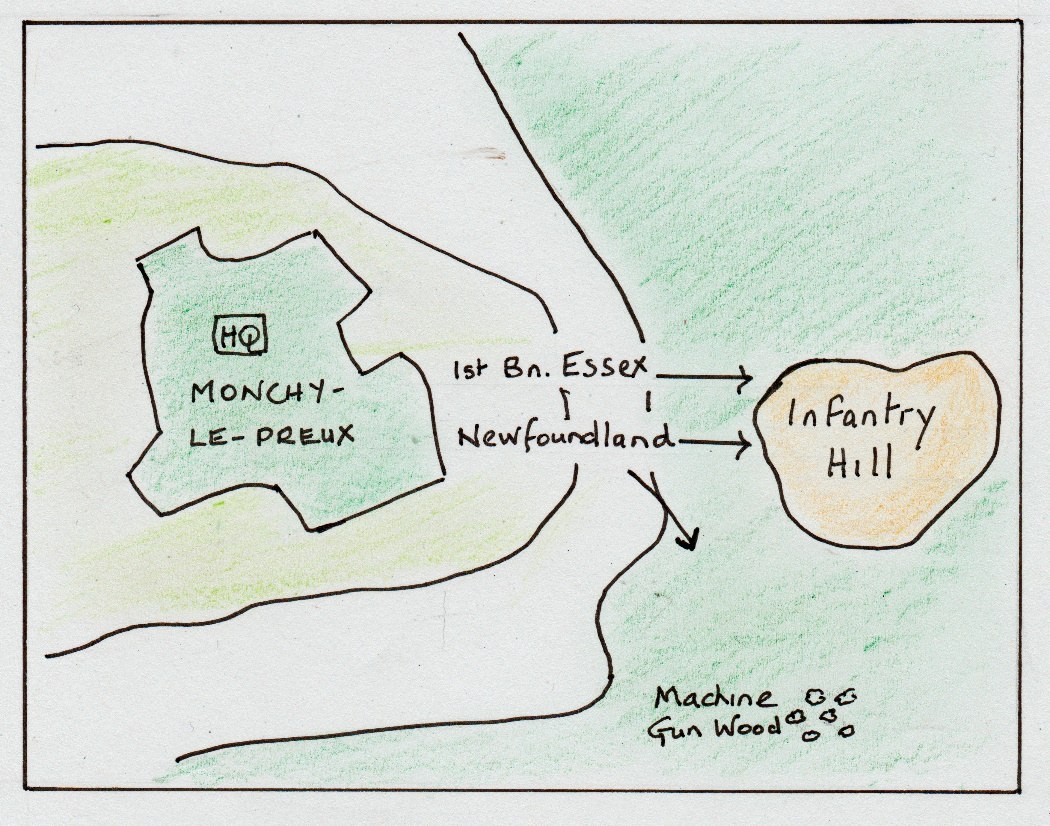
At 5.30 am on April 14th the two Regiments started this ill-conceived attack, uphill, against a partially surrounded position. The two Regiments had captured Infantry Hill by 7.30 am but before they had time to dig in the Germans counter-attacked. They were on a salient surrounded on three sides by the enemy. The tide rapidly turned and many soldiers were quickly either casualties, or captured, or both. Jeremy Banning, on his website, quotes from the press release given out when a memorial to the Essex Yeomanry and 1st Battalion, (among others), was unveiled in Monchy-le-Preux on 21st May 2016.
On 14th April, the 1st Battalion Essex Regiment attacked east of Monchy into a wooded area aiming for their objective, some high ground known as Infantry Hill. Initial success, with ground captured and prisoners taken was reversed by a heavy German artillery barrage plus a simultaneous counter attack by the 3rd Bavarian Regiment, one of the enemy’s finest fighting units. The battalion suffered 661 casualties, so many that a temporary battalion formed with the Newfoundland Battalion named the 1st Newfoundessex comprising only 400 men.
The Essex 1st Battalion’s War Diary has two brief entries for the day:
14. 4. 17 Attacked German line at 5.30 am. Casualties 17 officers 644 other ranks.
14. 4. 17 Remainder of 1st went into Caves in Arras at 8 pm.
Archibald Dicks was one of the men in this ill-fated attack. It was not until 25th May that the Wellingborough News reported that Archibald’s mother had received official confirmation that he had been missing since April 14th. Again, on the 6th June 1917, the Chronicle and Echo reported:
Dicks, Pte. A. (27) Essex R. of 8 Hudson’s Cottages, Irthlingborough, missing since April 14th is now reported badly wounded and a prisoner, enlisted July 1916, going to the Front in November.
It must have been an agonising time for Florence but she would now have had some hope of better news, after thinking Archie was probably dead. Jean Rowland has said that, in May, Florence had received a letter from Archie in his prison-of-war camp saying that he was seriously wounded in the leg and was a prisoner in Germany. It was again reported in the Northampton Mercury of 31st August 1917 that he was a POW.
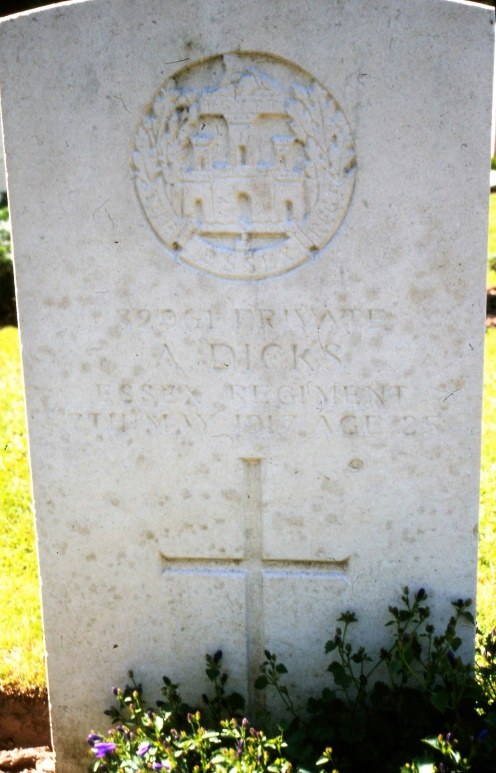
In fact, the death of Archie on 7th May 1917 had been published in the Daily Casualty Lists on 22nd August. His death certificate records that he died, aged 26, in Hamborn-en-Rhein, now a district of Duisburg. There was a prison camp at Hamborn and I think he was in a hospital there, or nearby, when he died. It is thought that he may have died of the virulent “Spanish Flu” but, if so, his injuries were probably a contributory cause. He would have been buried locally but in 1922 it was decided that the graves of Commonwealth serviceman, who had died all over Germany, should be brought together in four permanent cemeteries, one of which was Cologne. This was done in 1923 (when there was still an army of occupation) and more than 1000 Allied soldiers were buried there as well as some German servicemen. His grave was in Cologne Southern Cemetery (Plot XI. G. 12.).
He was entitled to the British War and Victory Medals.
Florence and son, Reginald, as he was usually called, had to carry on life without Archie. She received a small war pension and did not re-marry. She died in 1933, just 43 years old, and Reginald, aged 16 and now an orphan, had to go and live with his aunt.
Charles Dicks ?
There is a Charles Dicks on the Kettering Roll of Honour website, who was born in Ringstead (possibly in 1897), and died at home. Unfortunately, I have been unable to locate this man although there is a Charles Edward Dicks born in about 1880. I have contacted the compiler of the website but there is no longer contact with the local person who researched this Roll of Honour so no further information is possible.