The Great War: N–Z · Story 12
The Sawford Family
Very Simplified Family Tree
           George Sawford b 1795 -------------------------------------------------------------- Ann Cobley
                                        I                                                                           I
 Thomas Sawford b1818 m Elizabeth Whiteman (2nd)   William Sawford b1821 m Mary A Barker (2nd)
                  I                                                                                  I
Thomas Sawford b1853 m Elizabeth Childs           Walter Sawford b1854 m Elizabeth Perkins
                  I                                      I                I
JESSE Sawford b1879                 George Sawford b1873 m Minnie Braines     ERNEST Sawford b1894
                                                                             L                        l                          l
               ARTHUR b1895     WILLIAM b1897    PERCY b1900
The men who served in WW1 have forenames in CAPITALS
The Sawford (or usually Sorford in the early 19th Century Parish Registers) family have been an important part of Ringstead village life. The Sawford men who we will be looking at all trace their ancestry back to George Sawford and Ann Cobley who married in Ringstead Church on 14th October 1816. Two of their sons were Thomas, who was baptised in the same church on 24th July 1818 and William who was born on 23rd August 1821, but not baptised until July 24th 1831, (when they also tried to baptise Thomas again). Ann died, aged 47, and was buried on 16th April 1837.
Thomas, the older son, married Elizabeth Richardson on 10th January 1839 but she died just six years later, aged 28. He married again on 14th October 1847 to Elizabeth Whiteman and it is a son of this second marriage, another Thomas, who was born in 1853, whose line we will follow. He married another Elizabeth, Elizabeth Childs, on 30th November 1876. The couple had at least six children but it appears that only one son, Jesse was called to service. There were other sons in the unlucky age range which qualified them to be conscripted but do not appear to have been called up. It may be that they had moved and do not appear on the Ringstead record, or they had illnesses or disabilities that exempted them from service.
As we have seen, George and Ann also had a son called William who was born in 1821. He married Esther Hornsby in a joint wedding with his brother Thomas’s second marriage, on 14th October 1847. Esther gave birth to a child they called George but he died soon after, on July 6th 1849. Esther followed him before the month was out, on the 24th July.
Like his brother, William re-married, to Mary Ann Barker from Old. They had a son called Walter, born in 1854 who married Elizabeth (what else?) Perkins on 25th December 1872 in Ringstead Church. Walter and Elizabeth had eight children and the eldest son, George, married Minnie Braines and three of their sons were called to serve in the Great War. There were two other brothers of George, John William, born in 1880 who died of fever in South Africa in the Boer War, while serving with the St John Ambulance, and the youngest brother, Ernest Walter whose military service spanned a far greater period than most of the men from Ringstead.
Jesse Sawford (1879-1944)
Jesse was the second child of Thomas and Elizabeth, born in late 1879. He had an older brother Reynold (sometimes Reginald) and four younger siblings, three of them male, William Harold, Alec and Horace Ralph, none of whom appear to have been conscripted. [William] Harold did go to a Military Tribunal in 1917 and was given temporary exemption. He died in 1924 so may have had medical problems. Horace Ralph, born in 1891, died in 1917 so, again, he may have had good reason not to be called up.
In the 1881 Census, the family were living in Church Street, near the school. By 1891, now shown as living at 7, Church Street Jesse had become a shoemaker. He married Ellen Archer in 1910 and, in the 1911 Census, they were living in Church Street. Jesse was shown as an “Army Bootmaker” and more specifically a “Sewer”, but like many at the time he was out of work. Next door lived his widowed mother, Elizabeth, and his unmarried brothers and sisters. The two sons, who were handsewn men working at home, were both out of work like Jesse. The factory-made boot was taking over the military trade.
Ellen (sometimes Nellie) was the daughter of Arthur Archer who was an innkeeper and shoemaker. He had taken over the licence of the New Inn in the mid-1890s. Arthur died on 20th February 1913, aged 54 and his widow, Sarah Ellen, took over the licence. It is likely that she had always done much of the bar work when Arthur had been the licensee. We have looked previously at the brothers and cousins of Ellen who fought in the war.
It may be that Jesse had to swallow his pride and get factory work when the Western Front demanded huge numbers of boots and the military boot trade was briefly reinvigorated in Raunds and Ringstead. In 1917 he was working for Owen Smith, a wholesale boot and shoe manufacturer, who had a factory in Grove Street in Raunds. Jesse was working there as a “Hand Laster”. He was called to appear before a Northamptonshire Military Tribunal to rule on his exemption from service. His case was first adjourned to the 26th June 1917 and he was then granted a further exemption until the 10th July.
That appears to have been the end of the delay to his conscription and he was posted to the Royal West Surrey Regiment. He was given the Regimental Number 61022. It is not clear, but it may be that he was first with the 1/4th (Territorial) Battalion and was perhaps transferred to the 1/5th at the end of the war. All we know is that he served in these two Battalions. Both served much of the war in India but the 1/4th spent the whole war there and the Ringstead Roll of Honour only mentions India in his entry.
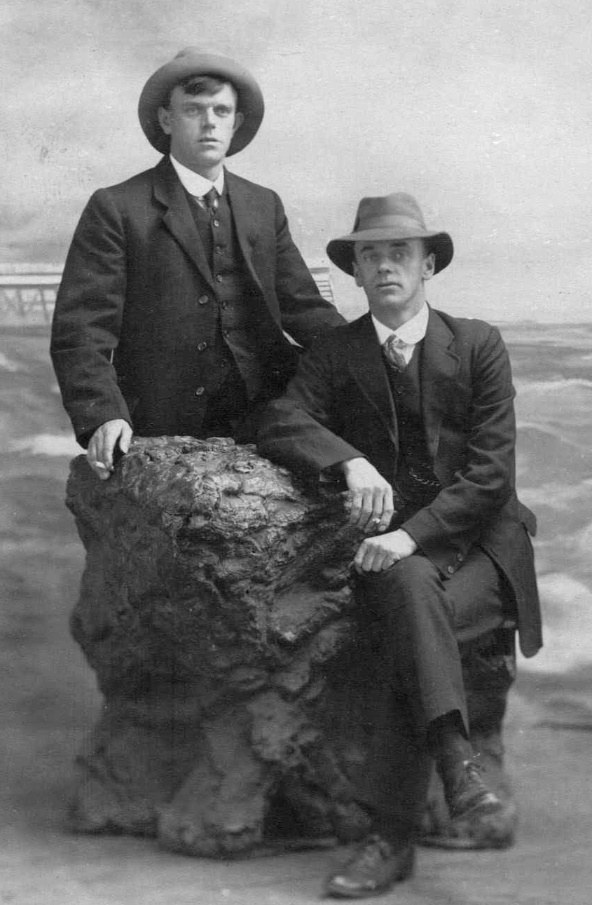
The 4th Battalion of the Royal West Surreys was a territorial unit, originally a volunteer force, designed for home defence. With the coming of the Great War, many territorials volunteered for overseas service. This new reserve unit became the 1/4th Battalion. The Regular Army was initially desperately wanted on the Western Front so forty battalions were replaced by some 55,000 territorial soldiers in India.
Jesse did not see those early years where the 1/4th were on the North-West Frontier, close to the Afghanistan border. Like many Europeans, before and after, in the sub-continent, they were struck down with sickness. In May 1917 while waiting at Tank the men contracted malaria, sand-fly fever, as well as suffering heatstroke. The Battalion was withdrawn from active service and sent to Dashai and Jutogh in the Simla Hills, to recover. Only some 200 men, out of a force of 750, could make the initial move, with many of the sick being left to recover at stations along the route, only rejoining the Battalion later.
The men then moved to Lahore and it is about this time, in early 1918, that Jesse probably joined the “Queens” as the Royal West Surrey were known. There was little fighting during this time but an outbreak of what was later, in Britain, called “Spanish Flu”, swept through India, killing six million people in two months. Among the dead were twenty soldiers from the Battalion.
In January 1919 demobilisation began, with small parties of men returning home, when a new crisis on the North-West Frontier sent the 1/4th back into action. The end of the Great War meant little to the Afghans, still subject to foreign interference. The British had been concerned that the Russians would launch an attack on India through Afghanistan. There had been two Anglo-Afghan Wars in the Nineteenth Century and at the end of the First World War a third Afghan War flared up when they invaded northern India. The Afghans wanted greater recognition of their status and control over their own foreign policy. There were also political tensions within Afghanistan and, when their leader was assassinated, his successor decided to invade British India, partly to placate the hardliners in his own country.
The Afghan army was comparatively small and poorly organised but there were some 80,000 tribesmen who were formidable fighters, especially in the rocky terrain which was their home. The 1/4th were posted to the Peshawar area in May 1919. They were part of a British and Indian force that surrounded the city and threatened to cut off the water supply. The pro-Afghan faction’s leaders were delivered to the besieging force and the crisis averted. By August the incursion was over but, in the following settlement, the Afghans did gain control over their own foreign policy and it is seen by them as an important War of Independence.
It was a short but sometimes vicious war and it was said that captured British soldiers could expect torture, mutilation and death. The whole Indian posting was unpopular with the territorial troops because they were mainly confined to garrison duties with, added to the dull routine, often sickness, heat, and little chance of home leave. Once the Great War had finished the men wanted to be back home and one can imagine that the 1/4th was not a particularly happy unit at this time.
From Peshawar the Battalion were sent to Bombay where, on 18th October 1919 they embarked, arriving in England on 14th November 1919.
Jesse was not entitled to the Victory Medal but he was to the India General Service Medal with a clasp inscribed Afghanistan- North-West Frontier 1919. By 1920 he was back living in Church Street Ringstead with wife Ellen.
In 1939 they were in Warners Cottages in London End in Ringstead. Jesse was working as a bench hand in s shoe factory. Living with the couple was Ellen’s widowed mother, Sarah Archer.
Jesse died on 5th May 1944, aged 66, and Ellen in 1967 aged 78.
Ernest Walter Sawford (1894-1934)
We now look at the other side of the tree which comes down from William, born in 1821, who married Mary Ann. in 1854. Their eldest son, Walter, born in 1854, married Elizabeth Perkins on Christmas Day 1872 in Ringstead Church. They had eight children and the oldest son, George, born in 1873, had three sons, and we will look at these next. First, we will look at the youngest son Ernest Walter born on 27th July 1894.
As we have said earlier, Ernest’s older brother, John William, had died of Enteric Fever in the Boer War in 1900. In the 1901 Census, Ernest was living with his parents in No. 1 Dearlove Cottages in Ringstead. His father, Walter, was the Manager of a Boot and Shoe Factory. By 1911, Ernest was the only child living at home and was working as a butcher.
Ernest’s war career was unusual, although not unique, in the men of the village who went to War. He enlisted on 29th July 1912, two days after his eighteenth birthday, with the Royal Marines Light Infantry and was given Service Number 16385. We can see from his Service Register that he enlisted in Birmingham. He was 5ft 6¾ inches tall with hazel eyes and brown hair. He also had a birth mark on his upper arm and various scars on his face and body.
He was first sent to the Reception Depot at Deal in Kent and was in training there until 14th May of the following year. It seems likely that he was able to swim when he enlisted, for he was tested and passed on 16th September and, on 5th December 1912, he was given the Certificate and Medallion of the Royal Life Saving Society at Deal.
On 15th May 1913, he was sent to “E” Company of the Portsmouth Division. On 5th November 1913 he was posted to HMS Glory for which HMS Argonaut was the depot ship. Glory had been launched in 1899 and in 1909, after service abroad, she was reduced to reserve status and remained militarily inactive until the outbreak of the First World War.
Before then, Private Ernest Sawford was posted to the Portsmouth Division on 6th February 1914. He was posted again on 27th May to HMS Venerable and this was his ship for the first two-and-a-half years of the war. Venerable was a London Class Pre-Dreadnought battleship. She had four 12-inch (305mm) guns and a top speed of 18 knots (21 mph). She was launched in November 1902 and in 1909, after a major refit, she served with the Atlantic and Home Fleets.
When war broke out in August 1914, Venerable, with Ernest aboard, worked in the Channel covering the Portsmouth Marine Battalion’s movement to Ostend and in October bombarded German positions on the Belgian coast. Areas around Nieuport were deliberately flooded, stopping the German attack which then diverted inland, out of range of the Venerable’s guns.
She returned to home waters but once again sailed out to bombard German positions near Westende, designed to engage German attention to support a British offensive at Neuve Chapelle. She was used again in May to try to stop German artillery attacks on Dunkirk but was unsuccessful. It was at this time that Ernest sustained wounds in his head. She was sent to the Dardanelles and from 14th to 21st August bombarded Turkish positions at Suvla Bay. Bad weather made accurate shelling impossible and Venerable left the area and in October was refitted at Gibraltar. Then in December she was sent to the Adriatic Sea to reinforce the Italian Navy against the Austro-Hungarian fleet until December 1916.
Ernest Sawford returned on the Venerable to Portsmouth and, on 28th December 1916, was once again part of the Portsmouth Division, remaining with it until the 6th March 1917. He was then posted to HMS Caledon the following day.
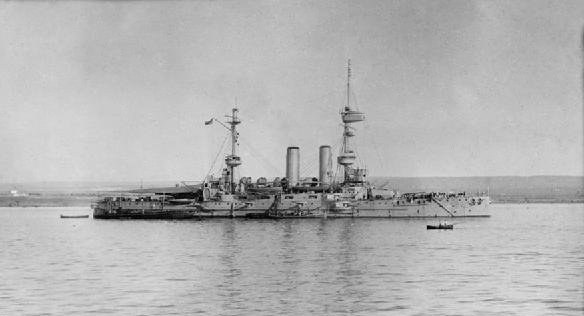
The Caledon was a modern cruiser and Ernest was part of its first crew as it completed its trials, ready for operational service. He now saw very different waters to the Mediterranean because the Caledon became the Flagship of the 1st Light Cruiser Squadron as part of the Grand Fleet at Scapa Flow. This is an area of sea in the Orkneys, north of the Scottish mainland. Its importance through the ages has been that it is protected from the worst of the weather, in the lee of some of the main islands in the group. Another Ringstead man, John Owen Roberts was also in this area from 29th May 1918 on HMS Cardiff.
On 17th November 1917, the Caledon took part in a naval action against the German warships in Heligoland Bight. She was part of an attempt to cut off and destroy a force of German minesweepers which was being escorted by light cruisers. A chase followed but the British cruisers came under fire from German battleships and broke off the engagement. Caledon was hit by a single 12-inch shell but luckily it did not explode and the ship did not sustain any major damage. Nevertheless, five men on the Caledon were killed and John Henry Carless was awarded a posthumous Victoria Cross for remaining at his gun after receiving a fatal wound.
Through 1918 the Caledon continued as part of the Grand Fleet, based in Scapa Flow. On November 21st the German fleet surrendered. When the Germans heard that the fleet was to be divided up among the Allies, they scuttled their own fleet on 21st June 1919. Before this, however, the Caledon, as part of the Grand Fleet, had sailed to the Baltic in support of shore operations against the Bolshevik forces who had taken over Russia and also blockaded a fleet, now in Soviet hands. The Caledon became Rear Admiral Cowan’s flagship and moved to and from the Baltic.
We do not know exactly when Caledon ended these Baltic exercises but we do know that on 3rd March 1920, Ernest was 25 years old and staying in the Union Jack Club on Waterloo Road in London. On that day he married Dorothy Vavasour Elliott who was living at 22 Tenison Street in Lambeth. The wedding was at Lambeth Wesleyan Chapel. After the marriage the couple seem to have set up home in Portsmouth where Ernest was in the Portsmouth Division from 29th July 1920 until 5th September 1922.
On 6th September Ernest joined HMS Fisgard. This, however, was the name of a shore establishment used to train artificers and engineers for the Navy. It was based on old moored ships at Portsmouth. This training was widened to include an electrical and ordnance branch. On 25th September 1925 he moved briefly to the Portsmouth Division before a posting to HMS Cardiff on 24th October 1925. He was again at sea, for the Cardiff was the flagship of the Third Cruiser Squadron, in the Mediterranean. On 29th May 1928 he was back in Portsmouth, based at Deal from 13th August, until the end of 1930. He worked as a butcher at Deal Depot and received three pence a day extra.
On 19th November 1930 he started a year on HMS Iron Duke. The London Naval Treaty specified that the four Iron Duke Class battleships should be scrapped, or otherwise demilitarised, and it had been converted into gunnery training ships. Ernest then moved onto HMS Dolphin which was another shore-based establishment. It was at Fort Blockhouse in Gosport and was the home of the Royal Navy Submarine Service from 1904 to 1999.
Ernest’s time in the Navy appeared over on 28th July 1933, which was the end of his second period of engagement. He received a pension of £57 1s 0d. He and his wife were living at 37 Henderson Road, Eastway, Southsea. He then enlisted in the Royal Military Police on 6th February 1934. These “pensioner special constables” were the forerunners of the Admiralty Constabulary. Horatio2, on the Great War Forum website, has revealed that “Applicants were accepted only after replacing substandard teeth with dentures at their own expense”.
In many ways the military police fulfilled a role not dissimilar to the original duties of the Marines as maintaining order aboard ship. Unfortunately, Ernest did not have much time in his new post, for he died on 22nd October 1934.
The Sons of George and Minnie Sawford
We will look finally at three of the sons of Ernest’s oldest brother, George. He had been born in 1873 and married Minnie Braines from Twywell in 1893. At first, the young couple lived in Rushden and Arthur their first child, was born there on 3rd August 1895. They soon moved back to Ringstead and, in 1901, were living at 4 Denford Road. The two youngest children, William (3) and Percy (9 months) had been born in the village.
By 1911 the family had moved to a six-room house in Gladstone Street. There were now five sons in the family but their mother, Minnie was missing. She was a patient in Crescent House, a “Female Convalescent Home” in Marine Parade, Brighton. The census show that she had had had six children, five of whom were still living. Was it the death of a child that led to Minnie’s convalescence?
It is worth pausing a little, before we look at the three sons, who were called up to serve in the war, to consider George, their father. A newspaper article in the Evening Telegraph on 15th February 1939 reports on his life and his funeral. It shows us, once again that, for all the people we look at, the official records leave out much of the important things of their lives. In the case of George we see that he had been a member of the local Labour Party and of the Ringstead Co-operative Society for forty years and had held “a position of trust” at the “Working Men’s Club” for many years. He had also worked tirelessly to raise money for the Blind and Crippled Children’s Fund. He was obviously a well-liked and respected member of the community and these aspects of character, negative or positive, do not usually show up in the public records.
Arthur Sawford (1895-1981)
In the 1911 Census, Arthur, aged 15 had worked in a local boot and shoe factory as a “Boot Tipper”. His work would have given him some exemption from conscription but not for long.
Most of Arthur’s military records have been lost but we know from the Ringstead Roll of Honour that he was posted to the 21st Battery of the Royal Field Artillery in Egypt and Salonika. The Absent Voters’ List reveal that he was also in the Army Service Corps (ASC) with Service Number 390437. There are also a couple of Medical Records that have survived and with these we can give some account of Arthur’s wartime service.
Arthur would have enlisted, in about October1915, with the Royal Field Artillery (RFA), and was given the service number 114121. It seems likely that he had six months training, possibly at Woolwich, and was posted to active service, around March 1916, with the rank of Gunner.
There is some confusion about the units he served in, according to the Roll of Honour and the Medical Records, although it may be that he served in the 21st Battery briefly. When we look at his Medical Records, it would appear that he was first in “D” Battery of the 100th Brigade, which was part of the 22nd Division, in Salonika. There were various reorganisations and renumberings of the batteries and he was later shown as part of “C” Battery. The 22nd Division had been in the eastern European warzone, based in Salonika, from 27th October 1915 although the artillery units were still arriving into mid-December. We cannot be sure when Arthur arrived but we do have accounts of the original journey of the 100th Brigade which was through France and by ship from Marseilles. Certainly, part or all of Arthur’s journey would also have been by ship under similar conditions.
The horses for the artillery would have travelled with the men and “mucking out” was an awkward job. Ivor Davies, from the 100th Brigade, is quoted in the Under the Devil’s Eye, describing the scene.
One man would manoeuvre the horse into the alleyway between the stalls – his mate would shovel and sweep away any manure into the alleyway. The other men would shovel the manure into large baskets, carry them outside and empty them overboard; those fellows soon found the windward side of the ship.
There was also a very real threat from the German and Austrian submarines and Hospital and Troop Ships were regularly hit and sunk.
The troopship would finally arrive in the Gulf of Salonika. The city had a fairy-tale appearance from afar with towers and minarets and Mount Olympus in the distance. Unfortunately, although it was a picturesque, vibrant and multicultural place it was dirty and smelly according to the men who served there. Also, the ships sunk by the enemy meant that human and animal remains would wash up on the beaches to the south of the city.
The early fighting against the Bulgarians, allies of the Germans, by the French supported by the British, had not been successful and they had been forced to move back to Salonika to regroup. At this time the British government was considering abandoning the whole campaign in the region, especially as the Greek King’s government was a hostile host to the Allies. Nevertheless, during the winter, the army built defensive lines in the surrounding country and the city itself became a large military base, increasingly under Anglo-French control. The enterprise became too large to be abandoned.
It was the French who were the senior partners in the Salonikan Campaign, but the main focus of both governments was the Western Front and the upcoming French offensive at Verdun. It was decided that a breakout north from Salonika would tie down German troops and prevent them from reinforcing their army in France and Belgium.
It seems likely that Arthur was part of the 22nd Division that moved north out of Salonika on 15th April 1916, although some units did remain behind to protect the city. The new British commander in the area, Milne had decided that Sarrail, the French commander, was too much of a risk-taker and it was agreed that the British and French should have responsibility for different sections of the advance.
After long, exhausting marches in the intense heat, the British engaged the Bulgarians in the Battle of Horseshoe Hill. This was finally taken but the Bulgarians were strongly entrenched and in the following advance to reclaim Serbia, the Russians and Serbs particularly suffered many casualties.
On 2nd November 1916, Arthur was taken to 28th General Hospital suffering from “Debility”. Debility was often used as another name for “Shell Shock” or “exhaustion of the nervous system”. We would probably now see it as a form of Depression or Post Traumatic Stress Syndrome. However, debility was a term that was also used when men suffered from lack of energy caused by other illnesses. Perhaps he had undiagnosed malaria. The area north of Salonika was often swampy and malaria was endemic. Arthur remained in hospital until the 20th December when he was “discharged back to duty”.
The following Spring, on 15th March 1917, he was once again sent to the 28th General Hospital but this time diagnosed as “Malaria R”, a reoccurrence of malaria, which perhaps throws light on his earlier episode of debility. This time, it was decided that he should be put on H.M Hospital Ship Dover Castle. He was taken to No. 2 Convalescent Hospital in Egypt on the Suez Canal.
A couple of months after Arthur was on board, on 26th May 1917, the Dover Castle was sunk between Malta and Gibraltar by a German U-boat. The captain of the U-boat was later tried for sinking a Hospital Ship but was acquitted by a German court as he believed that he was acting under Government orders.
The Ringstead Roll of Honour states that he had been invalided home and demobilised so it seems that he did return to England and was discharged from the Royal Field Artillery. This was not the end of his war service, however, because, as we have seen, in the Absent Voters; List, he was in the Army Service Corps with Service Number 390437. Chris, on the Great War Forum, has shown that a number of men with adjacent service numbers to Arthur in the ASC were transferred in January 1918 but we cannot be certain.
The Army Service Corps were the support men of the army, taking supplies, food, equipment and ammunition to the troops. We do not know where Arthur served but it seems likely that it was a home posting. His service number has a “T” before it which indicates that he was in the Horse Transport section of the ASC where his experience with the Royal Field Artillery would have been useful.
He was discharged on 19th March 1919 and received a pension because of his malaria. It is also noted on his records that he had exophthalmic goitre. This is also called Graves Disease. Symptoms may include irritability, muscle weakness, poor tolerance of heat, diarrhoea and weight loss. It can also lead to eye problems including protruding eyeballs. Its cause is still not entirely understood but it can be triggered by stress. Could this be another explanation of his debility?
Arthur returned to Ringstead and in 1920 he was living with his parents, George and Minnie in Gladstone Street. In the following year he married Rose Harrison. They had two children, William born on 11th April 1922 and Kenneth on 6th November 1924.
Both Arthur and Rose worked in the boot and shoe trade. In the 1939 Register of England and Wales, Arthur was a “Boot Operative, a Stitcher and Screwer” and Rose was a Hot Wax Machinist. They were now living at 27 Barn Close in Raunds.
In March 1939 William, their son, was hit by a car near Chowns Mill and had to be taken to Northampton General Hospital with an injured right leg. Arthur died on 8th September 1981 and Rose on 2nd September 1985. Her son William followed a few weeks later.
William Sawford (1897-1917)
Arthur had a brother born in 1897 who was called William. In 1911 he was thirteen years old and was still at school but he also worked part-time as a grocer’s errand boy. When war started in 1914 it was thought that it “would be over by Christmas” but soon reality set in as the injured men came home and many never returned. On 31st March 1916 William was 18 years 7 months old and was medically examined for military service. He was 5ft 5 inches tall, weighed 124 lbs and had a 34 inch chest.
William had started work at Adams Brothers (in the former Britannia Boot and Shoe Co-operative building in Denford Road) but he was called up for service on 17th November 1916 and first drafted into the 99th Training Reserve Battalion of The Buffs (East Kent Regiment) two days later. He had been given Regimental Number G/13877 and probably did his initial training at the Maida Barracks in Aldershot. He was then transferred to the 1st Battalion, which would have been a Regular Army unit at the beginning of the war, on 12th April 1917, and posted overseas.
The War Diary of the 1st Buffs recorded that on the 29th April 1917 the Battalion was in trenches near Philosophe, between Bethune and Lens. On that day 122 Other Ranks joined the unit to replace those lost. We can see the ferocity of the action the Buffs were confronted by, in that, in April, for three Military Crosses, one Distinguished Conduct Medal and eleven Military Medals were awarded.
On 1st May the 1st Battalion were in the Hulluch Sector but on 3rd they were relieved and went into huts at Mazingarbe. Another 50 Other Ranks joined the unit on the 6th. They were once again in the Front Line trenches on the 19th May. The War Diary shows a continual drip of the wounded and killed. On 23rd May one Other Rank was wounded in action and on the 24th two were killed. One of these men was William Sawford although some records show his death as on the 23rd May.
William had been in France for six weeks and only about half of that that time in a war zone. The Corporal of his company wrote to his parents:
It is with the utmost regret that I have the painful duty to perform of informing you of the death of your son on May 23rd. He was killed instantaneously by a shell and suffered no pain whatever. Although he had only been with the regiment a short time he made himself well-liked by his willingness and devotion to duty, showing signs of becoming a non-commissioned officer very shortly. Both the platoon and myself wish to tender our sincere sympathy.
Was it really like that? We will never know. He was nineteen years old.
He is commemorated at Philosophe British Cemetery at Mazingarbe. The inscription on his grave, selected by his family was:
He rose from the ranks to a higher life.
William had been the secretary of the Wesleyan Bible Class in Ringstead. A remembrance tablet for him and four other young members of the class, killed in 1917 and 1918, was erected in Ringstead Wesleyan Chapel. This was moved later to the back wall of the former Cemetery Chapel which is now the Ringstead Heritage Centre. His name is also on the War Memorial erected in the churchyard in 1924.
Percy Sawford (1900-1960)
The last of the brothers, old enough to serve in the Great War, was Percy, born on 18th June 1900. His parents would have thought that he at least would be safe from being in a war zone. In a way they were right although it must have been hard for them, especially after the death of William in 1917. Percy was conscripted but was not called upon to serve abroad.
He enlisted on 18th June 1918 when he was just eighteen years old. He was 5ft 4½ inches tall, weighed 115lbs with a 33½ inch chest, and had brown eyes and a pale complexion.
He was mobilised on 3rd July 1918 in Northampton and was first posted to the 53rd (Young Soldier) Battalion of the Rifle Brigade (The Prince Consort’s Own) which had been founded there on 27th October 1917. Two days later, on 5th July, he was transferred to the 52nd (Graduated) Battalion.
The 52nd was based at Colchester and on 2nd February 1919 he was fined four days’ pay for overstaying his leave pass. It was a common offence among the men who we have looked at in these biographies, especially after the war had finished. On 12th February he was compulsorily retained in service and on 21st March was posted to the 5th Battalion at Colchester.
The 5th (Reserve) Battalion had also spent the war in England. From March 1916 it had been stationed at Eastchurch on the isle of Sheppey, in the mouth of the Thames. It was separated from the north Kent coast by a narrow sea channel called the Swale. Eastchurch was part of a defensive system for the Thames and Medway. It was also the site of one of the earliest airfields and saw the development of the British aeroplane industry by the Short Brothers. The Isle of Sheppey was so important that it was sometimes called Barbed-Wire Island and a passport was needed to get on the island during both World Wars. It is not clear if Percy saw any service in Sheppey or spent his time only at Colchester Barracks.
He was finally posted, on 7th August 1919 to the 2nd Battalion of the Rifle Brigade and on 24th September was appointed as an unpaid Lance Corporal. Demobilisation of all the volunteer and conscripted troops was now moving towards completion and on 24th October 1919 Percy “proceeded to No. 9B Disposal Station” at Purfleet. His short time in the army was over.
On 16th October 1918 he had had a medical examination and, although his eyesight and physical development were considered good, he was placed in category B2. It appears that he had flat feet and suffered from goitre, like his brother, Arthur.
Percy returned to Ringstead and in late 1922 he married Lily Waterman. Lily had been born in Sunderland in County Durham. Her parents were from Oxfordshire but her father, Cardinal William Waterman, had worked as a foreman in a clothing factory in Sunderland and the family were there in the 1901 Census. He obtained a new job as manager of a clothing factory in Woodford, across the Nene from Ringstead. In the late 19th century two clothing factories had opened in Woodford, Wallace and Linnell and the Ideal Clothing Factory and it was the latter which Waterman managed. In 1911 the family were living in “Sunnyside” in the village.
Percy became a worker for the London Midland and Scottish (LMS) Railway Company and, soon after their marriage, the couple moved to Nottinghamshire. In 1924 they had a daughter, Edna May born in the Mansfield District and, in 1930, another daughter, Mary, born in the Southwell District of Nottinghamshire. The 1927 Electoral Register shows Percy and Lily living in Main Street, North Muskham, a few miles north of Newark.
In the 1939 Register of England and Wales, Percy was a “LMS Signalman” and Lily had the usual “Unpaid Domestic Duties”. There are two “officially closed” records at the address, probably the two daughters.
Percy died on 22nd October 1960. He was living, at the time of his death, at 9 Cedar Avenue in Newark and was still working as a signalman for British Railways. Although there is a small discrepancy in the given birth date it looks as if Lily died, aged 87, in 1987 in the Burnley and Pendle District of Lancashire. Her daughter, Edna, had married Thomas Pickles from Nelson in Lancashire so perhaps she was living near or with the Pickles at the time of her death.