The Great War: A–M · Story 3
The Archer Family
The Archer family seem to have arrived in the Raunds and Ringstead area in the 1830s. William Archer had been born in Weekley, some ten miles north-west of Ringstead, in about 1800 and had married Elizabeth Purser at Great Barford Church in Bedfordshire on 23rd November 1819. Their earliest children, Emma, George and Ann, were born in Great Barford although Ann, along with three of her younger siblings, John, Jane and William, were baptised as a “family lot” in Raunds Church on February 10th 1839.
One of these younger children, John, born in about 1832 in Raunds, married Elizabeth Nunley there on 3rd October 1853. John had become a bootmaker and the couple were living in Brook Street. John and Elizabeth had seven children but it is only the descendants of the oldest son, Owen, born in 1853, and the third child, Arthur, born in about 1858, who we are following here.
Owen married Ringstead girl, Mary Ann Phillips, in 1871 and the couple had five children all born there, including Joseph and George Horace. These two sons fought in the First World War. Another older brother, William born in about 1875 had a son Ralph Owen Ewart and he too also fought. Arthur, younger brother of Owen, married Sarah Ellen Hasseldine on 1st February 1884 and they had three children. The two sons, Fred born on 17th July 1884 and John Herbert, born on 11th June 1896, also could not escape the Great War. It was a time to be born in the Edwardian era for, with luck, the War would pass you by.
In this series of biographies we are considering the men in the Archer family who were from Ringstead and served in WW1. Some Archers, including the daughters who married, would have remained in Raunds or moved elsewhere. Those affected would have been wider than we are recoding here. An example of this is John Archer, born in 1895, the son of Walter Archer, older brother of Joseph, William and George Horace Archer. He married Lydia Harrison on 26th December 1894 in Raunds. They moved to Ringstead, like Walter’s brothers, and had two sons. Theirs was a stormy marriage and in August 1906 Lydia accused Walter of persistently abusing her both mentally and physically. As a result she had moved back to Raunds to live with her father. The court granted a separation order and gave Lydia the custody of the two boys, John and Ernest, and ordered Walter to pay maintenance of 12s 6d, a week. Young John, who was only twelve, had to appear in court to corroborate his mother’s story.
He became a Private in the 9th Battalion of the Norfolk Regiment and was killed on 21st March 1918 in France. Perhaps his parents had already reconciled or was it this tragedy that brought them back together? We do know that in the 1939 Register they were both, living in Grove Road in Raunds. So here we have a Ringstead born man who is not on the Ringstead Roll of Honour. Families would have had sons, brothers, cousins and uncles who served in that most terrible of wars, besides the men we are recording here.
The Archer Family
A Simplified Family Tree
William Archer -------- Elizabeth Purser
______________________________________I______________________________________
      I                          I                         I                             I                          I                          I                              I
Emma               George                Ann                  I                      Jane                  James                 Thomas
                                                                                         I
                                                                                         I
                                                   John Archer ------------- Elizabeth Nunley
                                    I
     _______________________________________________I______________________________
     I                            I                         I                            I                           I                         I                              I
     I                  Clara Ann                   I    Eliza Emma                  Ann             Sarah Hannah         Walter
     I                                                      I
     I                                                      I_____________________
     I                                                                                                     I
Owen ------------------Mary Ann Phillips                                     Arthur ---------------- Sarah E. Hasseldine
                        I                                                                                                         I
      ________I__________________________________                          __I__________________
      I                I                  I                               I                       I                        I           I              I                  I
Elizabeth      I                   I                               I                       I                        I       Lilian        Ellen            I
   Ann            I                   I                               I                       I                        I                                             I
                      I                   I                               I                       I                        I                                             I
Lydia --- Walter       William--Florence   Joseph       George Horace     Fred                        John Herbert
            I                                    I
        John             Ralph Owen Ewart
Fred Archer (1884-1941)
As we have seen, Fred Archer was the son of Arthur and Sarah Ellen, born on 17th July 1884 and baptised on September 21st in Raunds Parish Church. Arthur was a shoemaker, born in Raunds but who, in the middle of the 1890s, took over the New Inn in Ringstead. Arthur continued with his shoemaking and, as was often the case, it would have been Sarah who ran the pub day-to-day. Most village pubs needed a second income to make them viable. Arthur died on 20th February 1913, aged 54 years, and his widow took over the licence of the New Inn.
Fred had already left the family home before then for, early in 1907, he married local girl Lilian Cobley and in 1911 they were living elsewhere in Ringstead with their three-year-old son Arthur.
Fred (rather than Frederick) was a popular name at the time because a jockey of this name had been the most successful and famous of the Nineteenth Century. He had died in 1886 and if we look at a record of WW1 soldiers, we find a long list of men with that name. One, born in Raunds a few years earlier, had joined the Northamptonshire Regiment and was charged with deserting his regiment at Gillingham.
As a family man, and working in the military boot trade, Fred would have had some protection from the initial conscription but huge losses meant that, very quickly, most men in a wide age group became liable to being called up.
The Ringstead Roll of Honour records that he served with the Royal Garrison Artillery (RGA). Unfortunately, most of his records have been lost so there is some uncertainty about his military career. Luckily, the Absent Voters List, which was first prepared in 1918 to give those soldiers still away from home a postal vote, lists Fred. His home was said to be Wyman’s Road, which led to Slade Farm, and he was shown to be a Gunner in the R.G.A with Regimental Number 178148.
The Siege Batteries of the RGA had heavy howitzers firing large, high-explosive shells in a high looping trajectory from well behind the front line. Its job was to weaken and destroy the enemy before any soldiers “went over the top”. Fred’s entry in the Ringstead Roll of Honour records that he was only engaged in “Home Defence”. We must assume that he manned one of the coastal or other gun batteries which defended Britain in the case of air raids or invasion.
There is only one other record that I have found which records that on 20th February 1918 he had been serving six months so he must have enlisted in September 1917. It also records that he was in “B” Company, in No. 2 Siege Artillery Brigade of the Royal Garrison Artillery which was based at Catterick. He was admitted to the Camp Military Hospital there on 20th February 1918 and was discharged to two days light duties on the 5th March. Unfortunately for his place in posterity Fred had been suffering with piles, a painful condition that was the butt of many Music Hall jokes.
After the war Fred would have returned to Ringstead and it may be that he was home early for the Northampton Chronicle and Echo of 21st September 1918, reporting on the Ringstead Fete in aid of War Charities, states that in the Fancy Dress Competition. . .
Special prize given to Mr Fred Archer, Ancient Days, which created a great deal of amusement.
If he was our Fred, he could not have been home long for, as we have seen, he was on the Absent Voters’ List for 1918.
Fred probably first went back into shoemaking but in April 1923, like his parents, he entered the beer trade and was granted the licence to run the Red Lion Inn in Raunds which was on the Stanwick/Chelveston Crossroads. It was demolished in the 1950s and replaced with a pub of the same name. Fred was there in 1925 but I am not sure how long he lasted as a publican. In the 1939 Register of England and Wales he was back working as a clicker and his wife, Lilian was a heel maker. They were living in the new Council Houses in Denford Road, Ringstead. He died just two years later in 1941, aged 57 years.
John Herbert Archer (1896-1917)
John Herbert Archer, younger brother of Fred, was baptised in Raunds Church on 11th June 1896, the son of Arthur and Sarah Ellen. The 1901 Census, however, confirms that he was born in Ringstead where his parents ran the New Inn. By 1911 he was 14 and acting as an “Errand Boy”, probably helping his mother in the pub and his father with his shoemaking.
If he had been born just a few years later he would have missed the call-up for the war but he was enlisted in June 1916 to the 2nd Battalion of the Royal Fusiliers, also known as the City of London Regiment (not to be confused with the London Regiment). The Royal Fusiliers raised 47 Battalions for service during the Great War.
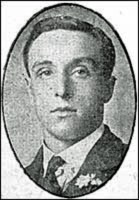
John was given the Regimental Number 5100 and by 8th December of the same year he was in France. He would first have been posted to one of the Base Camps near the coast of France, the largest being Étaples. From here he was posted to the 22nd Fusiliers just four days later.
He would have arrived at the front just after the terrible carnage of the Battle of the Somme when the war of attrition was halted more by fatigue and the coming of winter rather than any decisive victory.
In the following year the 22nd were involved in the smaller battle of Miraumont. It started on February 17th 1917 and was a disastrous one for the Allies. We get a glimpse of the, often futile, attempts to impose order on the chaos in this extract from The Royal Fusiliers in the Great War by H.C O’Neill. He was an officer at this battle and one can sense his frustration and anger at what occurred.
It had been freezing for months, and the ice and frozen snow in the broken trenches and “over the top” made the trek to the jumping-off position a trying and arduous task. A party of the battalion had a night or so previously spent time and patience in setting a tape to mark the line that was to be taken up at the start; but most of this was lost when the men arrived, tired and fed up, at about 11.30 p.m. on the night of the 16th. Most of the tape had been blown up by the enemy shells, and some trodden out of recognition.
It was not until the file of men bundled into a line of another regiment of the same brigade that the approximate position of our starting line was ascertained.
The Boche were ready for us*, for his barrage opened even before our own, and before our battalion had passed over our own front line – a weak line of scattered shell holes – there were great gaps torn in our waves.
Just over the second enemy line our “waves” became groups, and the steady advance appeared to be in artillery formation. The officers, many of whom were in an attack for the first time, did all they could to put matters right, and some of them managed to continue their advance on approximately the right bearing and in correct formation.
Presently the notorious “Boom Ravine” was encountered but we met with no further danger than a lurking German here and there who whiled his time away until he should be taken prisoner by sniping. After this point the battalion appeared to me to vanish, and instead one saw small parties here and there moving in varying directions.
*It was reported later that some British soldiers had deserted before the battle and given away the plan of attack to the Germans.
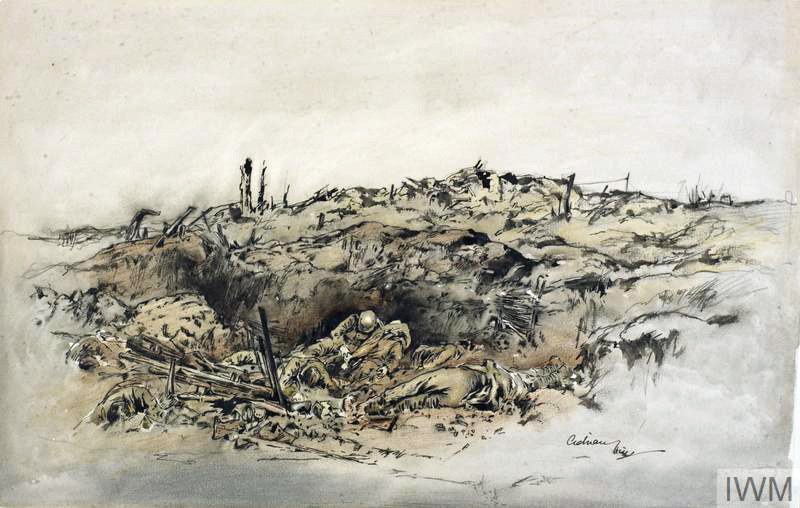
The 22nd suffered many casualties and men taken prisoner. John managed to come through but it must have been a terrifying, disorientating time for him. Sadly, it was when the soldiers were back in their defensive lines that John accidentally killed himself while cleaning his gun after the battle. His death was reported in this way to the local newspaper by a Private Burgess, a Northamptonshire man who was serving with John. We have no way of knowing if his death was just a mistake caused by fumbling fingers in the bitter cold or if a young shell-shocked man taking his own life rather than face another day of terror.
His death is commemorated on the Thiepval Memorial and on the Ringstead War Memorial. He was twenty years old.
Joseph Archer (1880-1966) and George Horace Archer (1881-1962)
We now turn to the cousins of Fred and John Herbert. Joseph and George Horace were the sons of Owen and Mary Ann Archer who had moved to Ringstead and all their children were born in the village. Joseph was born on 1st July 1879 and, in the 1881 Census, he was one year old and living with his parents in Ringstead High Street. In 1899 he married Florence Minnie Fox. Florence came from the large family of ten children of Joseph Fox, an army bootmaker and Dinah, his wife. In 1891 the Fox family were living in Carlow Street and Florence, aged fifteen, was a shoe closer.
By 1911 Joseph Archer, aged 30, was an “Army handsewn bootmaker” but was “out of work”. Joseph and Florence had two children, Joseph Edward, aged nine, and Florence Winnie, aged three. They were now living in Carlow in Ringstead.
At the beginning of the war the army relied on regular soldiers and volunteers but, despite opposition, conscription became necessary. At first Joseph, as an older, married man with children in a protected trade, would have not been considered but as the slaughter continued the need for replacements stretched the conscription net ever wider.
Meanwhile, his younger brother, George Horace, born on 7th November 1881. I realised that I had come across George Horace Archer before, when telling the stories of the headteachers of Ringstead Church of England School. In January 1893, the School Logbook records the arrival of a new, very young headmaster called Albert Crew who tried to impose his will on the older boys and events quickly spiralled out of control. George had refused to salute the headmaster as they left school and laughed at his action. He was called back but tried to run away. The Log Book continues:
He was brought back to the classroom, took the cane and broke it up.
Archer refused to receive any punishment and the master was compelled to resort to force. Archer lay on the ground and refused to get up. He was punished with a small cane, which was split halfway, as left by the late Headmaster. This cane has not and will not be used until after the 24th Inst.
The master had to use forcible means for administering punishment as the boys was extremely violent. After he was punished he (Archer) stood and returned the usual master salutation – with a salute of ‘Good morning, Sir’.
George’s mother, and older brother, William, then came to the school and a small fight ensued between William and Albert Crew. It all ended in an inconclusive court case a few months later and in May 1893 Albert Crew left the school.
After his school career, George went into the Army boot trade. In the 1911 Census, aged 22, he was the only child still at home with his widowed mother, Mary Ann. Nevertheless, it seems certain that he had a son aged four months old at the time of the Census with his girlfriend, Martha Hepsiba (Hepzibah) Knighton. The name of the boy was Horace Aubrey Archie Knighton and he had been born in Irthlingborough. One suspects that the names Horace and Archie are deliberate clues to his father. They had a second child born in 1913 who was called Fred.
I have not found that George was called to pay for the maintenance of his children but, in May 1913, he was ordered by the court to pay one shilling a week towards the upkeep of his own mother, Mary, who was chargeable to the Thrapston Union. In the following July, along with his brother Joseph, he was again summoned but the case was dropped when it emerged that they had both signed an agreement to pay the Union.
In 1916 George finally married Martha Hepzibah Knighton.
There are very few army records for either of the brothers but the Medal Rolls show that Joseph’s Regimental Number was 178107 and George’s 178297 so they were enlisted quite close together. Neither was entitled to the 1914 or 1914/15 Stars which confirms that they were conscripted in 1916 or 1917.
They both joined the 498th Siege Battery of the Royal Garrison Artillery (R.G.A.) as gunners. It seems likely that both brothers and cousin Fred joined at a similar time because their Regimental Numbers were Joseph 178107, George Horace 178207 and Fred 178148. Unlike Fred, however, who also joined the R.G.A. both Joseph and George fought in France and Germany.
The 498th Siege Battery would have consisted of a group of five officers and 177 other ranks with seventeen riding, six draught and eighty heavy draught horses. There were also three two-horse carts and ten four-horse wagons. There would have been also a supporting ammunition column and a headquarters brigade. The 498th had six-inch Howitzers.
We cannot be sure when the brothers first saw action but we know that the 498th Siege Battery was attached to the 4th Army of the Allies and in 1918, after another German offensive which was pushed back, the Allies launched what turned out to be a decisive counter-offensive, pushing the Germans to the Hindenburg Line.
There followed what was later called the Hundred Days Offensive for, after years of stalemate and attrition, the Allies began to move forward in a number of small successful actions. The Allied commanders were not aware just how weakened and dispirited the Germans had become. The 498th had the difficult task of keeping up with the advancing troops. The Germans did fight a number of rearguard actions but they were forced to abandon large amounts of equipment and supplies. Finally, at 11am on the 11th November 1918 the Armistice came into effect.
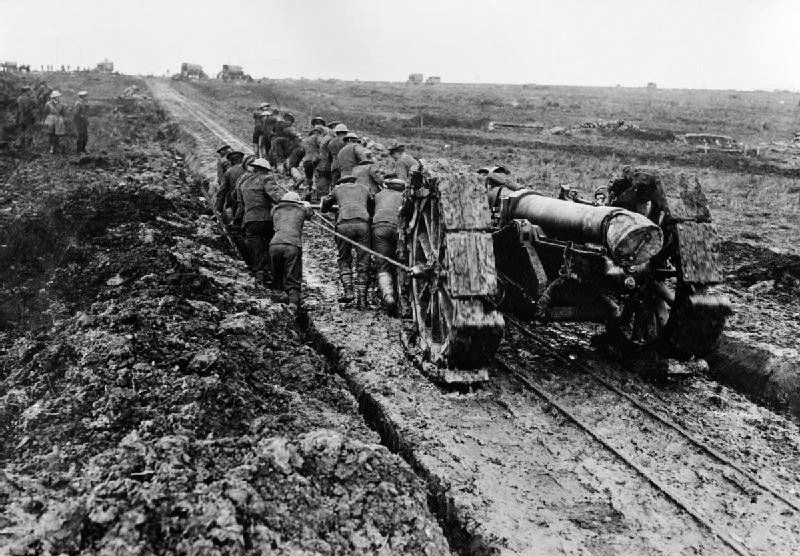
The 498th, as part of the Allied Fourth Army, rolled into the Rhineland and became an Army of Occupation. It was later considered by some historians that it was the shame of this prolonged occupation which created the fertile ground for the rise of Hitler and the Nazis.
After the war Joseph returned to Ringstead and we see in the 1939 Register for England and Wales that he and his wife, Florence were living in Ringstead High Street, two doors away from the Post Office. He had now become a road labourer, probably because there was not enough work in the army shoe trade anymore. Still living with them was their son Joseph E[dward] who was single, 37 years old and a riveter of army boots in a local factory.
On 12th August 1966, Joseph, of 32 High Street Ringstead, died and probate was granted to William Joseph Freeman, a retired road foreman. His estate was worth £2,206.
George, too, returned to live in Ringstead High Street, probably living at number 55. He remained a handsewn shoemaker although in the 1939 Register he was out of work. Martha was doing “unpaid domestic duties” and the three children were still living at home. Horace was doing “edge trimming and jointing” and Fred is “console lasting”, both in the shoe trade. Dorothy Ann, born after the war, on 21st April 1920 was a tailoress and there may be another child whose record is “closed”.
George died on 15th March 1962 and administration was granted to his wife, Martha Hepsibah with effects of £546. 10s. Martha died a few years later, on 29th February 1966 with administration granted to the oldest son, Horace Aubrey Archer, a shoe repairer.
Ralph Owen Ewart Archer (1899-1992)
George’s older brother, was William Archer, born in 1875. It was William who had fought with George’s headmaster when his younger brother had been caned. He married Florence Mayes in 1897and had one child, Ralph Owen Ewart Archer, born on 11th August 1899 in Ringstead. By 1911 William was 36 and a handsewn military boot maker, living with Florence (33) and “Ewart” who was 11 years old and their only child. They lived in Rosebery Street in a small housing estate that had been built on the east of the village. They had six rooms which would have been very spacious compared to most of the old Ringstead cottages.
It may be that Florence had an underlying illness for, in 1914 she died aged just 37. William remarried the following year (1915) to Lilian Georgina Home and, with Ralph, they moved to nearby Gladstone Street. It was here that Ralph was living when he signed his Short Service Attestation for the duration of the war on 2nd July 1917. He was just 17 years 11 months old and was placed on reserve. On 1st November 1917 the form was countersigned by the Lieutenant Colonel who commanded the Northamptonshire Regimental Depot in Northampton.
Ralph was just 5feet 5 inches tall with a 35¾ inch chest so he was small, but not particularly so, among the young recruits of the time. His Regimental Number was 47529. He became a private in the 4th Battalion of the Northamptonshire Regiment on 4th November 1917. It was not until 9th April of the following year that he sailed from Dover to Calais and was taken to the Base Depot. He finally joined his battalion at the front on 20th April and remained in France until 5th March 1919.
He seems to have moved between battalions of the Northamptonshires and on the Ringstead Roll of Honour for World War One, written in 1919 he is stated that he was in the 3rd Battalion. The 3rd, however, did not serve abroad and I think that it was with the 6th Battalion that he served in France; (his records are now very faded).
If this is correct it means that on his arrival at the Front on the 20th April 1918 he would have found himself in the Somme area and under attack from a German offensive. The 6th were part of sporadic fighting with heavy losses on both sides. On 8th August, however, although it was not clear initially, there began one hundred days of an almost uninterrupted Allied offensive. The static trench warfare of much of the war was replaced by a succession of successful assaults. By 18th September the Hindenburg Line was reached and quickly broken.
There was fierce fighting, however, and a number of V.C.’s were won by some heroic actions. But the push was now irresistible and the German army was finally broken. On 11th November 1918 the Armistice was signed and Germany defeated.
It is not clear, but it seems that Ralph suffered with an abscess on his right thigh on 27th October 1918. Was this the result of a wound or louse bite? The records do not tell us. He was first treated in the field hospital and then moved to No, 6 British Red Cross Hospital, known as the Liverpool Merchants’ Mobile Hospital. It had 252 beds and from September to December 1918 it was based at Trouville.
It may be that Ralph was invalided home at some point in early 1919 and joined the 4th Battalion. On 4th February 1919 he was in hospital again, this time suffering from the terrible “Spanish Flu” which killed more people than the War. He was, however, treated in this country, in the 2nd Eastern General Hospital in Brighton.
When he had recovered, Ralph was posted with the Northamptonshires, possibly with the 1st Battalion this time, to Ireland. This was not a soft non-combative posting, for the soldiers faced a largely hostile civilian population, and the IRA was in the middle of a campaign to kill British soldiers. It was also recorded that the Northamptonshires went on a rampage, setting fire to buildings, whenever a soldier or policeman was killed.
On September 8th 1919 he was examined at Templemore and signed to confirm that he had no disabilities caused by his army service. Ralph returned to England and on 9th October 1919 he was demobbed and place on the “Z” Reserve List for those who could be recalled if there was a resumption of hostilities. His military career was over. He was twenty years old.
Ralph married Doris Maud Sawford in the Spring of 1925 and the couple were living in Gladstone Street in the 1939 Register of England and Wales. Ralph was now a clicker in the shoe trade and Doris (also born in 1899) is a machinist. Living with them was Doris’s widowed mother, Florence Sawford. Not far from them in 1939, living in Denford Road, was father, William Archer, still doing handsewn boot work, and his second wife, Lilian. When William died on 8th May 1964 he was living at “The Bungalow” in Denford Road.
Like many people, Ralph did not move far from his birthplace apart from some eighteen months from 1918 to 1919 which probably marked him for the rest of his life. His wife Doris, died in 1982 aged 83, and Ralph was 92 when he died on 14th May 1992. At the time of his death was living at 9 Gladstone Street in RIngstead. It appears that they did not have any children so his wartime trauma must be remembered by others.