The Great War: A–M · Story 39
Victor Marshall Moon (1896-1916)
Victor Marshall Moon was not listed in the Ringstead Roll of Honour. The Moon family were constantly on the move and Ringstead was just a port of call in their travels. When war came they were living elsewhere. His father, George Thomas Moon was born in Finedon in 1873, son of furnace labourer, John Moon and wife Louisa. George did not follow his father’s trade but became a finisher in a shoe factory and on 17th September 1894 he married Esther Judge.
Esther was the daughter of Thomas Judge, a painter and glazier from Brackley and wife Martha who had been born in Radstone. In the 1881 Census the Judges were living in Kettering Road, Northampton. We see that it was another family that was always on the move. The children had been born in Waddington and Stone in Buckinghamshire and Brackley and Northampton in Northamptonshire.
Were the family of gypsy stock? Certainly the wandering life was to continue for the young couple. In the 1901 Census they are living in Westfields, Raunds and we can see from the birthplaces of the children that they had lived in Finedon, Ringstead, and Irthlingborough before Raunds. It was in Raunds that Esther lost her nine-month-old son, Ernest William, who died of “Convulsions” on 4th January 1905. The family were living in Francis Terrace at the time which is in the Westfields area. They were soon on the move again. The National School Admissions Register for Old in Northamptonshire show that thee children, Victor, Annie and Raymond, had been admitted to the local school on 1st March and Lewis on 26th April 1909. Previous to this, they had been at Walgrave School, just a few miles away. It also shows that they all left the school and the area on 7th June 1909, just three months later. The parent’s name was shown as Thomas Moon but the use of a second name was a common practice.
The family moved on again and in the 1911 Census were living in Wymington, just south of Rushden. We see that a new child, Rhoda Alice, had been born in Old in 1910 so the move to Wymington cannot have been long before the Census. There has been a major change in the family, however, because George Thomas Moon has disappeared and the head of the household is shown as Stanley Underwood, aged 46, and also born in Finedon like George.
The children attended the South End School in Rushden and the Admissions Register shows that a son, Lewis Arthur Moon, had started at the school on 6th November 1911. The person in the Guardian/Parent column is Esther Moon who was now living at 48 Crabb Street in Rushden. Surprisingly, for Elsie Rhoda Moon, who entered on 13th May 1912 the parent/guardian was shown as George Thomas Moon. Finally, there is another son called Herbert Stanley Underwood Moon, on 9th November 1914, and his parent/guardian was shown as Joseph Stanley Underwood of 48 Crabb Street.
It seems certain that [Joseph] Stanley Underwood was Esther’s new partner. Strangely, George Thomas Moon seems to disappear from the official records. Did he die, change his name, emigrate or take to the road where he went unrecorded. There are many George Moons in the records but none seem to match our man.
It is George and Esther’s son, Victor Marshall Moon, born on 9th September 1896, who we are concerned with in this biography. He probably finished his education at Old School in 1909 and, in 1911, was at Wymington with his mother and her new partner. In the period soon after the Census he probably moved with his family to 48 Crabb Street in Rushden and started work at Knights, a large Rushden boot manufacturer.
Whether it was the upheaval in his family, or a need to find a more exciting career, he joined the army before the war. In March 1913 he, along with a few shoe workers, had been summoned for gaming with cards at Rushden. Card playing in all forms was extremely popular with the shoemakers, and gambling was also prevalent. He was fined 10s. 6d. including costs. Was his enlistment a way of getting away from bad company? Whatever the reason he enlisted with the Northamptonshire Regiment at Northampton, probably later that year and was given Regimental Number 9745
Although most of Victor’s military records have been destroyed we do have a great insight into his time in the trenches from articles in the Rushden and Wellingborough newspapers. These have been transcribed by Nicky Bates and posted on the Rushden Heritage website and I would recommend that anyone interested should read the full account.
The 1st Battalion of the Northamptonshire Regiment, at the beginning of the war, was stationed at Dettingen Barracks at Blackdown, a “suburb” of the large Aldershot Camp. The Regimental History describes it as a “collection of huts erected at the South African War”. It was after this war that the British Army had been re-organised and an “Expeditionary Force” had been formed. This had some 160,000 men divided into six Divisions with a Cavalry Division and “line of communication” troops. Every Division consisted of three Infantry Brigades, each of four Battalions and had 76 guns and a quota of cavalry, engineers etc. The 1st Northamptonshire Regiment was in the 2nd Brigade of the 1st Division. It all seemed a great improvement, and it was far better than the mass of individual units with their own organisation that had gone before. Unfortunately, the Great War was also different to anything that had gone before and the army nearly cracked under the strain.
There were delays between Victor’s letters to his mother, and their publication so it is sometimes difficult to be sure of dates or even months. As we have seen the 1st Northamptonshires were in Aldershot but, in a letter home, Victor wrote in late September or early October 1914 that he was billeted with E Company in Weymouth and was having “a fine time by the sea”. Now the 8th (Reserve) Battalion of the Northamptonshire Regiment was formed in Weymouth in October 1914. It may be that he was in training with the 8th when the 1St Battalion embarked for France on 12th August and so missed the chaotic retreat after the Battle of Mons and also the Battle of the Marne.
The minimum age for joining the Regular Army was eighteen, although, theoretically you needed to be nineteen before being sent abroad for foreign service. Many recruits did not have birth certificates and usually their age was taken as told to the recruiting officer. The youngest soldier known to have fought in the First World War was twelve years old.
Soon after he had written home, he had been ordered to the Western Front and joined the 1st Battalion in a position a few miles from Le Bassee on 12th November 1914. He later told a Rushden Echo “representative” in the bullish language of a new recruit.
This was my first experiences of war in any shape. . . It was night when we got to the firing line, and you could hardly realise what all the confused noises meant. A burning haystack near to us showed the enemies our movements. Bullets kept coming ‘ping, ping’ all around us. A few yards at a time we progressed, one lot laying down firing while the others ran a short distance with bayonets ready to stick any German that came near enough. In this way we eventually got to the trenches we were aiming at. . .
. . . The following morning, the trenches we had won were lost to the Germans, who stormed them too hotly for us. Some of the trenches were so full of water that it came up nearly to your neck!
He told how he had seen a body badly mutilated and how it had affected him badly. He continued:
But since then I have seen thousands of bodies similarly mutilated, and they do not affect me quite so much. One can get used to sights even as bad as that in time. I have known bodies to lie for three weeks before it was possible to bury them.
It seems that the interview with Victor took place when he was in hospital or recuperating in England after he had been wounded in the head. The report date was 3rd February 1915 although the actual wound may have happened earlier. It seems now, perhaps from his mother, that it had been discovered that he was not yet nineteen years old. He would have reached the necessary age on 9th September 1915 but did not return to France until November.
The 1st Northamptonshires had fought in the inconclusive Battle of Loos which took place from 25th September to 8th October 1915 on the Western Front. It was the biggest British attack of 1915 and the first time that the British used poison gas and also the first mass engagement of the “New Army” units.
It was not a success and no breakthrough was achieved. The 1st lost ten 0fficers and 362 Other Ranks during the action. The Battalion was then not in any major battle until the summer of 1916. Victor was not to see the summer because, on 8th or 9th April 1916, he was seriously wounded in the abdomen, back, head and arm. After the battle the Northamptonshires were in billets in Les Brebis, a mining village, about eight miles south-east of Bethune, before moving up as a Reserve Battalion behind the Front Line at Loos. The War Diary tells of the 8th April:
Quiet day – Relieved 2/KRRC in front line. Signallers Adv[ance] Parties, Lewis Gunners, and Crater Parties at 3 P.M. C1 move 7.15 pm. Relief completed about 10 p.m. 2/Lt G.H. Crawford was killed in front of HART’s CRATER by a fragment of shell.
No sign of anyone else being injured, but Other Ranks rarely reached the War Diaries, except as occasional statistics.
There was, however, more activity the following day so I think that the 8th is a typing error and he probably died on the 9th as the official records show. The War Diary for the 9th April records:
Enemy active with rifle grenades. Capt. MARTIN of the right company wounded in the head by a fragment of one. We retaliate with Trench Mortars. . .
. . . About 10.30 am a small party of Bombers went into SEAFORTH SAP beyond our barrier and got under the near lip of Rifleman’s Crater. From there they threw bombs into the crater. Then Pte. Neville crawled up the lip and looked into the crater. He saw 6 dead Germans but no live ones. No defensive works but three holes supported by wooden frames. Possibly entrances to dug-outs. The party then returned to our barrier in the Sap.
It seems likely that somewhere in this activity that Victor was badly wounded. He was taken to the 33rd Casualty Clearing Station, which would probably have been a tented area behind the line with a basic operating theatre. It was from there that the Chaplain wrote to Victor’s mother that his condition was critical. It was probably obvious that he was not going to survive. According to another Northamptonshire soldier, H.J. Partridge, Victor had been wounded in the morning and died that same night and he did not think “that he suffered much”. The Chaplain gave the time of death as 8pm and told Esther that:
He sent you his love and said you were not to fret over him.
It may have been so, but if it was otherwise, who would tell a grieving mother?
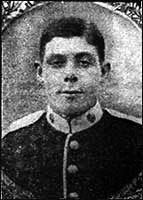
We see in the photograph and in his interview and letters that he was an optimistic, cheerful young man, much loved by his mother. Many thousands like him were buried in the cemeteries of France or still lie strewn under the fields of France and Belgium. He was buried the day after his death at the Bethune Town Cemetery, Pas de Calais, Grave III. G.47. He was entitled to the 1914 Star and British War and Victory Medals.
In Rushden, as we see today by roadsides after traffic deaths, shrines were erected to the dead in various streets. Crabb Street had its own, with flowers and Union Jacks, which, in March 1917, had the names of six young men including Victor Moon.
After her early travels, Esther had now settled and, in 1939, she was still living at 48 Crabb Street. She died in July 1956.