The Great War: N–Z · Story 8
Walter Shedrick Pitts (1890-1966)
John William Pitts was born in Tansor on 13th December 1863. His background was a little complicated but, looking at the 1871 Census, he appears to have been the son of Mary Pitts before she married Thomas Upex on the 25th September 1865. In that Census, Thomas and Mary were living with her father, James Pitts, in Tansor.
John William seems to have been missed by the 1881 Census officers but this was not unusual for young men “on the tramp” for work. We next catch up with him when he married Theodosia Atkins in the Oundle District in the second quarter of 1884. Theodosia can also be a little difficult to follow through the records mainly because of the many versions of her Christian name. She can be Theodicia or Dosia or even Doshe. She was the daughter of William, a labourer from Elton in Huntingdonshire, and his wife Sarah Atkins.
Theodosia had had a child called John William P. Atkins before her marriage. It seems very likely that the “P” was for Pitts and, looking at the names, that he was John William’s child, and he does eventually take the Pitts surname. In 1891 the family were living in Ringstead and there were three children. John William, the father, was a platelayer, working for the London & North Western Railway Company, based at Thrapston. Walter Shedrick, and it is usually this spelling rather than Shadrick or Shadrack, was just five months old.
By 1911 John was still a platelayer, and he and Theodosia had been married 27 years and had three children, all still living. Walter was now twenty years old and working as a shoe greaser, doing government contract work in a local factory. Theodosia died the following year.
The Great War came in 1914, but like many others, Walter did not volunteer but carried on with his family life. On the 3rd April 1915 he married Mary Ann Hales. She was the daughter of farm labourer, John Hales and his wife, Emily, and in 1901 the family was living in Titchmarsh. By 1911, Mary Ann had become a domestic servant in Rockingham Road, Kettering. We do not know how Walter and Mary Ann’s paths crossed but obviously they did. They had a daughter, Ivy May, born on 14th January 1916.
The young family set up home in Carlow Road in Ringstead, with John William Pitts, Walter’s widowed father.
Walter was conscripted but, initially, was posted to the “C” Company of the 84th Training Reserve Battalion with Service Number T.R./5/59511. He was given a further medical examination at Northampton on 23rd November 1916. He was 5ft 8 inches tall with a 34½inch chest and a weight of 134 lbs. (9st 8lbs or 60.8 kilos). He occupation seems to have been given as just “shoe”, but I believe that he was a labourer within the shoe trade rather than a craftsman.
He appears to be a reasonable candidate for active service but when we look at his other medical details, we see that he had poor eyesight (6/18 in both eyes) and deafness in both ears. He would have been a danger to himself and others in a warzone.
In June 1913 there was an Army Council Instruction which transferred the Agricultural Companies to the Labour Corps. On 18th June 1917 Walter was transferred to the 436th Agricultural Company of the Labour Corps, based at Northampton, and given a new Service Number, 495750. He took with him to his new unit a list of the army clothing and other items which helps give a picture of the non-combative soldier’s pack. The items that he had were: 2 pairs ankle boots ; 1 service dress cap; 2 pairs of drawers; 1 D.M. {drab mixture] greatcoat; 2 service dress jackets; 1 pair of putties; 2 pairs service dress trousers; 1 cardigan; 1 each of cap badge, kit bag, pair braces, brass button, brass, blacking, clothes, hair, polishing, shaving, tooth, brushes; 1 fork; 1 holdall [like a cloth tool roll]; 1 housewife [sewing kit]; 1 knife; 3 flannel shirts; 3 pairs of worsted socks; 1 spoon; 2 hand towels; 1 razor.
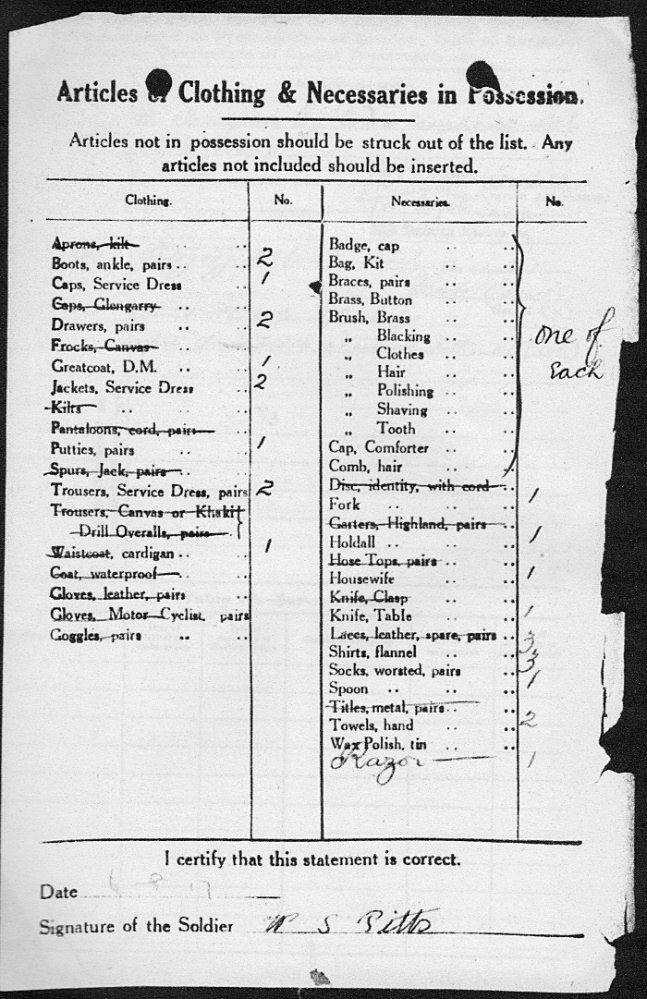
The Agricultural Companies were not a “formed” unit. The 436th had a small headquarters section in Northampton but the men would have either lived at home or were billeted near the farm where they worked. The farmer would be charged for their services.
The shortage of men to work on the farms had become acute. Besides the need to feed the nation there was a huge army and its animals abroad. Philip Wilson, in March 2013, on the Great War Forum pointed out that, besides ammunition at 56,000 tons a week that was shipped out to the Western Front, the second highest weekly tonnage was forage at 35,970 tons. This would have consisted largely of hay straw and oats for the horses and mules.
On 3rd April 1918 Walter was examined again and reported to have “chronic middle ear catarrh” and given medical category BII (two). He would never serve in a fighting capacity and he was sent to the Dispersal Unit at Purfleet and demobilised on 23rd January 1919.
He returned to Carlow Road where he, and his wife May Ann and their children continued to live with Walter’s widowed father, John William Pitts. Walter now had the vote and appeared on the Electoral Register, but Mary Ann did not qualify, and it was not until the 1928 Representation of the People (Equal Franchise) Act that she was able to vote. The couple had at least three more children after Ivy: Walter Richard had been born on 30th October 1917; John in 1921 and Leslie in 1924.
It would not have been an easy life and Walter was charged with petty theft. In the Northampton Mercury of 22nd January 1926 there is a report of a local court case:
Walter Shedrick Pitts, a labourer, living with his father at Ringstead was charged with breaking and entering, in the day time, the dwelling house of Alfred Reeder, and stealing a metal watch, value 7s. and a pair of leggings value 7s. 6d. at Ringstead on the 15th January. Sergt. Johnson stated that when he saw prisoner at Ringstead, prisoner at first denied knowledge of the matter, but eventually said he did go to Reeder’s house and took the watch and leggings. Prisoner produced the watch from a tin in a barn, and the leggings from a barn adjoining. – Prisoner was remanded and told that if he could provide a surety he would be liberated on bail.
Jon Abbott, on the Ringstead Heritage website has told how, in 1927, Ringstead had its first electricity sub-station built in Church Street near the junction with Carlow Road. Although they were living in one of the first houses which had a potential electricity supply laid to it, John William Pitts refused to have it turned on and the family continued to rely on oil lamps.
By the 1939 Register of England and Wales, John William had retired and Walter was now a roadman with the County Council. His date of birth is shown as the 18th October 1891 but I think that this should be 1890 (and, in one of his military records, it is 1889).
Walter’s eldest son, also Walter, married Edith Saddington in 1940. In October 1943 Walter Shedrick Pitts was once again in the newspapers because of a court case. He had stolen £30 in notes from his son’s father-in-law Samuel Saddington, who was a smallholder and dairyman in Raunds. Samuel put in a plea for Walter, stating that he must have been desperate and at the time had yielded to sudden temptation. He also said that “during the last three years his troubles have been excessive”.
We do not know all of Walter’s troubles but his father had broken his thigh not long before this case. In the following year his youngest son, Leslie, was killed while fighting in Western Europe. What other troubles had assailed the couple?
Walter died on 8th November 1966 and Mary Ann, aged 87, died some ten years later, on July 4th 1976. She was living at 6 Greenbank Terrace in Ringstead at the time of her death.