The Great War: A–M · Story 17
Cyril Cottingham (1898-1981)
The Cottinghams were a family with aspirations. They were Nonconformists who originally came from Thorpe Achurch in the eighteenth century. In the family tree were men like William Frost Cottingham, a Baptist missionary who died within weeks of reaching Africa and Edwin Turner Cottingham who became a clockmaker in Thrapston and took part in an expedition to help prove Einstein’s Theory of Relativity.
Cyril’s father, Ernest Cottingham, with a friend, cycled to London and back in 1891 to set a local record. Ernest married Sarah Daisy Braine in 1897. He was a handsewn shoemaker by trade who became the Assistant Overseer for the area.
Ernest and Sarah had two sons, Cyril and Edward, and in 1911 they were together, living at 7 Spencer Street, in Ringstead, part of the Tilcroft new estate. Cyril was aged twelve and still at school, but also earning money as a “milk boy”, probably helping with the delivery of milk around the village in the early morning.
Much of Cyril’s Service Record has been lost, probably in the Second World War bombing of the Record Office. When war was declared in August 1914, Cyril was only sixteen year’s old. His medal card does survive and from that we know that he was not entitled to the 1914 or 1914/15 Star, so it seems likely that he was part of the conscripted army which started in 1916. He only became eighteen on 24th June 1916 so it seems certain that he did not join up until the Summer of 1916 at the earliest.
When he enlisted, it was with the First Battalion of the Queen’s (Royal West Surrey) Regiment. The Royal West Surrey was a regiment to which a number of local men were posted. The First Battalion was, at first, a Regular Army battalion made up of career soldiers, but the war had destroyed much of the professional army and it had to be made up again from the new volunteers and conscripts.
Cyril had a particularly active and distinguished army career. We know that he won the Military Medal and Bar and from this, and the Battalion’s War Diaries, we can get some idea of his time at the Front. He was “gazetted” (listed in the London Gazette), on 14th December 1917. It was the norm for these to appear some months after the action for which the medal had been awarded which would place it in September 1917.
When we look at the War Diary for the 1st Battalion we find that the Queen’s spent the whole of July 1917 in billets in Picquigny engaged in training but then received orders to march to Longpre and travelled on by train through Abbeville and along the coast through Etaples, Boulogne and Calais and finally to Dunkirk. From there they marched some eight miles, to Ghyvelde on the Belgian border.
After the Battle of Arras the Allied High Command turned their attention to the area north of Ypres in another attempt to make a conclusive break through the German Front Line. On August 14th the 1st Battalion moved up to the front but were caught in a devastating barrage on the way there. In September it moved back to training ready to move to Dickerbesch to take part in the Third Battle of Ypres which had begun on 31st July 1917.
This campaign, often remembered by the evocative name of Passchendaele, was a series of actions, which carried on into November, to try to control the ridges south-east of Ypres. The Allies had planned a major offensive in great detail, trying to avoid the mistakes of the past. At first it was successful although at the cost of great loss of life on both sides. As was usually the case the advantage was with the defenders and the attack faltered and the Germans counter-attacked.
What really bogged down the campaign was the terrible weather in Flanders. In one of the worst summers in living memory some five inches of rain fell in August, with little sunshine to help dry the sodden ground. Writing of the Flanders front in August 1917, Lieutenant General Sir Hubert Gough stated:
The state of the ground was by this time frightful. The labour of bringing up supplies and ammunition, of moving or firing the guns, which often sunk up to their axles, was a fearful strain on the officers and men, even during the daily task of maintaining the battle front. When it came to the advance of the infantry for an attack across the water-logged shell holes, movement was so slow and so fatiguing that only the shortest advances could be contemplated.
[Quoted by Peter Hart in “The Great War”]
As usual, offensive was met by counter-offensive, and it was in one of these see-saw actions that Cyril Cottingham distinguished himself. The British had a planned attack for the 26th September but either from captured soldiers or other espionage, the Germans had gained knowledge of this. On the previous day, the 25th September, at 3.30 in the morning the enemy opened up an artillery barrage greater than anything seen before in the war. It not only targeted the Front Line trenches but also carpeted the supply area behind so that it was impossible to move transport or troops up to the forward positions.
Following the barrage, the Germans attacked in a massed formation. Parts of the 1st Battalion of the Queen’s were overwhelmed. The enemy were described as:
“. . . debouching from the village of Ghelavelt armed with flame throwers, the stream of burning oil thrown from those devilish weapons reached a length and height of 100 yards and set fire to the trees, which being as dry as tinder, immediately took fire.
The bombardment lasted all day and the following night. The two Front Line companies of the 1st Battalion lost all their officers and most of their men. Many were never found in the deep mud-filled holes.
The British attack of the 26th was ordered to go ahead, even though the Division, (of which the 1st Battalion was a part), had suffered some 5000 casualties. The remains of the Division, reinforced by other Brigades, swept forward and made some limited progress.
In the midst of this mud and slaughter, Cyril Cottingham acted with bravery, beyond the normal resolution needed just to exist in this hell and was recommended to receive the Military Medal. This decoration had been instituted on March 25th 1916, (although made retrospective to 1914), for other ranks, including non-commissioned officers, to mirror the Military Cross for officers. There was also had a small gratuity attached to the award.
It was reported in the Appendix to the October 1916 section of the 1st Battalion’s War Diary that Cyril, along with twenty-one other men had been awarded the Military Medal for their heroism in the actions of the 25th and 26th September.
Of course, the Passchendaele Campaign lumbered on but, in early October, the 1st Battalion of the Royal West Surrey Regiment moved to Wizernes and then by train to Bailleul and from there marched to “Aldershot Camp” near Neuve Eglise. In early November they once more moved up to the Front Line to relieve the Canadians on the Passchendaele Salient.
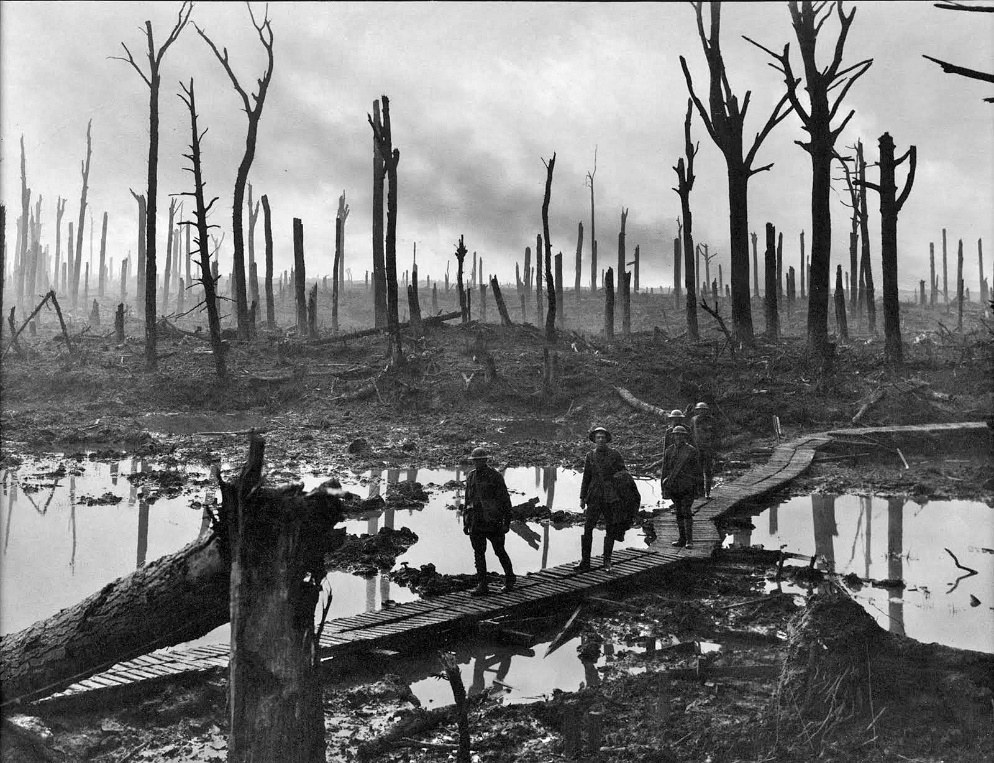
Conditions had worsened. The local stream, the Revibeeke had overflowed its banks and shell holes filled with water and a single, constantly shelled, duckboard track was the only pathway to the front line. The horror of men being sucked into this quagmire has been often told. It was this mire that brought the 1917 campaign to a standstill although there were still sporadic actions and artillery fire.
It was in this final phase, continuing into the new year, that Cyril won the bar to his Military Medal for his bravery under fire. He was gazetted on 12th March 1918 but the award was for his actions in early November 1917.
Cyril, now a Lance Corporal, was part of two raiding parties sent out to find out more about the Germans opposing them and also to kill as many as possible. In all the chaos, it is easy to believe that these actions were ill-prepared, but this was rarely true although it sometimes was possible that, because of all the detailed preparations, the High Command went ahead with actions, even though conditions had adversely changed. A section from the final orders for the raid attached to the War Diary will give some idea of the detailed planning.
Zero will be 2.15 am 11th inst.
Raiding Party will be in allotted positions at 1.30 a.m.
On conclusion of raid, party will return to Bn: Reserve Trenches.
Gaps in our own wire at “P” and “Q” will be cut by 12.30 a.m. by “D” and “B” Company and will be mended by “D” and “B” Companies respectively as soon as possible after completion of the raid.
Company Sergeant Major of “A” Company will be at point “P” and Company Sergeant of “B” Company at point “Q” for the purpose of checking number of men returning by name.
Very Lights will be fired by Units on our flanks as well as by “D” “B” and “C” Companies from Zero Hour plus 3 minutes to Zero plus 15 minutes.
Stokes Mortars will fire at a medium rate of fire from Zero minus 1 minute to Zero hour on the enemy’s front line trench between B and D, at zero they will fire at selected targets.
At Zero plus 20 two buglers will sound a succession of high “G’s” as a signal from withdrawal. The bugler will be with O.C. “A” Company the other at point “Q”.
Hot tea will be taken to all Companies, leaving BETHLEHEM FARM at 4.0 a.m. 11th inst. A half issue of rum will be mixed with the tea for Raiding party and a half issue will be served out on return to Battalion Head Quarters.
Unfortunately, the reality often quickly turned all the careful planning to mud. There was also attached to the War Diary a report of the raids. The “Left Party” found the barbed wire was uncut and they could not reach the enemy trenches but gave and received fire so that four were wounded. The “Right Party” did make their target and it seems likely that Cyril was part of this raiding group. The report graphically describes their experience:
Right Party encountered no opposition and no machine gun fire. Found gap about 10 yards wide and first four men got into trench and a group of Germans got out behind their trench and started bombing and shooting, except one who was taken prisoner. In the trench. Of the others in this group one was shot by Sergeant HAYES, one killed by 2nd Lieutenant PARKES with a revolver, one was bayonetted and a fourth shot. The trench was waist deep in water and impossible to work along it – one man had to be pulled out, leaving his gum-boots behind. No sign of other Germans and being unable to get along this party returned. No casualties with this party. Our artillery was bursting well just beyond the enemy trench and barrage on right was very good, about forty yards clear of the party.
There was no artillery retaliation except for a few Trench Mortars and no rifle or Machine Gun fire on the return.
Our Very lights worked well and greatly assisted the party.
Both parties worked their way back by tapes laid out as they went, which were then pulled in.
Report on Raid of Night of 10/11th November [Some shortened names given in full]
The Battalion’s War Diary records that Lance Corporal C. Cottingham received a bar to his military medal for his gallantry in this action and five other men received the Military Medal.
Cyril’s war was far from over because the Royal West Surrey’s 1st Battalion continued to see much of the action in 1918, the last year of the war. The battle season opened with a great Spring offensive by the Germans against the fragile British Front Line, designed to drive a wedge between the British and French forces and win the war before the Americans could tip the balance of power firmly in the Allies’ Favour.
The “Michael Offensive” was fought over much of the wilderness left by the Battle of the Somme in 1916. The Germans started, as in 1914, by forcing the British to retreat and capturing territory. The 1st Battalion were in the Battles of Messines (10th – 11th April), Hazebrouck (12th – 13th April), Bailleul (13th – 15th April) and Kemmel Ridge (17th – 19th April).
By the 29th April the Germans had made great advances and continued to advance but also suffered heavy casualties and were running out of men and supplies. In this terrible arm wrestle, the Germans appeared to have the upper hand, but the energy slowly drained from them, and when the Allies once more applied pressure the enemy were broken. After the trench war stalemate the Hundred Days Offensive saw the Allies drive rapidly to victory. The fortified Hindenberg Line was breached and the Germans were rolled back until the signing of the Armistice on 11th November 1918.
It was a hard-won victory, however, for the soldiers on the ground. The Battle of the St. Quentin Canal ran from the 29th September to the 2nd October 1918. In this offensive the British managed to cross and secure one of the few bridges across the canal allowing the Allies to surge over and overwhelm the Germans, taking some 5,000 prisoners.
Nevertheless, there was still great loss of life on both sides and it was not an easy victory for the Royal West Surreys, because the use of various types of poison gas had become part of the armoury of both sides. It was not a great killer of men, but it created an atmosphere of constant fear. Yellow-green Chlorine Gas was the first gas used, by the Germans, on 22nd April 1915 but Phosgene followed, which was six times more deadly and being colourless could give a fatal dose without the soldier being aware. The victim’s lungs would fill with fluid and they would suffocate in an agonising death. Finally, Mustard Gas, first used by the Germans in July 1917, was used more in the final years of the war. It caused painful blistering and temporary blindness.
On 1st October 1918, Cyril Cottingham was taken to Number 3 Casualty Clearing Station Hospital suffering from the effects of gas poisoning. He was immediately transferred to the Sick Convoy and spent 33 days in hospital so that it is unlikely that he would have re-joined his battalion until the time of the Armistice.
Cyril’s fighting days were over after a short but distinguished army career. He had one last affliction to face, when he went down with an illness that took the lives of more people than even the Great War. The epidemic of the “Spanish Flu” found a home in the exhausted soldiers of the Western Front. Cyril reported sick with this influenza on 27th November 1918.
Eventually, he was demobbed and returned home to Ringstead. He was entitled to the British and Victory Medals as well as his gallantry awards of the Military Medal and Bar. Some 80,000 Military Medals were awarded during the Great War but far fewer received the Bar which was a second medal award. It seems rather sad that his bravery does not seem to have been really appreciated in the Northampton Mercury.
Cyril appears to have returned quietly home and became a labourer on the Midland Railway at Thrapston. He was still living in Ringstead as he remained on the Electoral Roll until 1925, although probably leaving the area the previous year. He had joined the National Union of Railwaymen on 19th April 1919 when he was still only twenty years old. He transferred to Staveley, near Chesterfield, in Derbyshire and joined the local branch there on 16th November 1924 as a porter.
When he married Edith Annie Houghton, some three years his senior, on 14th June 1925, at the Independent Wesleyan Church in Rushden, he was living at 12 Wharf Lane in Staveley. By the time of the 1939 Register of England and Wales he had moved within Staveley to 10 Bond Street. Although not all the family have been “unlocked” for public viewing, it looks as if the couple have two children still at home. Cyril died on 11th July 1981, aged 83. He was living at the time at 74 Fern Avenue in Staveley. Did his second home for nearly sixty years appreciate the quiet hero that they had in their midst.