The Great War: A–M · Story 10
Stuart Dimbleby Bates (1891-1971)
Stuart Bates was the son of John Bates, a well-respected Baptist Minister in Ringstead for 32 years. John had previously been the Minister at Kislingbury where Stuart had been born on 17th November 1891. He was given the middle name Dimbleby after his mother’s family for she had been born Rebecca Jane (but also known as Jennie) Dimbleby.
In 1911 the Bates family were in “The Manse” in Ringstead. Living in the eight-room house with John and Rebecca were two grown up daughters, Beatrice and Ethel who were both school teachers and Stuart who was nineteen years old and working in a local butcher’s shop.
When the Great War started, there was initially no conscription, although plenty of exhortation from local bigwigs. On 29th June 1915 Stuart enlisted at Thrapston. He was 23 years 7 months old, 5ft 10½ inches tall with a 36-inch chest. When we look through his military records we see that Stuart seems torn between his desire to “do his duty” and his beliefs. We see this clearly in a letter sent by the officer in charge of records for the Army Veterinary Corps, (A.V.C.) to the Recruiting Officer at Thrapston. It states briefly:
As this man refuses to enlist into the infantry, rather than lose his service, I will accept him for enlistment into the army veterinary corps.
It was received at Thrapston on 28th June 1915. Some six months later, when conscription came in, he would have been seen as a conscientious objector but in June he was a volunteer and did not need to enlist in any capacity.
After joining the A.V.C. he remained on duty in England as a horsekeeper or 111 days but was then posted to the Mediterranean Expeditionary Force. We know from the Ringstead Roll of Honour that Stuart first went to Egypt where the first main task for the British troops was the protection of the Suez Canal. His Medal Card shows that the code of the initial Theatre of War that he entered was “4a”, which, after January 1916, referred to Egypt. Before this date it referred to British East Africa, but I suspect this is a not an unknown mistake in writing up the cards.
In Egypt the A.V.C. would have cared for the mules and horses and there were a number of specialist hospitals for treating camels.
At some point Stuart was posted to Salonika and, in all he was in the eastern Mediterranean for 2 years 93 days.
The ailing Austro-Hungarian Empire was allied with Germany in the Great War. The Serbians had been at war with the Austro-Hungarians and had achieved some success. At the start of the war, however, the Germans decided to shore up its allies against the Serbs. It became clear that, if the Allies did not intervene, the Bulgarians would take advantage of the situation. On 14th October Bulgaria had allied itself with the Central Powers and attacked Serbia.
The only practicable base for the Allies to use was the Greek port of Salonika, even though Greece itself tried to remain neutral. They bullied the Greeks into acceptance of this intervention. The first Allied troops had begun to disembark at Salonika on 5th October 1915. They then advanced to support Serbia but it was already too late and some 250,000 Serbian troops were rescued by the Royal Navy and evacuated to the Greek island of Corfu. The British and French fell back to a line just inside the Greek border and this “Salonika Front” became static and, despite a failed Allied attack in early 1917 the stalemate continued until the Autumn of 1918.
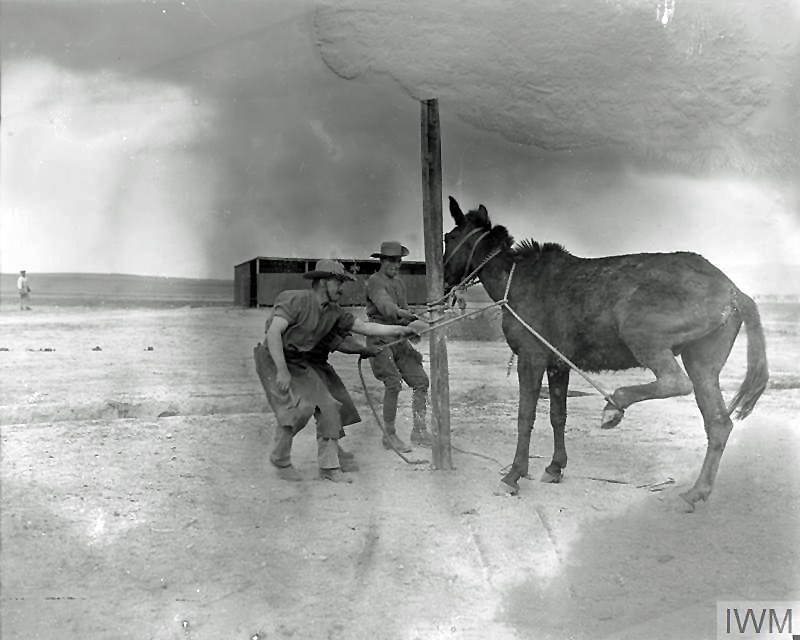
Stuart’s role, as part of the A.V.C. would have been the care of the horses and mules that were the main means of supplying the troops through the difficult terrain to the Front Line. We know that at some point in his army career that Stuart was stricken with malaria and it seems most likely that it was during his service in Greece. The area was full of stagnant pools and was blisteringly hot in Summer. As a result, it was one of the worst areas in Europe for malaria. Added to this, the poor sanitary arrangements led to Enteric Fever and Dysentery being almost endemic among the troops.
During the campaign the British forces lost 23,787 casualties in combat, but there were 162,517 cases of malaria and, in total, 505,024 non-battle casualties.
Despite having this illness, which was debilitating, with the symptoms often recurring at intervals, Stuart seems to have worked well and on 26th July he was appointed a Lance Corporal and then, on the 28th November 1917, a Lance Sergeant. The use of this last rank varied in the Regiments but usually meant a sergeant who could be demoted by his commanding officer and not only by court martial as was the case with a normal Sergeant.
On 18th January 1918 he embarked at Salonika and disembarked three days later at Taranto in Italy. He remained in Italy for 58 days, excluding a 16 day “Overseas Furlough” that he received from 20th March to 4th April 1918. At the start of the Great War the Italians had withdrawn from their agreed alliance with the Central Powers and fought on the Allied side.
On the 19th April 1918 there was a sudden and unexplained change in Stuart’s army career. A Statement of Service records that he was “compulsorily transferred to the Northumberland Fusiliers 1/5th Battalion”, but he retained his Lance Sergeant rank and pay. His regimental number now changed to 73010. The problem is that the 5th Battalion of the Northumberland Fusiliers were fighting on the Western Front in Belgium during all of 1918.
Stuart finally left Italy, and was in France from 15th July 1918. On 29th August 1918 he was again transferred to the 2nd Battalion of the South Staffordshire Regiment. I can only presume that he was put on the strength of the Northumberland Fusiliers but his move to France was delayed.
It is unclear just what Stuart’s engagements were, but we do know that he had arrived in France just as the tide was turning in the Allies’ favour. The German Spring Offensive, although it forced a large Allied retreat, so weakened the Germans that when a counter attack came their resistance finally crumbled. In what is usually known as the Hundred Days’ Offensive the Allies, for the first time in the war moved forward rapidly and the static trench stalemates were broken. Nevertheless, it was often a hard progress that cost many Allied, as well as German, lives.
On the day of the Armistice, 11th November 1918, the 2nd Battalion of the South Staffs were at Amfroipret, north of the Foret de Mormal and East-North-East of Cambrai.
Stuart remained in France until 21st March 1919, when he had been there some 250 days. He arrived back in England on 22nd March and was finally demobilised on the 19th April 1919. He was declared to have a 20% disability because of the effects of the Malaria and received a pension of eight shillings a week from 13th February 1920 until 22nd March 1921. He was awarded the 1914/15 Star and the British and Victory Medals.
On returning to civilian life in Ringstead, Stuart married local girl Ivy Elizabeth Adams in 1920. At first the couple lived in Denford Road, possibly with Ivy’s parents in “Fernlea”. His mother died in 1924 aged 71 and his father, John died in 1928, his funeral attended by very large crowds.
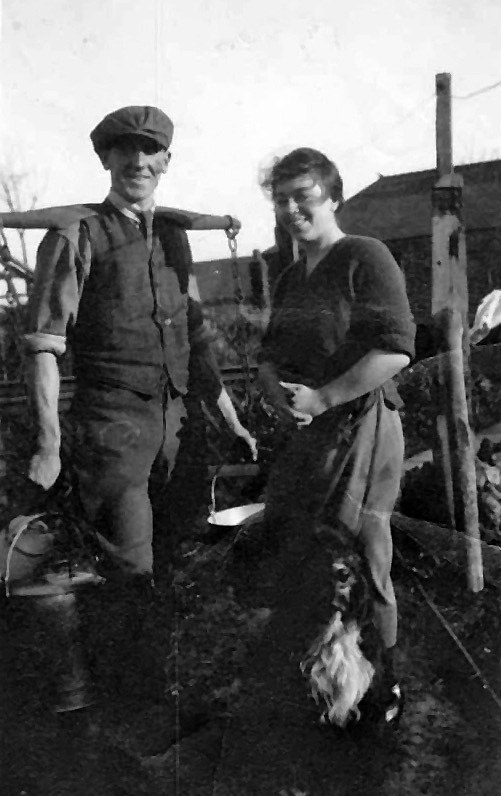
In 1931 Stuart and Ivy moved to Yew Tree Farm in the High Street and, on 8th May 1932, their only child, Janet, was born. They had become farmers and, in the 3rd February 1933 edition of the Northampton Mercury, we see an advertisement for eggs and chicks of the “Noted Light and White Sussex hens” which we are told are “All Blood Tested Stock Selected for Type and Stamina”. It was the dairy herd that became the mainstay of the farm and they sold milk around the village from churns which they ladled into the customers’ jugs. A few older villagers still remember that Ivy sold home-made ice-cream at the back door of Yew Tree Farm and that airmen from USAF Chelveston were appreciative customers.
In 1939 the couple were living at the farm with daughter Jane and “hirehand” Winifred Jessie Walker who had been born in 1898. They are also said to have had an evacuee living with them during the war. Stuart was shown as a farmer and Ivy has the usual “Unpaid Domestic Duties” but she was known in the family as a dressmaker (as well as the ice cream making). A small farmer’s wife can never be lazy.
We know, from a later auction sale in 1951, after the death of William Robinson, that Stuart had rented two meadows on the east side of New Road containing 9,919 acres and an enclosure of arable land situated in Ham Lane and known as “Pit Field” containing 8.237 acres.
In 1943 Stuart found himself in a similar position to that of Alan Bennett and his “Lady with a Van” many years later. He had brought a case against Percy Bellamy. His solicitor stated:
Bates . . . gave the man permission to put a caravan on his land. He had lived in it for two or three years until it rotted and he had replaced it with an old, small eight h.p. car. He was living in it although there was barely room in it for a person to lie down.
On October 9th Bates gave him notice to leave but although he said he would go he was still there . . .
The Bench granted the application.
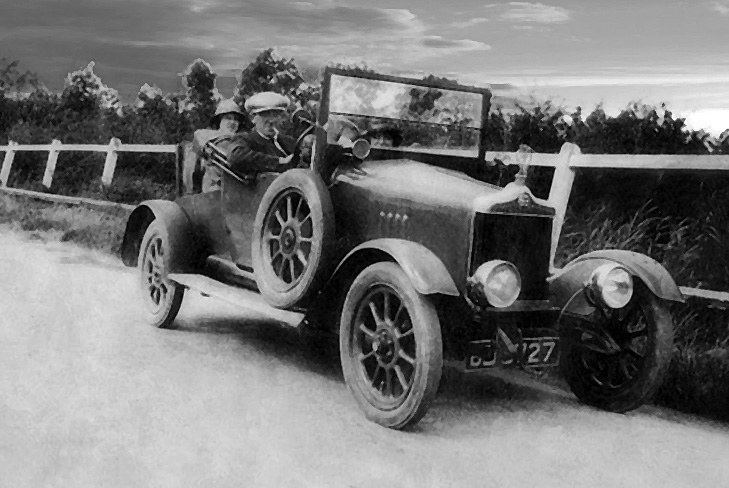
When we see the photographs of Stuart on the farm or in a sporty car there does seems in him a little of Pop Larkin in his namesake, H.E. Bates’ novels. It is type of rural life that flourished in the “Back to the Land” movement of the 1920s and 1930s and flickered again in the 1970s but has now almost entirely disappeared from the landscape.
Stuart died in late 1971 and Ivy in 1979.