The Great War: A–M · Story 8
Arthur Frank Barnard and Ronald Barnard
The Barnard Family had moved to Ringstead from Elton in Huntingdonshire in about 1896. The tracing of their ancestry is confused by the fact that, in the 1861 Census, Emmanuel, who was the father of the two brothers we are looking at in this biography, had the surname Barnett. He had also been christened Barnett on 29th April 1860 when he was two year’s old, son of Hannah Barnett, a single woman. Hannah had been a servant, aged eight, at Winwick in 1851 and a housemaid aged 19 to a farmer and his wife in Elton in 1861.
In 1871, however, Hannah and her son Emmanuel were living with her parents. William and Mary Ann, who in 1861 were Barnett and are now Barnard, so the whole family has changed its name. This may be due to acceptance of a Census Collectors version of their surname because of their lack of literacy or it might be a deliberate act. It was not uncommon especially among people of gypsy heritage.
Emmanuel became a labourer on the railways and in Spring 1884, as Emmanuel Barnett, he married Margaret Hilliard in the Oundle Registrar District. They spent their early married life in Elton and had three children: two sons, Jesse and Arthur Frank (born 10th April 1889), and a daughter, Kate. In about 1890 they moved to Ringstead. In the 1891 Census for Carlow Street in Ringstead Emmanuel Barnard was a platelayer on the London and North-Western line. Visiting Emmanuel, Margaret and the three children was Arthur Hilliard, aged twelve and born in Elton, thus confirming the Barnett/Barnard transformation.
By 1901 they were living in Carlow and Emmanuel was still a platelayer. There is another child, now, called Ronald, aged four and born in Ringstead. Emmanuel was 52 years old by 1911 and appears to have a platelayer’s pension which would seem to imply that he had some kind of disability. Frank, who seems to have discarded his first name, Arthur, was 22 years of age and working as a horseman on a farm. Ronald, aged 14, was a carrier’s boy. The family were now living in Barritt’s Yard in Ringstead.
It is Frank (as I will now call him) and Ronald who are the soldiers of the First World War that we are following here.
Arthur Frank Barnard (1889-1949)
In the year before the war started, on 5th July 1913, Frank married Sarah Elizabeth Judd at Thrapston Register Office. They had two children, Florence Mary, born on 28th August 1913 and Lily, born on 4th December 1914, both in Raunds. It was in Raunds, too, that Arthur Frank Barnard” signed the Military Attestation Form on 9th December 1915. He was 27 years 8 months old and a milkman on a farm. He was 5 feet 3 inches tall with a 35½ inch chest. Initially, he would have been on reserve but on 25th May 1916 his attestation was approved and he was mobilized. On 30th May 1916 he was posted to the 3rd Battalion of the Northamptonshire Regiment. He remained in England, training, until 13th September 1916 but the next day he embarked at Folkestone and disembarked at Boulogne in France.
He would have been taken to one of the base camps before being allocated to the 6th Battalion of the Northamptonshires, in the field, on 30th September 1916.
He was to remain in France for 240 days. He saw the last days of the Battle of the Somme, which was the name given to the campaign around the area of that river which, confusingly, encompassed a number of individually named battles. The War Diary for the 6th Battalion reveals that it had just been engaged in the Battle of Thiepval Ridge where it had lost 13 of its officers wounded or dead, and 157 Other Ranks, wounded, missing or dead.
The Diary for the 1st October reported that one hundred men had joined the Battalion at night and Frank would have been one of these new boys. The next day there was company training but on 3rd they were taken by train to Candas and then marched to Bernsail, arriving at 9 pm in the dark. The following days were spent in training, Church parades and intercompany football matches. It would have been obvious that they would soon be in action in what became known as the Battle of Ancre Heights.
They moved with the rest of the 54th Brigade on 15th October, finally ending in billets in Bouzincourt and began to practise their roles in the plan of attack. They moved again to Albert and on 25th October 1916 they relieved the 7th Bedfordshire Regiment in the trenches north of Coucelette. Immediately they were under enemy fire and had six casualties on that first night. Frank would have been quickly introduced to the reality of war.
On the 26th October the War Diary recorded:
Weather fairly fine. Light continuous shelling of REGINA and VANCOUVER trenches specially on left of REGINA which was constantly being blown in by enfilade of 5.9 guns from direction of LOUPART WOOD. About 1 a.m. two Germans came up to our parapet and gave themselves up. “A” Company H.Q. in REGINA TRENCH was twice blown in, in the early morning. Casualties 8.
They were relieved on the 29th by the 8th Suffolk Regiment and, in misty conditions, this went well. The Diary entry, however, is scathing about the conditions in the trench and the inability of the artillery to stop the enfilade fire. It records:
The enemy showed no activity in front but the continuous enfilade shelling of trenches which contained few traverses and no dug-outs made this a very trying time in the trenches. Total casualties 52 including 7 missing.
We see how the design of the trenches could be a matter of life or death. The traverses were angles or bend in the trenches and the dug-outs were small caves cut into the trench, often supported with boards or corrugated iron sheets which gave the men some respite from the weather. Both features also gave the soldiers some protection against “enfilade” fire where the enemy artillery was in a position to fire along the trenches from the side.
For most men it was the details that mattered. The ordinary soldier rarely had much of a grasp of the wider battle tactics but tried to do what was required of him in his small sector and to survive day-to-day. The cold fogs and rain made life miserable, with long periods of boredom suddenly broken into by hellish times of gas, shells and bullets, of mayhem and fear.
The Battle of Ancre Heights finished on 12th November with some limited gains and led into the Battle of Ancre which was the last British attack of the Battle of the Somme. The rain had stopped on the night of 11th November and a full moon illuminated the landscape. Towards dawn, however, a thick mist reduced visibility to nil which masked the Allied attack but also led to units losing their way in the thick mud. The Northamptonshires did not take part in the first offensive but were moved up to the Front Line trenches on the 18th November as part of the 55th Brigade. For them the zero hour was 6.10 am but, because of lack of communications, they were “not able to carry out the consolidation allotted to them”.
After Ancre, the Battalion marched from Warley through Berneuil, Demqueury, Le Plevy and Oneux to Neuf Moulin where they trained and practised attacks before once again moving to Canchy on 14th December. On 25th December they had Christmas Dinner in two relays.
The new year continued with training and the occasional bath. They also received new box respirators which gave much more protection against the gas attacks.. On 11th January they marched along bad roads arriving on the 15th at the Front. They took over duties from 2/8th Battalion of the Royal Warwickshire Regiment at Aveluy, where there was little action. On the 15th February they again took over Front Line trenches from the 8th Battalion of the East Surrey Regiment. The following day a party of officers and NCOs marked out their battle stations.
By 4.50 am the next morning the whole Battalion was in position at Miramount. The ground was now wet and slippery and the overcast sky made it very dark.. The attack began following an artillery barrage but found that the barbed wire had not been cut in enough places, so the soldiers had to funnel through the available gaps. After some good forward progress, they met considerable opposition and although still moving forward they suffered many casualties. This war of attrition continued through March at St. Leger and late in the month they moved to billets at Thiennes.
On 30th April they were once more in the trenches, this time west of Cherisy. The weather was fine and there was little shelling. On 1st May they were relieved and marched back to bivouacs at Neuville Vitesse where they once more prepared for battle and on 3rd May they marched back to the trenches. They were not a first engaged but were ordered to counter attack after a “rolling barrage” of shells from the artillery. [During the war the “rolling barrage” was developed where the artillery shelled just ahead of the advancing troops. It could be effective but it did lead to casualties from “friendly fire”.] There was much enemy gunfire and “B” Company suffered 50% casualties and “C” Company also suffered badly and had to withdraw to its original positions.
It was during this first engagement on 3rd May 1917 that Frank Barnard suffered a gunshot wound to his right hand. He went via the 44th Field Hospital to Le Treport from where he was taken, by the Hospital ship St Denis, back to England on 3rd June. Frank was to remain in England for 159 days and would never return to the Western Front although his war was not over.
He went first to Wharncliffe War Hospital in Sheffield, arriving on the 11th May and remaining there for 56 days. He seems to have been left with numbness in his index finger but it was a wound that many of his fellow soldiers would have welcomed. In July 1917 he went to Thetford for training and was posted to the 3rd Northamptonshire Regiment on 8th September. On 18th October 1917 he embarked at Southampton and on 1st November he went ashore at Alexandria in Egypt as part of the 1/4th Battalion of the Northamptonshire Regiment which had been in Egypt since the end of 1915, having fought in Gallipoli..
He was part of the Egyptian Expeditionary Force (EEF) fighting against the Ottoman Empire which was an ally of Germany in the Middle East. The Ottoman Empire had been created by Turkish tribes and, at its height controlled much of Eastern Europe, the Middle East and North Africa. By 1914, it was disintegrating and was sometimes called “the sick man of Europe”
The EEF was a very multicultural force with troops from the British Isles, India, Australia, New Zealand and the West Indies. The original reason for its establishment was to protect the Suez Canal but its brief had been widened and a series of defensive posts had been built extending into Palestine. In March 1917 the EEF had tried to take the Ottoman garrison in Gaza but the two attempts had been disastrous failures.
When Frank arrived in Egypt he was promoted to Acting Corporal. Neither the Ringstead Roll of Honour not his military records show that he served in Palestine and it may be that he remained in the Suez area protecting the canal. The 1/4th, however, did take part in the Palestine campaign so it is certainly possible that he served there too. In 1917, they had fought in Battles of Gaza and then the Battle of Jaffa. Frank would have joined them late in this campaign.
In 1918 they were also involved in the fight at Ras al Ain. This was the site of one of the death camps where mainly Armenians were sent. The word “genocide” was first used about the systematic extermination of 1.5 million Armenians by the Ottomans, mainly during the First World War. The able-bodied men were either massacred or put into forced labour camps and the women, children and the infirm were taken on death marches into the Syrian desert from which few returned.
On 1st June 1918 Frank had attended the Imperial School of Instruction at Zeitoun, rejoining his unit on 28th of the same month. This establishment on the outskirts of Cairo was mainly a training school for officers and non-commissioned offices. It did, however, also run courses in Stokes Mortar, Machine and Lewis Gun instruction, as well as course in Signals and Telephones, and Artillery.
The 1/4th Northamptonshires were also involved in operations at Berukin. The final offensive of the EEF, known as the Battle of Megiddo, opened on 19th September 1918 with the Battle of Sharon which was ultimately successful although the Battalion suffered many casualties including the death of the Commanding Officer.
That was their last action and the 1/4th ended the war on 31st October 1918 in Beirut, which at this time was part of Palestine. The Armistice of Mudros was signed on that same day.
He would have remained after the Armistice as part of an Army of Occupation. In early 1919 the Battalion had to suppress riots in Egypt which delayed their demobilisation.
On 16th February 1919 Frank Barnard was sent to the demobilisation camp at Kantara. The following day he was admitted to the hospital suffering from scabies. On 25th February he embarked at Port Said and was shipped home. Finally, on 12th April 1919 he was demobbed and transferred to “Class Z” which meant that he could be recalled if hostilities suddenly broke out again. His character had been assessed as “Very Good”.
His Medal Card shows that his Regimental Number was 25165 and that he was entitled to the Victory and British Medals. It may be that this card was written before his time in the Middle East so he may have been entitled to at least one other medal.
The Electoral Roll for 1920 recorded that he was living in Bank Cottages in Ringstead and he and his family lived there for most of that decade. In 1931 he is recorded as living in the Council Houses in Denford Road. In the 1939 Register of England and Wales Arthur F. Barnard was a “road man” for the N.C.C. (Northamptonshire County Council). Sarah was with him and there are four children: Lily born 4th December 1914, Arthur born 27th November 1919, Clifford born 14th October 1923 and one record officially closed.
Arthur died, aged sixty, early in 1949.
Ronald Barnard (1896-1917)
Some would have said that Frank Barnard had a good war, a small injury taking him away from the trenches. His younger brother, Ronald, born on 27th August 1896 and baptised on October 18th in Ringstead Parish Church, was not so fortunate.
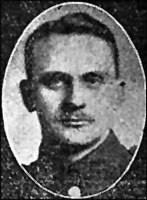
In the 1911 Ringstead Census Ronald was fourteen years old and a “carrier’s boy” living with his parents Emmanuel and Margaret. He followed his father onto the railway, as an employee of the London and North Western Railway Company, and in 1913 or possibly 1914 became a junior porter on Ringstead Station. It seems likely that he was still there when war was declared.
Details of his medals are all that now exist of his military records. They do show that he was entitled to the British and Victory medals but not the 1914 or 1914/5 Stars which probably means that he was called up in early 1916 following the introduction of conscription in January 1916.
By this time the “Old “Pals” Battalions which could take out a whole generation of young men from a community, had stopped and men were allocated to a range of regiments. Ronald was posted to the 7th Suffolk Regiment and given the Regimental Number 45027. At some point he was transferred to the 1/4th Battalion of the Suffolk Regiment. We know that the 1/4th Battalion was, in 1916, at the Battle of the Somme, fighting in the Battle of Albert, the attacks on High Wood and the capture of Boriska and Dewdrop Trenches, In 1917 they took part in the First and Second Battles of the Scarpe which were part of the Battle of Arras, The Actions on the Hindenburg Line, Operations on the Flanders coast, the Battle of the Menin Road Ridge and the Battle of Polygon Wood.
Unfortunately, we cannot be sure when Ronald joined the Battalion in the field so we will just tell of his final days.
The names of the later 1917 battles fought in by the 1/4th Suffolk Regiment may not register with most people because they form part of the Battle of Passchendaele or the Third Battle of Ypres which are the names given to this overall campaign. This was fought in Flanders at the western end of the Front, near the coast of Belgium. Like most actions in this terrible war, it was a story of small gains and reversals, with heavy loss of life. It was the wettest August for 30 years and heavy rain and the consequential mud made movement difficult for the soldiers and almost impossible for the heavy artillery.
On 12th October 1917 the Allies tried to gain ground around the village of Passchendaele but the continual driving rain caused the High Command to abandon the planned attack. The 4th Battalion of the Suffolks were in what had been called the “Railway Dugouts” near leper (Ypres). The War Diary for the Battalion recorded:
October 12th. Bad weather. Parties as usual. 1 O.R killed 1 O.R. wounded. The minimum reserve under Capt. H. Pretty left at 11 a.m. for KORTEPYP Camp
October 13th Bad Weather. Parties as usual
October 14th “ “
October 15th Orders received from C.R.E. 1st Division at 12.10 p.m. that Bn. Would be relieved at about 12 noon that day. After numerous enquiries from the Division and the 9th Bd. Who knew nothing about it, the Bn. Was eventually relieved by the 7th Leicestershire Regiment.
It was during this period that Ronald Barnard was wounded. It may be that he was the “Other Rank”, for only officers and N.C.O.’s tended to have names, who had been wounded on October 12th.
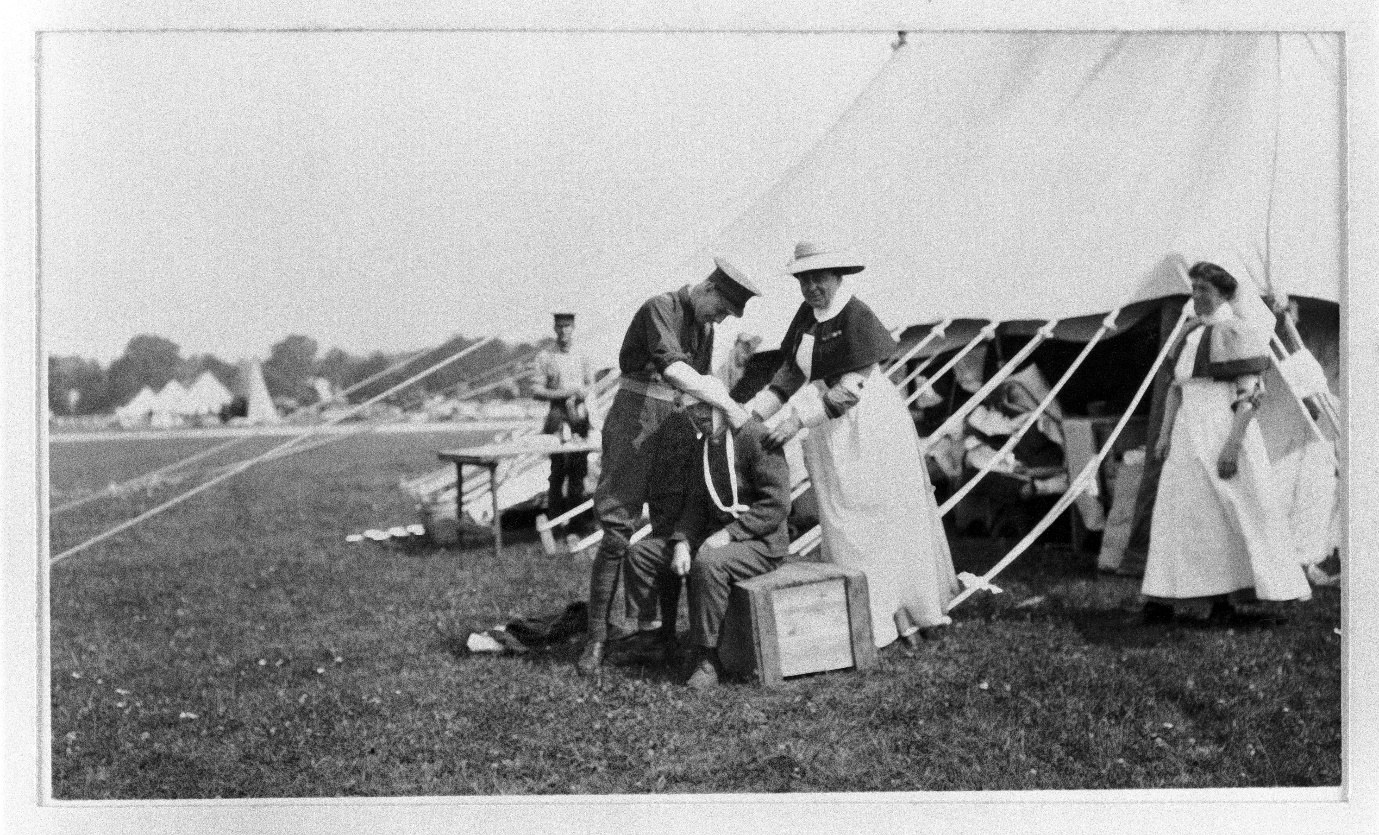
Ronald was taken to Godewaersvelde casualty clearing station where he was put on a train to Rouen. He was admitted to hospital in Rouen on 13th October with gunshot wounds to his right arm and left thigh. The transcription of the hospital records state that he was discharged back to duty on the 14th October. This seems unlikely and he almost certainly died at the hospital of his gunshot wounds on 15th October.
His death was listed in the Northampton Mercury on Friday 23rd November 1917, although he is shown as coming from Thrapston. His name is on the Ringstead War Memorial in the churchyard. He has a grave at the St Sever Cemetery Extension near Rouen which was one of two burial grounds for the hospitals. He was twenty years old.