The Great War: A–M · Story 5
The Baker Family including Frank Robinson
As people researching their families find, life is full of coincidences. While looking around a “War and Peace Exhibition” at Ringstead on Saturday 2nd November 2013 I met up with Kay Collins from the Rushden and District History Society. She had a photograph of a family including four young men in uniform. It was thought to be in some way related to Frank Robinson from Ringstead and the men were named from the left (with their position in the family) Charlie (3rd), Herman (eldest) Arthur (2nd) Walter (5th). The women were Clara (6th) and Edith Ann (4th). There was some confusion about the older woman in the middle and it was wondered if she was Edith and the younger woman on the right was Ann.
Luckily Herman was an unusual name, and perhaps one which attracted some comments in 1914. It was comparatively simple to find him and thereby the family name and Frank Robinson’s connection. Frank was born in 1895, the son of Francis and Violet Robinson. In 1920 he married Clarice (Clara) Baker and it is her family that we see in the photograph.
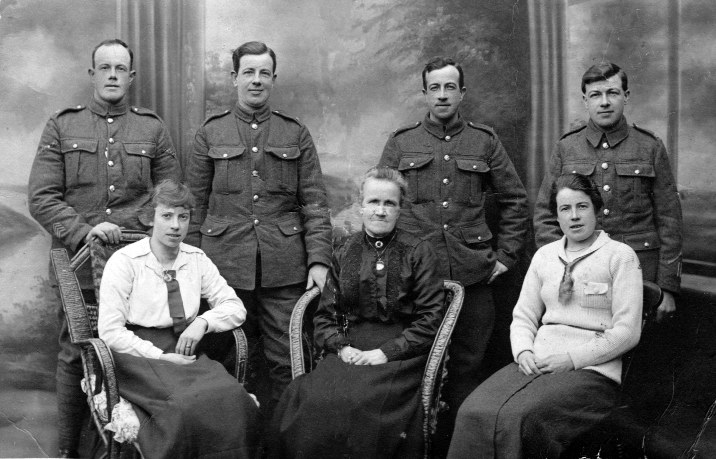
That was how I started my brief look at the Baker family and brother-in-law Frank Robinson in Book 2 of Ringstead People. The Baker children were born in Ringstead to Ralph and Annie (née Mayes), who were married in Ringstead Church on September 14th 1885 . Ralph, an army bootmaker, died in 1906 and it is the widowed Annie proudly seated in front of her four enlisted sons with her two daughters sitting either side of her. Herman and Arthur did not enlist until 1917 so we must presume that the photograph was taken towards the end of the First World War or just after it had finished.
Herman Baker (1887-1948)
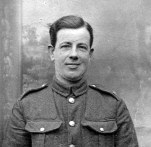
The eldest child, born on 30th April 1887, was Herman Baker who is second from the left in the photograph. He married Charlotte (Lottie) Octavia Gray on 21st September 1908 and the 1911 Census for Ringstead has them living in Chapel Yard in the Ringstead High Street with their one-year-old daughter Elsie Florence. Lottie is a year younger than Herman and was born in Heckmondwike, a small town south west of Leeds, in Yorkshire. Lottie was the daughter of Alexander and Albertine Gray. Alexander was a shoemaker but although born in Bradford, we can see, from the children’ birthplaces, that he had pursued his craft in Yorkshire and Surrey as well as in Northampton. In 1901 the family were living at 9 Carlow Road in Ringstead.
What the photograph of the Baker family does not make clear is how small the brothers, and most men at the time, were in comparison with today’s average young man. Herman looks one of the tallest of the brothers but his Record of Service shows that he was 5ft 6½ inches in height with a 34½ inch chest. For his trade or calling he has put down “shoe hand” and had asked to enlist in the RFA (Royal Field Artillery).
At first he went to a Field Depot but on the 1st February 1917 he transferred to the 6th Company of the Machine Gun Corps (Reg. No. 83933). On 11th April 1917 he was posted to the British Expeditionary Force in France. He embarked at Folkestone and disembarked at Boulogne before moving to the Base Depot at Camiers which was just north of Etaples. It was not until 4th May 1917 that he joined the Machine Gun Corps in the Front Line.
On the 1st June he became ill and was taken to the field hospital at Camiers where he was diagnosed with P.U.O. or Pyrexia (fever) of Unknown Origin which was usually called Trench Fever, (not to be confused with Trench Foot). Trench Fever was an increasing problem in the trenches as the war progressed and produced symptoms of headaches, rashes, inflamed eyes and leg pains. It was not considered by the men a serious condition and often disappeared in under a week although some sufferers might need to be hospitalised for a further couple of weeks to fully recover. It also often recurred at 4-6-week intervals although usually with diminishing intensity. It must be remembered that soldiers afflicted with the disease would compare the symptoms to the fear and misery of their life at the Front. In 1918, it was discovered that P.U.O. was caused by the excretions of lice, which were one of commonplaces of life in the trenches, being rubbed into a wound or abrasion.
On 13th June 1917 Herman returned to England on the SS Brighton and remained for some 280 days. This indicates that he had a more serious attack. He was first at the V.A.D. Hospital at 27 Charles Street, Berkeley Square, a large Georgian house in Mayfair and then was sent to the Paddington V.A.D. Hospital at 37 Porchester Terrace, Bayswater. These V.A.D. or Auxiliary Hospitals had been set up by the British Red Cross and St John Ambulance working together as the Joint War Committee. Each establishment usually had a commandant, quartermaster and matron but were mainly staffed by members of the local V.A.D. (Voluntary Aid Detachment) who were trained in basic first aid and nursing. The patients were generally the less seriously wounded and these hospitals allowed the wounded or ill soldiers to recuperate under a more relaxed regime. One of the alternative names for Trench Fever was Shin Bone Fever for it could produce great pain and sensitivity in that area. In 1918 Paddington was designated an Orthopaedic Hospital so it may be that Herman was receiving some form of massage or even electrotherapeutic treatment for this condition.
On the 19th July 1917 he was certified fit enough to go home to his family in Rushden on an eight-day furlough. Was the family photograph taken then?
His war was not over, however, for on the 29th March 1918 he embarked once more at Folkestone and joined the Machine Gun Corps’ Base Camp at Camiers and on the 6th April 1918 he returned to the Front Line. He seems to have remained there until 8th February 1919 but, from the 14th September 1918, he was performing the duties of a shoemaker for the army left in France. It is often said that an army marches on its stomach but of course it also needs well shod feet: a car certainly requires fuel but it also needs tyres.
Finally Herman returned to Purfleet and was demobbed on 14th February 1919. Appearances can be deceptive but when we look at Herman in the photograph we do see the character noted on his army record, He was described as temperate, reliable and intelligent.
At some point his mother and the family had moved to Rushden. Herman too had moved with his wife Lottie and their child, Elsie, to 3 Oak Street in Rushden and this is why he was not included in the 1919 Ringstead Roll of men who had served in the First World War.
Soon after returning home Herman and Charlotte moved to 73 Queen Street, Withernsea in East Yorkshire, still as a shoemaker. It may be that father-in-law, Alexander Gray, had some influence on this for in the 1911 Census he, with his family, had moved back to Yorkshire and was a boot repairer, living at 256 Division Road in Hull. Albertina had become a midwife.
What we discover from later events is that Herman played the clarinet and saxophone while Charlotte sang and played the piano and violin. The photograph of the Ringstead Band in the chapter on Benjamin and George Roberts in Ringstead People, and the many newspaper reports, show that the village had a long musical tradition which Herman and Charlotte carried on. While in Withernsea they had a son, born on March 1st 1921, who they named Kenneth. Kenneth as a child learned, probably mostly from his parents, to play piano, saxophone, violin and accordion. He later switched to the cornet and played in the local Gospel Mission Band. The family then moved on to Hull in about 1936, and Kenneth joined the West Hull Silver Prize Band as a solo cornet player. It is through the life stories of their son that we are told a little more about Herman and Charlotte because, known as Kenny Baker, he became one of the most well-known and internationally respected British jazz musicians of his age.
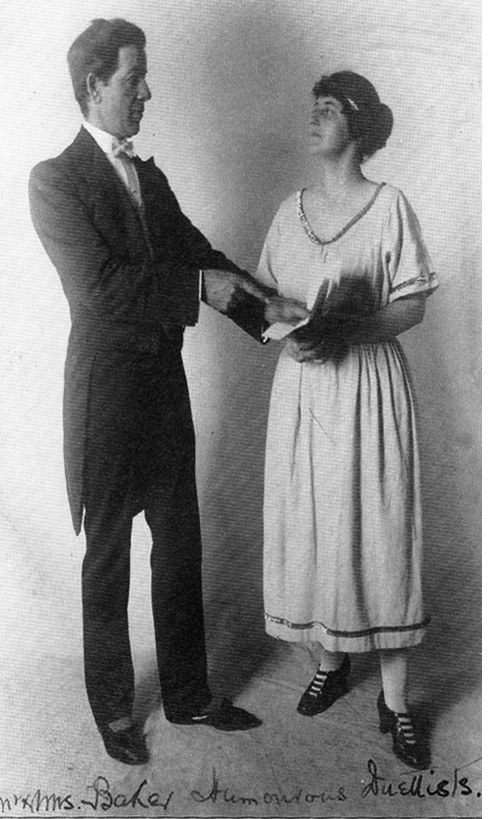
The authorised biography of Kenny Baker makes clear that not only did Lottie help with the shoemaking, probably doing the “closing” of the uppers but also ran a boarding house for the summer visitors. It also tells us that husband and wife both played in dance bands but she was the more accomplished musician, gaining qualification in piano, accordion, violin and singing. She formed a small orchestra to accompany the silent films at the local cinema and ran a female accordion band. She was also the main driving force in her son’s early musical training, teaching him to sight read music and insisting that he had good musical grounding. In the local paper we see a few examples of her drive in her charity work. The Hull Daily Mail reported on 7th December 1922:
There was a charming scene at Unity Hall, Withernsea, on Tuesday evening, when some thirty children in fancy costumes, composing Mrs H. Baker’s Juvenile Concert Party, gave a delightful entertainment on behalf of the fund for providing a Christmas treat for the children of ex-Servicemen.
We also see that husband and wife performed and daughter Elsie gave “a very pretty song and dance step” and that Mrs Baker designed and made all the dresses. Again in 1925 the Hull Daily Mail reported on a musical service at the Withernsea Brotherhood where Herman performed on the clarinet, Elsie sang sweetly and Herman, Lottie and Elsie were part of a quartet. We see a very musical family performing for the community before son Kenny started on his rise to fame.
On 30th July 1933 Herman was driving his car when he came upon a serious accident. A motorcycle and sidecar had overturned in an eight-foot drain on the Kilnsea Road to Spurn Head. The young wife of the driver was killed and a girl seriously injured but a nine-month old baby was found safe in the mud of the drain. We also note that Herman was stated to come from Withernsea. By October 1938, however, when he was found guilty of driving without insurance, (an oversight, Herman said, due to being on holiday at the time of its renewal), Herman was reported to be living in Hull. As we have seen this is confirmed in his son’s biography and it seems possible that when he moved his business had been taken over by younger brother, Walter, but this has yet to be proved.
Surprisingly, in the 1939 Register of England and Wales, Herman, a bootmaker, and Charlotte are shown at 26 Linden Avenue in Kettering with “General Shop Keeper”, Arthur J Fox and his wife Florence. When we look a little further, however, we discover that Arthur is the son of Frederick and (Mary) Elizabeth Fox. Elizabeth was the older sister of Charlotte and the two families lived a few doors apart in Carlow Road, Ringstead in 1901. Lottie and Herman are staying with their niece and her family, probably on a short visit..
There is no sign of Kenny. He was back in Withernsea, a musician, staying with older sister Elsie who had married postman Sydney Cowen in 1929. It seems that this was one of the few times from then on, that Kenny was in Humberside for in 1939, Kenny had answered an advertisement and became part of comedian Sandy Powell’s travelling show and his career had begun.
Herman died in 1948 aged 61 in the Holderness District of East Yorkshire. Lottie married again as we shall see in the story of Herman’s brother, Charles Baker.
Arthur Harry Baker (1889-1974)
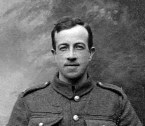
The second oldest son was the last of the Baker boys to enlist. He had been born in 1889 so, when he joined up in 1917, he was some twenty- seven years old. His brothers had been in the boot and shoe trade but Arthur was a farm labourer and was enlisted in the Army Veterinary Corps, (the prefix Royal was added in 1918). This Corps had qualified veterinary surgeons as officers but farmworkers, ostlers, blacksmiths and others used to working with horses formed the Other Ranks.
At the beginning of the war the cavalry regiments, along with the Guards, were seen as the premier regiments in the army. In 1915, at Mons, there was a major cavalry charge but that was the last one of real significance although some useless, suicidal attempts occurred throughout the war. Trench warfare and the machine gun ended the horse as a useful fighting force. The Charge of the Light Brigade had been over fifty years earlier but the old order could not believe that the cavalry had become obsolete.
Nevertheless, as the books by Michael Morpurgo and the subsequent War Horse play and film have once again made clear, horses still played an important part in the Great War and, despite the various veterinary corps’ attentions it is believed that some eight million horses died on all sides during the conflict. Mechanised transport, especially over rough terrain was still unreliable and horses had a vital role in the movement of supplies and artillery to and around the battle front.
Originally, I had thought that Arthur’s war records had not survived but I think, although not complete, there are enough to fill in some of his army career. The Medal Roll for WW1 shows that Arthur Harry Baker of the Army Veterinary Corps (Regimental Number SE29437) was entitled to the British War Medal, which showed that he had served overseas, and the Victory Medal, which meant that he had been in an area of active fighting.
In 1914 the Veterinary Corps was based in a number of places across the British Isles with detachments in Egypt and South Africa. With the start of the Great War, the Corps reorganised to provide a Mobile Veterinary Section as part of each Division that went overseas. I still have not found the Division to which Arthur was attached. Perhaps more details of his service will come to light.
Arthur’s son, Derek, remembered that his father was said to have been discharged because of bleeding ears and had to have a metal plate inserted in his head. It does seem the sort of injury that could have occurred from the kick of a horse or perhaps from falling off one. On the other hand it could have been bomb blast damage.
In my research I was led astray by one of the coincidences that makes nonsenses of many Ancestry family trees. An Arthur Harry Baker married Maud Estella Fox in 1922 in the Thrapston District. Maud was the widow of Ringstead bootmaker Nathaniel Fox who had died in 1920. The marriage was not a success and on 3rd August 1923 the Northampton Mercury reported a case brought by Maud telling of Arthur’s assaults on her. This was dismissed as a “tissue of lies” but a fortnight later she successfully applied for a maintenance order of £1 a week. The couple had briefly lived together in Lower Street Ringstead and had a son, but Arthur moved to Kettering and I think he later died there.
Despite the name and the Ringstead connection this Arthur is not our man. He was probably a carpenter named Arthur Henry Baker who came from Rushden originally. I include these brief details just to show how easy it is to be misled without certificates or census details to confirm facts. [Just to confuse things more the older sister of Lottie Gray, who married Herman Baker, married Frederick, the brother of Nathaniel Fox.]
Our Arthur Baker married Constance Lily Houghton (possibly in Higham Ferrers) in 1920. Constance was the daughter of Silas Ponting and Elizabeth Ann Houghton. He was a currier’s labourer and the family lived at 13 York Road in Higham.
After leaving the army the family remembers that Arthur became a gravedigger for some twenty years and in the 1939 England and Wales Register Arthur is a “Cemetery Caretaker” living in Higham Ferrers. During the Second World War Arthur worked at Chelveston air base for Braybrooke’s Haulage. He then repaired Wellington bombers at Sywell Airfield. It may seem unlikely that a man with Arthur’s background would be allowed to do this kind of important repair work. However, on the BBC WW2 People’s War webpages, Olive Skinner was quoted as remembering that:
I was just 17 and working in the office of a shoe factory when the War broke out. As soon as the opportunity came, I took a job more useful to the War Effort, working for Brooklands Aviation at Sywell Aerodrome at Sywell in Northamptonshire. I would cycle the five miles from home to Sywell, where we would repair Wellington Bombers in vast hangers. The planes were a skeleton metal framework with heavy linen stapled to it, and then painted with 'dope'. They were extraordinary aircraft, and when we got them for repair I often wondered how they managed to fly with so much damage.
The planes were stripped to the frames and fabric replaced. I remember having to hand sew the seam along a length of wing with my curved needle. At the regulation eight stitches per inch, it seemed like a mile. I still have my needle to this day, ready for any more repair work!
It was a world away from today’s computer-packed fighting machines
Arthur finally worked as a stonemason for Marriotts the builders. I believe that Constance died, aged 70, in 1968 and Arthur in 1974.
Charles Mayes Baker (1892-1978)
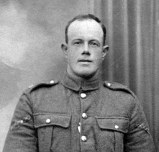
Charles Mayes Baker [Charlie] was born on 23rd December 1891, (the Death Index on Ancestry has 1890 but I think this is incorrect). He worked as a platelayer for the London and North Western Railway Company. Charles enlisted as a Sapper when he was 23 years old, joining the 118th Company of the Railway Corps of the Royal Engineers at their headquarters at Longmore Camp in Hampshire on 9th December 1915. The Woolmer Instructional Military Railway had been constructed there and this was used in the training of the railway troops who would have to carry out their work in very different conditions to the ones they had been used to.
The railway troops are another less well-known part of the war effort in the First World War. There had been a large recruitment drive among the employees of the various railway companies. A special port was built at Richborough in Kent from which trains were loaded onto boats in a sophisticated roll-on roll-off system and taken across the Channel. Boats would also bring trains loaded with tanks to France so they could be taken to the Front. By mid-1915 there were eight Construction Trains operating in France which carried the Sappers and their equipment to where they were needed. Once at their destination they would pitch tents for their accommodation. They would try to lay standard gauge track as close to the front as possible and also carry out repairs to sections destroyed by shellfire. Where possible, light narrow-gauge railways would be run even close to the Front Line.
Charles first embarked with the British Expeditionary Force on 6th February 1916 and at some point joined the 298th Railway Company. He seems to have adjusted to army life well for he was first appointed a Lance Corporal, then promoted to full Corporal and finally to Second Corporal. Second Corporal was a rank only used in the Royal Engineers and Army Ordnance Corps and meant that the person held full non-commissioned officer rank.
In April 1917 he was admitted to hospital, perhaps with Trench Fever, but rejoined his unit within a week. In July he was given leave and on the 10th July 1917 he married Winifred Shallow and appears to have moved to 25 Red Row in Raunds. Winifred Shallow had been born in Pentney, the daughter of Robert, a bread baker, and his wife Clara from Irthlingborough. Clara had been a Britchford and in 1911 Winifred is staying with her mother’s sister, Laura and her husband George Robinson. It does not seem that he was a relation of the Frank Robinson who married Charles’s sister Clarice.
On 5th April 1919 Charles was demobilised as a Class Z Reserve. There were still some fears that Germany might not accept the terms of the Peace Treaty and these Class Z men would have been recalled immediately in the case of the conflict breaking out again. As we know, this did not happen for another twenty years and Charles went back to his work as a platelayer in the Rushden and Higham Ferrers area.
The 1939 Register of England and Wales has Charles working as a “Colliery Permanent Way Foreman” in Leicestershire. He and Winifred, with son Frank (who ws an electrician underground in the colliery), were living in a cottage at Measham Hall near the Colliery. Measham Hall is a few miles from Ashby-de-la-Zouch. We see that Frank was born on 31st December 1922 and a little research tells us that his birth was registered in early 1923 at Atherstone in Warwickshire. The couple had three sons in all, Kenneth, George and Frank.
At some point the couple separated or divorced, or Winifred died (although one Ancestry tree has her dying in the Northampton District in 1987 aged 92). Certainly, we know from Charles’s descendants, that he married again in 1955 in the Coalville District of Leicestershire to Charlotte, the widow of his eldest brother Herman. In 1959 Charles went out to Australia with his son George and the rest of George’s family followed. They remained, but it seems that Charles could not adjust to Australian life and returned home.
At some point, Charles moved to Harrow in Middlesex and, at the time of his death, on 17th April 1978, he was living there at 4 Heath Road. His birth date is given as the same as in 1939 Register which confirms we have the correct man.
Walter Baker (1896-19??)
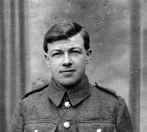
Walter Baker, born in 1896, was the youngest son in the family. His enlisted in 1916 like his oldest brother, Herman, but he went into the Northamptonshire Regiment rather than the Machine Gun Corps. Walter’s records have nearly all disappeared so we only know a little of his army career from his Medal Card and a brief newspaper report.
He remained a Private throughout the war but changed regiment twice. The reasons for these transfers could have been because so many men in a battalion had been killed in action that it ceased to be a viable unit and the survivors were sent to bolster up other regiments. It was also the case that after the first wave of deaths the new recruits would be transferred to whichever regiment was in need of replacements.
By checking the records that have survived, of men with similar regimental numbers and military history, Steve (Stebie9173) on the Great War Forum website has managed to reconstruct the likely path of Walter’s early army career. Like Horace Allen of Irthlingborough, Walter would have enlisted at Northampton in November 1916 and been posted to the 3rd Battalion of the Northamptonshire Regiment for training.
He was sent to France on 1st February 1917, initially to No. 17 Infantry Base Depot at Étaples, south of Boulogne. Frank James in his recollections, A Privates War, describes “Etaps” as it was known to the soldiers.
It was a large bivouacked area near the sea and covered several acres. Its purpose was to hold and give further training to troops fresh from England and then send them off to join their various units in the battle zone.
This was in 1914, and James and the other men of the Northamptonshires travelled from Le Havre in overcrowded cattle trucks. There may have been some improvements by early 1917 but one suspects that it would have been a largely similar experience for Walter. He had travelled with the Northamptonshire Regiment (Reg. No. 30926) but it is likely that at Etaples he was transferred to the 2nd Battalion of the Royal Inniskilling Fusiliers and his Regimental Number became 40722. He joined his new regiment and soon after, on April 1st, as part of the 32nd Division, he took part in the fierce battle to take Savy Wood near St Quentin. The Battalion War Diary for April 1st records:
Battalion receives order at 11.30 am to advance at 1.30 pm. Battalion advances to SAVY in Artillery formation, under hostile artillery fire. Battalion formed up and advanced at 3 pm in extended order. C, B and D companies in front line and A company in support. Battalion met with heavy enemy artillery and machine gun fire.
The Inniskilling Fusiliers, as part of this advance, gained the wood after thirty minutes intense fighting and consolidated “strong posts” but at the cost of 152 casualties: Officers 1 killed and 10 wounded; Other Ranks 31 killed, 107 wounded and 3 missing. John William Elliot of Raunds was also in the same battalion and was killed there. He is remembered on the Raunds and Stanwick War Memorials.
Walter was badly injured in one leg and would have been taken back, via a chain of casualty posts to a Field Hospital behind the lines. He was probably evacuated from France on 17th April to Newcastle Military Hospital. It may be that his return to England was delayed by the mining of the hospital ship Salta on the 10th April.
He was in Newcastle Military Hospital (a requisitioned lunatic asylum) for five months. It is presumably, after he had recovered, in the autumn of 1917 that he was transferred finally to the Royal Irish Regiment (Reg. No. 18580).
Walter joined the 2nd Battalion of the Regiment and fought with them at the Battle of Albert on 21st and 22nd August 1918. which was part of the lead into the final Battle of the Somme and the Allied victory. The Rushden Echo of 13th September 1918 reported that, youngest son of Mrs R [Ralph] Baker of 32 Winchester Road, Rushden, was again in hospital. He was in Birmingham suffering from a shrapnel wound in his leg sustained on August 22nd 1918. The report continued:
Pte. Baker had once before been wounded in the leg, and as this limb had occasionally caused him inconvenience during the last time out he asked the doctors at the hospital of which he is at present an inmate to make an examination. The X-Rays have revealed the cause of the trouble, viz., a machine gun bullet which has thus been embedded in the muscles for twelve months.
One would imagine that Walter’s war was over and he was demobilised before June 1919 when the Ringstead Roll of Honour was printed.
It was believed by the family that Walter moved to Ashby-de-la-Zouch in Leicestershire where he worked as a winder in a local colliery. This may be true but his older brother Charles worked at the colliery at Measham Hall which is only a few miles from Ashby-de-la-Zouch. On the other hand, in the 1939 Register, there is a Walter Baker, born on 24th November 1896 who worked in a Boot and Shoe Repair Shop living at 31 Cammidge Street, Withernsea. (Oldest brother Herman had also lived in Withernsea with a similar job.) With him is his wife Alice M. Baker, born on 5th May 1905. Checking further a Walter Baker married Alice M. Gallagher at Patrington, (5 miles from Withernsea), in Yorkshire in the last months of 1921. The Banns had been called on the 11th, 18th and 25th September 1921 in the Owththorne with Rimswell Parish Church. Could there have been some confusion between the brothers or is it just a coincidence of names?
If the Withernsea man is the correct Walter, he died in 1977 in the Hull District.
The Three Baker Women in the Photograph
The two younger women in the photograph are Clarice Emma (Clara) who married Frank Robinson and, on the right Edith Annie Baker. Edith married Herbert Woodham from Kimbolton in 1921. Herbert too had served in the army, in the 4th Battalion of the Royal Sussex Regiment and had received a severe gunshot wound in his left arm.
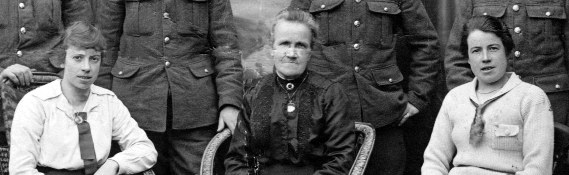
The father of the family, Ralph Baker, had died on 3rd August 1906 and it his wife, Annie, who sits in the middle in her black “widow’s weeds”. Ralph had been buried in Ringstead Cemetery in 1906 and although Annie moved to Rushden sometime in the 1910s, when she died on 31st August 1944, she was buried near her husband in her home village.
Francis Horace Robinson (1895-1970)
If we now return to Francis (Frank) Horace Robinson, who was born on 23rd March 1895 in Ringstead. He was the grandson of Elijah Robinson who had been the landlord of the Black Horse public house in Ringstead High Street as well as being a small farmer and carrier. Landlords of small village pubs often had a second occupation and it meant that the wife, in this case Sarah Ann (née Childs) would have done most of the bar work. Elijah gave up the licence to his eldest son William in 1894 but continued with his carrier business and perhaps a little farming. He became ill and was diagnosed with “consumption of the throat”. He became very depressed and committed suicide by cutting his own throat on 31st October 1902. He was 62 years old.
In 1901 his son, Francis senior, and wife, Violet were living at 5 Denford Road with their children, Frank, Dora and Beulah. Francis was an army boot welt sewer and by 1911 his son, Frank, aged sixteen, was a shoe finisher. The family was now living in the High Street. The military boot and shoe trade began to improve as by 1913 war with Germany seemed inevitable. Most of Frank’s records have been lost but we know that he enlisted on 20th January 1916 and joined the 28th Battalion of the Royal Fusiliers (Reg. No. G/11402). At some point he was injured and also transferred to the 7th Battalion of the Queen’s (Royal West Surrey) Regiment (Reg. No. G/14941). As we have said, losses were often so great that whole Battalions were almost wiped out and became part of another Regiment and it may be that Frank (or Horace as he was known by his family) was part of this movement. The exact sequence of events is unclear as Frank’s records were probably burnt with many others in a German bombing raid in 1940.
The War Diary of the 7th Battalion of the Queen’s (Royal Surrey) Regiment has survived and been put online. We do not know when Frank was wounded and captured but it seems certain that the two occurrences were linked. His early repatriation would have been because of his wounds so it seems likely that he was taken some time early in 1918. We know from the Diary that the 7th Battalion was involved in the attack on the Bois de Hangard, some 20 kilometres west-south-west of Amiens on 26th April. The Battalion was attached to the 53rd Brigade which was itself part of the 58th Division. Like many battles at this time it was an attempt to retake positions previously held and lost.
The rain was falling heavily when the Battalion moved off, soon after 7.30 pm. They struggled to the Villers-Bretonnneux - Domart Road after having been badly guided, arriving at 10.30 pm. They halted in Artillery formation, while being shelled at intervals by heavy explosives and gas. Everywhere was confusion, made worse by a mist which crept up soon after midnight hiding the wood from their view. They eventually reached their allotted positions by 4 a.m. and were told that zero hour had been brought forward from 6 to 5.15 am. Three tanks took part in the operations that morning but had little effect and returned back to their base. The Diary continues:
From midday till 3 p.m. 26th the enemy subjected the whole area of VILLERS – BRETONNEUX and DOMART to a most intense bombardment of H.E. and gas. No infantry action followed. Troops holding the line South of the wood were forced to leave their posts during the bombardment but returned immediately it ceased.
The Queens were finally relieved by a French Battalion and by 1. 30 am of the 28th they moved back to bivouacs at Blangy-Tronville, having “partaken of tea” at Gentelles Wood on the way. The list of the Battalion’s total casualties shows that two officers and ten “other ranks” were killed but only one officer was wounded, one missing and one “wounded and missing”, whereas Other Ranks had 85 wounded, 41 missing and one “wounded and missing” and a further four had died of their wounds. The whole daylight attack was called a “dismal failure” in the official history of the Great War and the capturing of the wood by the Queens was one of the few successful actions, however temporary.
It seems a possibility that Frank was one of the men listed as missing although we cannot be sure. What we do see in the Diary is the training, drill, billet cleaning and organised football matches behind the lines; the carefully drafted battle instructions with details of meeting points, dress, equipment to be carried, and battle formation that would have defined Frank’s daily life We also glimpse how quickly the conditions and enemy action shredded these plans so that at Hangard Wood it became a series of separate skirmishes with almost all coordination gone. It was often in this sort of action that prisoners were taken.
Certainly we know that Frank was captured by the Germans and taken to Langensalza Prison of War Camp in Germany. Conditions may have improved a little by the time Frank became a prisoner but in December 1916 George Mulford from the 12th Yorks and Lancs Regiment recalled:
Think of the conditions of 12,000 men huddled together on a large sized ploughed field so situated that it caught all the water draining from the surrounding hills. . . Food of the vilest and unhealthiest nature for human consumption. Long ramshackle dilapidated barracks to hold 7-800 men with no thought in their construction for comfort and accommodation.
George also stated that the guards at Langensalza were the most brutal and ferocious that he ever saw and it is likely that at the time when Frank was there it could still be a very hard place. Even as late as November 27th 1918, Corporal Golding of the Leicestershire Regiment recalled an officer named Krause exacting revenge. There had been a wooden theatre and the various nationalities had built small changing rooms on the side. These they were now dismantling for firewood. The camp had a Help Committee made up from the prisoners which tried to make life at the camp as bearable as possible and it seems they had their own hut. Suddenly Krause came with his men and surrounded the theatre and committee hut. Golding continues:
There must have been 15 to 20 prisoners standing outside the hut and I should say about 30 others round the theatre. When the order to fire was given, I tried to get into the committee hut, but the door was so crowded by others endeavouring to do the same that I could not get in. At least 15 shots were fired in the direction of the committee hut.
He saw three of the men who were killed and two others were wounded. It must be remembered that on 11th November 1918, over two weeks earlier, the Armistice had been signed. Fortunately for Frank he had been repatriated on 5th May 1918 almost certainly because of his injuries which were considered to have rendered him incapable of taking part in any further military action.
The dates are unclear but it appears that early in May 1918, just before his repatriation, Frank had been allowed to send a postcard home, addressed to his father stating his name, regiment, prisoner number and the camp and the simple message, “I am well”.
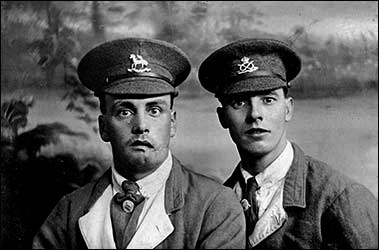
On the front of the postcard is a photograph of Frank in his darker uniform with another prisoner. It seems to have been taken in a substantial place with ornate windows. Perhaps it was in the chapel which we know was in the camp but is also possible that it was taken in a photographic studio with one of the painted backdrops that they used. We also know that there was a bootmakers’ workshop at the camp and perhaps Frank worked there to help repair the prisoner’s boots.
We also learn from Derek, a son of Arthur Baker, that there was another side to the Germans’ treatment of the POWs. The stories of brutality must be balanced by their treatment of Frank. As we can see in the photographs of Frank he has a scar across his chin and he holds his mouth awkwardly. His nephew has filled in some of the details of what happened to Frank. He knew him not as Frank or Horace but as Uncle Joe. He recalls:
He was taken prisoner after being shot in the mouth and the Germans fashioned him a set of false teeth. He had no lower jaw, however, so the teeth were fitted with metal springs to enable him to open and close his mouth [and] when he talked he never moved the bottom of his mouth but his head moved instead! A source of fascination for all the children at the time.
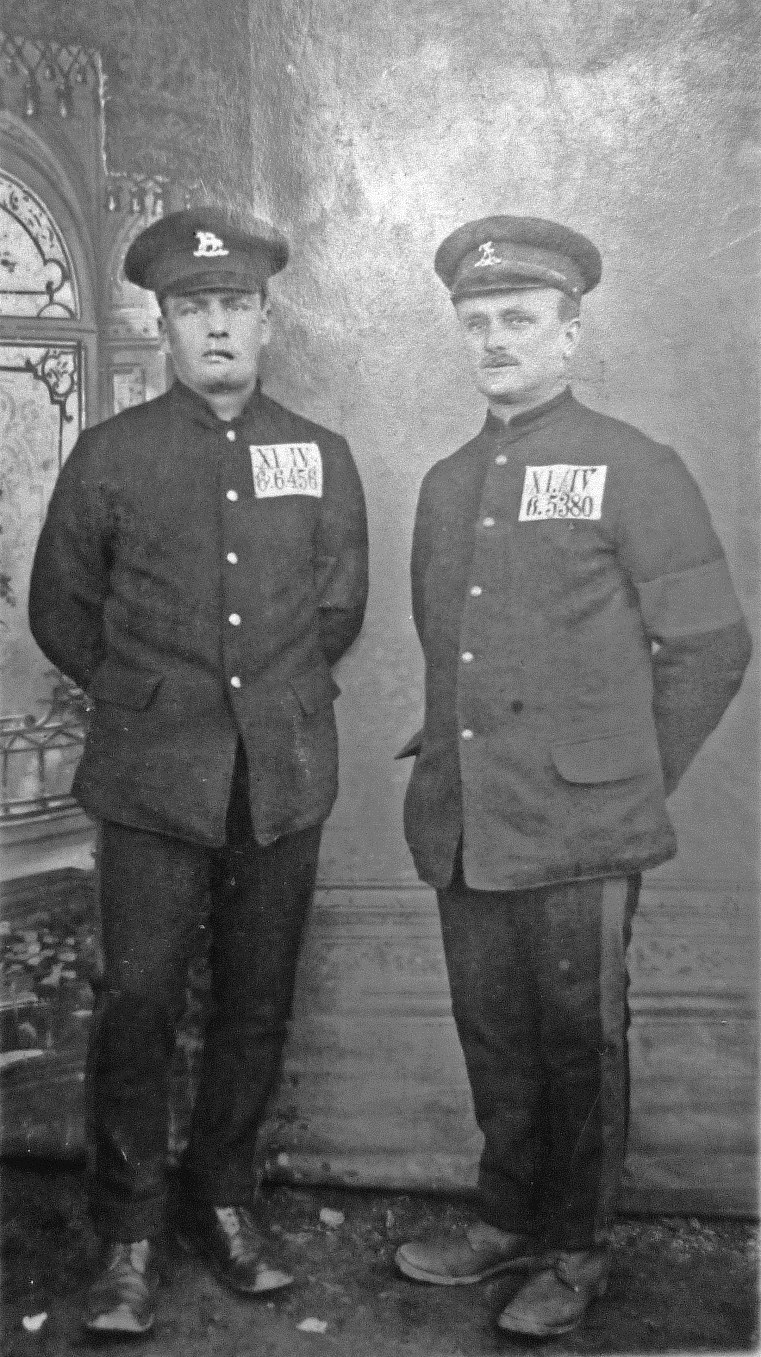
Frank (wrongly entered in the roll as “F.A. Robinson”) was deemed entitled to a “War Badge” which was awarded to soldiers wounded and unable to serve further. He was discharged on 31st July 1918 when he was 23 years and 4 months old. He was shown as being at the Regimental Depot which is where he would have been sent after his repatriation to England. He would have returned to Northamptonshire soon after. There is a photograph of Frank in the blue “hospital” uniform worn by wounded soldiers. The main reason for the badge and the uniform was to make clear that the wearer had served his country and was not avoiding enlistment. Besides the white feathers that were sent, there could be abuse and even violence against men suspected of not “doing their duty”.
Frank returned to his job as a shoehand in a factory and married Clarice E. Baker on 31st July 1920 in St Mary’s Church, Rushden.
In the Register of England & Wales, taken in 1939 to get an accurate list of the population at the beginning of the Second World War, Frank and Clarice were living at 74 Shirley Road in Rushden. He was now a foreman in the “Heel Building Department” of a local shoe firm. Mother-in Law, Annie Baker was living with Herman, Clarice and their family. He died in 1970
At each Remembrance Day we are asked to remember the dead of the Great War but all those men who served are now dead and we should also remember the millions who survived and lived shattered or troubled lives because of the terrible places that these ordinary men found themselves. We also see that the war memorials do not show just how many people in a village like Ringstead were directly affected by this deadly attrition of men by machines.