The Great War: A–M · Story 38
William Meadows (1888-1976)
More than most, the life of William Meadows had many surprising twists. His early life was touched with tragedy and this caused him to look for a life outside Ringstead and gain a measure of fortune and fame.
We will start his story with another William Meadows, born about 1826 in Slipton, a few miles north of Ringstead. On 19th December 1850 in Ringstead, he married Emily Tilley, a local woman, daughter of glazier, Jonathan and his wife Elizabeth. She had been born in 1818 but tended to underestimate her age. She was about 32 when they married and it appears that the couple did not have any children. By 1871, their niece, Rebekah (or more usually Rebecca), aged 14, was living with them. She was the daughter of Joseph Tilley, the younger brother of Emily.
In September 1878 Rebecca, aged twenty, was walking home to Ringstead from Raunds when she was attacked and sexually assaulted by Thomas Baker, an eighteen-year-old labourer. She struggled and managed to get away and told some men on the road what had happened and urged them to catch Baker. A Hargrave coal agent and news vendor, called Walter Yorke, pursued him in his horse and cart and spied Baker on the Hargrave Road. He fetched a policeman from Raunds and Baker was caught and identified by Rebecca. At the Quarter Sessions in Northampton, Thomas Baker was sentenced to twelve months hard labour.
In the 1881 Census, taken on the 3rd April, Rebecca (23) was still living with William (56) and Emily (60). Also living with them was Emily’s unmarried sister Rebecca (73), a lacemaker, one of the few women in the village still practising that craft. On 1st August of the following year, Emily was buried in the local churchyard. Her age was given as 64 years so she had aged four years in five months. William then married his niece, although not a blood relative, the young Rebecca, the following year. They quickly had three children, Emily, Elizabeth and William. William, the father died, aged 63, and was buried on 20th December 1889, leaving Rebecca with three young children.
William, who is the main subject of our story, had been born on 23rd October and baptised on 23rd December 1888, just a year before his father’s death. In the 1891 Census, the widowed Rebecca, aged 34, was working as a shoe hand. The three children, Emily (8), Elizabeth (4), and William (2), were with her and she had two lodgers to help with the finances, Isaac Tilley, 34, a farm labourer and probably her brother and James Worsley (45), a house painter, born in Douglas, capital of the Isle of Man.
The following year Rebecca married John James Worsley (now 48) who was a widower, on 11th September 1892. By the 1901 Census the couple were living in Barritt’s Yard in Ringstead. Rebecca’s eldest daughter Emily was now 19 and a dressmaker, Elizabeth,15, a boot closer, and William (13) for whom no occupation was shown. The couple also have two more children, John James (8) and Eleanor (4). There were also two new lodgers, Samuel French (33) and Joseph Drew (34).
Any temporary stability for William and the other children was soon to be shattered because, early in 1904 Rebecca too died. Her eldest daughter, Emily, married Thomas Hallam, an older man with children, and went to live at 52 Station Road in Ilkeston, Derbyshire. She seems to have become the surrogate mother for the younger children and Nellie (Eleanor) was visiting her in the 1911 Census. She was also the person who William gives as his next of kin on military forms, as did his stepbrother John James Worsley.
By 1911, William’s stepfather, John James Worsley, aged 67, was in Thrapston Workhouse and may have died there, aged 85, in 1920
Soon after the death of his mother, on 9th April 1906, William Meadows had filled in the Military Attestation Form to join the 3rd Battalion of the Northamptonshire Regiment. He was 5ft 5¾ inches tall with a 34-inch chest and had brown eyes and hair. He was only 17 years 6 months old (but his age sometimes has a year added). He was given the Regimental Number 7512. The 3rd Northamptonshires was a reserve battalion for training new recruits and on 29th June 1906 he was transferred to the 15th (Kings) Royal Hussars, possibly after some basic training at a camp at Little Brington. As we shall see, there is some confusion about his new Regimental Number which was probably 6021.
In 1909 the 15th Hussars were posted to South Africa from India, where there would still have been tensions following the Boer Wars. It is therefore probable that William had served in India. In the 1911 Census there is one for the 15th Hussars and we see William Meadows in the list of Officers and Other Ranks. He is shown as 23 years old and formerly a shoemaker born in Ringstead. As to where he was, the Census states Egypt, Sierra Leone, South Africa and Sudan for the 15th Hussars which is not very helpful.
On January 17th1913 the Battalion arrived in Southampton from South Africa after an absence from Great Britain of thirteen years, though nearer to seven for William. They docked and entrained for Longmoor Military Camp in Hampshire which had accommodation for men and horses. It is not clear if at this point, having completed his seven years, William decided to return to civilian life for William Meadows with number 6021, who we know to be the correct man did not enter the warzone until January 1915.
Meanwhile the officers of the 15th spent time competing in various polo competitions and possibly, like Siegfried Sassoon, some went fox hunting. But very soon war loomed and, on 18th August 1914, the Battalion arrived in Rouen in France and their world changed. The Battalion was split up into three separate squadrons and each was attached to a different Army Division. At first, the terrible stupidity of the cavalry charge against modern weapons was ignored. It was a lesson that should have been learnt at the Charge of the Light Brigade in the Crimean War in 1854, some sixty years earlier. Policing duties in South Africa were one thing, charging against machine guns was quite another. In the Rushden Echo of 20th November 1914, local man Private Sharpe reported to the parents of another local trooper:
. . . Harry was the only one who returned after a glorious charge of the 15th Hussars, and he was on foot when he reached the British lines, his horse having been shot from under him.
If, as seems likely, he did miss these naive early encounters, he was very fortunate. The main task of the Hussars, however, was as reconnaissance units, trying to report on enemy positions and movements. When William arrived in France in late January 1915 trench warfare was already establishing itself as the major fighting regime. The three squadrons of the 15th were still in separate Divisions with A Squadron billeted in a farm near Mont Noir, B Squadron near Locon and C Squadron in Bethune. The Regimental History records:
The town of Bethune, which was still almost untouched by gun-fire, became quite gay, the streets were crowded, the shops all did a roaring trade and the cafes were always full. The mining country where both B and C Squadrons now found themselves, the prominent pilons and fosses [pitheads] and the acres of mining cottages, seemed at first very strange after the Aisne and Ypres country but this area became later on very familiar to everyone in the Regiment, as it did indeed to the whole British Army.
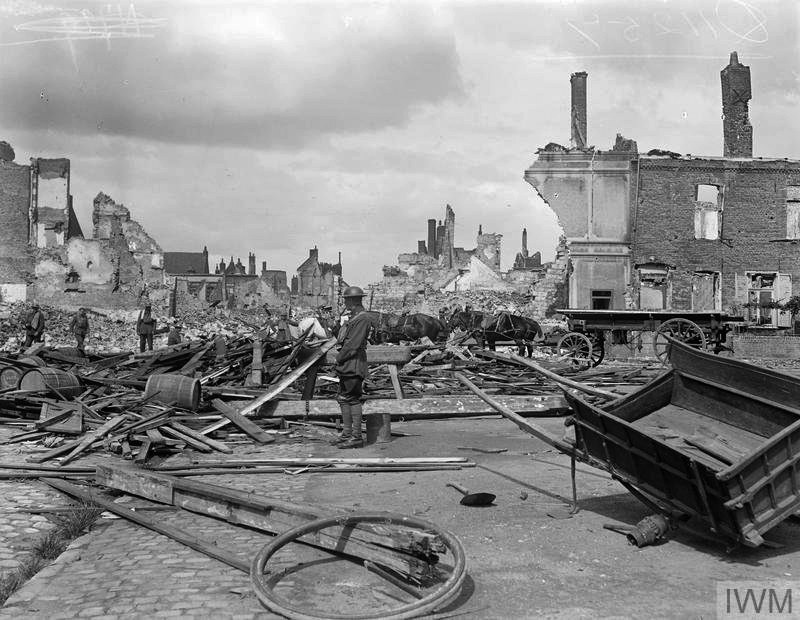
The Regimental History continues by describing the role that the 15th and the other Divisional Cavalry units played at the time.
During the ordinary period of trench warfare the squadrons of divisional cavalry did not as a rule have very much fighting to do, but they were by no means idle, as there were many different duties upon which they were employed. There were examining posts to be found on bridges and cross roads, guards over headquarters and important buildings. The various brigade and divisional headquarters had to be supplied with mounted orderlies. The Provost Marshal also required his share of men for traffic control and various other duties. The remainder of the men had to be ready at a moment’s notice, for they acted as a mobile reserve in the event of anything serious taking place.
On 10th March the Battle of Neuve Chapelle was fought but the 15th were not called into action. You feel that, without the “charge”, the army was not quite sure what to do with the Hussars, to use their mobility to best advantage, in the increasingly static warfare.
It is not a surprise, therefore that on 9th April 1915 the three squadrons were ordered to leave their respective divisions and were once more re-united as a Regiment and became part of the 9th Brigade with the 19th Hussars, the Warwickshire Royal Heavy Artillery and, later, the Bedfordshire Yeomanry.
They began training as a unit again but, at 7.45 am on 23rd April, without prior warning they were ordered to saddle up. The panic was caused by the Germans using poison gas shells. On the 24th the 15th moved to a wood and spent the whole night and the following day there in the pouring rain. On the 28th, however, William and the rest of the Battalion had to proceed to a farm a mile west of Ypres as a digging party. Under the direction of the Royal Engineers they dug new trenches next to a canal north of the city. But the Germans were forcing an Allied retreat and new trenches had to be dug anew as the Front Line gave ground. At this time there was a severe shortage of ammunition so often the troops had to huddle in the trenches as the German bombardment went unanswered.
On 13th May 1915 the Germans launched the heaviest bombardment of the war so far. Following this German assault, the 15th were part of an attempted counter attack. The History records:
At midnight, in pitch darkness and in pouring rain, the 15th Hussars formed up, and with fixed bayonets advanced to the assault of the German trenches, the position of which was only vaguely known. The reader can well imagine how very difficult and hazardous was this task. Luckily an officer who had been through the First Battle of Ypres remembered a track which led to the ruins of a farm near which the German trenches were supposed to run. The Regiment was thus enabled to keep its direction, and to the relief of everybody the trenches were found abandoned by the enemy. They were, however, badly knocked about, and almost untenable, consisting for the most part of shell holes filled with liquid mud. Our dead, our dying and our wounded were lying in all directions, mostly from the 8th Cavalry Brigade and the first thing to be done was to evacuate the wounded.
It was decided, however that these trenches were not defensible and a new line further back was dug by the Hussars. The men were tired and wet but from 3 am they worked feverishly in the rain to provide some cover from the enemy. Fortunately, the next morning dawned with heavy mist and they were able to make some reasonable trenches. The Hussars had originally been based on the colourful Hungarian Hussars and had prided themselves on their glamorous uniforms. Now they were in khaki and there was little glamour.
On the 18th May 1915 at 6.45 pm the 15th Hussars left their huts at Vlamertinghe and marched one and a half miles to Ypres where they occupied some five hundred yards of Front Line from the stables at Hooge Chateau to Sanctuary Wood. These trenches were in a terrible condition with mud and water over two feet deep in some sections, there was little defensive wire and there were no communication trenches behind the line. At night the men worked to improve the trenches, put up wire and dug communication trenches. All the time they were under the threat of sniper fire and occasional machine-gun bursts.
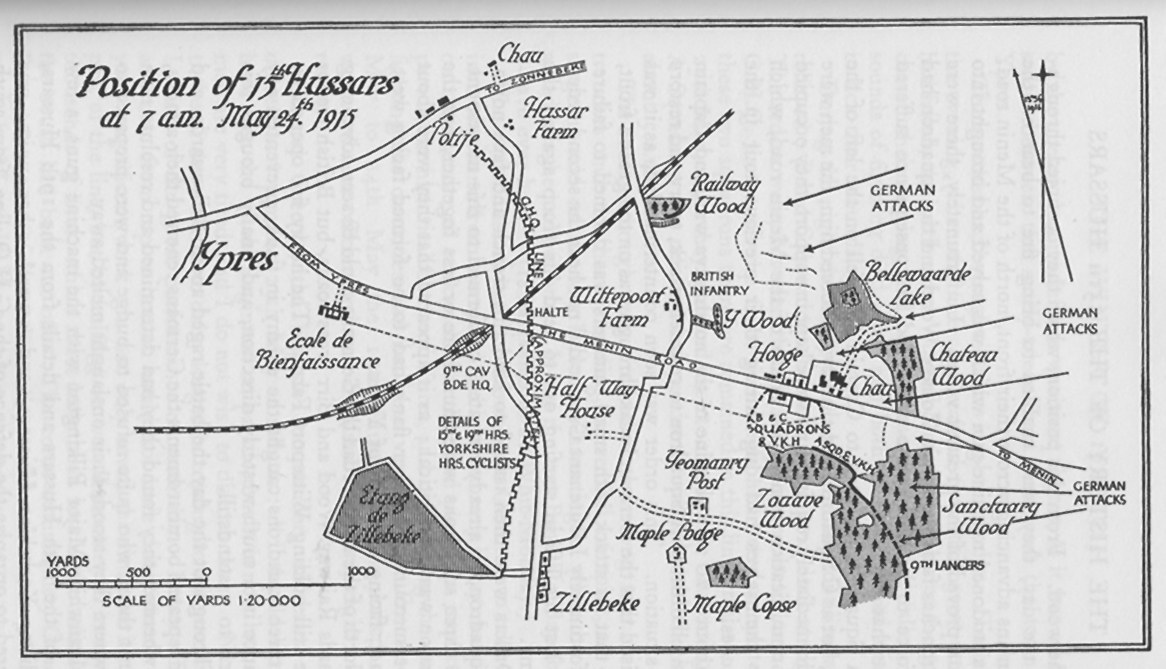
On 23rd/24th May the 15th were relieved by the 9th Lancers. Fortunately for the 15th, it was only now that the Germans released clouds of poison gas and attacked behind it. The 9th Lancers suffered badly but the gas thinned further back, and in spite of the inadequate gas masks, the 15th had only light casualties. Captain Stanhope of C Company realising that the Lancers were in trouble moved forward to assist. The other two companies also moved into the Front Line and there was heavy fighting. Despite lost ground by the Allies, the Germans failed to break through. It was probably during this turbulent period that William Meadows was wounded.
I have put “probably” because we do not have detailed records of William for this period and the man recorded as wounded had Regimental Number 1045 (not 6021). There is, however, no trace of another William Meadows with this number in the 15th and it seems very likely that it is our man and some mistake has been made in the ambulance train. As Peter (PRC), on the Great War Forum has pointed out.
Don't put all the blame on sloppy record keeping by the RAMC medical clerks - you may have a badly injured GSW victim, doped out of his mind on pain relief and speaking in a regional accent, it may be dark, his injuries may have made his ID disc unreadable or lost, none of his mates are with him, the tag from any earlier medical assessment has been lost or disfigured and it's fairly clear this guy needs to be moved on asap once stabilised and there are more coming in. The clerk isn't likely to get a second chance.
On the 25th May William was taken first to No. 3 Casualty Clearing Station, where he would have been assessed and then, because of the severity of his “gunshot wounds” caused by a shrapnel shell he was loaded on No. 5 Ambulance Train and taken back to England on a hospital ship.
Luckily, later records do seem to confirm that he was our man. They state that he was in France between 26th January 1915 and 27th May 1915 when he was brought back to England dangerously ill from shrapnel wounds and was treated at the Military Hospital in Aldershot. I think that the Ringstead Roll of Honour that has him wounded and demobilised was based on information from this period and William had disappeared from local view.
He did return to France, however, but over a year later, on 19th July 1916 and it seems likely that this was when he joined the Royal Engineers. Had his injuries made horse-riding difficult or was there now less demand for cavalry? He was given the Regimental Number 357555. We have no detailed records of his service with the Engineers except that he was promoted to Corporal. In view of his later career, he also picked up what we would now call “transferable skills”. He probably served with the RE until the 2nd May 1918
The Royal Flying Corps had been formed as a unit within the Royal Engineers but on 1st April, it, together with the Royal Naval Air Service, became an autonomous body, the Royal Air Force. The RFC had worked hard to slow the German advance during the Michael Offensive ensuring that the controlled retreat of the Allied Armies did not turn into a rout. The battle reached its peak on 12 April, when the newly formed RAF dropped more bombs, and flew more missions than on any other day during the war. The cost to halting the German advance was high however, with over 400 aircrew killed and 1000 aircraft lost to enemy action. It may be that William was part of an urgent drive to recruit replacement pilots
On 4th May 1918 William Meadows joined the new organisation and was given another Regimental Number 319080. He seems initially to have remained as a Corporal, the RAF only introducing its own ranking system in 1919. He would have returned to England on the 2nd May and undergone the training to become a pilot which by this time was an 11-month structured course. He first went to the Cadet Distribution Depot (CDD), was deemed “Fit as Pilot” on the 17th May and was posted to the 16TTW (Transition to War?) on the 25th. On the 2nd June he was sent to the 10th Cadet Wing where he would have had a two-month course which included drill, physical training, military law, map reading and signalling using Morse code. His record shows that he moved to the 5th Squadron of the RAF but the RAF Museum website states that he would have moved to a Training Depot Station (TDS) where he would have completed a minimum of 25 hours elementary flying training, both dual and solo, on Avro 504 aircraft logged over three months followed by a second phase of 35 hours flying time with five hours on a modern front-line type of aircraft. Students also had to demonstrate proficiency in cross-country and formation flying, reconnaissance work and gunnery. Finally, the men completed the training in the skills they would need to survive in combat.
By the time that he had completed his training the war was over and it may be that William did not complete this final phase until later. On the 18th December 1918 he was posted to a Rest Camp near Bedford and then, on the 3rd March 1919, to Crystal Place which was used by the RAF as a Ground School and balloon observation station. Perhaps it was here that he finished his training and was permitted to wear his Pilot’s Wings. His records show that he was “Discharged to Commission” on 5th April 1919. He was now an officer.
The periods of training outlined by the RAF Museum website do not seem to fit exactly to the records of William’s movements but I think that it is approximately correct. It also seems likely that soon after gaining his wings that William left the RAF. When we look at the brief record of his RAF career there is a surprising entry that decided his future career. His permanent home residence is shown as c/o Sir Charles Walpole, Broadford, Chobham, Woking, Surrey. In 1926 Walpole was found dead in his London home in Kensington Court, having committed suicide with a shotgun. He was said to have been suffering with sunstroke. Charles Walpole’s gardener at his Broadford estate had also been diagnosed with sunstroke when he threw himself under a train on his wedding day in 1899. Was there any connection?
One of Charles’s sons, John Robsart Walpole, had been a regular soldier who re-joined in WW1 and was killed on 1st July 1916. More relevantly, another son, Charles Archibald, was the Manager of the Anglo-Persian Oil Company. When William married on August 2nd 1924 his occupation was “Engineer” and it seems certain that he had already joined the Anglo-Persian (or later Anglo-Iranian) Oil Company. His new wife was Marianne (or Marianna) Alice Stokes, of Paris Farm, Lingfield, Surrey. At the time of the marriage William was living in Powis Square in Bayswater, about one-and-a-half miles from Kensington Court, Charles Walpole’s London home. We can see William’s direction of travel by the profession he had given for his father, which was “Gentleman”. The Electoral Rolls show that William Meadows senior did have the right to vote which meant that he had some land interest but his fellow shoemakers would have been surprised by this description of him.
The 1911 Census for Wisbech in Cambridgeshire shows Marianne Stokes staying with her older sister and her husband. It shows her as 28 years old and a hospital nurse. It also describes her as a “British Subject by Parentage” born in Coney Hall in West Wickham in Kent. Her father, William was a farmer at Coney Hall Farm. The whole estate was later sold and became an area of the London Borough of Bromley.
Marianne was living in a bungalow on Paris Farm and through the 1920s the Electoral Rolls show her there but not William. On the 26th September, only weeks after his marriage, William Meadows, a “Driller” was on the British Tanker Company’s British Mariner bound for Abadan in Iran. The tanker company was part of Anglo-Persian Oil Company It seems likely that most of William’s life was spent working on the oilfields in Persia. He was at home sometimes, however, and on 10th August 1926 Marianne gave birth to a son, William and she travelled with him and her husband to Abadan from Swansea on the British Viscount, on 27th November 1927. They were not together long for in 1930 Marianne died and was buried in the churchyard of St Peter and St Paul in Lingfield. Within the next few years William married Olga Mary Oldham, some twenty years his junior, in the British Consulate in the inland port town of Mohammersh [Khorramshahr]in Persia. Olga had been born in the Goldstone District of Surrey.
As we have seen, William had become a driller, which was a team leader in charge of oil well drilling. The driller also led the crew and the running of the rig, monitoring and dealing with any emergencies. It was an important role and as we have seen, meant that most of his life would have been on the oilfields. We see again that he left Falmouth on 12th October 1932 for Abadan. This time the tanker ship was the British Commodore and William’s occupation was given as “Petroleum Engineer”. His intended country of permanent future residence was given as Persia.
In the London Gazette of 12th June 1947, under “Foreign Services” in the Civilian Division, William Meadows, Driller, Anglo Iranian Oil Company Ltd [The title changed in 1935 and later became British Petroleum]. was awarded the British Empire Medal for “Meritorious Service”. Was it for service during the Second World War? With reason, the Iran government had always believed that it was not receiving as large a share of the oil profits as it was entitled to and there were always tensions. In 1941, the British and Russians occupied Iran to safeguard the oilfields and secure a safe supply route to the USSR, although a number of the tankers were sunk by the Germans during the war. A continuing supply of oil was vital to the Allies’ war effort.
On 10th June 1948 William Meadows, engineer, aged 58, sailed with Olga (38) and their 4½ year-old daughter, Dawn. The port of departure was Banare E Mahshahr [Bandar-e Mahshahr] and was heading for Grangemouth in Scotland. The intended future country of residence was still given as Iran. Their residence in England was now Woodglade in Lingfield.
There appears to have been one last voyage, when William, now 60, with Olga, 49, and six-year-old daughter Sylvia (Dawn was Sylvia’s second name) who had been born in Ahwaz in Iran. William was now shown as retired. The arrival date was the 17th June 1949 and they were heading for Wood Glade in New Chapel Road, Lingfield. I believe that, at about this time, the couple bought a large Georgian house in Wells-next-the-Sea called Marsh House. When we look for William’s death, there is one last surprise. The entry reads:
MEADOWS, William de Warrenne, otherwise William of Marsh House, Wells-next-the-Sea, Norfolk. Died 5th April 1976. Probate Ipswich 18 June. £16,487.
At 87, William’s gentrification seems complete. Olga lived to be 81 and died on 22nd January 1990, leaving £251,276. She had continued to live in Marsh House.
We have seen a remarkable journey for William Meadows from a poor childhood marred by tragedy. He had been badly injured in the First World War but it also gave him access to a successful career. Did he ever go back to Ringstead to visit those who stayed behind? All these brief biographies only give a glimpse of lives now gone but with William, more than most, you need the personal accounts of family or friends to join the public record dots together.