The Great War: A–M · Story 18
The Dainty Family
The Dainty family was originally from Titchmarsh. We will begin with William, an agricultural worker, born there in about 1809, and his wife Elizabeth. They had a son, also named William, baptised there on the 8th November 1835. He was in Back Lane, Titchmarsh in the 1851 Census with his parents and brother, John.
William, the younger’s, marriage arrangements were more complicated. From the records, it appears that he may have married Rebecca Plowman in Titchmarsh on the 26th July 1958. For some reason the couple parted and by 1861, aged 25, he was lodging at 196 Great King Street in Hampton, Birmingham, with tailor John Humphrey and his wife Jane, who were from Moreton Pinkney in Northamptonshire. With William was his wife “Ann”, aged 30, and also born in Moreton Pinkney, and their five-month-old, baby, George.
I do not think that the couple could marry without William committing bigamy and when they returned to Titchmarsh they had to revert to their unmarried status. Their son, George Dainty aged three was buried there, on 28th December 1863. I have not been able to find them in the 1871 Census but, in 1881, William was shown as 45 and single. He was an agricultural labourer living again in Back Street, Titchmarsh. With him is Maria Wilson, single, aged 50, with her two children Jane E. (11) and Mary M. (6). If we look back we find that Maria Wilson (sometimes Willson) had been born in Moreton Pinkney on 5th April 1827 and baptised there on 1st March 1829. She was the illegitimate daughter of Comfort Wilson, who married John Prestidge a few months after Maria’s birth. Comfort died in 1842.
The couple’s daughter, Jane Wilson, had been born in Titchmarsh but Mary was born in Sheffield. Matching the ages and place of birth it looks likely that “Maria” was the same person as “Ann” in the 1861 Census. The movement of the Dainty family between Northamptonshire and Yorkshire also complicates the issue.
But what about the male heir that we need to move forward with this surname? George William Dainty had been baptised in Titchmarsh on Whit Sunday, 20th May 1866, the son of William Dainty and Maria. Tellingly, the surname “Dainty” has been underlined four times. In 1871 he was six years old and staying with his grandparents, William and Elizabeth in Titchmarsh. He was called by his second name, George, probably to distinguish him from his father (and perhaps to replace the George who had died in 1863). I cannot find him in the 1881 Census. Perhaps he was making his way north because on 13th June 1886 he married Sarah Ann Schofield in the church at Brightside Bierlow. In 1891 George William and Sarah Ann had a first child, Walter aged one year, and they were lodging with Sarah’s father-in-law, Charles Schofield at 10 Upwell Lane in Brightside Bierlow near Sheffield.
His father William, too, had moved to the Sheffield area and aged 55 was working as a bricklayer’s labourer. With him and Maria “Dainty” there was still one daughter, Mary Maria (now also Dainty) and a granddaughter, Rebecca Dainty who was just five months old. They too are living in Brightside at 49 Woodbine Lane. By 1901 William and Maria were living at 11 Clarendon street with their daughter, Maria and her husband William Slack from Middleton in Derbyshire, and their children. They had married in 1892 in the Sheffield area. Her sister. Jane Elizabeth Dainty had married William’s brother, George Slack, the previous year and he features in the second book of these biographies.
It seems possible that something had happened to William, the father’s, first wife, Rebecca Plowman, for a William Dainty married Maria Wilson in the West Riding of Yorkshire in the 2nd Quarter of 1904. Is this the couple able to marry at last? It is also possible that the death of their daughter Mary Maria in the Thrapston area in the Spring of 1904 may have been the catalyst.
Meanwhile, their son George William Dainty was only two doors away at number 15, and, aged 36, was a stone quarryman. With him was wife, Sarah aged 33 and children Walter (11), Charles W., Mary M. (6), Florrie (4) and John W. (1). Now living with them was father-in-law, Charles Schofield (72) a widower and Emma Baugh (69), perhaps his partner.
By 1911 the family were back in Northamptonshire. They were living in Thrapston and George William was an ironstone miner (above ground), probably working in the quarries around Islip. With him was wife, Sarah Ann. They had been married 25 years and have had nine children, seven of whom are still living. The oldest son, aged 21, was an ironstone labourer like his father, but Charles William (19) was a shepherd on a local farm. The other children were Mary Maria (16) a domestic servant, Harriett (16) no occupation, George (8), William (6) and Violet (3). One suspects that Harriett was being kept at home to help with the housework and the younger children.
George William’s father had remained in the Sheffield area. We know this from a tragic accident that had happened a few months after the 1911 Census had been taken.
William had ben blind for some ten years and he would walk around the district, guided by his twelve-year-old granddaughter (probably Lily Slack). On Saturday 6th May 1911 she was guiding him from Attercliffe Common to Newhall Street. As they were walking past, a man stepped out from behind a tramcar and was struck by a motor car. He was knocked back unconscious, but in falling he collided with William who fell violently striking his head on the ground. He was taken to Firvale Hospital but died later that day.
More heartache was to come for the family, for the Great War was soon to begin and the two oldest sons, Walter and Charles William, were called to fight for their country.
Walter Dainty (1889-1965)
Walter Dainty had been the first child of George William and Sarah to survive into adulthood. Their eldest child, George William, like his father, had been baptised at Brightside on 18th May 1887 but was buried there on 13th March of the following year.
Walter was born on 12th September 1889 and baptised at Brightside Church on 25th of the same month. In the 1891 Census he was with his parents, lodging with his grandfather Charles Schofield. Judging from the dates and places where the children were born it appears that the family moved back to Northamptonshire in about 1904. By then Walter had followed his father into the ironstone mining industry as a labourer.
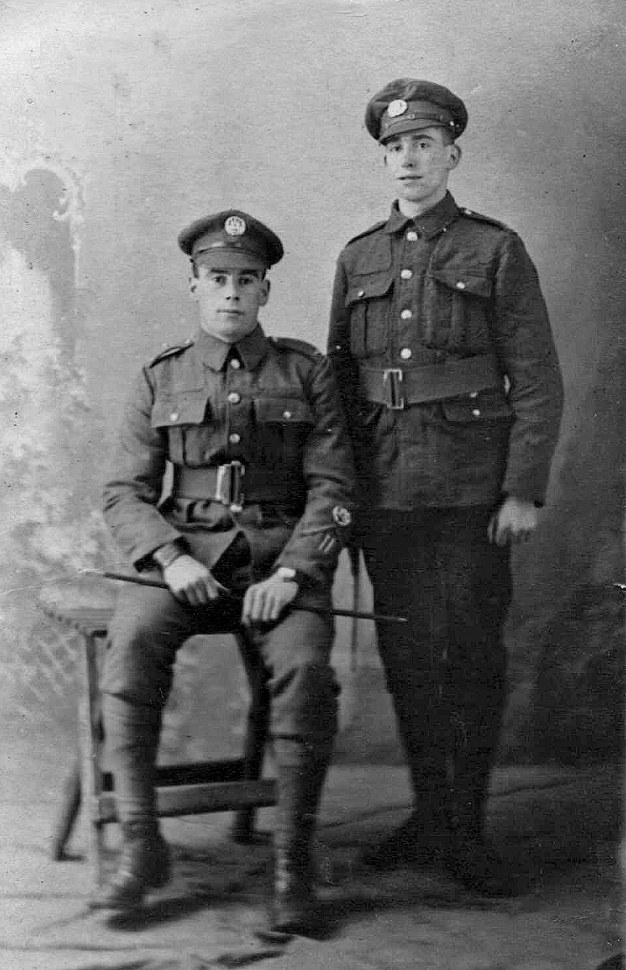
They were first living in Thrapston but within the next few years they moved to Rosebery Street in Ringstead. We know that they were there when Walter attested on 17th December 1914 at Rushden. He was twenty-five years old and five feet 5 inches tall.
His mother, Sarah Ann, suffered something of a shock. Ernest Edward Slack, her nephew from Sheffield, had joined the Northumberland Fusiliers. During his sick leave from his Regiment, he stayed with the family. Ernest stole a ten-shilling money order from her and was sent to gaol for a month, with hard labour.
Walter had signed up with the 2nd Battalion of the Northamptonshire Regiment and was given the Regimental Number 16763 (sometimes shown as 16765). He was posted to the Northampton Depot on the 18th December 1914 and sailed to France on 22nd April of the following year. The 2nd Battalion had suffered terrible losses in the Battle of Neuve Chapelle and Walter was one of the men from the New or “Kitchener’s” Army who filled the gaps.
He was to remain in France for 108 days and fought in some of the terrible battles of the Western Front. He would have been in the Battle of Aubers Ridge where the 2nd Northants were one of the lead Battalions in the offensive. The “No Man’s land” between the opposing trenches was less than 200 yards across. After heavy artillery fire, with the 2nd East Lancs, they moved forward. The History of the 2nd Royal West Surreys described what happened.
9th May 5.40 am. On further advance the East Lancs are hit by heavy machine-gun and rifle fire by the time they had progressed thirty yards from their own trenches; the Northants coming up ten minutes later, were similarly hit, but a party got through one of the gaps [in the barbed wire] blown by the field guns, and into the German front trench.
6.10 am. The front and communication trenches are by now crowded and chaotic. German shelling adds to the confusion. By now the fire across No Man’s land was so intense that forward movement was all but impossible. The support battalions of the 25th Brigade, the 2/1 Lincolns were ordered forward, to cross the craters; they did so losing many men on the way. Men of the Brigade were at this time seen to be retiring to their front line, having received apparently a shouted order. German prisoners making their way to the British lines were mistaken for a counterattack and there was great confusion.
As was often the case, the attack crumbled into stalemate. There were more than 11,000 British casualties on the day, the vast majority of those who died were killed within a few yards of their own front-line trenches.
It is difficult to imagine the impact this mayhem would have had on inexperienced young soldiers like Walter Dainty. Originally a Regular Army Battalion the 2nds had lost most of their professional soldiery in the first year of the war. Nevertheless, on 18th October 1915 the 24th brigade, of which the 2nd Northamptons were a part, were transferred to the 23rd Division to show the ropes to the less experienced battalions. The casualties had been so great that experience was a rare commodity.
In March 1916 they moved to the front line again between Boyau de L’Ersatz and the Souchez River where they were exposed to heavy shelling. The 2nd Battalion of the Northamptons were in that long Summer and Autumn campaign known as the Battle of the Somme which ran from 1st July and the 18th November 1916. It was an Allied Offensive by the British and French Armies and is remembered particularly for the great losses on the first day.
On 23rd July 1916 the Battalion marched to billets at Annequin and were training and preparing for action until the 30th. It is possible that Walter was injured, along with three other men and an N.C.O. when a Mills No. 5 Grenade went off prematurely during a practice on 28th July. All the men were sent to hospital and the matter reported to the Brigade H.Q.
On 30th July they marched back to the trenches. There was no major action in their sector but the Germans were continually peppering the trenches with “moaning minnies” (minenwerfers were a type of trench mortar) and aerial darts. The latter never became an important weapon but were feared by the ordinary soldiers. Invented by the French but used by both sides, they were like thick five-inch nails, with a sharpened point. They were packed in boxes of 500 and placed in a hole in the aircraft’s cockpit. The pilot pulled a string to release them and they spread over a large area, producing horrific injuries if they struck home.
It was most likely that it was during this period in the trenches that Walter was injured. He would have been sent, via the Field Ambulance, to the nearest Field Hospital and then ferried back to England in one of the Hospital Ships on 8th August 1916. He was taken to the Northumberland War Hospital where he was treated until 4th September 1916 and then, perhaps, sent to a Reserve Battalion for rehabilitation. It was only on 16th September 1916 that the Chronicle and Echo reported that he had been wounded.
He reported to the 17th Infantry Brigade Depot on 19th October 1916 and then was transferred to the 2nd Battalion of the Royal Berkshire Regiment on 30th October and given the new Regimental Number of 37472. He joined his new Battalion in the field on 1st November but it appears that on the 10th he was “Permanently attached for fatigues” to the 256 (Tunnelling Company) of the Royal Engineers, the last to be formed.
The records are a little confusing but it seems that he remained part of the Royal Berkshires and was, in effect, “seconded” to the Royal Engineers. Fatigues were often given as a punishment but referred to any duty which does not require the use of an armament. In March 1916, many former miners had been withdrawn from the ranks to establish a Tunnelling Company of the Royal Engineers. It seems very probable that because of his background and strength, (unusually he had a 40-inch chest), he was thought to be most useful in the dangerous work of the tunnelling engineers. The website quotes the words of E. Synton, written in 1918:
Everybody damns the Tunneller; GHQ because he invariably has his job finished months before the rest of the Army are ready for the ‘Great Push’; Army troops because he invariably upsets all their preconceived notions as to the safety of trenches and dugouts; Divisional troops damn him because he is outside their sphere of influence; Brigade troops because he refuses to move when they do and because he knows by heart that part of the line to which they come as strangers; Brass hats because they dislike his underground habits; Regimental officers because he refuses to allow them to use his deep and snug dugouts; Subalterns because of his superior knowledge; Tommy because he is the direct cause of numerous extra fatigues and – alas that it should be so – because of his extra pay; and last and loudest, the Boche damn him because of his earnest and unceasing attempts at uplifting and converting them into surprised angels. It is also owing to his success in this noble work of the missionary that the Tunneller is highly respected by all branches of the forces.
The only blot on his record seems to have been when he left “works without permission whilst on active service”, He was sentenced to four days No. 2 Field Punishment. Field Punishment No.1 was quite a common sentence where a soldier was placed in fetters and handcuffs (or similar) and attached to a fixed object. In the early part of the war this was often done with arms outstretched and the legs tied together, as in a crucifixion. There were stories that men had been placed in view of the enemy or with their feet not touching the ground. No. 2 Field Punishment was less onerous, for the man was fettered and handcuffed but not attached to a fixed object, so he was able to march with his unit. Nevertheless, he still had to endure hard labour and usually loss of pay.
Walter seems to have finally been transferred to the Royal Engineers 254 (not 256) Tunnelling Company on 3rd April 1918, with Regimental Number 359899 and it was as a Sapper that he finished the war. His service abroad finished on 15th December 1918 and he returned to England the following day. He was finally demobilised on 21st January 1919 and put on the “Z” Reserve which meant that he could be recalled if hostilities erupted again. He was entitled to the 1915 Star as well as the British War and Victory Medals.
He returned to Ringstead and probably took up again his pre-war job as a railway labourer. Early in 1926 he married Audrey May Liddington, some fourteen years his junior, in the Wellingborough District, possibly in Finedon where Audrey was living with her family, at least until 1916. Her father’s brother, John Francis Liddington was killed right at the end of the war in October 1918.
In 1939 his father, George William, now retired, and mother Sarah Ann, together with Walter’s brother William Charles who was a stockman and shepherd, were still living in Rosebery Street. Walter, a railway labourer, was living with wife Audrey in Agutter’s Cottages, set in the bend of Denford Road. It does not appear that they had any children
Walter died, aged 75, on the 30th July 1965 in the Thrapston District and Audrey died ten years later.
Charles William Dainty (1891-1932)
Charles William Dainty was born in the Sheffield area on 19th December 1891 and baptised at Brightside Parish Church on January 16th 1892. He was the son of George William Dainty and Maria Wilson. He moved with his family back down to Northamptonshire, first to Thrapston and then to Rosebery Street in Ringstead, shortly before the First World War.
He was a stockman on a local farm, although it appears that he had previously been an ironstone labourer like his brother. Charles attested on 23rd November 1915, aged 23 years 11 months and was put on the Army Reserve. He was mobilized on 8th February 1916 and became a soldier in the Northamptonshire Regiment with Regimental Number 22985. He was much slighter than his older brother being 5ft 5½ inches tall with a 35inch chest but was deemed “fit for general service”. The war was to put a great strain on his mental and physical health.
He was first posted to the Northamptonshire Regimental Depot and joined the 8th Battalion on the 10th February 1916. He was appointed Lance Corporal on 5th June 1916. In a reorganisation of the Reserve Battalions following conscription, the 8th became the 28th Reserve Battalion. Increasingly, after conscription, soldiers were allocated to a Regiment and Battalion, partly to prevent the wholesale slaughter of the young men from a particular village or town who had signed up together.
On 6th September 1916 Charles sailed to France and joined the 2nd Battalion of the Northamptonshire Regiment in the Front Line on 23rd of the same month. Just three days later, on 26th, he was shown to have been wounded and in brackets beside the entry it has the words “Shock Shell”. As he progressed through the hospital system the words become transposed to “Shell Shock”. It seems likely that it was the mental effect of action rather than a purely physical condition that Charles was suffering from.
His brother, Walter, was also serving in the 2nd Battalion although at this time he was returning to England after being wounded. Physical wounds were treated with respect but mental trauma was often looked on by fellow soldiers as weakness and even cowardice. By the end of the war 80,000 men had been treated for “Shellshock” and many suffered from it after the war had finished. Treatment did improve but the main purpose was to get the men back to the Front as quickly as possible.
In 1917, Siegfried Sassoon, who was treated for “war neuroses”, wrote with bitter irony:
Charles was finally sent back to England for treatment on 2nd November 1916 and remained there for 171 days. He first went to Birmingham War Hospital where he was described as still being in a very nervous state. He remained there until 14th November before being transferred to Woodcote Park Convalescent Hospital which was used mainly by the Canadian and troops from the Empire, especially after the carnage of Gallipoli. He recuperated until 28th January 1917. It is likely that the main “cure” was exercise and fresh air. His report stated that he was, “Still out of breath and cannot march far. Improving”.
He returned to the Depot of the 3rd Northants on 30th January 1917 but was deprived of his Lance Corporal stripe because he was “Absent off sick leave on 2nd/3rd April 1917 by twenty-three hours 55 minutes. It may be that he had been deemed as not suitable for this role and one would guess, pride apart, that he would have been glad to lose it.
On 23rd April 1917 he sailed from Folkestone to Boulogne and joined the 17th Infantry Brigade Depot at Calais. It was not until 4th June 1917 that he re-joined the 2nd Battalion of the Northamptonshire Regiment in the field. 31st July 1917 marked the beginning of a new phase of the war usually known as the 3rd Battle of Ypres This started with a planned assault by the Allies. It was also the day when Edgar Mobbs the charismatic leader of the Northamptonshires’ 7th battalion, was killed.
For Charles, it would have been a day, once again of panic and fear for his military record shows that he was “Buried by Shell” blast with, in brackets, “Concussion”. On August 3rd he once more returned to England, this time on the Hospital Ship St Patrick, a converted ferry from the Fishguard-Rosslare route, requisitioned for the duration of the war. There is some confusion here because the Register for the No. 2 Military Hospital at Old Park, Canterbury has Charles admitted to hospital on the 2nd July 1917 but I think perhaps this should be 2nd August and he was in hospital for 15 days until 16th August. He was once again diagnosed as having shellshock. One could hardly be surprised in the circumstances.
He remained in England until 30th September 1917, before returning to Boulogne on the following day. On 3rd October 1917 he was posted to the 17th Infantry Brigade Depot in Calais before joining the 7th Battalion of the Northants in the field on 9th October. Just three days later on 12th October he was sent to the Field Hospital. Again, he proceeded through the system to Rouen. He had been diagnosed as suffering from Myalgia (acute muscle pain). Once more he returned home and finally was sent to the Red Cross Hospital in Gloucester to recover until 16th January 1918 when he was granted a furlough until the 25th.
I think he must have then been posted to a Reserve Battalion although I have not found any evidence for this. He embarked for France on 4th April 1918 and joined the 7th Battalion on 18th April. Six days later, on the 24th April, he was once wounded, in the leg by a bomb (probably a shrapnel shell). Again, he went through the casualty system from Carrieres to Étaples and on to Trouville.
This time he did not return to England but re-joined the 7th Battalion of the Northants in the field on 16th June 1918. On the 19th June he was treated for Pyrexia (Fever) or P.U.O. (Pyrexia of Unknown Origin). This was more usually known as Trench fever and was an unpleasant and sometimes very painful condition caused by the excretions of lice entering a wound. He was at Trouville, also suffering a “mild” attack of influenza, until 21st September. On 5th November he was sent to the 24th Division’s Reception Camp and an 10th November he re-joined the 7th Battalion of the Northamptonshire Regiment. The Armistice was signed on the following day.
Charles remained in France until 28th January 1919, returning to England on the following day. On 24th February 1919 he was demobilised. Perhaps surprisingly, he was placed on the “Z” Register which was for soldiers who could be recalled if hostilities began again.
Charles retuned to Ringstead and in the 1920s was living with his parents in Rosebery Street. We have seen that throughout the war he had suffered from mental and physical “wounds”. It is difficult to believe that these problems did not stay with him in his civilian life. He died in 1932 aged 39 years of age. He was a casualty of the war as much as those who appeared on the Ringstead War Memorial.