The Great War: A–M · Story 14
The Braybrook Family
Each of these stories is trying to reveal a little of the individual lives of the men of Ringstead who fought in the Great War. We see that, sometimes, a number came from one family but this is not the only connection hiding below the surface. Some men were neighbours or friends, or members of extended families masked by differing surnames. There was a tangled web of ties, bloodlines and friendships that would have involved most of the village.
James Braybrook was a farm labourer born in Keyston in Huntingdonshire in about 1837. Today, the A45 slices through between the two villages but for many years there was a well-used cart track between them starting in Denford Road. He married Frances Knighton from Tansor on 24th July 1857 and they produced at least ten children: Rebecca, Elizabeth, John, Joseph, Mary, Emma, Frederick, Charles, Louisa and Matilda.
One daughter, Louisa married Arthur Baxter and lived in Ringstead. We have seen that both their sons, Percy and William were killed in the war. Her father, James, lived in Ringstead with the Baxters after the death of his wife, Frances, in 1898.
John, the oldest son, born in about 1862, also moved to Ringstead marrying Mary Ellen Dunkley there, on 30th March 1891. He seems to have had an entrepreneurial spirit because although originally a labourer like his father, by his wedding he was a carter and, in the Census of that year, he was a coal merchant. In 1897 he wrote to George Capron about renting some vacant land and his address was The Swan, Ringstead. In 1901 he was described as an innkeeper and coal merchant.
In the 1901 Census the couple had three sons, Herbert (9), Frank (7) and Sydney (2) and by the following Census there were also three daughters. The 1911 Census states that they have had eight children, one of whom had died. This was Margaret Annie who had died in 1897 as a baby. Another daughter, Violet, was with her maternal grandparents. Herbert had already left home and was working as a groom in Thrapston. By 1910 John’s tenure of The Swan had finished and his coal business also seems to have failed. He was now an ironstone labourer and the family were living in Rosebery Street.
Herbert John William Braybrook (1892-1917)
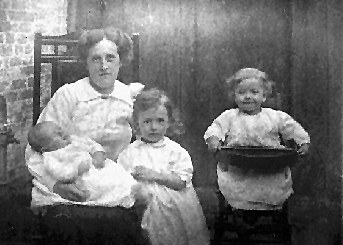
Herbert, the oldest child, began his working life as a groom in Thrapston, where he was in 1911, before moving to Leicestershire. Soon after moving, in 1913, he married Annie Sarson in the Barrow-on-Soar District. She was the daughter of Thomas and Sarah who had come from Derbyshire. In 1911, her father was working from home in School Street in Syston as a tailor. The newly-wed couple also lived in School Street, at number two, perhaps with Annie’s family.
They were not to have a long married life but between 1913 and 1916 they had three children, Margaret, Herbert and Thomas. Before the birth of the youngest, Thomas, Herbert had volunteered at Leicester, for the Leicestershire Regiment. He was, initially, given the Regimental Number 16166 but later changed for 20087, and then 203181 when a new system of six-figure numbering was introduced.
He embarked for France on 30th July 1915 and fought on the Western Front. The 6th, 7th and 8th (Service) Battalions had been formed in Leicester in September 1914. In April 1915 they all became part of the 110th Brigade, 37th Division and followed the same path in the war. They first landed in France on 29th July 1915 so it seems likely that Herbert was initially in one of these battalions.
The 7th Battalion, in 1916, were in action in the Battle of the Somme, including The Battle of Bazentin Ridge (14th-17th July) which was initially a successful Allied attack but which, as usual, descended into a continuing attritional action with neither side gaining a decisive advantage. The rain and the mud in a shell-holed landscape weighed the balance in favour of defenders over attackers. In September there followed The Battle of Flers-Courcelette and The Battle of Morval. Just before this, however, Herbert was wounded and may have missed these later actions. On 22nd August 1916 he appeared on the War Office Casualty List. He was entitled to wear a “Wound Stripe”. These stripes had only just been introduced by an Army Order of 6th July 1916. Accidental or self-inflicted wounds were not eligible.

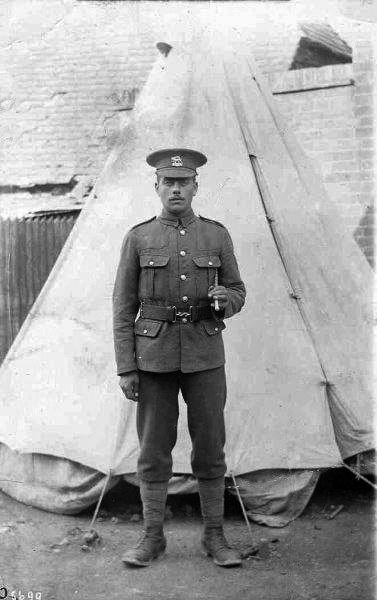
It was a small stripe of Gold Russian braid (or, later, sometimes brass, because it was easier to detach and clean) which was worn vertically on the left arm of the uniform between elbow and cuff. It was quite inconspicuous and not easily seen in faded old photographs.
Herbert’s wound was reported on 25th August 1916 in the Leicester Journal, but we are not sure if he returned to England. It may be that he did, and it seems likely that it was at this time that his regimental number changed from 16166 to 20087.
We do know that in 1917 he was serving with the 1/4th Battalion of the Leicestershire Regiment. In May of that year the 4th Battalion were in trenches at Lievin, near Vimy, preparing for an assault against the Germans. On 8th June the day started at 5 a.m. with a heavy shell bombardment of the enemy positions. It continued until “zero hour” which was 8.30 p.m. plus three minutes. The troops began to assemble in the trenches ready to move forward. At 8 p.m. the enemy barraged the assembled troops. Had they had intelligence about the intended assault?
At zero hour the Leicesters “went over the top” and started towards the enemy trenches, with a creeping barrage of shrapnel bombs moving ahead of them. Herbert was part of “A” Company which had been specially trained for “wiring” but it was not called upon. “Wiring” was dangerous work, done at night, to repair and rebuild wire defences and cut the enemy's. On the Western Front, cutting parties tried to create breaches in the wire lines, giving a better chance of crossing no man’s land. On this day some 70 “Other Ranks” in the Leicesters were killed.
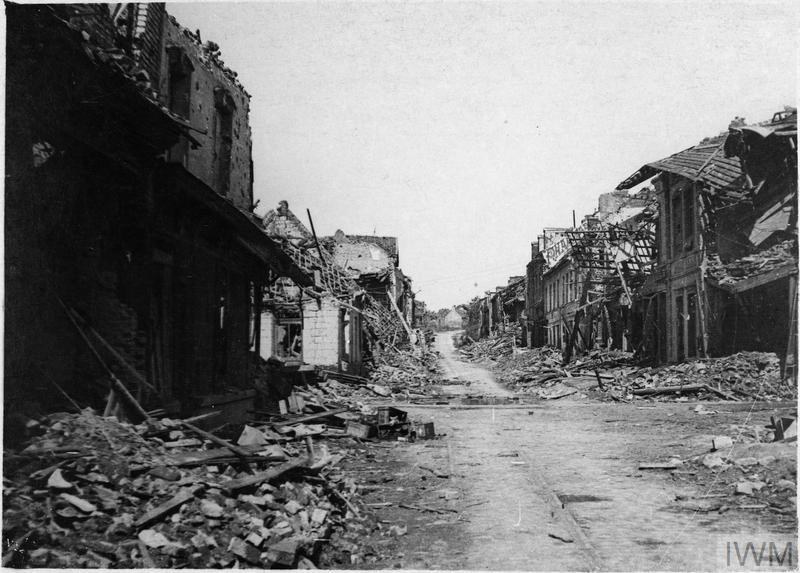
Herbert was one of these casualties of the 8th June and was buried in La Chaudiere Military Cemetery at Vimy. He was twenty-five years old. His death was recorded in the Northampton Mercury on 6th July 1917 (which has his death as June 9th) and in the Leicester Journal on the 20th July 1917. His Regimental Number was now given as 203181. He was entitled to the 1915 Star and the Victory and British Medals. He is not on the Ringstead War Memorial but he is on the large imposing one at Syston.
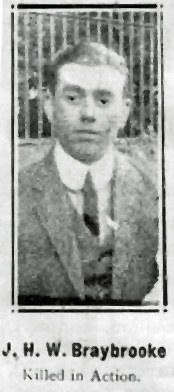
His widow, Annie, had had a very brief time together with Herbert but she never married again. In 1939 she was recorded as still living at 2 School Street in Syston with her three children, Margaret, Herbert and Thomas. She died in 1968, over fifty years after the death of her husband.
Sydney Edward Braybrook (1897-1976)
I have not found any military records for the middle son, Frank although this does not mean definitely that he did not serve in the army. He remained in the area and in 1939 he was living with his family in Raunds. The youngest son, Sydney Edward Braybrook, certainly did join the army and served on the Western Front.
In 1911, Sydney was twelve years old and in the occupation column has written “school” and “errand boy”. He was only sixteen when the war started and one suspects that his parents would have hoped that the war would be over, if not by Christmas, at least before he reached eighteen years of age. Unfortunately they were wrong and conscription was introduced. On 26th June 1916 Sydney was posted to the Queens (Royal West Surrey Regiment) just one month after his eighteenth birthday.
He was given the Regimental Number G/30153 and became part of the 8th (Service) Battalion. In the previous year, at the Battle of Loos, the Division it was part of, suffered 4178 casualties and spent the rest of the year rebuilding its numbers.
His military records are largely lost but he should not have been in France until he was nineteen years old. but it seems likely that he was there some time in 1917. The Queens were part of the 72nd Brigade, 24th Division, and fought in the Vimy area as part of the Battle of Arras. This started on 9th April 1917 but when one reads the War Diary for the 8th it is almost lost among the small actions and continual losses and the details of movement to and from the trenches and the days of comparative rest and training. On the Royal West Surrey website, Michael Page quotes from a letter sent on May 18th by Harry Brodie, an officer who saw action there, and who had this unique view of the battle.
I saw a good deal of the so-called battle of Arras – a huge operation lasting for days. One day in particular I was on a ridge a few miles in front of Arras – shells from our own heavy guns & from the German guns were [coming] in the air above – not many. A mile or two further ahead was a line of small explosions & puffs of smoke when the shells were playing on the contending front lines. Our guns were letting off not far ahead at all sorts of angles. A battalion on the right were cooking their evening meal, while waiting to go forward. An occasional shell dropped into a mined village about 100 yards to my left – aimed at the X [cross] Roads in the village – but not so far stopping a ceaseless stream of lorries & waggons. A little further to my right a game of football was proceeding. A little to the front – perhaps a quarter of a mile nearer the enemy a regimental band was playing popular airs – & right above aeroplanes – not bigger than dragon flies were flitting about [hounded] by the little white puffs which represent the shrapnel bursts from Anti-aircraft guns – in a line below the moving aeroplanes were our stationary balloons – called (and they are very like) sausages. Green rolling country dotted with tents – horse lines – several with trenches strewn with rusty barbed wire – all villages in sight in ruins – all trees cut rather neatly down & evidently in process of conversion into sleepers for light railways – & perhaps for dug out[s] – the whole gilded by an afternoon sun – with some nesting partridges calling amidst all the din & confusion.
As Hardie says later in his letter, the ordinary soldiers in the trenches, “see practically nothing of what is going on”.
There followed the Battle of Messines in June, the Third Battle of Ypres in October before they moved south to take part in the Cambrai Operations when the Germans counter-attacked.
The campaigns of 1918 really started in March with the great German offensive often known as “Operation Michael”. This was, by World War 1 standards, a successful German attack which the Allied forces managed only to slow and make expensive, in terms of Germans killed. In this terrifying scramble to safety many acts of heroism were recorded. One was by Lance Corporal J.W. Sayer of the Queens who held the Germans back from Shepherds Copse in the defence of Le Verguier on 21st March 1918. He was awarded the V.C. but this goes unrecorded in the Regimental History written in 1925 perhaps, partly, because he was not from one of the Regular Army Battalions. For Sydney and the 8th it would have been a time of chaos with battalions separated and trying to hold the line to enable some sort of orderly retreat.
The Germans, however, had nearly exhausted their supply of men and the “100 Days” of the Allied decisive counter attack followed. The Surrey’s final engagements were The Battle of the Sambre and the Passage of the Grand Honelle. They ended the war at Bavais in France.
One wonders if Sydney celebrated too much for, three days after the Armistice, he was taken by train from Delsaux Farm to Carnieres to be treated for inflammation of the connective tissue of the right hand. He was only in hospital for a day and, on the 15th November was discharged back to duty.
He remained in the army,, but on 20th March 1919 he was deemed no longer physically fit for war service. On 16th May 1919 he was given a silver badge and was finally discharged from the army. The silver badge could only be worn on civilian clothes and was designed to stop the wearer being bothered by the white feather women, although by this time this seems less likely. He was awarded the Victory and British Medals. On his Medal Roll it has him in the 10th Battalion so perhaps he was transferred near the end of his military career.
Sydney was still only twenty years of age. He returned to Ringstead and married Ellen M. Groom in the last quarter of 1919. I have not found any children of this marriage. Ellen died early in 1939, aged forty years, and Sydney married again to local woman Evelyn Louisa Weekley in the third quarter of the same year. So, in the Register of English & Wales, taken on 29th September of the same year, it is Sydney and Evelyn who are together.
Sydney was now an Iron Blast Furnace labourer and must have, to some extent, recovered from his wartime injury. Evelyn died too on 19th April 1960 at the Kettering General Hospital. At the time of her death the couple were living in “Sunnyhill” in Denford Road. This may be 34 Denford Road where Sydney died too on 6th April 1976