The Great War: A–M · Story 12
Cecil Bellamy (1888-1968)
Cecil Bellamy was the illegitimate son of Jane Ann Bellamy. He was born on 9th January 1888 and christened in Ringstead Parish Church on January 24th1890. In the column for “Father“ the name “Michael” has been written in and then crossed out. It seems possible that when the vicar asked Jane who the father was, she misunderstood the question and gave her own father’s name.
In the 1891 Census, Jane was a shoe stitcher. She and three-year-old Cecil were boarding with Reuben and Lucy Shipley and their children in Church Street. On 6th August 1895 Jane married Albert Victor Smith and it may be that Cecil never lived with his mother again. In the 1901 Census, aged thirteen, he was still living with the Shipleys at 18 Church Street. He was now shown as a nephew. Living next door were Percy and Herbert Baxter.
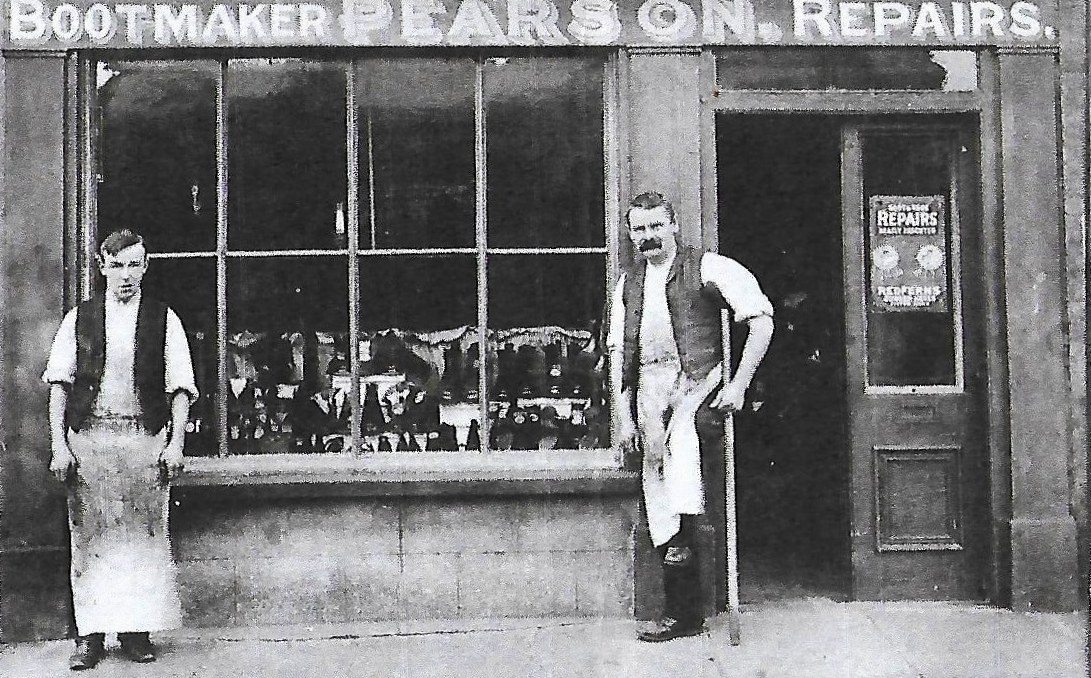
Jane, meanwhile, was living with her husband in Wood Street in Wellingborough. With them was Jane’s daughter, Bertha aged nine, and three children from their marriage. By 1911 they had moved to 57 Nelson Street in Kettering but by now Cecil had found a new home in March in the Cambridgeshire Fens. He was boarding again, this time with John Pearson, a bootmaker and dealer, at 5 Nene Parade. Cecil, now 23 years old, was working for John as a Boot Repairer. When we look more closely we see that John Pearson was the famous man on the Raunds March in 1905. He had lost a leg to childhood tuberculosis and had walked all the way to London on crutches. He had later set up business in March and Cecil had joined him there as an assistant.
It was at March, on 11th December 1915, that Cecil enlisted in the Suffolk Regiment and was placed on the Army Reserve List. On 29th April 1916 he had his army medical at Bury St Edmunds. He was 28 years 2 months old. His height was first recorded as 5 feet 3 inches tall which was originally the minimum height for soldiers to be accepted into the army. Later, in 1915, this was relaxed and the “Bantam Battalions” were introduced. In Cecil’s case his correct height of 5 feet 1 inch was later inserted. The officers, who mainly came from the affluent classes, were on average, some six inches taller than the men that they commanded. He had a 35-inch chest and weighed 99 lbs (7 stone 1 lb or just under 45 kilos). His physical development was described as “good for size”. He had upper and lower dentures.
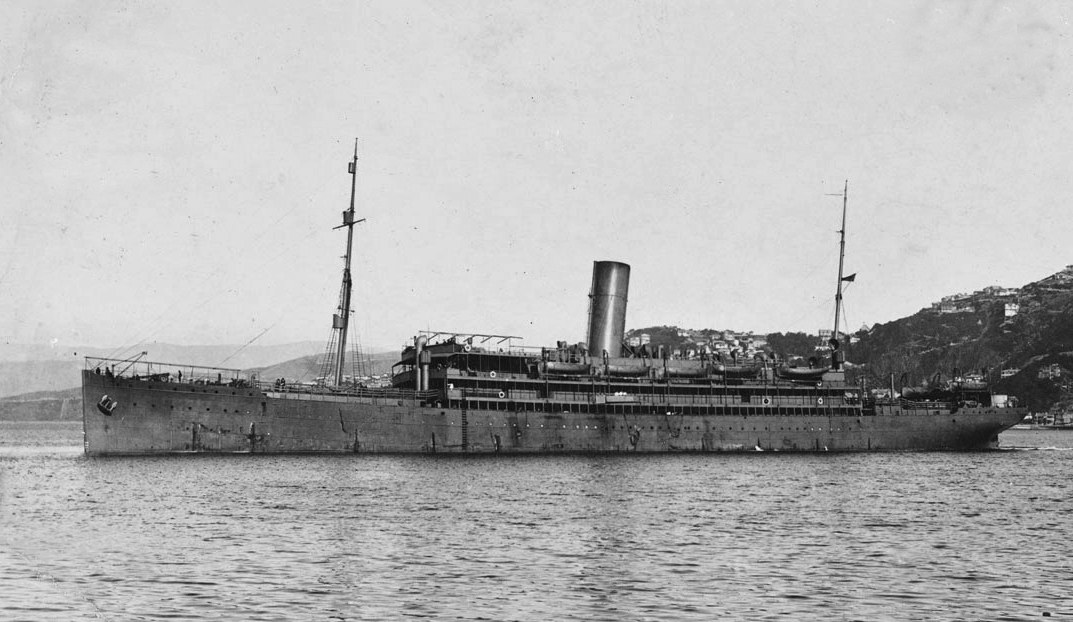
Cecil stayed in England, training with the Suffolk Regiment, from 18th May until 28th August 1916. He was then transferred to the 2nd Battalion of the Norfolk Regiment. On the 3rd September he was taken to Devonport and the following day he boarded the H.M.T. Tahiti. I think it was actually, His Majesty’s New Zealand Transport Ship (H.M.N.Z.T.) Tahiti which on 22nd August 1916 had been part of a convoy bringing various New Zealand Brigades (including some Maori contingents) to England to be taken to the Western Front. On her voyage home she took some of the 2nd Norfolks to Basra (now in Iraq) where they disembarked on 28th September 1916.
Cecil remained in the area, then known as Mesopotamia, for one year 280 days. He was fortunate in that he had missed the Seige of Kut. Despite attempts by the British to lift the siege and rescue the 2nd Norfolks being starved into submission, they were forced to surrender on 29th April 1916. Most of the Battalion were taken into captivity and many died under the harsh regime. It was one of the British Army’s worst defeats. For a time, the 2nd Battalion ceased to exist and Cecil was part of the draft of troops brought in, in its reformation.
One major cause of the defeat was the lack of a transport infrastructure and the British now put their efforts into improving the port of Basra, building roads, bringing in more and larger river steamers and putting new field hospitals into service. This enabled troops to be moved quickly up to the Front Line and to be better supported.
When Cecil arrived he went to Sheikh Sa’ad as part of the new 2nd Battalion and spent the next few months in training.
The British, now properly prepared, advanced up both sides of the Tigris River. They retook Kut and by early March were at the outskirts of Baghdad. On 11th March 1917 they entered Baghdad and were greeted as liberators. Unfortunately, Cecil could not have been part of this victory celebration for, a week earlier, on 4th March, he was admitted to Field Hospital A36 with diarrhoea, the scourge of European in Africa and Asia. He was fortunate not to have been in the area a year earlier. As we have seen in the biography of Henry Attley many Indian troops fought in Iraq. The Brigade Major of the 69th Punjabi, Thomas Catty, wrote in his diary on 19thJanuary 1916:
At Amara we heard tales of the bad medical arrangements but it wasn’t till we got to Sheikh Saad that it really came to our notice. On landing there the place was ankle deep in mud. The OC [Officer Commanding] told us that he had 1000 Indian sick and wounded and only one IMS [Indian Medical Service] man, who was down with dysentery, to look after them. There were no dressings or medicine and most of the wounded . . . had not had their 1st Field Dressing removed . . . all agreed that the state of affairs was disgraceful. The fellows on shore were very despondent and said the boats going down stream were awful – when you went on board the stench nearly knocked you down.
Cecil was discharged from hospital on 9th March and on the 22nd went to a rest camp in Sheikh Sa’ad.
It appears from his records that Cecil did not rejoin the 2nd Battalion of the Norfolk Regiment at Baqubah, some 31 miles north-east of Baghdad, until 20th September 1917. On 1st December he travelled with the 2nds to the Ruz Canal Camp and attended a training school for the Stokes Mortar. This was a small British 3-inch trench mortar which had only recently been introduced. It was a simple weapon but, because the barrel was only three times the weight of the bomb it was delivering, it had a large recoil that could cause serious injury if it was not properly set up.
We may think of this posting as an easy option compared to the Western Front but as John Ball, writing on his website about his father who served in Mesopotamia, makes clear, it could be a draining place to serve in. He quotes from a newspaper article written by Edmund Candler.
The heat of the desert in trenches and tents is staggering. One feels as if one were standing at the edge of a huge fire in a high wind, licked by gusts of flame.
The flies were unbelievable. You could not eat without swallowing flies. You waved your spoon in the air to shake them off: you put your biscuits and bully beef in your pocket and surreptitiously conveyed them in closed fist to your mouth, but you swallowed flies all the same . . .
However, the 1917 summer was even worse and it was known in Baghdad as “the hottest season in the memory of man”.
Cecil remained in Amara until 9TH March 1918 when he went to the post camp at Hinandi, near Baghdad before, once again rejoining his battalion at Mirzana on 23rd April 1918. He then left his unit for leave in India on 29th May. It was not until the 10th June that he embarked on the A.T. (Army Transport) Versova at Basra for India and returned there on 5th August 1918. On 23rd August 1918 he rejoined the 2nd Norfolks at Mirzana. He then remained in Mesopotamia until 30th October 1919 as part of the Army of Occupation.
He left Iraq finally by ship on 31st October 1919 arriving in England on 2nd December but was not finally demobilised, on Class Z, until the 31st December.
It seems that Cecil never returned to Ringstead to live. In April-June 1921 he married Emily Spencer in the North Witchford District of Cambridgeshire. Emily had been born in Wimblington and in 1911 was a servant in Wisbech. March is just ten miles from Wisbech so did she meet Cecil when taking shoes to be repaired for her employers or was she now living in March? At the time of her marriage she was residing at 5 Johnson Square in March. Both of them were in their early thirties for the war had delayed marriage for many couples.
They lived at 4 Nene Parade in March, next to the Ship Inn, where Cecil had his shoe repair shop. They had at least three children, with the oldest, Jack, becoming a boot repairer at the shop. In the 1939 Register of England & Wales we see the family together there, and it may be that Cecil and Emily lived in March for the rest of their lives.
Certainly in 1965 the Bellamys were still there with son, Jack, still at home. Cecil died in 1968. He was eighty years old.