The Great War: N–Z · Story 23
John Thomas Watts (1887-1917)
Hannah Groom was born in Denford to brewer John Groom and his wife, also Hannah, in 1844. In 1861, aged 16, she was living in Church Lane with her father and her brother, Joseph, and his wife and family.
Hannah had not married, but had three children, George, Harry and James. Meanwhile, over the hill in Ringstead, William Thomas Watts had married, the unfortunately named, Fanny Elizabeth Annies on the 19th November 1874. I have not found any children for the couple who, in 1881, were living in Ringstead High Street. Fanny was entered under her second name, Elizabeth. She is shown as having been born in Pertenhall in Bedfordshire, but so is the next person in the Census, and I think this may be an error by the collector.
In 1886 Fanny died and was buried in Ringstead on the 14th August. William married again, to Hannah Groom of Denford on 10th October 1887. As we have seen, Hannah had three children of her own. She was seven years older than William and at 44 years old would seem unlikely to have a further child but, by the end of the year a son, John Thomas Watts was born. He was christened in Ringstead Parish Church on March 9th 1888.
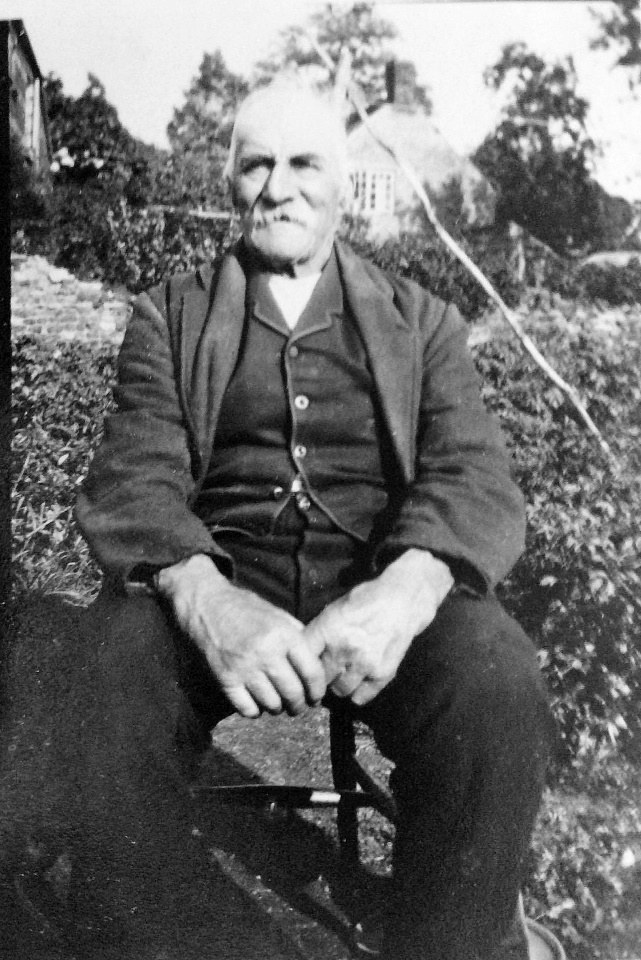
In the 1891 Census, William, aged 40, and now an Ironstone Labourer, was living in Carlow Street with Hannah, her three grown up sons and three-year-old John Thomas. They were next door to the Axe and Compass public house. By 1901, William was a builder’s labourer. Hannah died in 1908, aged 65, and in the following Census, at the age of 60, he was now a road labourer. Only George Groom, aged 49, an Ironstone Labourer, one of Hannah’s older children, was still with his widowed stepfather. [John} Thomas, aged 23, and now a “Handsewn Army Man” was also with them in Carlow Street.
John was out of work, as many of the “Handsewn Men” of Raunds and Ringstead were in this Census. When the Great War came three years later, it brought work but took away fathers, sons, brothers and husbands.
As John’s military records have been largely lost we can only estimate when he attested, mobilised and was posted to the Western front. We do have some evidence. He joined the Northamptonshire Regiment and was given Regimental Number 23449. Two experts on the Great War Forum, Steve (Stebie9173) and Craig (ss002d6252) have used the records to show that he would have attested in late 1915 under the Derby Scheme.
This scheme, named after Lord Derby, was introduced in 1915 to try to increase the number of recruits, because the initial flood of volunteers was drying up. All men between the ages of 15 and 65 had to register and this revealed that almost five million men of military age were not in the forces. Of these, only 1.6 million were in protected occupations. The Derby Scheme was brought in to allow men, who voluntarily attested, to either agree to immediate service (Class B) or be put on a deferred list (Class A) under the understanding that they would be mobilised later.
John Watts attested under this Scheme and at about the same time he married Lucinda Bate (or Bates) at the end of 1915. I Have not managed to find Lucinda in other records before her marriage but I think this may be that she used another first name.
Craig, on the Great War Forum, has looked at John’s pension records and has estimated that he would have been mobilised in February 1916 and Steve, on the same site, has worked out that he would have been with the 6th Battalion of the Northamptonshire Regiment in France in late July 1916. We also know, however, that Lucinda became pregnant in late 1916 so, unless John was not the father, he either did not go to France before the end of 1916 or he had leave from the army at this time.
If John had joined the 6th in late July 1916, he would have joined a unit that had fought bravely, with terrible losses, at Tones Wood and Pozieres. After that the Battalion was in and out of the trenches, sometimes under heavy fire, but with no further significant actions. That winter was a bitter one for the men with snow and ice.
In February 1917 the 6th were in the line near Miraumont and Grandcourt, battles mainly remembered for the terrible conditions. The Germans had started a planned retreat to the heavily fortified Hindenburg Line that they had been constructing. Although they were giving up their positions, they had planned this an orderly retreat with a strong rearguard action to allow this to happen.
At the beginning of March, the Battalion moved to dugouts and tents in Thiepval Wood. They were fighting alongside the 12th Middlesex and the 7th Bedfordshires, supported by a squadron of cavalry and a company of cyclists. On the 21st March the 6th were relieved in the Front Line and in a series of moves by bus and train, linked by marches, they had reached Thiennes by the end of the month. In the following two weeks they were in camp, training but the weather was very wet and often the physical work was replaced by lectures in the billets. They may have been bored but at least they were dry.
On the 21st April 1917 the Battalion moved to Manqueville, still training and with the luxury of an occasional bath. They then received orders to move to the Arras area and by the 28th, the A and D companies were in the Front Line, with the B and C companies in support. It was here that another Ringstead man, Charles Arthur Major was killed. By May the Allies were in front of the Hindenburg Line with the 6th at Cherisy.
On the night of the 3rd May 1917, a preliminary bombardment was followed by a rolling barrage some 200 yards in front of the advancing troops. The War Diary has inserted a report of this attack by the 6th on Fontaine Trench, by Lieutenant Colonel R Turner D.S.O. which continues with the account:
. . . the Northampton Regiment attacked on a 2 Company front in three waves. They must have followed the barrage very closely having of course a certain percentage of casualties from our own barrage. Immediately they came into view over the crest they were under very heavy Machine Gun fire and they covered the ground at the double.
The left Company seeing that the way was clear and that there was cover in the CABLE TRENCH ) O.32.a.3.8 got into the trench and bombed straight down FONTAINE TRENCH and were in the trench 10 minutes after barrage opened having a bombing post at O.32.a.5.7 to protect NORTH flank as the Company advanced down FONTAINE TRENCH they killed a few of the enemy and discovered a few dead from previous artillery fire and could observe from their position the right Company advancing to the attack. The right Company as they neared the trench did so in small rushes from shell-hole to shell-hole, when within 30 or 40 yards of enemy wire they were completely held up in shell holes by very heavy Machine-Gun fire.
A vigorous resistance was made but left Company Commander seeing that the right Company could not possibly gain their objective and as the left attacking Battalion was not in touch with him although he was actually in that area - he retired along CABLE TRENCH back to their original front line.
Some of the right Company started a gradual retirement from shell-hole to shell-hole.
The account does not give any hint of the noise or the fear of the battle. The estimated casualties for the day were 6 Officers and 105 Other Ranks killed, wounded, or missing. This disastrous attack was eventually successful but for John Thomas Watts the war, and his life, were over. He was now not a man but merely a statistic. His name is on the Arras Memorial, Bay 7. He was entitled to the British War and Victory Medals.
His widow, Lucinda, was given an immediate grant of £3 and a pension of 18s. 9d (about 95 pence) a week from the 19th November 1917. She is shown on the Army Pension Card as now living in Carlow Street, possibly with her father-in-law. A daughter, Gladys May was born four months after John’s death on 29th August 1917.
Lucinda married again, to Ross Mayes at the end of 1919 and they had a child, Sylvia Bertha Mayes, born at the end of 1921. Ross Mayes died in 1928 and, in the 1939 Register of England and Wales Lucinda Mayes was still living in Carlow Street with daughter Gladys and possibly Sylvia (usually known as Bertha), for a record has been officially blanked out. Also living with them was Harold H. A. George, a furnace labourer, who Gladys was to marry soon after the Register was compiled.
Gladys went on to work for BeBe Dolls, a firm which was set up in Ringstead by the Popper family, originally Jewish refugees from Czechoslovakia. They had first started the business in London and, when that had been bombed out in the Second World War, moved out to Ringstead. They made dolls, bears and other soft toys and employed many Ringstead women before selling the business in the early 1980s. It finally closed in 1987.
Lucinda Mayes died in 1984 aged 91 years, 67 years after the death of John Thomas Watts.