The Great War: N–Z · Story 11
The Ruff Family
Arthur and Sarah (née George) Ruff had moved from Keysoe, in Bedfordshire, to Woodford. Soon after their marriage, around 1869, they moved once again, this time to Ringstead. The Roll of Honour has only one Ruff included but at least two other men from the family fought in the Great War. All three men were children of Arthur and Sarah Prudence Ruff. The couple had ten children, although the oldest child, Elizabeth died when only fourteen years old.
We are able to deduce the family’s movements from the birth places of the older children but all of the youngest eight were born in Ringstead. Of these, the last three sons, Hessel, Harvey and Reginald are the subjects of our biographies.
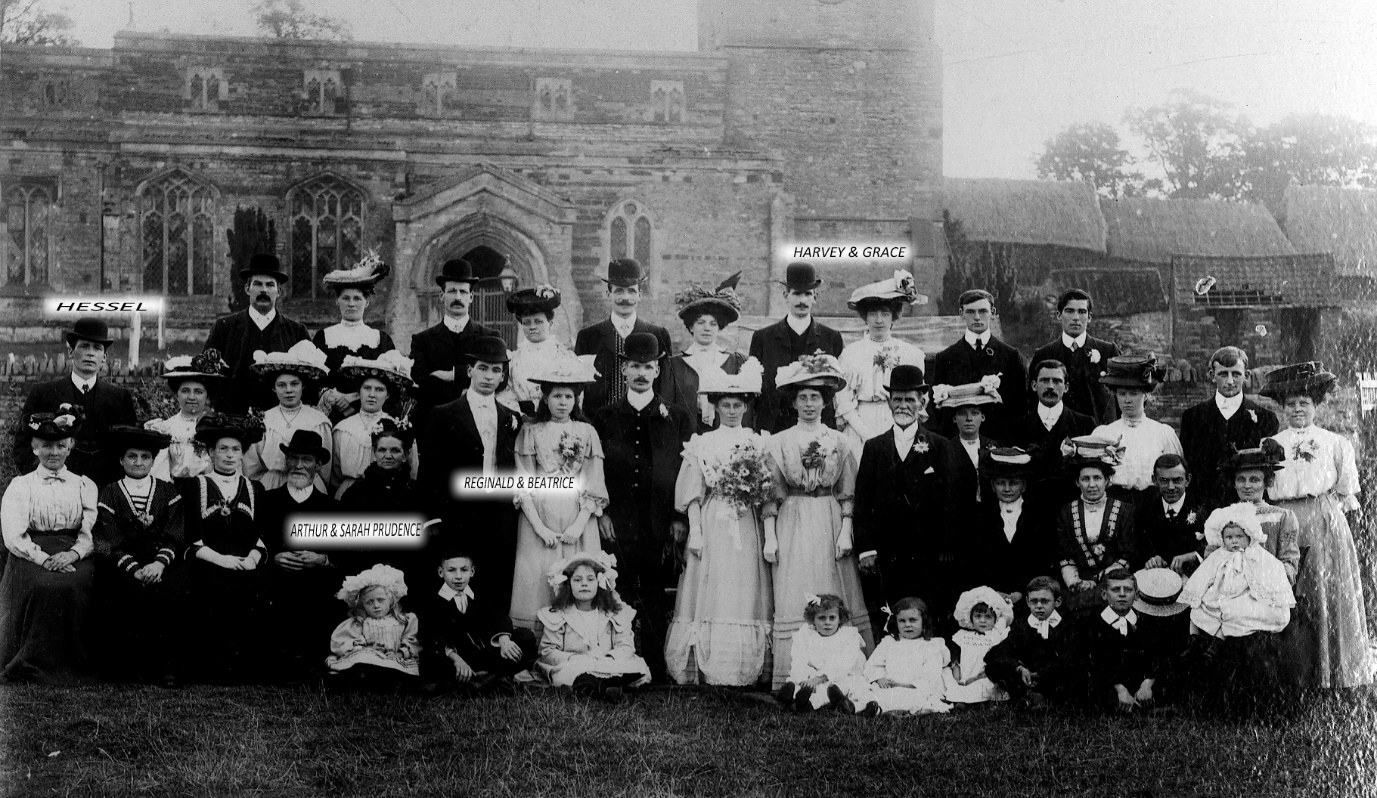
Hessel Ruff (1880-1939)
Hessel, the seventh child, was the oldest of the three men who fought. He was born in Ringstead on 22nd May 1880 and in the 1881 Census was living with his family in Sivers Buildings. His father, Arthur, aged 36, was an army boot maker. The family were still there, at No. 7, in 1901 when Hessel was 21 and a boot finisher, Harvey (15) was a boot laster and Reginald (12) was probably still at school.
A descendant believes that at least one member of the family, possibly Arthur Ruff, was involved in the setting up of the Unity Boot and Shoe Co-operative Society. It is a little confusing for both Arthur, and eldest son, also Arthur, were of an age to be involved. The only reference in a newspaper I have found was that the secretary of the Unity was Mr. L. Ruff, who could have been another son, Lewis, born in 1878. Certainly, Arthur senior is shown in the 1901 Census as working at home.
On 22nd October 1907, Hessel married Eva Louise Weekley in Ringstead and they set up home in Denford Road. Eva had been born on 6th July 1880, so was just a few months younger than her husband. She was the daughter of William Bradley Weekley, a shoemaker and his wife, Elizabeth, and in 1901 they were living at No. 1 Church Street. By the 1911 Census the couple were living in the High Street in a five-room house and had a son, Edward Stanley born on 30th January 1909. While living there, they had a further child, Lily Ellen, born on 25th October 1912.
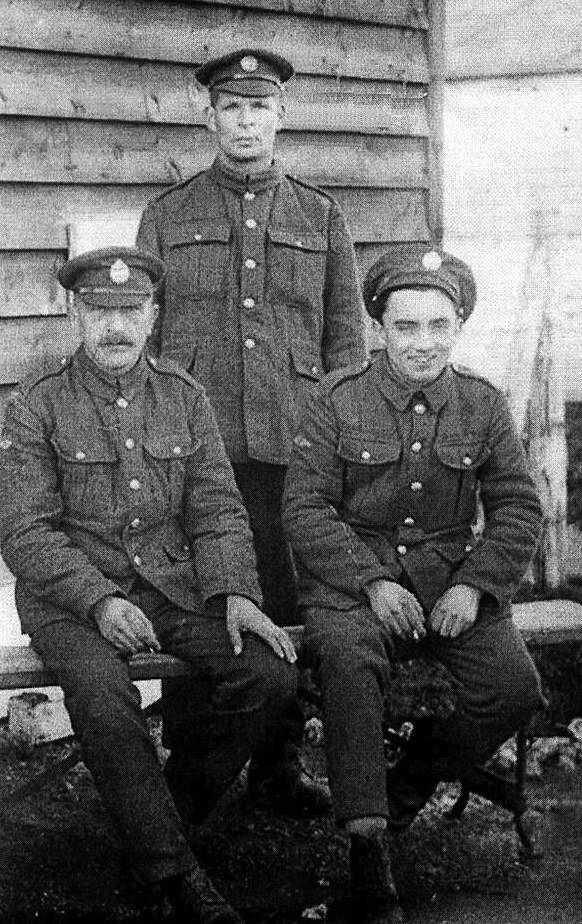
Hessel’s military records still exist, and we see that he was 5ft 9¾ inches tall with a 37 inch chest and weighed 149 pounds (67.6 kilos). He had dark hair with hazel eyes and was above average height and build for a working man of the time. He did have some physical problems, however, for he was assessed as 6/12 for both eyes and had varicose veins in his left leg. His Attestation Form also shows that he was a Baptist and was 35 years 9 months old when he first enlisted on 7th December 1915.
He was not finally mobilised until 3rd September 1918 and was posted to the Tank Corps at Wareham on 8th September. He was immediately transferred to the Tank Corps Reserve Unit for two weeks before being transferred again to the 22nd Light Tank Corps. He had been given Regimental Number 312427. I do not think that Hessel served in a war zone. A unit of the 22nd took one of their light tanks, a “Whippet”, nicknamed Julian’s Baby, (a larger tank named Julian had toured successfully before this), raising money for the War Savings Campaign by the sale of War Bonds. We do not know if Hessel toured with it.
The tanks were based at Bovington, near Wareham, and at the end of the war they were parked up there. We cannot be sure what exactly Hessel’s role was during this time. All we know is that he was demobilised on 17th January 1919 as, the Dispersal Certificate states, because he had “an offer of employment”
Hessel and Eva settled in Denford Road and he worked in a local boot and shoe factory. The Mercury and Herald reported, on 4th January 1935, a case in Thrapston Police Court. The case related to an accident on December 7th. Hessel and two other men were walking in Ringstead. A lorry approached so they moved to the left but Hessel was hit by the mudguard of a motorcycle sidecar travelling the other way. It was said in court that Hessel was only brushed by the mudguard but he was knocked unconscious and sustained a fractured ankle and other injuries. Stanley Knight, the motorcycle rider was fined £5 with £1 2s 9d costs.
It was at about this time that the family moved to 1 Lancaster Street in Higham Ferrers. In the 1939 Register of England and Wales, Hessel was shown there and working as a shoe finisher. Eva had no paid work but daughter Lily (25) was working as an uncertified teacher. Their son Reginald, born on 5th March 1921, was a milk roundsman.
Hessel had little time left to live, for he died on Thursday 9th November 1939. There was an account of his funeral in the Evening Telegraph on November 16th. This shows us that the official records only give a small part of anyone’s life. Hessel was part of a working-class community that, denied by lack of other opportunity, continued to educate themselves and take pleasure in the world. The report states:
A native of Ringstead, Mr. Ruff resided there for 55 years before coming to Higham Ferrers, where he was employed by Messrs. John White (Impregnable Boots) Ltd. He was a member of the Rushden Adult School Choir and a past member of the Thrapston Band Club and leaves a widow, two sons and a daughter, Mr. Edward Ruff, Coventry, Mr. Reg. Ruff, Higham Ferrers, and Miss Lily Ruff, Higham Ferrers. Four brothers and three sisters are also bereaved.
The report also shows that the service was held at Hessel’s house and was conducted by a Minister of the Methodist Church. He was 59 years old. Eva died in the summer of 1954, aged 74.
Harvey William Ruff (1885-1962)
Harvey Ruff was the ninth child of Arthur and Sarah, born on 6th September 1885. By the 1901 Census he was fifteen years old and working at home with his father and siblings, as a boot laster. By 1911 Arthur was unemployed and Harvey, now 25, was the oldest child still at home, working as an army boot maker in a local factory. The time of the handsewn men, working at home, was drawing to a close.
In 1914, Harvey married Grace Evelyn (sometimes Evaline) Burton from Raunds. She was the daughter of William and Annie, born on 2nd April 1887 and by 1911 was living with her family in Wellington Street in Raunds.
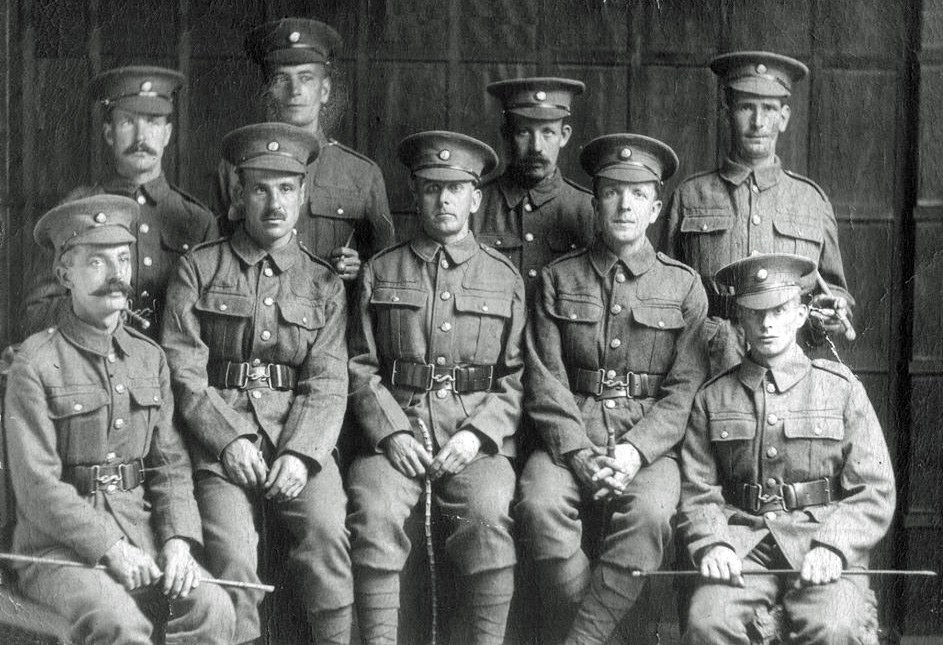
Of course, war was imminent but we do not know exactly when Harvey first attested for the army. We do know from his Demobilisation Certificate that he served in the 67th Divisional Cyclist Company. This was a Second Line Territorial Force Division and served on home defence throughout the war but also recruited and trained men to provide drafts for overseas units. It is likely that the photograph of Harvey shown below, with other men from the 67th was taken somewhere in Eastern England.
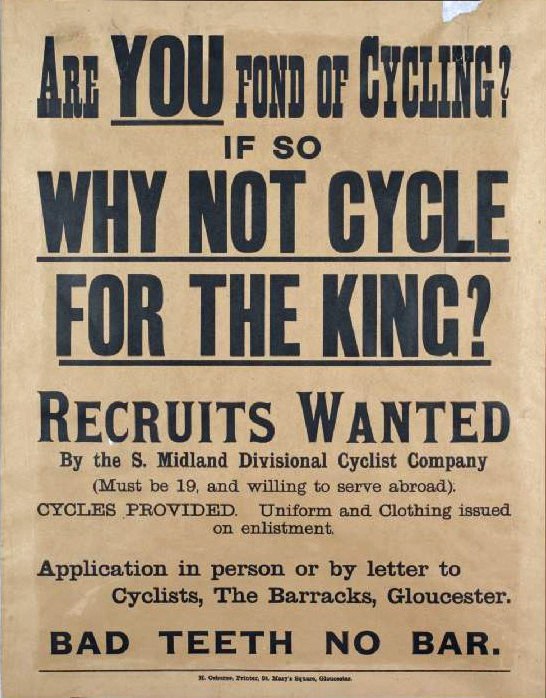
The idea of a cycling unit may now seem odd but as Chris Baker, in an article in The Gazette has written:
As early as the 1880s, the army began to include the bicycle in its armoury. Prior to this the army relied on men or horse transport to cover the ground. Each had limits to speed and range, and the horse needed much by way of logistical support for its feeding and care.
With a bicycle, an armed man could move relatively quickly across even poor ground and with a longer range than his marching capability. In other words, the bike brought new possibilities for the army to project its forces to where they were needed.
Early in the war, each Division of the army had a cyclist company added. The main roles of the cyclists, rather like the more glamorous Yeomanry, were reconnaissance and communications but, like the Yeomanry, they would have to turn their hand to trench digging or as mobile infantrymen if required.
Based on the research of Steve and Charlie on the Great War Forum website, on Harvey’s Regimental Number (21934), it seems likely that he was not transferred to the XV (15th) Cyclist Battalion of the reorganised Army Cyclists Corps until September 1917 at the earliest and possibly not until April 1918.
In September 1917 the 15th were at Fort Mardyck, some four miles west of Dunkirk centre, undergoing training with numerous parades. They were still in a war zone, however, and were at times under fire, so that one man was killed and six wounded during the month. In the middle of October, the Battalion moved to Coxyde de Ville, (15 miles east of Dunkirk along the coast) carrying out fatigues, mainly digging trenches under the supervision of the Royal Engineers. This continued through November with the men carrying out “salvage fatigues” before moving back to Fort Mardyck where the work continued.
On December 3rd 1917 the Battalion moved to Wormhoudt and then, via Morbecque, to Estaires, where the working parties continued into the new year. At this time, they were mainly digging trenches for communication cables, to keep them, as far as possible, out of danger from enemy bombing. Lack of reliable communications was a constant problem, and as a result, some attacks started in confusion and the planned strategy disintegrated. Although not under intense fire the men did suffer occasional casualties from gas shell attacks.
The tedious, but essential work, continued through March with, on many days, the War Diary recording similar entries, such as:
1 Officer and all available OR [Other Ranks] on working parties under A.D. A.S. XV Corps.
So it continued, but on April 9th there was a change and the Diary records that the Battalion came under “heavy bombardment” and sent out patrols to see what was happening with the enemy. They were now under sustained shell fire as part of the German’s great Michael Offensive which had begun on March 21st 1918. The second phase of this offensive, known as the Lys Offensive was designed to capture the important rail centre of Hazebrouck and push on to the Channel coast so cutting off the British holding the Ypres Salient. The 15th were caught in the first attack in the Battle of Lys, known as the Battle of Estaires.
The Diary tells of the cyclists on patrol encountering and engaging the Germans and one patrol took part in fighting through the streets of Estaires. It was a frightening, chaotic time for all the soldiers, with the Allies in almost constant retreat. In the onslaught, one officer and two Other Ranks were killed and four officers and thirty-eight men wounded with twelve men missing (two believed prisoners) and eight Other Ranks wounded but remaining on duty.
The moved to Le Grand Hasard and were on digging duties, still in the Hazebrouck area, one of the prime targets for the Germans because of its rail links. The War Diary entry at the end of April shows the terrible times that Harvey and the other had endured:
Owing to the destruction, in action, of the Bttn documents and records the strength of the Bttn at the beginning of the month cannot be given. The Bttn are now 2 officers and 63 OR under strength.
Although much ground was lost along the Western Front, the line finally held, and the German Offensive, men exhausted and supply lines overstretched, began to falter. Through May 1918 the Diary tells, beside the working parties, of the training of guides as well as Lewis Gun and musketry training. They were based at le Grand Hasard but now, through to July, there were few casualties. On the 7th July, the 15th moved into billets at Blaringhem where Platoon Training continued.
The pendulum was now swinging back at increasing speed and on 1st September the Battalion were instructed to pursue the enemy as part of a concerted Allied attack. The War Diary reports that they were now at De Seule-Sternwerck and that:
The cyclists were detailed to form a screen in front area of the infantry and to locate hostile snipers and the M.G.s [machine guns] when located, word was to be sent back to the infantry who would deal with the hostile opposition. If, however, the cyclists were strong enough to tackle the opposition themselves they must do so.
On 17th October they were once more in the firing line with orders to reconnoitre the enemy positions. By the 18th the outskirts of the village of Petit Audenarde had been reached and there was now continual forward movement, although sometimes met by heavy rearguard shelling by the Germans. Through early November the Battalion was at Mouveaux, undergoing training, and they were there on the 11th when they received news of the Armistice and were ordered to “stand to”.
From then on, the Diary lists parades, educational lectures and classes, rifle drill and generally anything to keep the men occupied. This continued into December but now also with medical inspections and baths to try to clean the men up ready for a return to civilian life. On Christmas Day there was Divine Service, followed by dinner and a concert.
The military and educational training continued into January 1919 but, all the time, men were being sent back to the UK for demobilisation, or to other units as part of the Rhine Army of Occupation. By the end of March only three officers and 32 men remained. The entries in the War Diary for these last few days have faded away like the men although the numbers now stay constant until the end of May 1919 when the Diary ends.
Harvey was demobilised on 19th May 1919 and returned to Northamptonshire but he was not in the 1918 or 1919 Ringstead Absent Voters’ Lists because he had already moved to Raunds where his service is remembered in the town’s Memorial Project.
Harvey and Grace only had one child, a daughter Phyllis Marie, who had been born on 10th October 1916. In the 1939 Register of England and Wales, the family were living at 26 Park Avenue in Raunds and Harvey was a stainer in the leather trade. Grace had the usual Unpaid Domestic Duties. Phyllis, who was a clothing finisher, married soon after the Register was taken, to Ernest Arthur Wheeldon and it is their son Martyn who we have to thank for the family photographs.
Harvey died on 20th May 1962 and Grace followed him, aged 85, in 1972.
Reginald Frank Ruff (1888-1956)
Reginald, the youngest child of Arthur and Sarah, was born some twenty-two years after the firstborn, on 12th August 1888. In 1901 he was twelve years old living in the Sivers Buildings in Ringstead with his family. By 1911 he was 22, and a clerk for a “Pork Pie Maker”
In the same 1911 Census we see that living in The Manse was Baptist Minister, John Bates, aged 55, and his wife Jennie (sometimes called Rebecca) who was 57. They had been married 29 years and had had five children, all surviving. Still at home were their two daughters, Beatrice (26), and Ethel (25), both schoolteachers in a County Council school and Stuart (19), who was a butcher and who we have encountered in these stories before.
John Bates had been a Baptist Pastor at Bugbrooke, where Beatrice and been born, and then at Kislingbury, the village of his birth. In 1893 he had been appointed by the Ringstead Particular Baptist Church and had been very active in fundraising in order to carry out extensive renovations to the Baptist Chapel. The family continued to live in The Manse until John’s death in 1930.
On 12th October 1912, Reginald Frank Ruff married Beatrice Elizabeth Bates at Thrapston. Their only child, Kathleen Mary, was born on 14th November 1915 and, less than a month later, on 9th December, Reginald attested and was placed on the Army Reserve. He was mobilised on 22nd May 1916 and posted to the Royal Garrison Artillery and given Regimental Number 86198. We see in the Descriptive Report on Enlistment that Reginald was 27 years old and was 5ft 8½ inches tall. His occupation was still listed as “clerk”. What is new is that his home address is shown as Shaftesbury Avenue in St. Neots in Huntingdonshire.
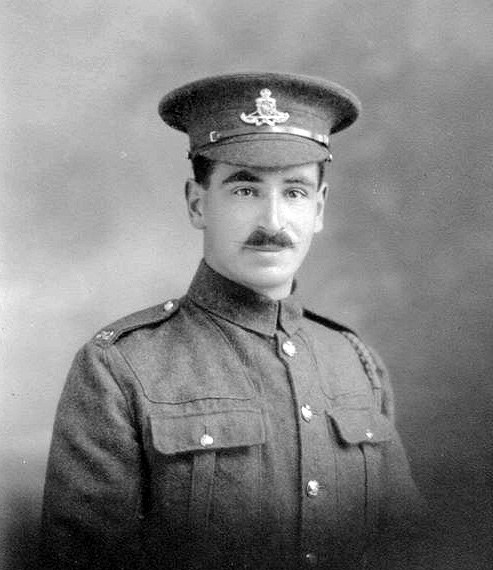
We do not know if it was pork pies that had taken Reginald to St Neots but it seems likely that, when he was mobilised, Beatrice and Kathleen moved back to live with her parents in The Manse in Ringstead. His military records, like many, are difficult to decipher, but it looks as if he was first posted to Harwich and, on 27th October 1916, he qualified as a “First Class Signaller”. On 9th November he was sent to “A” Siege Depot at Catterick as part of the Royal Garrison Artillery. This was to become a Signalling Training Centre in December 1916 so perhaps Reginald was sent to improve his skills.
He remained in the UK for 276 days but, as some point he joined the 266th Siege Battery of the Royal Garrison Artillery. It had been formed on 30th September 1916 and moved to Horsham and on to Lydd and Codford. Reginald joined them and embarked at Portsmouth (although the War Diary says Southampton) on 16th February 1917. He disembarked at Le Havre the following day. On the 19th February they entrained and during the next week after a series of daily moves they arrived at Dainville on 9th March and took up their first position at the railway station there. Nine days later they had to dismantle the battery and move it to Agny.
It would have been heavy work and we get a hint of the frustration that the men must have sometimes felt from the War Diary:
19th March. Arrived Agny and started to get into action. When nearly ready [we] were ordered to move to another position to make room for the 9.2inch Battery.
By 21st March they were in a new position and in action. Most of the Diary is made up by details of how much ammunition has been fired, the time, and a map reference and type of target, such as “trenches”. They were positioned in the Agny area until the 11th April when they moved to Neuville Vitesse. Of course, they were also a prime target for the enemy and at St Martin Sur Coseul seven men were killed and five wounded. Still the entries are mainly lists of map references and targets.
In May the Battery were on the move through La Herliere, Framecourt, St Venant, Morbecque and Fletre to Kemmel, some 85 miles north, arriving there at 1 am on 21st May. Immediately, they went into position. On 24th, however, they left the section and moved into billets, but by the 29th they returned to Kemmel. Once again the lists continue.
In June the 266th moved to Vlamertinge and the bombardments continued through July. On August 2nd they moved once again. We see now in the Diary the continual daily casualties and the lists of targets which include harassing fire on road, barrage fire, house, dugouts, trench, wire and neutralising fire on a hostile battery.
In October 1917 the 266th were stationed at Crucifix Road at St Martin-sur-Coseul and the litany of the bombardments continue, even on Christmas Day. Men only appear anonymously as wounded or killed.
The Diary does not even record the places they were at but merely states “In the Field”. The lists continue into 1918 as before but at this point the Diary finishes, the rest, presumably, destroyed. We do get some idea of the daily slog amidst the mud and the fear but much of it lost in the detailed ballistics.
We do know that, at some point in 1917, he was appointed as an Acting Bombadier and this was confirmed on 18th July 1917. Also, on 13th April 1918, he was appointed Acting Corporal to stand in for a wounded man and this promotion was confirmed when this man was invalided out of the army. At some point after this he was, for a time, sick and in hospital. Martyn Wheeldon has confirmed that he was badly gassed and this caused chest problems for the rest of his life. There is also an entry to show that he was granted leave to the UK from 27th December 1918 to 10th January 1919, probably because of his exposure in a gas attack. Whilst on leave he was sent to Purfleet for discharge.
He returned to civilian life and it seems, from one undated note on his file, that at the end of the war, or just after it, he was residing at 37 Symington Street in the St James area of Northampton, with its rows of neat terraced houses. By 1926, however the family were living at “The Stores” in Grantchester near Cambridge and we see in the 1939 Register of England and Wales that they were still there, next to the Rose and Crown Yard, and Reginald described himself as a Grocer and Confectioner. Beatrice had no paid work but daughter Kathleen, who married the following year, was a Municipal Clerk.
We know from the Electoral Roll that they were still there at least up to 1945 and Martyn has confirmed that in 1947 Reginald and Beatrice with Kathleen and her husband, moved back to Northamptonshire. They lived together in Raunds, at 65 Midland Road. Reginald became Secretary at Nene Plastics in Grove Road in Raunds, a post he held for seven years until his retirement at the age of sixty-five. He died on 15th September 1956 at Addenbrookes Hospital in Cambridge. I think that Beatrice may have moved back to the Cambridge area after his death, living in Girton, but she died in Woodlands Nursing Home in Earith in Huntingdonshire on the 10th September 1961.
.