The Great War: N–Z · Story 2
Joseph Arthur Norris (1889-1931)
Like many of the young men who I have written about in these life stories, Joseph Arthur Norris’s military records have been largely destroyed. He is different, however, in that I have not managed to find any evidence that he ever lived in Ringstead. However, he was put on the Ringstead Roll of Honour, so it seems that he was for a time in the village and it may just be the lack of public records that have hidden his residence, perhaps in his early married life. We will assume that he was entitled to have been included on the Roll of Honour and try to write his story.
Joseph, who sometimes used his second name, was born in Irchester in 1889, the son of George and Lillie Norris. George had married Lillie Goddard in 1887. I have not found a christening for Joseph but the couple’s later children were christened in the Irchester Parish Church. I mention this because at some point the family became stalwarts of the Salvation Army. This had been formed in 1865 in the East End of London so was still a young organisation in the 1880s and 1890s. It was an inclusive organisation and, although it thought baptisms and other rites unnecessary, it did not denounce them.
In the 1901 Census the family were living in London End in Irchester and there were seven children Fanny, Thomas, Joseph, Edith, George, Elsie and Doris. George was still a shoe finisher and all the children, including Doris who was less than a year old, had been born in Irchester. The oldest child, Fanny, has the surname Goddard, so was born before the marriage but is shown as George’s daughter.
By 1911 the family had moved to Highfield Cottages in Raunds. These were a terrace of houses at the top of Marshalls Road, built beside the Coggin’s Shoe factory for its workers. In the same Census we see two women living together in 7 Primrose Hill in Raunds. Louise Harrison was 25 years old and from Staffordshire and Edith Clifton was 25 and from Buxted in Sussex. They were both Salvation Army Officers. In 1901 Edith had been an under housemaid in Tunbridge Wells. The Salvation Army had not been welcomed there at first, and the Salvationists had been met with sticks and stones when they marched to the Common for outdoor preaching. They became accepted and a Salvation Army Citadel had been built in 1886. Was it here that Edith was converted and joined the “Army”?
The First World War came in 1914 but, at first, Joseph was not called to fight. He was working in a local factory as a shoehand which may have given him some exemption. He had also been a Salvationist since 1906, along with at least some of his family. It was in his involvement with the Army that he would have met the two young female officers and it was Edith Clifton who became his wife early in 1915. They had a child, Ivy, who was born in the second quarter of 1917.
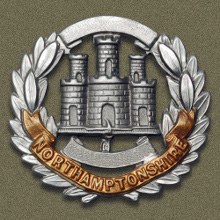
We know from the Ringstead Roll of Honour that Joseph was called up to the 5th Battalion of the Northamptonshire Regiment. He was given Regimental Number 43673. The 5th was one of the new “Pioneer” Battalions which were created in 1914 to provide skilled labour for the Royal Engineers and to relieve the infantry from tasks other than combat. The 5th Northamptonshires had been formed in August 1914 but did not land in France until 30th May 1915 and took part in the Battle of Loos.
Unfortunately we do not know when Joseph joined the army or when he was posted to the Western Front except that, because he was not entitled to the 1914/15 Star, it was not until 1916 at the earliest. I have tried to find a similar Northamptonshire Regimental Number but have not managed to find a soldier whose entry date is known. By checking many soldiers of whom we have some idea of the time that they went to France I believe that it would probably have been at least late 1917 before he reached the Western Front. We do have evidence that shows that he was in Rouen on 9th July 1918.
It seems likely that Joseph was there when the German “Michael Offensive” took place and threatened to win the war. Although the Battalion was set up to help the infantry by doing non-combatant tasks they were often called upon to also join their fellow soldiers in the trenches.
We know that Joseph, if indeed he was in France, survived this attack. His brother, just a little older than Joseph, Thomas James Frederick Norris, had emigrated to Australia but returned and enlisted on October 23rd 1915. He was serving with the 7th Northamptonshires and had been promoted to Lance Corporal. On March 22nd 1918 he was killed in action. The Rushden Heritage website has a report from the Rushden Echo of 26th April 1918 from a comrade of Frederick, as he was usually known:
. . . two of their company were wounded, one could walk and the other could not. Lance-Corporal Norris, with three others, rushed out to fetch them in, and a shell came and killed them all.
When and how did Joseph hear of his brother’s death? Was he told by an officer in his regiment or was it a letter from home? He would probably have received another letter from home some two months later, telling him of the death of his younger sister, Doris. She was only seventeen years old and had been ill for some time. The local newspapers reported:
A full Salvation funeral was conducted at the Citadel by Captain Cecil Chapman; a band attended, made up by Wellingborough, Rushden and Raunds bandsman, also a number of small girls, dressed in white and each carrying a bunch of white flowers, represented the Sunday School. The procession marched to the cemetery, where Captain Chapman oversaw the interment watched by a gathering of nearly 200, many from the Regulation Boot Company and Messrs Adams Bros as well as family and other friends.
Had his time at the Front made him hardened to death? It is more likely that it added to the sorrow for the deaths of his comrades in arms. The Wartime Memories Project records that the 5th were in action at the Battle of Bapaume and spent the Spring engaged in heavy fighting as the enemy advanced across the old Somme battlefields. From then they were in constant action in the Battle of Amiens and then the final forcing of the Germans back to the Hindenburg Line and beyond. We can see Joseph’s war in more details from the War Diary of the 5th Battalion
This was very different to the usual Infantry records. If we look at the entries from early February 1918 when the Battalion was at Sailly Sur La Lys we see:
Strength of Battalion on 1st February 1918.
Feb 1st 1917 [should be 1918] ‘A’ Company work on CHARRED POST, WINDY POST and Strong Point ‘K’ at M.6. Central, trench boarding, revetting and banking and repairing parados [banks at the rear of a trench]. ‘B’ Coy commenced work on a strong point at H.18. C. 3.3. [from a detailed trench map]. ‘C’ Coy continued work on strong point at M. 5. B. 1. 9. This is now almost completed. ‘D’ Coy continued work on FLEURIE SWITCH and BOIS GRENIER constructing new fire bays.
When the great German Offensive began in late March 1918, they had to put down their tools and pick up their rifles. The official history of the Northamptonshires records that:
The men of the 5th were rushed up by motor-buses to Albert and succeeded in holding up heavy attacks at a cost of 34 killed and 45 wounded.
On the 24th March they were sent to Bouzincourt to reinforce the 7th Norfolks and 7th Suffolks who were being overrun. They suffered 11 Other Ranks killed and 40 wounded with 23 missing and 5 shell shocked. The line could not hold and there were retreats to new Front Lines. Now the men were trying desperately to construct new defences but they also had to serve their time in the Front Line trenches.
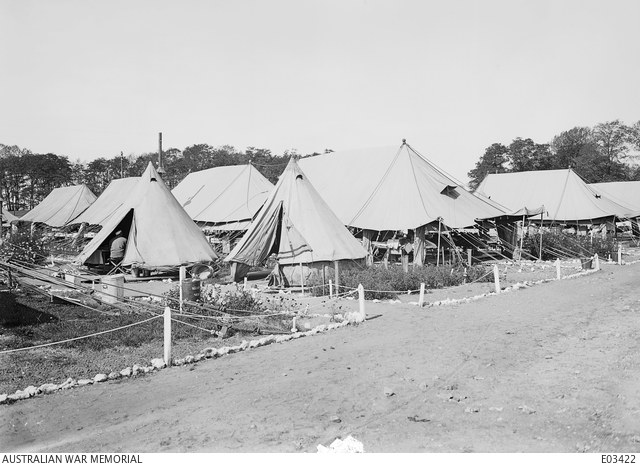
By May we see the tide has turned and despite counter-attacks by the Germans, the Pioneers were now trying to repair and improve captured German trench systems. By July the War Diary entries are brief and although there is some trench work we see increased training and resting. It was during this period, unrecorded in the Diary, that the deadly “Spanish Flu” reached the Battalion. On 9th July 1918 Joseph, with some of his fellow 5th Northamptonshires soldiers, was struck down by the influenza. He was admitted to No. 1 Australian Hospital at Rouen but it is not recorded how long he was there before returning to duty.
There was still determined opposition from the Germans but there was also a continual Allied advance and by September the men of the 5th were repairing and constructing bridges, tracks and crossings and craters around Manancourt as well as still putting out wire to protect positions.
Now the Battalion were enjoying, “Training, rest and recreation at Aniche” They were trying to repair roads and bring back into use some of the infrastructure destroyed in the war. There was also time for practising the “March Past” ready for inspection on the 20th. From February 2nd to 4th 1919:
All companies employed on roads and making Divisional Racecourse and grandstands on Divisional Football Ground.
The work had become mainly the repairing of roads, and other fatigues. We see the Battalion strength reducing as demobilisation increased. Also on 30th March 1919, at Aniche, the Diary records:
A draft of 1 Captain, w Subalterns, 1 C.S.M., 5 Sergts, 12 Corporals and 62 Privates were ordered to be despatched to 351 Prisoners of War Coy. BETHUNE. Only 1 Subaltern, I Sergt and 56 ORs can be found at present. . .
31st March. Draft standing by for entrainment orders.
The Ringstead Roll of Honour shows that he was with the 351 Company but I have not managed to find where the camp that they were guarding was situated. It is most likely that it was at Bethune and was only there until all the Germany prisoners gathered at the end of the war were sent home. I have also had information that it might have been in Jersey but this seems less likely.
All we can say is that in 1919 or 1920 Joseph returned to Edith at 35 (or possibly 30) Brooks Road in Raunds. He took up his employment again as a finisher in Adams Brothers shoe factory and also continued with his work in the Salvation Army. We know that he had at some point the roles of Treasurer and also Bandmaster. Their only daughter, Ivy was an invalid and probably took most of Edith’s time. In February 1931 Joseph, aged 42, had been distributing “self-denial week” envelopes in Leighton and Spaldwick with Captain Thomas Whitehead. It appears that they were both on motorcycles and, when on the Keyston to Bythorn Road, Joseph was in collision with a car driven by artificial stone contractor, Mr. F. Fentiman. He was knocked unconscious and Whitehead stayed with him while Fentiman went to Bythorn and telephoned Dr E. Gainer of Thrapston.
It does not appear that he regained consciousness and was taken home and seen by Dr McInnes of Raunds who ordered his removal to Northampton General Hospital. On February 22nd 1931 Joseph died of “laceration of the brain”. His effects were £63 15s.
Early the following year Ivy, the invalid daughter of Joseph and Edith had also died. Edith now was on her own. I have not established certainly what happened to her after this double tragedy but it may be that she returned to the Royal Tunbridge Wells area where she had been a servant and, in 1939, was living with widow Edith Brown and was a “Daily Domestic Servant”. If this was the correct person she died, aged 89 on 6th June 1975.