The Great War: N–Z · Story 6
Charles William Pettitt (1890-1954)
Charles William Pettitt was born in Raunds on 10th January 1890 and christened in Raunds Parish Church on April 6th. His parents were James and Sarah Ann. James was a shoemaker from Lower Dean, just over the border in Bedfordshire and Sarah from Bythorn In Huntingdonshire. All three places were in a triangle, some six miles apart from each other.
In 1901 James and Sarah were living in Marshalls Road in Raunds with children James (26), Albert (18), Fred (16), Arthur (13) and William (11). Charles William seems to have often been called by his second name. All the men were in the shoe trade except William who was still at school.
James, the father, died in 1907 and in the 1911 Census the widowed Sarah, aged 65 was still living in Marshalls Road with four of her children, including “William Charles”. She had had twelve children and, unusually, all of them were still living. Charles was twenty-one and now a Clicker, the man who cut out the uppers from the hides and considered the most skilled of the tradesmen.
War came in 1914 but, at first, Charles did not enlist. We know that he was not entitled to a 1914/15 Star so did not enter a warzone until 1916 at the earliest. We also know that he married Gertrude Manning on 24th April 1916 in Ringstead Church. We have already come across Gertrude in these biographies. Her younger sister, Florence married John William Pearson and both women were teachers in local schools.
Apart from the Ringstead Roll of Honour and the Absent Voter’s Lists for 1918 and 1919, just Charles’s Medal Card and the Medal Roll have survived so we only have a general idea of his war service. He did become a “Driver” with the Royal Field Artillery (RFA) and was given the Service number 182460.
A Driver was a rank in the RFA for a soldier trained in the management and use of horses. Usually the guns or wagons were drawn by six horses, driven by three drivers, all on the nearside horses. Intensive training was given in order to make the drivers competent enough to work as a team. They would also look after the general health and welfare of the horses. At some point Charles had the additional appointment of Saddler which would have given him a higher rate of pay. His experience in the military boot and shoe trade would have provided him with the transferable skills to maintain the saddles and leather work, and make emergency running repairs as needed.
The Ringstead Roll of Honour records that Charles’s war was in Palestine and Egypt. Then, as now, the Middle East was a volatile region with the once powerful Ottoman Empire becoming known as the “Sick Man of Europe” as it began to fall apart. The Turks were allies of the Germans and the area was strategically important, particularly around the Suez Canal, for British links with India, East Africa and Asia. Many men from these areas fought for the Allies, and the Chinese formed an important part of the Labour Corps.
The terrible defeat of the Allies at Gallipoli had made the position more perilous but, by the end of 1916, the Turkish threat to the Suez Canal had been largely beaten. Nevertheless, there had been defeats in the area and General Edward Allenby became the Commanding Officer and was given greater troop numbers and support. This led to the Turks being pushed back and Palestine was taken. By the end of October 1918 the Turks had been defeated and they sued for peace.
This was not an easy area for fighting, with poor communications, large desert areas and few clean water sources. The Allies’ supply chains were critical to any success. It seems most likely that Charles was with the 75th Division of the RFA and later transferred to the 1st Section of the 191st British Ammunition Column (BAC).
The BACs, as the name suggests, had the task of moving ammunition from the “Third Line” to the Front (“First Line”). Exactly how they worked would depend on local conditions but most of the haulage would be done by horse-drawn ammunition wagons, although mules were also used. These would take the ammunition to a site behind the Front where it would be collected by the Batteries and Infantry Brigades. If needed, men from the BACs would be used as replacements for casualties in the gun batteries.
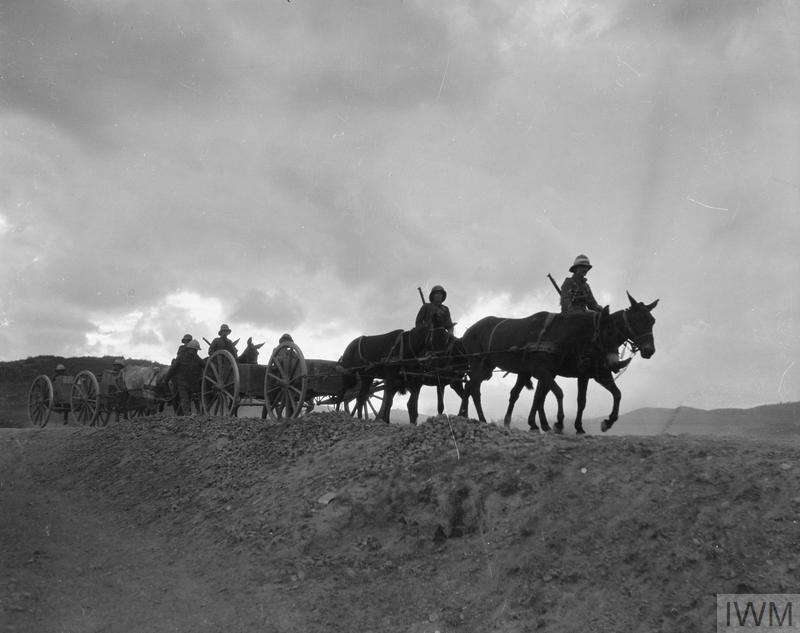
I have given below a very brief account of the battles which Charles would have been involved in, or supported, as part of the Ammunition Column. The 75th Division joined and took part in the invasion of Palestine, beginning with the on the 27th October 1917, leading to the capture of Gaza (6-7th November) and Junction Station (13-14 November), and the (20-24th November). In the Spring of 1918 the Division was involved in the actions at Tell 'Asur (11–12th March) and Berukin (9-11th April).
Following its reorganisation in the summer of 1918, the 75th Division joined General final offensive (the ). At the (19th September) the Turks were defeated and a final pursuit began.
After the end of the fighting on 19th September 1918, 75th Division and the rest of XXI Corps were set on salvage work and road repair until the Armistice with the Turks was signed on the 31st October.
Demobilisation began early in 1919, but 75th Division was selected for the Army of Occupation of Palestine and we know that Charles was part of this. In March 1919 it returned to garrison duty in Egypt, becoming responsible for the Eastern Delta, which was renamed 75th Division Area.
The British had declared Egypt a “Protectorate”, formally severing its connection to the Ottoman Empire. When war ended the Egyptians expected that there would be immediate independence and popular agitation began. There were mass demonstrations, but it was the uprising in the countryside that was more violent, involving attacks on British military installations, civilian facilities and personnel. By 25 July 1919, 800 Egyptians were dead, and 1,600 others were wounded. In 1922 Egypt was granted its independence although tension continued to simmer over British occupation of the Suez Canal area and broke out again with the Suez Crisis of 1956.
Nevertheless, after July 1919, the disturbances in Egypt had begun to die down, and units started to disperse to their home countries within the British Empire.
On the evidence of the Absent Voter’s Lists, Charles was demobilised, probably in late 1919 or early 1920. We know that in 1920 he was living in Rosebery Street and, by 1925, he and Gertrude had moved to Gladstone Street, also on the Tilcroft Estate, In the 1939 Register of England and Wales they were still living there. Charles was a Clicker’s Sorter and Gertrude was an Assistant Mistress at Ringstead Church of England Primary School.
Charles died, aged 64, on the12th January 1954. He had remained in the trade and was shown as a “boot operative”. Gertrude died in 1975.