The Great War: N–Z · Story 22
The Walker Families
There were two Walker families which had men who served in the First World War. One was an established Ringstead family while the other was only there for a few years. Both had complicated histories and, although I have not found any link between them, both had a son called Herbert Cecil, but born ten years apart.
We will first look first at the two families of Thomas Robert Walker.
The Sons of Thomas Robert Walker
Thomas Robert Walker had been born in 1843 in Raunds, to William, from Carlton in Bedfordshire, some fifteen miles south of Ringstead, and his wife Elizabeth (née Corsfort), a Ringstead woman. They had married in Ringstead Parish Church on the 9th May 1822 but had first lived in Raunds. The couple had six children, including Thomas, before moving to Ringstead. In the 1841 Census, William was shown as a “Farmer” but by 1861 he was just a “Labourer”. His wife, Elizabeth, died the following year, and by 1871 William, aged 72 years, was in Thrapston Union Workhouse.
Meanwhile, Thomas Walker had married Rebecca Staines on the 24th August 1864 in the Church of St Sepulchre in Northampton. They remained in Ringstead and had seven children in rapid succession: George, Maria, Jane, Ralph, Anne, Frank and Harvey. Rebecca died and was buried in Ringstead Churchyard on 27th September 1884. Thomas re-married some three and a half years later, in 1888, to Mary Jane Baines. Mary had been born in Stanground in Huntingdonshire and was some thirteen years Thomas’s junior. She had worked a servant and there is certain a nod to the Upper Classes in the names of the six children that the couple had. They were Horace Ross, Herbert Cecil, Hugh Lancelot, Percy Eric, Dorothy Emma Marguerite and Winifred Jessie.
Of the thirteen children of Thomas, only Frank, Harvey, Horace, Herbert, Hugh and Percy were of an age that made them likely to be conscripted. The oldest of this group, Frank, was born in 1874 and had moved to Higham Ferrars. The youngest was Percy born in 1893. I do not think that either, for whatever reason, was called to fight in the First World War.
Harvey Edward Walker (1880-1946)
Harvey was born on the 21st September 1880 to Elizabeth, Thomas Walker’s first wife. By 1891 he was living with his father and stepmother, Mary Jane, in Shop Street in Ringstead. By 1901 they were in No.1 Barnwell Cottages, next to the church, and he now had six stepbrothers and sisters. Harvey, aged 20, was working as a shoe riveter.
Harvey married Edith Louise Abbott in 1910 and in the 1911 Census we see that the couple were living in Sivers Buildings at the west end of the High Street, opposite the Swan Inn. Both were thirty years old and Harvey was working as a boot laster in a local army boot factory. Sadly, Edith died the following year and when war came Harvey was a widower.
In a previous biography we saw that Thomas Tomlin joined the 2nd Battalion of the Norfolk Regiment and was given the number 205464. It seems likely that Harvey was enlisted at the same time for he was given the number 205461 when he also joined the 2nd Battalion. As with Thomas Tomlin he would have been conscripted first to a training battalion as the six-figure numbers were not used in the Regular Army Battalions like the 2nds. Unfortunately, as we saw with Thomas, most of the records no longer exist, so any details of their service can only be seen as a possibility.
Unlike Thomas Tomlin, who served in India and Mesopotamia, Harvey served in India and the Salonica (or Salonika) warzone. After his initial training he would have been posted to India. He sailed out to Bombay (Mumbai) and then, probably mainly by train, travelled south some 300 miles to Belgaum where the 2nd Norfolks had a base camp.
The records show that many soldiers were posted to the 2nd Norfolks in India before being transferred to different Regiments in Salonika to fight the Bulgarians, or Macedonia against the Turks. It also appears, however, that most of the men first spent some time in India at the base camp. For example, it was raised in the House of Commons by his M.P. that Private Arthur William Corney, who was with the 9th Battalion of the South Lancashire Regiment:
. . . was sent to India in July 1917, arrived in Salonica, just before Christmas 1918.
Harvey Walker was also posted to the 9th South Lancs. and the timings of his move were probably similar to that of Corney. He would have entered the war zone area after the Bulgarians had surrendered. The Medal Cards for this group of men, from the 2nd Norfolks, via India, all have a resolved doubt about their entitlement to the British War Medal. It appears, as Peter (PRC) has pointed out on the Great War Forum, that they were entitled to the medal because they were in transit to a warzone, even though the conflict had ended before their arrival.
The issue raised in Parliament was about the fact that Arthur Corney had not had any leave and his MP was urging his speedy demobilisation. On 10th January 1919 Winston Churchill, who (as part of a Liberal Government) had become the Secretary of State for War, promised to look into the matter. We can only assume that Harvey was also fed up with life as part of the British Salonika Force (BSF), now an “Army of Occupation”. The Battalion was sent by Destroyer to attempt a landing at Dede Agach (now Alexandroupoli in Greece) but had been forced back by bad weather. They finally managed a landing and reached Makri, now also swallowed up by Alexandroupoli, just before the Armistice was signed with the Turks.
They returned to Chugunsi, now the Greek village of Megali Sterna, due south of Lake Dojran where demobilisation began and was completed by March 1919.
We do not have evidence for when Harvey was demobilised but it was likely to have been by mid-1919 and we know, from the Electoral Registers, that he was back in Ringstead by 1920. Oddly, the 1920-1923 Electoral Registers only show him in “Ringstead” with no mention of a street. Was he living somewhere away from the main village? By 1926 he was back living with his father Thomas and brother Percy in Leveratt’s Row (off Carlow Road, next to the Brook).
By 1929 Harvey had moved to Sivers Row (or Buildings) and in Spring 1931 he re-married, to Hilda Maria Abbott, both now in their fifties. In the 1939 Register of England and Wales they were shown as living in West End in Ringstead, which may refer to the same house as his father had lived in. Harvey was a bootmaker. Living with them was Gertrude (Gertie) Abbott, Hilda’s unmarried sister who was a lift (heel) cutter.
Harvey died on 4th March 1946. Hilda lived for another fifteen years and died on 14th February 1961. At the time of her death she was still living in West End and the Index of Wills and Administrations has her wrongly as a spinster. She left her effects to her sister, Gertrude.
Herbert Cecil Walker (1890-?)
Horace Ross Walker, the first child of Thomas’s second marriage, to Mary Jane Baines, would have been the next oldest child. He was a farm labourer before the war and had married Elizabeth Jane Headland on the 25th September 1912 in Woodford. I do not think that he was conscripted although we cannot be certain. He later became an Iron Ore Filler at a local blast furnace.
The next son after Horace was Herbert Cecil, born on 19th May 1891 in Ringstead. He had been christened with three of his brothers on 5th February 1894 in Ringstead Parish Church. He was with his parents in Leveratt’s Row and, aged twenty, was working as a baker.
War came, and the Ringstead Roll of Honour shows Herbert as first having been in the Queen’s (Royal West Surrey Regiment). It seems most likely that he was sent to one of the training battalions but was deemed not fit enough for military service in a war zone.
He may have been with the Regiment in the county of Surrey because he was sent to the 680th Agricultural Company, which was raised in Surrey, and given Service Number 464899.
Martin Stilwell, on the Surrey in the Great War website, has posted a fascinating account of agriculture at the time, and the role of the Agricultural Companies in the First World War. He tells how, before the war, agriculture was in recession particularly because of cheap imported grain and refrigerated meat. As a result, Britain had become dependent on imported food. The war took away men and horses from the land. At first, two good growing seasons mitigated this situation but increasing U-boat attacks, poor North American harvests and a bad local potato harvest, meant that, by December 1916, the Government realised that it needed to take action.
It agreed to pay a fixed price for the foodstuffs it wanted but it also took control of what farmers could grow. We know of the Dig for Victory campaigns of the Second World War but it was first in WW1 that “Ploughing Orders” came in, and pasture, cricket pitch or tennis court could be ordered to be ploughed and crops grown. This did not solve the food shortages and in 1917, among a raft of other help, the Agricultural Companies (ACs) were formed from those soldiers not fit enough for combat. It was also at this time that the Women’s Land Army was first used. Further men were still needed and the 680th and the 694th Companies were added to the work force, along with a fleet of tractors.
When Herbert was demobilised, he returned to Ringstead and in 1919 was living in Leveratt’s Yard (or Row) with his father, Thomas, and brother Hugh. He continued to live there until 1923, when he disappears from the Ringstead Registers. I have not managed to definitely place Herbert after that. There are some possibilities, including a “House Parlour Man” working for a Solicitor at Upton, but no one man whom we can identify as correct. We must leave it there.
Hugh Lancelot Walker (1891-1965)
The third “H” son, baptised on February 5th 1894 in Ringstead Church, was Hugh Lancelot Walker. There is some confusion about his date of birth. The Civil Registration records it in the January to March 1892 period which would normally mean that he was born at the end of 1891 or early 1892. In the 1939 Register of England and Wales he gave his date of birth as 3rd December 1894. I have found similar discrepancies in this register and I think his birth was probably on the 3rd December 1891.
In 1901, Hugh was living with his parents and siblings in No.1 Barnwell Cottages in Ringstead. He seems to have been missed by the 1911 Census but we know that he fought in the First World War. As for most of the Ringstead men, the military records of Hugh Walker have been largely lost in the Second World War German bombing raid. What we have are the Absent Voters’ Lists for 1918 and 1919 which give some service details and his Medal Card and the Medal Rolls.
Fortunately, we have already written about George Stanley Smart who also joined the Machine Gun Corps with Service Number 57027, just four ahead of Hugh Walker, whose number was 57031. Like George, he would have first been enlisted in the 3rd Battalion of the Northamptonshire Regiment for his basic training. They were both part of a large draft of soldiers who were then posted from the Northamptonshires to the Machine Gun Corps in mid-September 1916. Graham Sackler, the researcher for the Machine Gun Corps Database website, states that Hugh, like most of those posted, after his initial machine-gun training, would have been sent first to the MGC Depot at Camiers, near Étaples.
At this point in the war the men would have been sent to reinforce, or bring back up to strength, any of the Brigades along the Western Front that needed new men. George Smart, went to the 8th Machine Gun Company and was killed, probably on the 26th September 1917. Hugh, however, may have been sent to another company, so we cannot be sure in which actions he took part.
What we do know is that he did serve with the newly organised 57th Machine Gun Corps Battalion, which was part of the 57th Division and had been formed on the 1st March 1918. The War Diary of the Battalion starts on the 1st April 1918 and charts its progress during the last nine months of the war and into 1919. It does not give a real sense of the progress of the war and, like many of the diaries, tells of small battles and high casualties as the Allies began to push the Germans north and east on the Western Front.
The great “Michael Offensive” of the Germans in March 1918 had forced the Allies back and threatened to win the war. On April 1st the 57th were at Mondicourt, some seventeen miles south-west of Arras. They moved nine miles east to Fonquevillers in the Front Line and were subjected to artillery fire but also the “Yellow Cross Gas Shells” which sent the dreaded mustard gas into the troops in the village. Unusually, the War Diary lists all the casualties, including the Other Ranks, giving names and service numbers. In most of the Battalion Diaries only the officers and the very brave were named.
By September they were a further seventeen miles east-northeast in the area of Hendecourt-lès-Cagnicourt and Fontaine-lès-Croisilles. The Front was moving forward fast by the standards of the trench warfare that had preceded it, but it was still hard-won, and the 57th Battalion continued to sustain heavy casualties. In early October they were again attacking further north in the Fromelles area. The WW1 maps plot the Germans retreating east and north but they were not usually giving ground easily. In the period from the 1st to the 14th October 1918 the Battalion lost 10 men killed or died of wounds, 43 men wounded and 11 men missing.
On 11th November 1919, the Armistice brought fighting (almost) to an end. It is not recorded in the War Diary and the only entry is “No Change” from the previous day. On 30th November it recorded that “Ploughing for local farmers ceased”. On 17th December thirteen coal miners were released to demobilisation. Their services were needed urgently at home. On the 21st December “Salvage Operations Commenced”.
The new year began an accelerating demobilisation of the soldiers. Hugh Walker had been appointed a Lance-Corporal at some point and the Medal Roll shows that he was discharged and placed on Class “Z” Reserve. In effect his army service had finished. The Ringstead Roll of Honour states, however, that he was a Sergeant in the 107th Chinese Labour Corps and this is confirmed by the Ringstead Absent Voters’ List for Autumn 1919. Graham Sackler has suggested that he only held this post for a matter of months and perhaps he was “attached” to the Labour Corps while remaining on the MGC books. It may also be that his was a temporary promotion to enable him to have sufficient rank to carry out his new appointment.
The Chinese, until recently, have been the forgotten men of the Western Front. When we see China now, as a major world power, it may be difficult to believe that in 1914 this huge new republic was still in the thrall of various imperial powers including Britain, France, Germany and Japan. When war broke out the Chinese Government declared “Absolute Neutrality” but it began to believe that, to be on the winning side, would give it some standing in the world and a place at the table when the map of the world was redrawn. They also came to see that the Allies would be the ultimate victors and began to secretly petition to send soldiers and labourers to fight on their side.
At first, they were rebuffed but, after the terrible slaughter of the Somme in July 1916, the British followed the French, in accepting Chinese labour on the Western Front, in order to release soldiers to the fighting units.
The Chinese labourers were volunteers who signed a contract with their thumbprint and each was given a bracelet with their name (or nickname, if a written version of their name not known), and a number, in English and Chinese. This had to be worn at all times and the men, although technically civilians, were subject to military discipline.
Altogether some 94,000 men were used by the British during the war. With justification the Chinese considered that they were badly treated and not given proper respect. To get to Europe they had sailed across the Pacific in crowded ships and then were forced to cross an antagonistic Canada in locked train carriages with blackened windows. They were not allowed to set a foot on Canadian soil for any purpose or they would be subject to a prohibitive “head tax”, equivalent to a labourer’s wages for ten years.
Once in France or Belgium they were organised into companies under the command of British soldiers and worked behind the front lines. These men, from a quiet rural background, were often traumatised by the noise of artillery, gunfire, aircraft and bombs, as well as danger from enemy fire. Most did not believe that this is what they had signed up for.
After the Armistice the British soldiers began to demobilise but the Chinese remained until 1920. It was hard, unpleasant work and still had hidden dangers. In the Chinese Labour Corps, Mark O’Neill has written:
To the Allies, the Chinese men were as valuable after the war as they had been during the conflict. Large areas of Northern France and Belgium resembled a lunar landscape, with no buildings left standing, no roads, railways or telegraph poles, no farmland that could be cultivated. The countryside was covered with trenches and the debris of fifty-two months of fighting – the dead bodies of humans and animals, spent bullets, unexploded shells, barbed wire, rusting vehicles and scrap metal.
The enormous task fell to the French and British armies, each with their own contingent of Chinese.
Hugh became a Sergeant with the 107th Chinese Company. We do not know exactly when, but it seems most likely that it was early in 1919. As we have shown it would not have been an easy posting. The Chinese wanted to be home and many of the local people also resented their presence even though they were doing invaluable work which would enable the farms and factories to start working again. Discipline, through an interpreter, became more difficult to maintain as tempers frayed and fights broke out. Ten Chinese labourers were executed for murder during their time in Europe. One of these was Wang Ch’un Chi’ih who was in the 107th Chinese Labour Company. On the 8th May 1919 he was tied to a post and shot. The post is now on display in the town hall at Poperinge, near Ypres. Did Hugh have to stand and watch the execution of one of his men?
The Treaty of Versailles ignored the Chinese contribution and they were written, or painted out, of most of the memorial works produced after the war.
Hugh was finally discharged, as a Corporal in the Machine Gun Corps, on 3rd October 1919 and placed on the Class “Z” Reserve List, meaning he could be recalled if there was an unexpected resumption of hostilities. He returned to Ringstead and in the 1920 Electoral Register he was living with his parents in Leveratt’s Row. By 1923 he had disappeared from the Ringstead Electoral Roll and had probably moved away. At the end of 1925 he married Ida May Joyce. Ida had been born in 1897 at Harringworth in Northamptonshire, the daughter of Alfred Henry and Mary Ann Joyce. I believe that Hugh and Ida had one child, also Hugh, born on the 16th December 1927.
It may be that Hugh had to move to Rushden to find work. Certainly, the family were living there, at 101 Westfield Avenue, in the 1939 Electoral Register of England and Wales. Hugh was working as a boot operative.
Hugh Lancelot Walker died on the 4th January 1965. Ida lived almost a further two decades and died on the 19th November 1986, aged 89.
The Other Sons
There were three other sons who, as I have said, I do not think fought in the Great War. It is possible that they only did home duties so went unrecorded in the Medal Rolls, other records having been destroyed. There are also many soldiers with similar names who, without other evidence, we cannot be sure are the correct men.
Frank Walker was born on 14th September 1873 and married Mary Hannah Jackson on 20th August 1894. They moved to Higham Ferrers and he first worked as the secretary of the Boot Production Company and became a boot manufacturer in his own right.
Horace Ross Walker was born on 1st January 1889. He married Elizabeth Headland on the 25th September 1912 and in 1939 was an “Iron Ore Filler” living in Gladstone Street. He died in 1972.
Percy Eric Walker was born in about 1893. I believe that sailed to Brisbane in Australia on 16th August 1911 in the Assisted Immigration Scheme. If so, he seems to have decided to return to England and in 1931 was living in Leveratt’s Yard. He died in 1966, aged 73.
The Family of Alfred Walker
Charles Leigh Walker (1886-1966)
Andrew Walker, a saddler and harness maker, had moved, from the Kimbolton area of Huntingdonshire, with his wife Lucy (née Smith) to Raunds in the 1850s. In 1861 the couple were living next to the Robin Hood pub in Raunds with children, George (6), Alfred (2) and Walter (1). By 1871 Andrew had become the local Postmaster and the family had moved to the Post Office at 29 Brook Street. The Census shows that he was still a saddler and also had become a local preacher.
Andrew died on 7th January 1888 and in the 1891 Census we see that the oldest son, George, who had followed his father’s trade of saddler, had also taken over the Post Office. It is the second son, Alfred, born in 1858, whose families we will be looking at. He married Elizabeth Miller in 1877 and the couple had four children: Thirza, Annie Elizabeth, Ethel Ashton and Charles Leigh. In 1881, Alfred, aged just 22, had become a “Rural Messenger” and they were living at 61 Huntingdon Road in Thrapston with daughter, Thirza, only one year old.
Charles was born on the 13th August 1886 in Raunds. It is at this point that the family story becomes more complicated. His mother, Elizabeth, died in 1890 and, in the 1891 Census, Charles and his older sister Ethel were living with their Uncle George, the postmaster, and his wife, Mary. We also see that Ethel had been born in Ilkeston in Derbyshire, so the family had been on its travels in the 1881 to 1886 period. This was almost certainly connected with Alfred’s job, for in the 1891 Census, he was recorded as a “Railway Signalman” in the signal box at Spalding in Lincolnshire. Next door in “The Gatehouse” another signalman and his wife were living. Could it be that the Census found Alfred on night duty and he was lodging in the town or even in the Gatehouse?
Alfred remarried, to Alice Amelia Dent, on 16th October 1892 in Barnet in Hertfordshire and the couple had a further four children, Alice, Stanley Alfred, Leonard William and Herbert Cecil. As we have seen this last name had also appeared in the Ringstead, Walker family some ten years earlier. All the children were born in Hertfordshire.
When we look at the 1901 Census, we see that Charles and Ethel were still living with their uncle and aunt in Brook Street in Raunds where George continued as the postmaster and saddler. The couple also have a seven-year-old adopted son so perhaps they could not have children of their own. Meanwhile, Charles and Alfred’s father, Alfred, shown as a Great Northern Railway Signalman was living with his second family who were born in London, Bedfordshire and Hertfordshire.
Did Alfred keep in contact with the children of his first family? In 1911 Alfred and Alice were living with sons Stanley and Herbert at “Nantglyn” in London Road, Knebworth, near Stevenage. Of their four children, one had died. Alfred was now 53 and we might expect that he would carry on being a signalman and then retire close by. This was, surprisingly, not quite the case.
Meanwhile, Charles Leigh Walker had become, a Post Office Clerk and in 1911 he was staying with his sister Ethel who had married Alfred Jesse Penny in Raunds Parish Church on the 10th September. The couple had moved back to Ilkeston, where Ethel had been born, and so, confusingly, had Alfred Penny. There is a hidden connection here to link the two families. Alfred was working as a stone mason and they had a one-month-old daughter, Jesse. Was Charles saying goodbye? The following month Alfred Penny sailed to Halifax, Nova Scotia, preparing the way for the couple’s emigration. On 15th September 1911 Ethel, with six-month-old daughter, Jesse arrived in Canada bound for Calgary to join her husband.
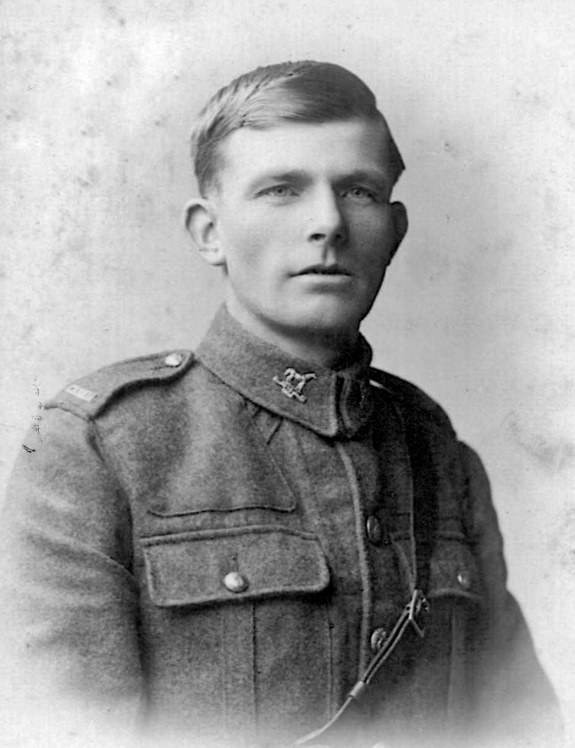
Did Charles join them for a time? The family have a photograph which they believe is of Charles, in Royal Mounted Police uniform as a young man. I have not found him definitely on a ship, to or from Canada, but Charles Walker (without the Leigh) is a common name. We also know that Alfred and Ethel Penny returned to Ilkeston during the war. Their son, Alfred Leigh Penny was christened in Holy Trinity Church there on May 4th 1916 and Alfred’s occupation is shown as “soldier”.
Charles was definitely in England in 1914 because he was in a court case, reported in the Mid-Sussex Times on October 19th 1915. A soldier had tried to fraudulently withdraw more money from his account than he had in it, by altering a number in his deposit book. Charles Leigh Walker was the clerk who, on November 23rd 1914 had been working in Rickmansworth Post Office and took the accused man’s initial payment. By the time of the case Charles had moved to the Gerrard’s Cross branch.
It was at Gerrard’s Cross that Charles enlisted in the Royal Engineers on the 11th December 1915 and his address was given as “Llanberis” Knebworth Station, Hertfordshire so we see that he had kept in contact with his father, Alfred and his step family. His occupation was given as “Post Office Clerk and Telegraphist”. At first, he was put in the Army Reserve Class “B”. He was given a medical examination and was adjudged to have a very good physical development but “bad teeth” and was “slightly varicosed”. On the 25th April 1916, Colonel A.M. Ogilvie, Director of the Army Signals Home Defence, wrote to the Recruiting Officer at High Wycombe, stating that Charles now needed to be called “to the colours”. He was sent to the Stratford Signal Depot at Bletchley.
Charles became a Sapper in the Royal Engineers and was first granted an extra sixpence (2½p) a day from the 1st May 1916 and a shilling (5p) a day when he had successfully completed his initial training on the 29th May at the Signals School at Fenny Stratford. After finishing his training at Bletchley, he embarked for France on the 14th July 1916.
On the 22nd July he joined the 4th Divisional Signals Company in France. At the start of the war there were fewer than 6,000 in the Royal Engineer Signals Service in twelve companies, with the Regular Signal Companies supported by a single motorcyclist section of the Special Reserve, and by 29 Territorial companies. By 1918 there was 589 companies, the majority of which were in France and Flanders.
We do not know the role that Charles played in the Signals. Because of his background and training much of his time would have been operating the telegraph system but whether in the Front Line trenches or in the Company Headquarters we cannot be certain. The men not only operated the systems but laid, and repaired, the communication wire, handled the mail, and carried messages by foot or horse. They would also operate in forward positions to assist the artillery in providing information on the enemy targets. In these positions they were an obvious target for enemy snipers and many were killed and wounded.
We know that Charles must have had leave in England for at the end of 1917 he married Sarah Jane Warren in the Thrapston area. Sarah had been born in Little Addington, the daughter of bricklayer Thomas Warren and his wife Sarah. It looks possible that it was at this point that they set up home in Spencer Street in Ringstead but this is not certain.
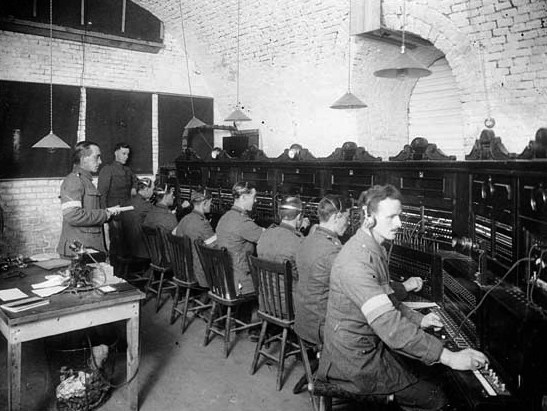
Charles returned to the Front and, on 8th March 1918, he was admitted to hospital with Trench Fever. This illness had first occurred in the soldiers in 1915 and was characterised by symptoms including headaches, dizziness, severe backache and severe pain in the shins. The fever usually lasted a matter of days but sometimes reoccurred and could be serious in some patients. It baffled the doctors at first but was finally found to be caused by the faeces of lice in the trenches entering a wound or abrasion. That Charles was stricken by it does show that he was probably sometimes in the front-line areas. Initially he was in hospital for 22 days but it seems that at the end of this time he was re-admitted for further treatment.
We do not know the details of his service but he was discharged in early 1919 and given a “Protection Certificate” to show that he was a returning soldier. The next of kin had been written alongside one document showing “wife” at 9 Spencer Street in Ringstead.
Charles’s half-brother, Stanley Alfred Walker, had been with the 17th (County of London) Battalion of the London Regiment, known as the Poplar and Stepney Rifles, as a Territorial soldier prior to the war. He fought in France from 9th March 1915 to 19th October 1916 but had been wounded in action and lost most of his right leg. Nevertheless, he later emigrated to Australia, as did his younger brother, Herbert Cecil. Perhaps more surprisingly, Charles’s father, Alfred, aged 61, with his second wife, had also sailed to Brisbane on the S.S. Euripides on the 25th September. He became a well-known figure in Maroochydore, a coastal town, some seventy miles north of Brisbane, where he had settled. He died in 1939 aged 81. His death certificate shows all his living children, from both marriages, including Charles.
I do not think that Charles and Sarah remained long in Ringstead and he disappears from the Electoral Registers in the early 1920s. In the 1939 Register of England and Wales he was living at 13 Milton Avenue in Barnet where he was still working as a Postal Clerk. It may be, however, that the couple did move back to Northamptonshire on Charles’s retirement. When his wife Sarah died in Kettering Hospital on 7th July 1956 she was shown as the wife of retired Civil Servant, Charles Leigh Walker, and was living at “Denscot” in Little Addington.
Charles then seems to have moved, like many others, to the coast for the rest of his retirement and lived at “Sea Merge” Overstrand on the north Norfolk coast. He died on 12th June 1966 in Sun Court Nursing Home in Sheringham.