The Great War: N–Z · Story 16
George Stanley Smart (1884-1917)
A Henry Smart had been born in Raunds in about 1814. He married Mary Ann Litchfield of Rushden in the Rushden Parish Church on June 4th 1838. Henry was a shoemaker and both the couple’s fathers were also in the shoe trade. Henry, however, changed his occupation and by 1851 the couple were living in Newton Bromswold, just three miles south-east of Rushden, and seven miles south of Raunds.
Henry was now a publican and grocer at the Swan Inn and Mary Ann was working at home as a dressmaker. Over the last decades we have seen the closure of many village pubs and it is worth remembering that, even in the Nineteenth Century, many needed at least a second income to survive. It is also likely that Mary Ann took an important part in the running of the business.
Among the couple’s children was Charles William Henry Smart who was baptised on April 2nd 1858 in Newton Bromswold.
On 24th 1862 Henry Smart appeared, at the Old Bailey in London, charged with trying to sell “a large quantity of beef unfit for human food”. From the court case we gather that Henry only had a couple of cows. Fortunately for Henry the cow was “thin” and poor-quality meat but not diseased or unfit for human consumption. He was therefore acquitted.
By 1881, Mary Ann was temporarily apart from her husband and she was in Rushden High Street with her son, Charles. He was twenty-three years old and shown as a farmer of 155 acres, employing two men and two boys. His father, Henry was still in Newton Bromswold living with his daughter Mary and her farmer husband. It appeared that the fortunes of the family were on the way up.
Later in that Census year, Charles married Maria Reynolds, on the 18th October in Pertenhall. By the 1891 Census he was still shown as a farmer living in Rushden High Street with Maria and their three children, George, (7), Florence (6) and Harry (1). Living with them was William Bailey, aged 18, an “Agricultural Servant” from Ringstead. Their son, George Stanley Smart, who is the subject of this biography had been baptised on March 2nd 1884.
It seems that the family’s circumstances waned because, by the 1901 Census, they were living at 5 Sivers Buildings in Ringstead. These “buildings” were a row of fairly poor cottages with few amenities. Charles, aged 42, had become a cattle stockman working on someone else’s farm. George, aged seventeen, was a boot and shoe maker.
By 1911 Charles, aged 53, was shown as a labourer on a farm and both George, aged 27, and his younger brother, Harry, were army shoemakers, but “out of work”. In 1914 the Great War was to bring work again to the army boot and shoe makers but in 1916 it also brought conscription which took many of the sons of the village.
George attested with the 3rd (Reserve) Battalion of the Northamptonshire Regiment in the weeks after 27th June 1916 and given Regimental Number 19334. After that, the dates are more problematic. He was probably transferred with a large group of his fellow soldiers to the Machine Gun Corps between the 14th and 16th September 1916 and given new number, 57027. They all would all have been sent on a six-week gunnery course at either Belton Park near Grantham or Clipstone Camp near Mansfield. Once this had been completed George would have been posted as soon as possible to France, to arrive by mid-November, at the Machine Gun Depot at Camiers. This was part of the vast Étaples Base Depot of the British Army.
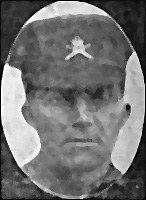
From Camiers the men would have been sent to whichever Machine Gun Company most urgently needed their services. For the Corps the manning of the units was far more fluid than for the Regiments for the guns needed to be at constant full strength.
When George joined the 8th Company of the Machine Gun Corps it was in the closing stages of the Somme campaign They were in action there, in the Battle of Ancre, from the 13th to the 18th November.
In early 1917 they had moved to the Arras area and fought in the Battles of the Scarpe and the Battle of Arleux. The Company then moved north into Flanders and were in action again in the Battle of Menin Road Ridge (20-25th September).
At this point the picture is a little confusing. Graham Sacker, on whose research much of the account of George’s military career is based on, admitted in his e-mail to me:
As a researcher and port of call for enquiries about the fate of MGC soldiers, this is one case I would hope never to be called upon to explain!
There are obviously some serious issues with the official version of events surrounding the death of George Smart.
Simply put, there seems to have been a confusion of Company and, more importantly, of place. When one considers the tens of thousands of men and the huge number of military units involved, organised on a system based on index cards, it is surprising that there were not more mistakes. One must also add into the mix, the often terrible, chaotic conditions under which field reports had to be written or typed. With the rider, that some things cannot be stated with absolute certainly, Graham Sacker did manage to bring some clarity to the confusion.
It seems likely that the “5th Company” in George’s records is an error and he was with the 8th Machine Gun Company throughout this time and certainly at the time of his death. We know from the War Diary that George Smart was named as part of “D” Section of the 8th Company on the 18th May 1917.
Following the Battle of Menin Road Ridge, the 8th were fighting, as part of the Flanders Offensive, in the Battle of Polygon Wood from the 26th to the 30th October 1917. “D” Company, which, as we have seen, George was part of earlier in the year was initially in reserve but was called forward and the War Diary records:
. . . the 4 guns of D Section were sent up at 9.30 am to consolidate, 2 guns being directed to Hill 40 + 2 guns to Leys [?] Cottage. The Section were much delayed by sniping and the Section Officer and several men became casualties on the way up. On finally arriving at the front line, there were only sufficient men and ammunition to service two guns; the guns were therefore sited in pairs [?] in shell holes, on the ridge between the WINDMILL CAB and the Railway Station.
At about 6.30 pm, while the teams were engaged in digging emplacements the enemy delivered a counter-attack. One gun came into action and fired a few bursts, but the line was forced back a little distance, and as the teams were reduced in numbers, the guns could not be got away and were lost.
The D Section suffered significant casualties during this opening phase of the battle, including one man killed, twenty wounded, thirteen gassed, one sick and four missing. George was one of these casualties.
It seems likely that he was one of the “four missing” for in the War Office Daily List 5412 of the 9th November 1917 he was reported as such. It was not until the 25th January 1918, in the Daily List (5475), that he was shown as:
“Previously reported missing, now reported killed”
Finally, it was clarified that he had been killed on the 26th September 1917. Unfortunately, it was also recorded that he was in the 5th Company and, later, he was commemorated on the Jerusalem Memorial (Panel 54 Upper). It seems certain that both of these “facts” are wrong. The correct version of events was recorded in the Army Register of Soldiers’ Effects which show that he was killed in action in France or Belgium and was with the 8th Company of the Machine Gun Corps.
It must have been an agonising wait for his parents, Charles and Maria, having some initial hope that he might have survived, but finally being informed of his death. He was entitled to the British War and Victory Medals.
His mother, Maria, was awarded a dependant’s pension of four shillings a week (20 new pence) on the 4th June 1918. George’s name was inscribed on the Ringstead War Memorial which was erected in the churchyard in 1924.