The Great War: N–Z · Story 21
Thomas Alfred Tomlin (1884-1968)
Thomas Alfred Tomlin was the son of Charlotte Tomlin, born on the 14th May 1884 and baptised the following year on October 28th, in Raunds Parish Church. In the 1891 Census, Charlotte was living with her parents and her children, Thomas (6) and Nellie (2) in Rotton (or Rotten) Row in Raunds. She was working as a charwoman
In early 1893, Charlotte married Thomas Adams and the couple had further children together. In 1901 Thomas was sixteen years old and still living with his grandparents, William and Emily Tomlin. He had become a pressman in a boot and shoe factory. The pressman would put the “knives” of the shapes of the shoe or boot pieces, rather like pastry cutters onto the leather. He would then operate a foot pedal which brought down the press to cut out the shapes. It was a skilled job and certainly not one for a daydreamer.
By 1911 he was back with his mother and her husband, Thomas Adams, who was a local builder. They were living at 14 Rotton Row and Thomas Tomlin, aged 26, was still a leather pressman. On the 10th February 1912, his mother, aged 49 years, was buried.
The war came but at first the army’s need for boots gave him exemption from conscription but, as the war dragged on, the rules tightened and also older men were being conscripted. On the 1st April 1917 he was called before a Military Tribunal and given a temporary reprieve but on the 15th June when he came before them again, the appeal by his employers, Adams Brothers, was dismissed. It was during the period of uncertainty that Thomas married Lily Henrietta Attley. Lily had been born in Ringstead on the 4th May 1893. Her father, Frederick was also born in the village but her mother, Frances, had been born in India. In the 1901 Census the family had been living in Northampton but, by 1911, Lily, aged seventeen, was working as a domestic servant in Finedon for butcher Edward Shelton and his wife, Ellen.
After their marriage in 1917, Thomas and Lily moved to Pierce’s Yard (various spellings) which was a group of cottages down the side of the old Police House, nearly opposite Ringstead House. The young couple were to have a brief time together in Ringstead and Thomas was living in the Yard when his conscription came through.
Unfortunately, as for so many men, his military records have been mostly destroyed in a WW2 bombing raid. As a result, although I have been helped by Peter and Charlie on the Great War Forum website, the account of his army career I have given seems a reasonable fit but is far from certain and must be read with this proviso in mind.
From the Ringstead Absent Voters’ List for 1918 and his Medal Roll and Card we know that he was first in the Norfolk Regiment and was given the Regimental Number 205464, These six-figure numbers were not given to men in the Regular Army battalions and it seems likely that he was first sent in July 1917 to a training battalion, possibly the 4th Reserve (or 3rd) Battalion at Halton Park, near Tring, before being posted to the 2nd Norfolks.
A number of men were drafted, first into the 2nd Norfolks, and later transferred to the 7th Berkshires. One of these was John William Clement Thake, who boarded a ship on the 7th October 1917, and arrived in India on 4th December. He joined the Depot of the 2nd Battalion of the Norfolks at Belgaum in India. John remained there for one year fifty days and then, after the Armistice, was sent to Salonika, arriving there on the 19th December 1918.
As a result of this, because he had not been in a warzone, there was initially some confusion as to William Thake’s entitlement to both of the basic war medals. It is possible that Thomas Tomlin followed the same path and it certainly seems, from the Roll of Honour, that he went to India first. There are differences, however, for the Roll also states that Thomas was posted to Mesopotamia, rather than Salonika. It may also be that Thomas went to a war zone earlier than John Thake. All we can repeat is that the following account is a possibility rather than a certainty.
In the summer of 1917, the 2nd Norfolks had been camped at Karnabit, east of the Diyah River on the Persian Front. There was also a separate “Segregation Camp” there because they had suffered a major outbreak of Diphtheria in the Battalion. On the 27th August 1917, the War Diary noted that, “the battalion is officially clear of diphtheria”. On the 2nd September, the Diary also recorded:
100 B.O.R.s joined the Bttn this day. This is a draft from England and the majority of the men having had 8 weeks training before being sent out
It seems possible that Thomas Tomlin was one of these men.
The 2nd Norfolks had been a Regular Army Battalion when war broke out but it had suffered a terrible and humiliating defeat by the besieging Turks at Kut-ul-Amara in present day Iraq. The Norfolks had been part of an ill-conceived attack on Baghdad which, after being taken with great loss of life, could not be held and the force retreated back down the Tigris, together with 1,600 Turkish prisoners and more than 4,500 wounded from both sides. They made at stand at Kut at the end of 1915 and into April 1916 but they were slowly starving to death. Cats and dogs were eaten and the Indian troops, unable to eat meat, were down to seven ounces of grain a day.
During the siege, some 1,750 men died. After the surrender the men were marched into captivity, with great brutality and two-thirds of the British troops did not survive. The 2nd Norfolks, as part of this force suffered terrible losses and as a result, for a time they were combined with the 2nd Dorsets and became the Norsets. Replacements were drafted in and the two units separated on the 21st July 1916 into their component parts. Few of the original “Regulars” would now have remained in the Battalion.
The war in Mesopotamia has been largely overshadowed by the horrors of the Western front but often the conditions were at least as bad as in the European theatre of war. The area could be very wet and cold but in the April to October period, temperatures were usually over 100 degrees Fahrenheit and often much higher. There were also many days of strong winds and sometimes tornados, stirring up great clouds of dust. In the same way as the rain in Flanders was unusually bad so, the hot season in Mesopotamia, was the worst in living memory.
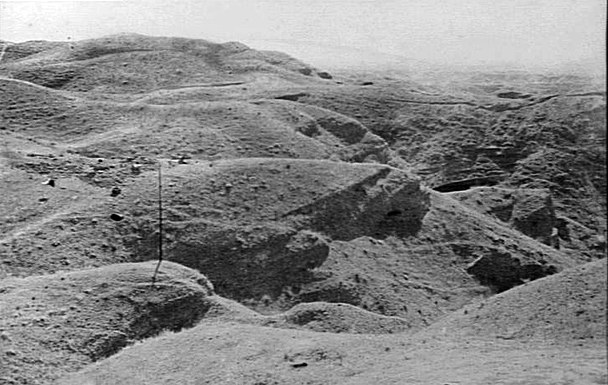
For the most part there was little large-scale fighting and heat and disease killed or incapacitated more men than the enemy. The area had few roads but did possess an important, ancient canal and irrigation system. In October 1917 the Brigade of which the Norfolks were part, was directed to occupy Jebel Hamrin and clear the Turks from the left bank of the Diyala River so that the Allies could control this canal system. The 2nd Norfolks task was to dislodge the enemy from the crest of the Jebel Hamrin. The Turks abandoned their positions before any real engagement and a pursuit began across the rugged hills and the broad plain beyond. After a brief skirmish at Kizil Robat, the Turks again quickly withdrew.
The Norfolks had to drive the Turks westerly from the far side of the river but the bridge had been destroyed and, when they tried to ford it, the men were swept off their feet and had to retire under cover of supporting machine gun fire. Eventually they did cross, using a makeshift pontoon bridge.
The enemy were in continual retreat north during early 1918 and in January the Norfolks were camping near the Ruz Canal, moving on to Kurdarrah where a tornado “flattened bulk of tents in camp”. When the strong winds allowed, they were digging strong points. In March 1918 the rains came and on the 31st of that month, the Diary records:
Whenever the wind blows from the south rain is sure to follow.
In April 1918 they marched to Mirjana and on to Kizil Rabat (Quizil Rubat) and on to Kifri. The enemy, however, was generally retreating before them so there was little contact and it was the harsh conditions which were hardest to bear. On 5th May 1918, the Diary wearily reports:
Dust storms all morning. No tents for troops, very hot, mosquitoes by night and flies in enormous numbers by day.
Now the Diary mainly reports on training, fatigues, firing practice and work on the railway. The heat began to increase in intensity. It is no surprise that on 12th June 1918, one man, Private Pocknall, decided to take a swim in the river and drowned.
By July 1918, the temperature had risen to 120 degrees and there was little activity. On the 12th July the War Diary irritably states:
The failure of Ordnance to supply us with Boots as required has now placed 102 men on the immobile list.
Would Thomas have seen the irony of this?
Work continued on the railway with the only death reported in the Diary coming from heatstroke.
It may be, at this period of inactivity that Thomas and some other men were compulsorily transferred to other Regiments, although it is not recorded in the War Diary. As we have said, the Medal Rolls do show that many men were transferred out of the 2nd Norfolks but, unfortunately, no dates are given. It is even possible that it was at this time that Thomas had spent some time in India because of a wound or sickness and then transferred to the new Regiment. We cannot be sure.
What we do know is that at some point in late 1918 or early 1919 Thomas Tomlin transferred to the 7th Battalion of the Berkshire and was given the new Regimental Number 219036. At the end of September 1918, the 7th Berkshires were advancing towards Sofia as part of the Army of Occupation, after the Bulgars had surrendered. On the 15th October, however, they were suddenly diverted to go to Mustafa Pasha, a railway station outside Odrin (now Edime). They then moved some fifty miles south to Adrianople, named after the Roman emperor Hadrian, and now confusingly called Edirne.
The Berkshires had suffered, like many troops who served in this area, with malaria and now “Spanish Flu” hit the camp. They moved on the Rustchuk (Ruse) and, on 11th December 1918, they entrained for Dobritch (Balchik), north of Varna, on the eastern shire of the Black Sea. Here they put the ejected Rumanians back in charge, in place of the Bulgarians, and went out in small parties to quell any minor uprising in the surrounding villages as a result of this change back to the pre-war situation.
On the 4th May 1919 the Battalion, sailed from Varna, across the Black Sea to Batum (Batumi) in Georgia, which was in a confused state after the Russian Revolution of 1917. The Battalion entrained again and travelled to Tiflis (Tblisi) some 300 miles east.
Demobilisation had already begun before the Battalion went to Koda, a hill station south of Tiflis. For the diminishing Battalion, it was then back to Batum before a small residue sailed to Constantinople where they were absorbed into other Regiments.
It seems most likely that Thomas Tomlin had left for home before this final date and would have been back in England by the end of 1919 at the latest. He returned to his wife in Pierce’s Yard in Ringstead. I believe that they moved back to Raunds in the early 1920s. By the time of the 1939 Register of England and Wales, they were back living in “Greyfriars”, Rotton Row in Raunds. Thomas was still working as a Pressman and Lily was a Ladies Hairdresser. I do not think that they had any children
Thomas died on 2nd June 1968 and Lily on 13th March 1973. She was still living in Greyfriars at the time of her death.