The Great War: N–Z · Story 20
Harry Tilley (1895-1915) and Horace Edwin Tilley (1899-1969)
For some men their service in the First World War was a long, terrible experience that scarred them physically or mentally for the rest of their lives. For others it was a brief interlude which, if not forgotten, was not a major influence on their later life. I think for Horace Tilley his military experience was more like the latter case although it was not without danger and unpleasant memories. For his older brother, Harry, it was even briefer.
There is some confusion about their father’s ancestry. Jonathan Tilley senior married Elizabeth Dixon on 25th December 1865. Jonathan junior was probably born on 29th December 1861, four years earlier, although he seems to have claimed a younger age sometimes, perhaps because of the age of his wife. When he married Susannah Dicks on 17th September 1894 he was shown as thirty years old and Susannah as seventeen. At his marriage his surname was given as Tilley-Dixon but he later dropped his mother’s surname and became John Tilley
Harry Tilley was born on the 31st November 1895 and Horace Edwin on the 22nd December 1899, the sons of Jonathan (usually known as John) and Susannah (or Susan). Horace was baptised in Ringstead Parish Church on the 5th June 1900. In the 1901 Census we see that father, John, was a farm labourer and milkman and he and Susan were living in Drayton Cottages.
The 1911 Census had them in the same home, now known as Agutter’s Cottages. John and Susan had been married 16 years and had had nine children, of whom five were living and four still at home. The children at home in 1911 were all boys, Harry (16), Horace, (11), Bertram (10) and Leslie (7 months). Susan’s widowed mother Emma Dicks was also living with them. The father, John, was still working as a “milkman on farm”.
The oldest daughter Jessie seems to be missing in the 1911 Census but she later married Wellingborough Engineer, Sydney Summers, in 1925 in Ringstead Wesleyan Church.
It was the oldest son, Harry who first enlisted. He volunteered on the 7th September 1914 in Northampton. He gave his occupation as “Carter” and was nineteen years nine months old. He was 5ft 5½ inches tall and weighed 134 lbs. Harry was enlisted in the 7th Battalion of the Northamptonshire Regiment and given Regimental Number 15142. He was medically examined and declared fit for service. On the 10th October 1914, however, he was discharged as being unfit for service. His character had been good but he had “very bad flat feet”. His service had lasted thirty-four days.
At the time, of course, marching both, in training and in troop movements, was a very important part of army life but perhaps there was something else wrong with Harry. On discharge he worked with the horses at Praed’s Mineral Water Works in Wellingborough. He was living with his mother’s widowed mother, Emma Dicks. In the 1911 census she had been in Ringstead with her daughter’s family but in 1915 she was living at 23 Palk Road in Wellingborough She may have moved but a Census is only a “snapshot” of one night so she could have been just visiting in 1911.
The Northampton Mercury of the 13th August 1915 told the story of his sudden death.
Emma Dix [sic] told that. . . he did not complain of anything and seemed all right. He was at work until 5 p.m. on Thursday and went out after tea in his usual health. He went to bed about 10.30. She awoke about two o’clock on Friday morning, and when looking to see what the time was she heard a noise in her grandson’s room. She went to him and waited with him until he died. He did not speak but made a noise. He died about 2.15, before the doctor arrived.
The doctor also gave evidence that he had died from double pneumonia and the postmortem showed evidence of “old-standing pleurisy”.
His brother, Horace Edwin Tilley, was some five years younger than Harry so was only eighteen on 22nd December 1917 and nineteen, the official age for overseas service, at the end of the following year. The Ringstead Roll of Honour does not have any wartime service listed for him but records that he was then (late 1918/early 1919) serving in Ireland with the 4th Battalion of the Norfolk Regiment.
We do not have any of his military records and, because he did not serve in a war zone during the Great War, he was not entitled to any service medals. I think the “4th Battalion” may refer to the 4th Reserve Battalion (rather than the 1/4th Battalion) which originally had been known as the 3/4th Battalion and on the 8th April 1916 had changed name. However, the only Norfolk Battalion to serve in Ireland in the 1918/1919 period was the 1/6th (Cyclist) Battalion which had remained on home defence during the war. It therefore seems most likely that he was transferred to the latter Battalion.
Although Horace had not served in the Great War, the posting to Ireland would have been a far from pleasant experience. At the end of the war, when the victorious powers were redefining the boundaries of many countries, Sinn Fein attended these meetings and argued that an independent Ireland should be included in this redrawing of the map. They were largely ignored and returned home empty-handed.
Frustrated by this lack of support and the long, dragged-out, passage of a Home Rule Bill, sections of the Independence movement began to organise on military lines and the Irish Republican Army (IRA) was born. On the 21st January 1919, the IRA shot dead two Irish policemen. This began an escalating series of attack and counter-attack with the war-hardened British troops retaliating to incidents with harsh, sometimes misdirected, reprisals.
For a young man caught up in this, it must have been a frightening experience. At least, in war, one usually knew one’s enemy.
At some point Horace returned home and, in 1921, he was living with his parents in Agutter’s Cottages again. By Spring 1925 they had moved to Carlow Road. It seems likely that Horace continued with his father’s milk round although I have not found proof of this. In the Spring of 1914, before the war had started an Edward Tilley, who was probably Horace’s cousin, had been summoned for selling adulterated milk in Ringstead. The case does show how different the local milk delivery was then to today’s industrialised process. The Northampton Mercury of 10th April reported on the case:
Aubrey Butlin, assistant to Mr T. Mattinson (Inspector under the Food and Drugs Act, Kettering), proved the purchase of a sample of milk, which was found to be deficient in fat to the extent of 12 per cent.
: - Defendant went into the box, and stated that he was milking five cows, two were in calf and three were not. On that particular morning he did not mix the milk as was his usual custom, as he was busy.
The Bench took a lenient view of his mistake and he was fined ten shillings (50 pence).
In the booklet “Stanwick – a retrospective glance No. 4”, Joan Whitby, talking of the 1940s, stated:
Taking the milk round was not like today – bottles and an electric float- but a horse and float and 2 gallon can with a measure. Customers used various receptacles – jugs, basins, etc.
Horace married Ada Beatrice Robinson in Spring 1930 and I think that they had four children. In the 1939 Register of England and Wales he was still a milkman, living in Carlow Road.
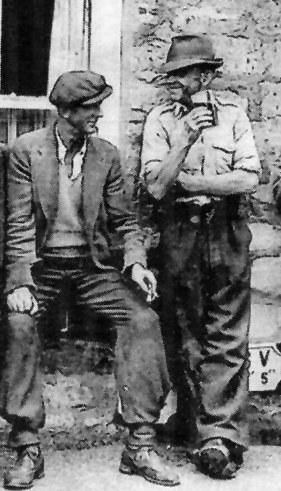
Horace died on 2nd March 1969, still residing at 23 Carlow Road and Ada, his widow, was living there when she died on 26th April 1984.