The Great War: N–Z · Story 10
The Roberts Family
We have begun a number of these stories, of men who fought in the Great War, by saying that the family name was well known in the village. The Roberts also had this distinction but, because of a Roberts who later became the first female Prime Minister, it is also known worldwide. In the Ringstead People books we have traced the family back to William Roberts who killed a fellow worker in the harvest field. William suffered many other tragedies in his family and we will see that some of his male descendants also struggled with what life had to offer.
For the purposes of our biographies, we will start their family tree with John Roberts, born in 1791, who was one of the surviving children from his father’s first marriage. John married Alice Page on 7th August 1830 in Ringstead Church. This was John’s second marriage, following the death of Rebecca, his first wife. The couple soon had another family and it is the lines of two of these sons, John born in about 1834 and Thomas born in about 1839, which we will be following.
The Roberts Family
A Very Simplified Family Tree
           John Roberts ------------------------------------------------------------------- Alice Page
                                        I                                                                           I
          John Roberts born 1834 m Letitia Phillips                   Thomas Roberts born 1839 m Mary Coleman
I                                          I                                                                       I
Benjamin m Ellen Smith     John b1860 m Sarah Lockie               George Henry m Mary Elizabeth Smith
                  I              I           I
 Edward Roberts b1897        John Owen Roberts b1888                      John Thomas Roberts b1892
John Roberts married Letitia Phillips on 12th September 1853 and among their children were Benjamin, born in 1858, and John, born in about 1860. Benjamin married Ellen Smith, and one of their children was Edward, born in 1897. John married Sarah Lockie and became a well-known organ builder and repairer. One of his sons was John Owen Roberts born in 1888.
If we now climb back up (or is it down?) the tree to Thomas born in about 1839 we find that he married Mary Coleman. When she died in 1872, he remarried, to Elizabeth Greetham, but it is a son of the first marriage, George Henry, born in about 1865, whose son we will be looking at. George married Mary Elizabeth Smith in1887 and one of their children was John Thomas born in about 1892.
So, we have our three men, Edward, John Owen, and John Thomas Roberts after an almost Old Testament trail through the family tree. We will start with Edward.
Edward Roberts (1897-1917)
We have written elsewhere in the Ringstead People books about Benjamin Ebenezer Roberts. He was born in 1858, just twelve years before the death of his father, John, in 1870. In the 1871 Census we see that he was aged 13 and living with his widowed mother, Letitia and was already working as a shoemaker.
In 1881 he was still working at this trade and living with Letitia and his siblings in Ringstead High Street. Next door lived another widow, Catherine Smith. Catherine and her husband had come over from Ireland and made their way through England from the west, possibly escaping the terrible famines in Ireland. One of her daughters, Ellen, married Benjamin at St Sepulchre Church in Northampton on 2nd March 1883. This was a High Anglican Church and one wonders if it was a compromise with Ellen’s possibly Catholic background and away from the Nonconformist eyes of Ringstead.
Benjamin and Ellen had eight children, one of whom died in infancy. In age order they were Eleanor (sometimes Helena), Harold, Frances, George, Alfred, Jessie and Edward. I have not found the infant death.
By 1911 three of the children had left home. Eleanor and Frances were both servants at Upton Hall. Eleanor was a parlourmaid and her sister a housemaid. Alfred whose eyesight was too poor for shoemaking became a shopkeeper in Grantham. It seems unlikely that he would have been conscripted in view of his disability.
It is the youngest child Edward, born in 1897, who was the only son that we know fought in the war. In 1911 he was a “leather chopper” in a “Lift Factory”. A “lift” was a heel made up from layers of leather. A. E. Fox and Company was a firm based in Burton Latimer but they had also opened a second factory at the bottom of Spencer Street in Ringstead.
In 1915, Frances, who we had last seen as a housemaid at Upton Hall, married in the village church there to “Drummer Thomas Garland” from the East Surrey Regiment. Alfred too married, to Beatrice Stephenson, on 2nd June 1917 at the Wesleyan Chapel in Grantham. The children were leaving home. Edward either volunteered in late 1915 or was conscripted in early 1916 and was posted to the Suffolk Regiment and given Regimental Number34620. Charlie and Jay on the Great War Forum website have helped me give some reasonably accurate dating for Edward’s service.
It seems most likely that he attested in December 1915 and was mobilised in June 1916. Unfortunately, we cannot be sure when he transferred to the Prince of Wales’s Leinster Regiment (Royal Canadians) but we know that this is what happened. The Regiment had been formed in 1881 as part of the Childers’ Reforms. It was a bringing together of former Regiments and one of these was Canadian, raised in response to a massacre of 120 women and children in India. The link with the Canadians weakened through the years but it still retained its nickname, “The Royal Canadians”.
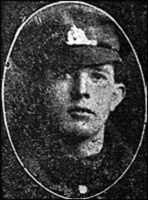
Edward, probably with others from the Suffolks, joined the 6th Battalion of the Leinsters in Salonika. Clive Aslet wrote in The Irish Times in 2016:
Now called Thessaloniki, the city itself had, until a few years before, been one of the jewels of the Ottoman Empire – a mysterious compound of the exotic and cosmopolitan, the place to which St Paul had addressed his Letter to the Thessalonians, in which Roman ruins stood beside ancient basilicas, recently converted back to churches from being mosques. From the port, serving the Balkans, it was possible to see Mount Olympus, home of the ancient gods, across the bay. But outside the city, the countryside hadn’t changed much from the days when Lord Byron was there, its tracks – there were no proper roads – still haunted by brigands. .
. . . the French and British threw a ring of barbed wire fortifications around Salonika (it became known as The Birdcage) and occupied the plains; while the Bulgarians dug themselves into the mountains. That was how things remained until the last months of the war. Stalemate.
It would have seemed a relief, at first, compared to the rain and mud of the Western Front but it had hidden dangers for the soldiers who were stuck there for two years. Writing of Medicine and Medical Service in the First World War, Leo Van Bergen stated:
At Salonika, the base of the British Balkan campaign, hospitals were in a dreadful state, every once in a while complicated even more so by extreme cold. Illnesses such as malaria, sand fever, typhoid, and dysentery raged among patients and doctors alike.
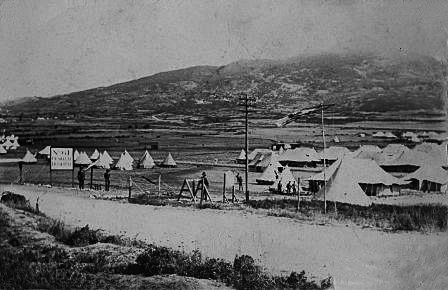
The Greek King changed his stance from neutrality to support of the Allied cause and, as a result, many of the British troops were not now required. In September 1917, the Battalion left for Egypt for service there and in Palestine. It seems unlikely that Edward travelled with them because he was already too ill to leave Salonika. He died of dysentery in the 61st General Hospital in Salonika on 1st December 1917. He was buried in the Salonika (Lambet Road) Military Cemetery in Grave 1300. He was 19 years of age. After the war he was also commemorated on the Ringstead War Memorial. He was entitled to the British and Victory Medals. His mother, Ellen, who, of course was Irish by birth, received a small pension.
Edward’s sister, Frances, had also suffered. It appears that her husband, Thomas Garland had been reported wounded in 1916 and then in 1918 as missing. It is a little confused but it then seems that he was reported as killed on 6th May 1918. This, however, was not correct and he was a prisoner-of-war and he did return to England after the war had ended. He became a sub-postmaster in Asfordby in Leicestershire and he and Frances were there with their family in the 1939 Register of England and Wales.
It would have been a terrible time for the Roberts family. When we look at photographs of Benjamin, he always had looked a rather sad, morose figure. This may have just been his natural look but we know that in the years after the war he began to sink into depression. In April 1925 he went to Irthlingborough Station and lay down, with his head on the rail, as a train approached the station. It was slowing, ready to stop, and the “lifeguard” in front of the wheels pushed Benjamin along so that he was not immediately killed but was badly injured. He was tried for attempting suicide and we learn that the family had sought to get him into a mental hospital but the required number of doctors had not agreed to certify him. He returned home into the care of his wife Ellen, who was a St John Ambulance nurse. He died a few months later, on 17th September 1925.
Was he another victim of the war? We will never know and he was not the only Roberts man to suffer depression in his later years. As we will see.
John Owen Roberts (1888-1957)
Benjamin’s younger brother was John Roberts who was first a shoemaker but later became a full-time organ maker and repairer. He had started his business in a barn behind the Post Office but later had a house he named Mozart House in Denford Road.
On 25th May 1885 he had married dressmaker Sarah Lockie in St Giles’s Church in Northampton. Again, like brother, Benjamin, some two years earlier, he had chosen to marry, not in either the groom’s or the bride’s home villages but in the county town. He too was a Nonconformis,t so did his bride want a church wedding and he wanted it away from the local rivalries of church and chapel?
In the 1891 Census the couple were living in the High Street and John was working as a shoemaker. They had two children, Florence (5), and John Owen (3). In the same Census, living in Denford, were Freeman Arnold, a bricklayer’s labourer, and his wife Lucy and their family, including youngest daughter Alice Martha Arnold, just three months old.
John Owen mother’s connection to Denford may have led to him meeting with Alice and, in 1908, the couple were married. He had become an army bootmaker but by 1911, like many at the time, he was unemployed. He and Alice had by then had two children, Constance, two, and Winifred just five months old.
As we have seen in other biographies, the closeness of a village community could provide support in times of need but could also lead to tensions. The Northampton Mercury of the 14th March 1913 reported on a case in the Divisional Petty Sessions.
Neighbours’ Squabbles – Harriet Bettles, married woman, Ringstead, was summoned for a common assault on Winifred Roberts, a child, at Ringstead on February 28 – Owen Roberts, shoe operative, Ringstead, (and father of Winifred Roberts) was summoned by Mrs. Bettles for assaulting her on March 1; and Mrs. Bettles was summoned by Owen Roberts for assaulting him on the same day. – Mr. J. Prentice appeared for Roberts – the Bench bound each party over in the sum of £5 to keep the peace for 12 months, each party paying own costs. – The case with regard to the child was dismissed.
Of course, greater battles and tragedies were to replace the petty squabbles of village life.
Some nine months later, on 28th November 1913, the couple had a son, Wilfred Edgar. The war started in 1914 bringing much needed work to the handsewn men and, at first, married men in the trade had some protection from conscription which was brought in in early 1916. It was not until September 1917 that John was called up. John was quite unusual among the Ringstead conscripts in that he was posted to the Royal Navy and was first sent to Victory I, the name given to the shore-based training unit in Portsmouth Harbour.
We do have a very brief account of his service and we see that he was 5ft 9½ inches tall with a 37½ inch chest. He had dark hair, brown eyes and a sallow complexion. John was given service number 7316 and trained as a “General Seaman” from 5th September 1917 to 15th February 1918 on “Victory I”. It appears that he was still retained on the strength of Victory, so it may be as part of his training he was sent to HMS Mars and given a new number, 593, He was with his new ship from 16th February to 28th May 1918.
HMS Mars had been built in 1894 and it was coming to the end of its useful life. At this time, she was being refitted in Chatham Docks for conversion to a harbour depot ship and John presumably served on her during this time in harbour, continuing with his training.
On 29th May 1918 he was posted to HMS Cardiff, a light cruiser, which was based at Rosyth, on the Firth of Forth. From there it patrolled the North Sea.
John would have been witness to one of the great sights of the First World War. Ten days after the Armistice, the entire German Fleet surrendered in the Firth of Forth. It was the greatest gathering of warships that the world had ever seen. The German Fleet consisted of 9 battleships, 5 battlecruisers, 7 light cruisers and 49 destroyers. The seventy ships were escorted into the sheltered estuary of the Forth by hundreds of Allied ships and aircraft.
The Germans had been instructed not to have their guns loaded and to have everyone on deck except for the engine crew. The Royal Navy’s Great Fleet had sailed into the North Sea forming two columns, six miles apart. Just before 10 a.m. it had met the German Fleet and it was HMS Cardiff, a small light cruiser, that led it to their surrender. A Times correspondent, on board HMS Seymour, witnessed this scene and described it as “a school of leviathans led by a minnow”.
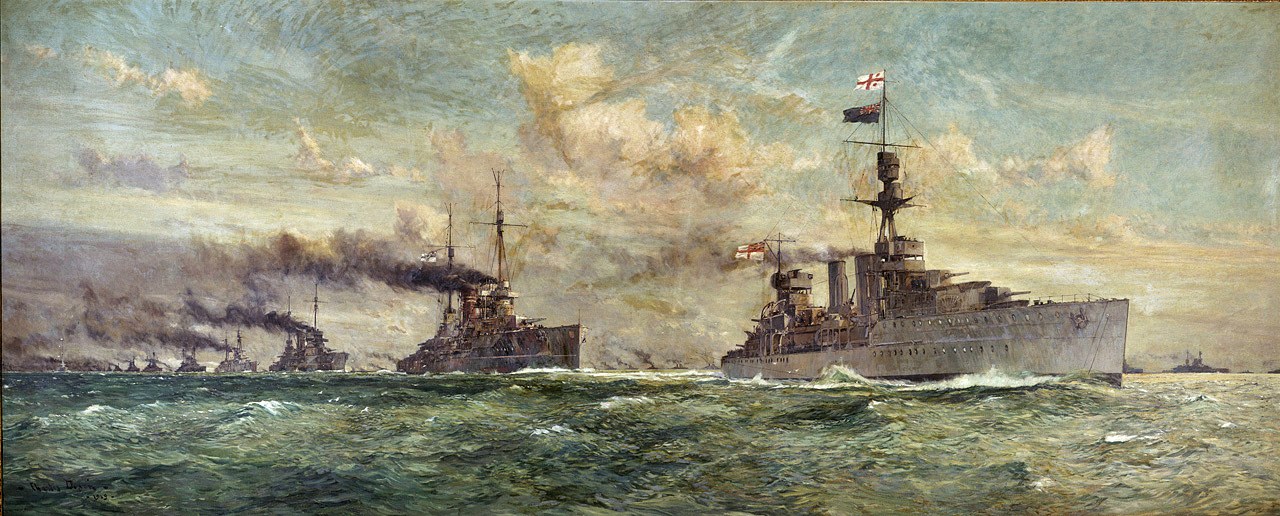
At first the German crews were confined to their ships but gradually they were allowed ashore. After news of the humiliating terms of the Treaty of Versailles which, among other things, divided the fleet among the Allies, reached the Germans, Rear Admiral Ludwig von Reuter ordered the sinking of his own ships. On 21st June 1919 the remaining crew opened all the flood valves and watertight doors and smashed water pipes so that the whole fleet was sent to the bottom.
HMS Cardiff, however, by this time had sailed to Denmark where it was based at Copenhagen and Libau (now Liepaja in Latvia) and Reval (now Tallinn in Estonia) and also visited Riga. After its tour of duty, it sailed back to Scotland, reaching Rosyth on 7th January 1919 before returning to Portsmouth four days later.
John Owen Roberts was demobilised on 4th March 1919 and returned to his family in Ringstead. In the 1920 Ringstead Electoral Roll John was living in High Street. His wife, Alice Martha Roberts, had not yet qualified to vote although by 1923 she is shown on the roll because she had reached thirty years of age. As we have seen in Edward’s story, John Owen’s uncle, Benjamin Roberts tried to commit suicide in 1925 and died a few months later. John Owen’s father, the organ-maker died in 1933. [Amazingly. His father-in-law, Lemuel Lockie lived to be 100 years old]. I think that Mozart House in Denford Road was, at some point after the death of John Roberts and the end of the church organ business, split into two cottages for John Owen and his married daughter.
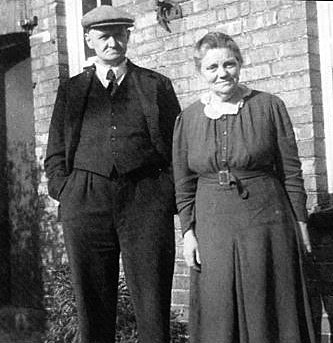
The 1939 Register of England and Wales shows John and Alice in Mozart Cottages in Denford Road, John was still a bootmaker and Alice has the usual “Unpaid Domestic Duties”. Living with them appears to be four children (the record of one is “officially closed” but may be Wilfred). Winifred, born on 28th December 1910, was still at home but is shown as “incapacitated”; John Owen junior, born on the 3rd April 1917, may be a shoemaker but he did become a brickmaker. Muriel, born on 24th January 1929 was at school. John’s widowed mother, Sarah, who has private means was also living with them.
A few months before the Register was completed, John Owen advertised in the local newspaper for a “Swarm or two of Bees”. It gives an impression of a happy country life. The years passed and Alice, John’s wife, died on 7th January 1957. We see from the Administrations and Wills Index that John, who had been granted probate, was still a boot and shoe operative in a local factory. I think that he retired at about this time and it seems that he was hit hard by the death of his wife.
He was living in Mozart Cottages in Denford Road and his daughter Muriel, and her husband John Henry Simms lived next door. One morning in May of 1957, just before 7 am, John Simms had gone outside to feed his chickens. He saw John Owen who greeted him with his usual, “Hello Boy”. Only half an hour later he went to the barn to fetch his bicycle where he saw John “hanging from the rung of a ladder standing at an angle”
John Simms fetched John Owen’s son, Wilfred Edgar from the Post Office where he lived, although he also worked in a local Boot and Shoe factory. The two men went back to the barn and took down John Owen’s body. His death was confirmed by Dr Alistair McInnes from Raunds who later told the inquest that his neck had been dislocated.
They found a small note written in pencil in John’s pocket. It was unsigned.
John Thomas Roberts (1892-1944)
Finally, we will trace the line of Thomas Roberts (born in about 1839), the youngest son of John and Alice. Thomas married twice but it is the line from his first wife, Mary Coleman, who died in 1872, aged 32, which we will be following.
Thomas and Mary had a son George Henry, born in about 1865, who married Mary Elizabeth Smith from Polebrook in 1887. One of their children was John Thomas Roberts, born on 29th April 1892 and he is our third World War One fighter. In the 1891 Census the family were living at 2 Carlow Road, just a few doors away from cousin, Benjamin, at number 8.
The decade after the Boer War was a difficult one for the military boot industry, with the Government trying to reduce the piecework rates. This led to great unrest in the area and then to the Raunds’ March in 1905. As happened, many years later, with the Miners’ Strike, tensions in the village and even within families became strained. George Henry Roberts was one of the men who continued to collect their work from the factory in Raunds in defiance of the strikers. Finally, violence broke out and he was “kettled” home with pots and pans and the windows of his house were broken by stones. At the trial of the men, William Roberts, George’s younger brother appeared on behalf of one of the accused.
Whatever the rights and wrongs of this case, it would have been a difficult and sometimes frightening time for the family. John Thomas may have suffered in the village because of his father’s unpopular actions.
In the 1911 Census, after the troubles of the Raunds March George had been married 24 years and the couple had five children, all still at home. The oldest child, Florence, aged 23, was a hat maker, and John, aged 18, a miller’s carter. Also in this Census was Annie Loakes, aged 17, a laundress’s assistant living in Great Addington with 56-year-old widow, Emma Ward. Emma was a “Dairy Keeper”.
The couple may have already met but in 1914 the Great War was to take John away from Northamptonshire. He first attested on 27th December 1915. We can see from his form that he was now working as a platelayer on the railways and was 23 years 7 months old. Initially he was put on Army Reserve but he was not mobilised until 8th February 1916. He was first posted to the 3rd Battalion of Northamptonshire Regiment and given Regimental Number 22989. The 3rd (Service) Battalion was a training unit which was based for most of the war at Gillingham. At the end of his training period he was transferred to the 2nd Battalion of the Northamptonshires, known as the Steelbacks, and first set foot in France on 31st May 1916.
July 1st 1916 was the infamous first day of the four-and-a-half-month campaign known as the Battle of the Somme. The British offensive was designed to draw the German forces away, to improve the chances of the French-led attack at Verdun. Unfortunately, the Germans were in strong defensive positions in the British sector.
The 2nd Battalion was part of the 24th Brigade, which temporarily formed part of the 23rd Division. The Battalion was involved first on the 7th July in the area of trenches known as Lozenge and Crucifix. With rain falling in sheets and casualties building up, these trenches rapidly became a congested quagmire. Any gains were soon lost and, all the time, the fighting was fierce with continual casualties.
On the 15th July 1916, the 2nd Battalion was transferred to the 8th Division and was in the Cuinchy sector. The book of the Northamptonshire Regiment 1914-18 records that:
“The History of the 8th Division” describes how the front was a maze of trenches, old and new. German, French and British; trenches blown in and disused, or abandoned and derelict; British fire trenches which had once been German communication trenches; trenches ending in saps twenty yards from the enemy lines; salients, re-entrants and fortified mine-craters – all reeking of death and stagnation. Any attempt to dig new lines was gruesome in the extreme. Bodies were turned up at almost every yard. In many places the parapet was largely reverted with corpses, thinly concealed by rotting sandbags through which at night rats fled squealing from their ghoulish repasts. And here in this sector was a continual struggle of mine and counter-mine which had reared great crater mounds of gleaming chalk along the narrow No Man’s Land. And here reigned day and night the nerve-racking expectation of being blown sky-high without warning. As a sector it was “unhealthy” in more ways than one.
The campaign, for the 2nds, continued with sporadic artillery fire and raids on the enemy trenches. On October 12th the 2nd Battalion moved south to take part in another phase of the Somme campaign. The weather had broken and the battlefield was once again a sea of mud. The 2nd, with the rest of the 8th Division, arrived in the Front Line and on 23rd October and were part of an assault designed to secure positions for the launch of an attack to take the village of Le Transloy. So it was, on 22nd October, that the 2nds relieved a battalion of the Sherwood Foresters in the Front Line. The Regimental history of the war records:
It was a typical Somme relief. Most of the guides lost their way – as well they might, considering that the country was blasted out of recognition and landmarks were hourly obliterated by shell fire – and it was nearly two o’clock in the morning of the 23rd before the relief was complete and the 58th [the old name of the 2nd Battalion] then took what rest they could, preparatory to the coming battle.
It is worth giving one more long quotation from the Northamptonshire Regiment 1914-18 to show that, for the ordinary soldier, it was not a series of major battles but a movement from one hellhole to another with more, or less, enemy fire and gas. It describes the conditions:
Everything was mud, mud – and again mud. There was thin, liquid, watery mud – mud like inferior gruel. There was a slightly thicker mud - a porridge kind of mud. But the bulk of the mud like simmering glue – in everything but the temperature, for it clung with icy chill. Billets in the back area were camps of dirty, wet and decrepit – gloomy archipelagos rising from the mud seas. The front line beggars description. It consisted of a mass of shell holes; of oceans of mud; of gulfs, inlets, lagoons and lakes of icy water. Trenches scarcely existed except for short lengths on higher ground: of communication trenches there were practically none; men had to do the best they could to improve such shell holes “as were least full of water and other unpleasant relics of the battle”. Villages there were in profusion – on the map; but in reality they were flattened brickwork. Looking back to those days it is hard to realize how human beings could have existed in such conditions.
1917 came with little achieved but the war of attrition was also wearing the Germans down. At the end of 1916 they planned and started building a strong line of defences, known to the Allies as the Hindenburg Line, which was back from the existing front line and was shorter so meant their troops were not spread so thinly. On the night of 23rd/24th February 1917 the enemy began a planned withdrawal back to this line.
The Allies tried to harry the retreating Germans but there had been a thaw and with, once more, heavy rain, the area in front of the Allies was turned into a morass so deep that men were pulled into it and drowned. Nevertheless, because the Germans were retreating, good progress was made at first although the German rear-guard fought with bravery and determination. In the offensive of the 4th March, the 2nd Battalion had 242 casualties. They moved into the back line but were quickly brought up again in terrible conditions. The War Diary drily remarks:
Working parties spent a great deal of their time digging each other out.
The losses would have created a constant need for promotions and John must have shown resolution and leadership skills for, on 17th March 1917, he was appointed a paid Lance Corporal. A little over a month later, on 20th April 1917 he was promoted to full Corporal.
Despite the general successes, there had also been the failure, in the Nivelle offensive, to break through the Germans decisively and it was decided that another attack must be launched. The Third Battle of Ypres started on July 31st 1917, and, after intensive training in this more mobile warfare, the 2nd Battalion became part of this new attack with three objective lines, blue, black and then green. In this, often featureless, terrain the lines were taped in advance (often to be obliterated in the mud and shellfire).
It was a difficult area in which to attack, with a large lake and a water-filled ravine. There was fierce fighting and many casualties but as the year moved to a close the action quietened, although not without casualties. The 2nd Battalion moved to Wizernes, training and resting for three weeks. After more time in the line they rested at Warrington Camp at the end of the year.
John was once more promoted to Lance Sergeant on 24th January 1918 and he retained this rank for the rest of his army career.
The Russian Revolution had taken them out of the war, enabling the Germans to bring more troops to bear on the Western Front. The Americans had also entered the war on the Allied side and their troops and fire power would be an increasing threat to the German Army. They decided to try one last decisive offensive to win the war.
The Michael Offensive began on March 21st 1918, on a morning of thick white fog. The Germans everywhere gained ground. The 2nds, as part of the 8th Division were at first in Reserve and by the time they were instructed to move forward the whole Allied line was in rapid retreat. The 2nds were forced to move backwards with this retreat in order to maintain the line and prevent the Germans getting behind them.
This rear-guard action was very wearisome and demoralising but the German attack began to falter. They too were worn out and the supplies and artillery struggled to keep up with the forward surge. The Battalion was relieved by the French in the line and, by April 2nd, were out of the action for rest and re-organisation. On the night of April 19th/20th the 2nds again went briefly into the line east of Villers Bretonneux. On April 24th the Germans launched another desperate attack and the Battalion, although behind the Front Line, were heavily shelled with high explosive and gas. It seems likely that this was when John Thomas Roberts was wounded.
His military records show that he suffered a gunshot wound in the head of the left femur (thigh) on April 25th 1918. We know that the tide was about to turn and the Germans, exhausted, would soon be in rapid retreat but, for John, the war was over. He was taken back to England for his injury to be treated and was transferred back to the 3rd Battalion on 7th September 1918. On 16th October 1918 he was demobilised. He had been in France one year 332 days,
John returned home and either met, or renewed his acquaintance with, Annie Loakes from Great Addington who we last met in 1911, aged 17, as a Laundress’s Assistant. The couple married in the second quarter of 1920. I think that, at first, they lived together in Great Addington but at some point they moved to 43 Ford Street in Kettering. That is where they were in the 1939 Census. John was working as a “Railway Relayer” which is described as “Heavy Work”. Did his war injury still cause him problems? There is a young child, Jean Small born in 1930, living with them but it does not look as if they had any children of their own. Could she have been an evacuee?
John Thomas Roberts died on 10th November 1944 at Kettering General Hospital. I have not managed to find the death of his widow, Annie.