The Great War: N–Z · Story 1
George Herbert Newell (1888-1970)
In the life story of William Meadows, we saw how his early life was chaotic but how it seemed to produce in him a desire to seek his fortune elsewhere, with the war being the catalyst for these changes. George Herbert Newell also had a childhood, separated from his parents, but he remained in Ringstead and became an asset to his home village.
George was born on 9th June 1888 in Ringstead and baptised on January 24th 1892, the son of John and Sarah Ann Newell. John Burrows (sometimes Burris) Newell had married Sarah Ann Coleman on 25th October 1886. John was the son of shoemaker Zephaniah and Hannah, a shoe closer, and had been born in Chelveston.
In 1891, Sarah Ann Newell was living in Church Street in Ringstead with her three children. Frank, the eldest, had the surname Coleman and was six years old so born before his mother’s marriage. The other two children were Kate (3) and George (2) and he is the subject of this story. We can also see that the father, John Newell is missing. Have the couple split up so quickly?
When we look for John, we find him lodging at South Lodge in Edgeware in Middlesex with gardener William Berry and his wife. He was a poultryman and servant, perhaps at the Elstree Hill School, or one of the large houses nearby. We see that he had been looking for work so that he could bring his family down to the big city. By 1901 the family had come together again and were living at 13 Plough Road in Battersea. John now works as a Railway Carman and oldest son Frank also worked on the railway as a “Carman Vanguard”. Carmen were employed by the rail companies to make local deliveries from the stations and goods yards and to bring parcels to the station. Frank was probably working with his father keeping an eye on the delivery items while his father delivered and was away from the cart. Kate was also at home and there were new children Arthur (9), Mabel (6) Elsie (3) and John (1). The three younger children were born in Battersea so Arthur was the last child born in Ringstead. It seems that the family moved to London in the mid-1890s.
But where was George? If we look back at Ringstead in 1901 we see him there, aged 13, living with his widowed grandmother Ann Major, a boot closer. We know from a later newspaper article that George had returned to Ringstead when he was nine years old, so some four years before the Census. What we do not know is why George, of all the children returned to his home village.
His family settled down to big city life. Plough Road was close to Clapham Junction, an important railway hub. By 1911 they had moved to Shakespeare Avenue in Harlesden, near Willesden another large Railway area. John aged 49 was still a carter for the railway as was his son, Arthur while Mable (Mabel) was an electric globe maker and the younger children, including a new daughter, Clara (5) were all still at school.
But George never joined them and seems to have settled well into village life. In about 1905 he had joined the Juvenile section and had become a “Junior Warden” in the National United Order of Free Gardeners whose origins were in Scotland in the Seventeenth Century. This was one of the many Friendly Societies which, rather like the Freemasons, provided comradeship, and an early form of “National Insurance” held together by strange symbols and rites and talk of ancient secrets. For many working families the “Gardeners” helped them in times of financial stress and saved them from destitution. The Ringstead branch was known as Clove Lodge and George continued with this association for much of his life. He was also a keen footballer and played into the 1920s, for Ringstead, Raunds and Thrapston. Like others who met on the playing fields of Ringstead, his career was to be interrupted by the coming of a terrible war.
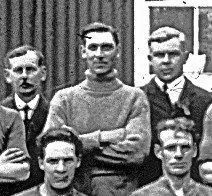
In 1910 George had married local woman, Eliza Jane Giddings, some seven years his senior. She too, had a complicated family background. She had been born in Peterborough but in 1891 was living with her unmarried grandmother, Dinah Giddings, who in the 1881 Census was, unusually, described as the “Mistress” of Daniel Major, her one-time lodger. It seems that Eliza Jane was the daughter of one of Dinah’s children but I have not found the birth. By 1901 Dinah was in Thrapston Workhouse, now morphing into an old people’s home for the poor working class. She died there, on 3rd July 1908 but her body was “collected by friends” and she was buried in Ringstead Cemetery.
By 1911 the couple were living in High Street in Ringstead with six-month old daughter, Lorna, born on 8th October 1910. Another child, Kenneth, followed on 5th June 1912. George was a married man with a young family but eventually the war machine came calling. We know that he served for three years and was demobilised in 1919 so it seems likely that he did not volunteer but was conscripted in early 1916.
Like a number of local men, he joined the “Suicide Club”, the nickname given to the Machine Gun Corps and was given the Regimental Number 59100. Of the 170,500 officers and men who served in the Corps in the Great War, 62,049 men were killed, wounded or missing. He would have been sent to Belton Park, near Grantham in Lincolnshire. In 1915, the owner, Lord Brownlow, agreed to his land being used as a training base for the Machine Gunners. His estate was covered with one thousand huts, a railway, chapel, hospitals and stable. George would have been trained to use the Vickers machine gun and to be one of a team. The carrying, setting-up and firing of the gun was heavy work and only the physically fit and intelligent were accepted.
The training period reduced as the need for casualty replacements became critical and may have been as short as six weeks. George was posted to the 62nd Machine Gun Company which was formed at Belton Park and sent to join the 21st Division on 4th March 1916 in France. It seems likely that George was with them. To get some idea how the men reached the Front during WW1 we will follow George on his journey from the War Diary.
The 62nd marched out of camp at 1 am on 24th February 1916 and arrived at Southampton at 10.30 am next morning. They embarked on a ship of the Australind Steam Ship Company in the afternoon but remained in Southampton Water until 3rd March waiting for favourable conditions. Eventually they arrived in Le Havre at 3 am on 2nd March. The Company disembarked, drew their winter clothing at 6.30 pm and marched to the train which left at 10.30 pm. At 8.30 am the next day they arrived at the railhead at Steinwerck. They detrained and marched some five or six miles to billets at Armentieres near the Belgian border, arriving there at 1 am, on the 4th March.
The life of the soldiers was full of fear, hardship, illness, tiredness but there were also long periods of boredom. The simple statement of a journey does not show how wearisome it would have been. The 62nd, however, did not have long to be bored after they arrived for, that same afternoon, they moved up twelve guns to the “subsidiary line and support points”. Fortunately, there was no action by either side in this first session of three days in the trenches and they were relieved and returned to the billets in Armentieres.
This was the normal pattern of trench life on the Western Front from reserve to front line and rest. On 23rd they marched to La Crèche billets where they trained and were inspected. They then had a period of transit by train and marching between billets, finally reaching Mèaute, some sixty miles to the south, on 22nd April.
The War in 1916 was dominated by two major campaigns, the Battle of Verdun that lasted from February to December, which largely involved the French, and the Battle of the Somme which started on 1st July following an Allied bombardment greater than anything the war had seen up to that point. This first day is now remembered as the day when the British Army suffered more casualties than on any other single day in its history. On the 1st July the 62nd were moved up to Sunken Road in front of Crucifix Trench in a 21st Division attack to capture the village of Fricourt. The various battles along the Somme continued until November 1916 and we see the 62nd moving to where they were posted. In August they were in the Arras area but did not seem to have seen much action. Certainly the Captain, G.G.N. Hodge, the commander of the 62nd had time to issue minutely detailed instructions as to when and how the men should salute the officers.
By early 1917, the 62nd were in the Bethune and Vermelles area and by May were based at St Leger. By 1st July they were at the Hindenburg Line. It was in the following six months that they had a fierce challenge in the Third Battle of Ypres and then at Cambrai. In Machine Gunner 1914-18, C.E. Crutchley records the memories of a 62nd “front line runner”:
My company was in the Bullecourt Sector during the summer months of 1917.
It was an area of devastation. The countryside was pitted with shell holes and only the stumps of once beautiful trees remained.
Our machine guns were set up amid the ruins on the outskirts of Bullecourt. It had been the scene of a big battle and when we took over there, bodies of dead soldiers still lay unburied. There was much strafing by day and night. Gunners not on duty rested in an old cellar of a house at the far end of the village. We had to share our rest billet with a team of trench-mortar men who had their gun fixed above us in the ruined house.
This soldier was appointed a messenger for the 62nd and we get some idea of the daily horror of trench life from his account.
Almost every day I had to pass along a deep trench which had been dug through the graves of soldiers.
Protruding from the sides of the trenches were portions of stockinged feet, and various parts of the human body. Although this spot was disinfected regularly by the pioneer squad, the stench was unbearable, and this was summertime and very hot weather.
Later in the year the 62nd were involved in the First Battle of Cambrai where tanks were an important part of the battle plan. Their task was to break through the German lines so that the infantry could follow in their wake. The machine gunners found it heavy work to keep up with this forward movement. They managed to get to the Hindenburg Line through the barbed wire and sniper fire and the next day reached a concrete dug-out which had been a German staff billet with beds and a wooden floor. They spent four nights around this area but as usual attack was followed by reaction. The “Gunner” wrote later:
On the morning of November 25th, 1917, the Germans launched a counter-attack, and I was once more a gunner with 62nd Machine Gun Company. The attack began in broad daylight, and looking across the valley on the opposite slope about half a mile away, I saw lines of field-grey figures steadily advancing, German artillery, supporting their infantry, sent over many gas shells, mixed up with shrapnel and H.E.’s. We quickly donned gas masks, sighted our machine-guns and opened fire on the grey figures, who rapidly withdrew to a distance our guns were unable to reach, and eventually disappeared in the valley below.
The 62nd and 51st Divisions held on all that day to the furthermost advanced positions reached in the initial attacks, but eventually the German counter-attack outflanked the British positions and forced a withdrawal. It was another nightmare experience.
By November the 28th we were back to where we had started. Many lessons were learnt at Cambrai regarding the use of tanks in open warfare, but the price in human lives was ghastly.
The Spring 1918 campaign was marked by the great German offensive which began in March. The 62nd Brigade Machine Gun Company had become part of the 21st Machine Gun Battalion on 24th February. On 19th March the Battalion’s War Diary reported that the “enemy artillery ominously inactive”. On 21st the Germans launched what they hoped would be the decisive offensive of the war. They attacked the British Third and Fifth Armies on the Somme in huge numbers. The 21st Machine Gunners were at the forefront of the battles that followed as they tried to stall the German assaults, and give the British troops covering fire, so that they could retreat in some order. As a result they were a prime target for the enemy and suffered many casualties. There was much ground lost by the Allies but the attrition of the machine gunners and the other troops gradually slowed the German onslaught to an exhausted halt.
As we have seen with the accounts of other soldiers, the tide slowly turned and the 21st Battalion of the Machine Gunners was part of the final advance into Picardy. At the Armistice on 11th November the Division was around Berlamont and on the 12th moved to Beaufort and then west to Amiens. Demobilisation began in January 1919 but it seems that George had to wait until 16th October 1919 for his release. We can see in the Absent Voters List for Ringstead that George may have become a V/L/Cpl which I take to mean that he acted as a Lance Corporal but was not paid for his promotion and was thus “Voluntary”. He was entitled to the British War and Victory Medals.
It would have been difficult time for his wife Eliza Jane (who seems to have been usually know as Janey) at home with her two children Lorna and Kenneth.
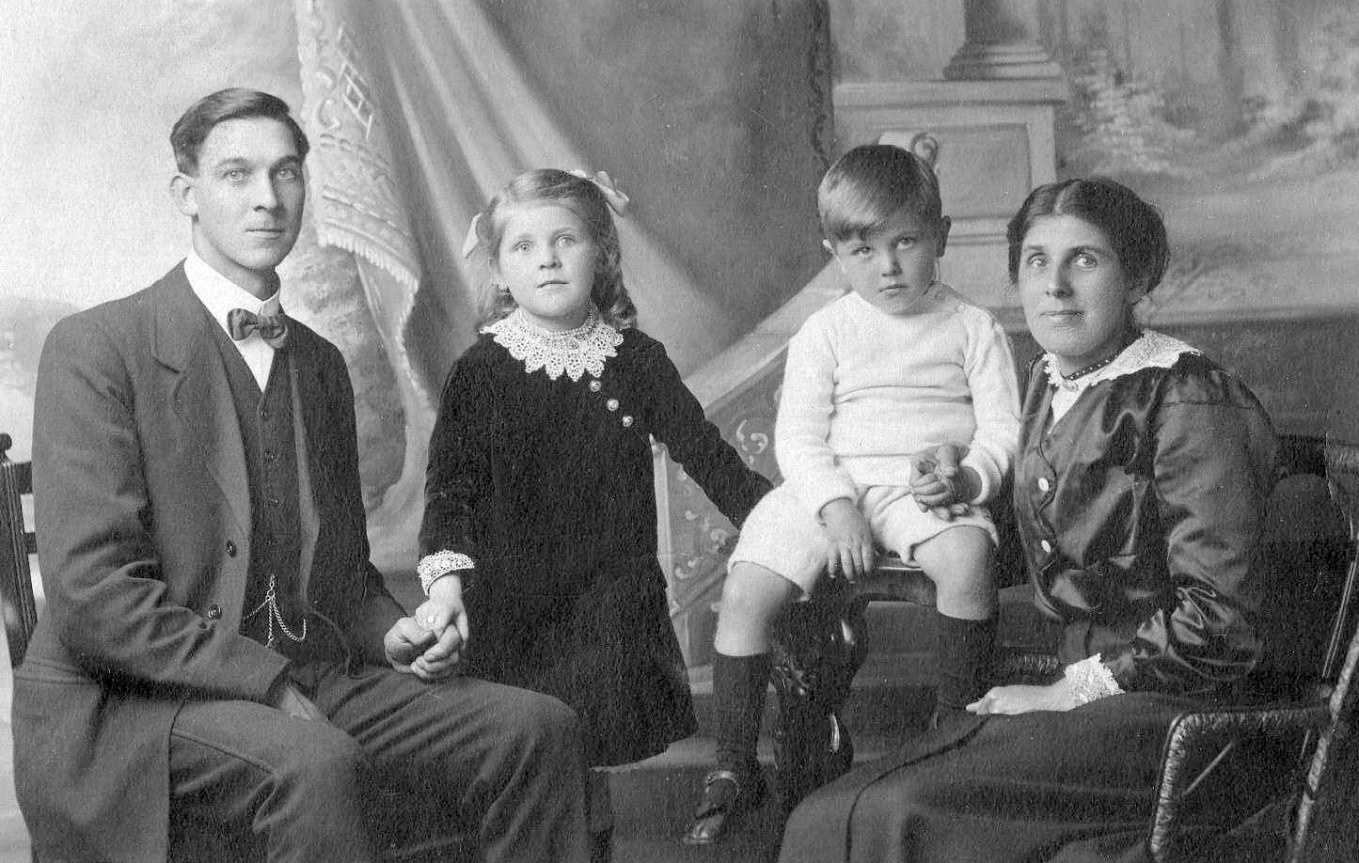
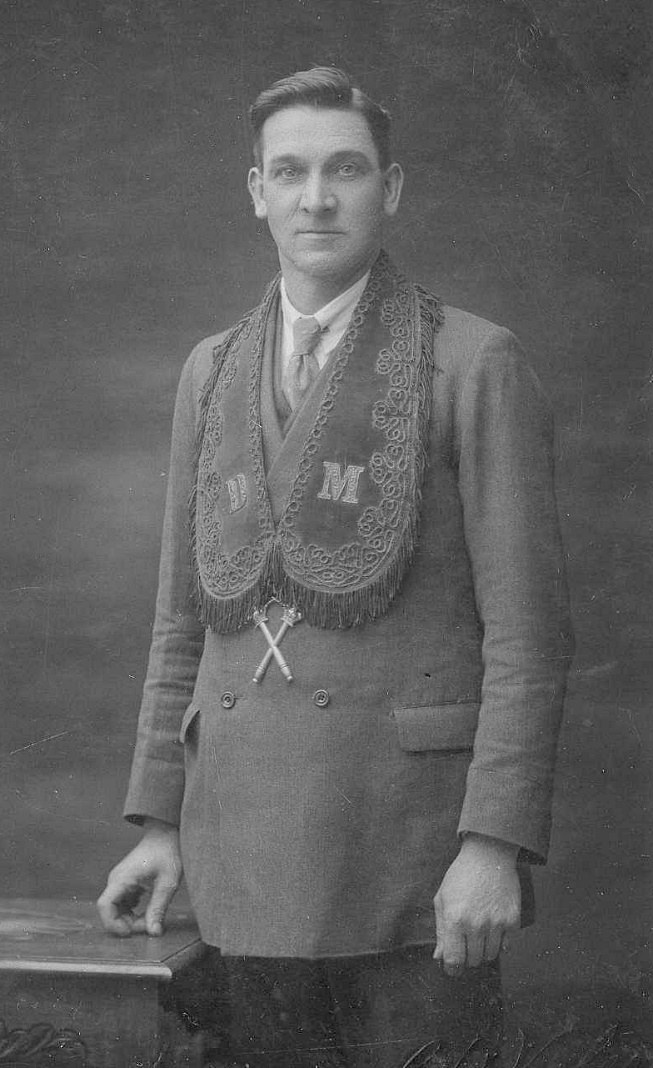
At some time, probably before the war, George had become a handsewn bootmaker and he also continued with his interest in the National United Order of Free Gardeners. We can see in the local newspapers, his involvement. The 31st January 1930 issue of the Northampton Mercury celebrated George’s appointment as District Manager and contained a short account of his part in the local area.
For 25 years he has been a member of the Clove Lodge, in which he has filled the offices successively of Junior Warden, Senior Warden, Deputy Master and Lodge Master. He was elected to the District Board in 1927 and has held various offices which lead up to the position he has now attained. He was in France for three years during the war with the Machine Gun Corps, and after demobilisation resumed his active interest in Friendly Society work generally and in that of the Free Gardeners particularly.
It seems likely that it was at this time that he had his photograph taken in a local studio wearing his District Manager’s collar of office.
The same newspaper article also reported that he was the local secretary of the British Legion. We get a picture of a man who was willing to put time into helping his former comrades and the local community. He also seems to have had a wider interest in the politics of the time and a clear view of his own beliefs. The reforming Labour Government, which had been elected by a landslide in 1945, at the end of another World War, introduced a National Insurance Bill in 1946 which would bring in a series of benefits to provide working people with some financial security in times of hardship and old age. This was seen by many in the movement as a threat to the Friendly Societies who had, for many years, struggled to help those in need. The members felt side-lined in the consultations for the new national scheme. I think George had a broader view [in the article it refers to R Newell but I think that this may be a mistake] which the Mercury and Herald reported in an article on a meeting of the “Gardeners”.
The only voice of support for the Government came from Mr. R. Newell (Clove Lodge), Ringstead, who pleaded that politics should be left out of the discussion.
“What would have been the position under a Conservative Government?” he asked. “Would the position have been the same? I have expressed the opinion that friendly societies would disappear, and now that time is at hand. Let us put our pettifogging ideas on one side and march towards the future”.
In fact, although the Friendly Societies lost many members, the Free Gardeners and others did survive. They were forced, however, to increase their charges and limit benefits in order to stay viable. The Mercury and Herald of 2nd February 1951 reported on a meeting of the Free Gardeners when an increase in charges had been proposed. George told the meeting that:
. . . his lodge, a small one, had lost some 50 members during the last two or three years. He was afraid an increase for the management fund of even 1d. might mean the loss of more members.
Instead of building up capital he thought more should be used for benefits.
Reading between the lines, we see that George felt that the time of the Friendly Societies was near its end. In 2000 the only lodge remaining in England was in Bristol but there are still some throughout the world and in 2002 a few lodges were re-opened in Scotland. Perhaps a sign of returning hard times.
Eliza Jane died in 1969 and George followed her in 1970, aged 81. He was one who stayed in the village of his birth but this did not stop him from leading a full and interesting life. Also, his descendant, Steven Kett, has written that he stayed close to his mother and father and the rest of the family throughout their lives. This bond was strengthened by the death of his youngest siblings, John in the First World War, and Clara on Armistice Day.