The Great War: N–Z · Story 25
Percy Reginald Wilson (1897-1918)
As we have seen with the Weekleys, some families had lived in the village for generations and were interwoven with other names, so, for better or worse, they could not turn a corner without meeting a grandparent, uncle or aunt, nephew or niece, or cousin. The name Wilson was not unknown in the village but our family came from the nearby town of Thrapston. Percy’s grandfather, William Wilson had originally come from Wadenhoe but had become a millwright and publican at the Fox Inn in Thrapston High Street. The millwright was a mixture of blacksmith, wheelwright and carpenter, and, as the name implies, he was often involved in the repair and construction of mills.
William’s son, Herbert, had followed his father’s trade. He met Amelia (or sometimes Emilia) Groom from Denford. In a case reported in the Northampton Mercury on 4th October 1881, about trouble at Denford Feast, it told of a “battle royal between the rival clans of the Yorks and the Grooms, old inhabitants of Denford”. When we look for a marriage, we cannot find one. The only Amelia Groom who married locally was in the Wellingborough District in 1899 and the husband was James Britchford. He was part of another family that had its fair share of time in court for fighting and drunkenness. Is it possible she had an unhappy marriage but, for whatever reason, was never divorced? For now, it is just speculation. In 1911 Amelia and Herbert stated that they had been married 22 years which would be about the time of this other marriage. There could have been an error in the original records or its transcription but in the1939 Register the couple are both described as “single”.
By 1901 the Fox Inn was run by Frederick Hodson and his wife Caroline. Herbert was now in the adjacent Brawn’s Yard plying his trade as a millwright. He was 38 years old and “Emilia” was 30. They had six children living with them. On the 8th February 1904 all the children were baptised together in Thrapston Parish Church. The oldest, Rose Maud, had been born on April 4th 1890 and the youngest, Margery Mabel on February 4th 1900. Percy Reginald’s birth is shown as October 7th 1898 but, judging by the Civil Registration Index, this is a year late.
Soon after this, the family moved to Ringstead and in 1911 were living in Pearce’s Yard (various spellings exist) and Herbert was working as a “Millwright - Flour Mills” The couple have had nine children, eight of whom were still living. New additions were May (6) born in Thrapston and Samuel born in Ringstead. They are shown as having been married 22 years.
Percy was working on a farm but, by the time that he was conscripted on 29th November 1916, he was in shoe work. He was posted to the No. 13 Territorial Force Depot which was in Clare Street in Northampton and was in the 3/4th Battalion of the Northamptonshire Regiment with Number 7461. After his basic training there, he was posted to the Machine Gun Corps for his further training on the Vickers Machine Gun.
Percy was in England being trained for a total of 133 days. On 11th April 1917 he embarked on a troopship at Folkestone and disembarked at Boulogne on the same day. He went to the MGC Base at Camiers before finally joining the 9th Company in the field, on the 21st April 1917. The 9th Company were part of the 3rd Division who fought on the Western Front for the duration of the war.
The Allied High Command had planned a major offensive. It was forcibly argued for by the French, who believed that the time was right was an attack on the Aisne-Champagne Front, with the British providing a diversionary attack in the Arras area. The Germans rather pre-empted the attack by making a planned retreat to the Hindenburg Line where they had been building concrete reinforcements and bunkers.
The British attack became known as the Battle of Arras and the first action that Percy would have been involved in was the Second Battle of the Scarpe which ran from the 23rd to the 24th April 1917. Although the British achieved some limited success, the main French attack was a failure with terrible losses, leading to low morale and mutinies in their army.
Further phases of the Battle of Arras, in which the 3rd Division were involved, were the Battle of Arleux and the Third Battle of the Scarpe. With the French temporarily in disarray, the British needed to continue the fight in the Arras area to give their allies time to regroup. The resulting British engagements had some minor successes but few gains, mainly because of a lack of artillery. This holding campaign was bought at a terrible price in British casualties. Field Marshall Sir Douglas Haig, the British Commander, believed that in modern war, you had to wear down the enemy until they were unable to resist a decisive blow. The French attack had come too soon in this process.
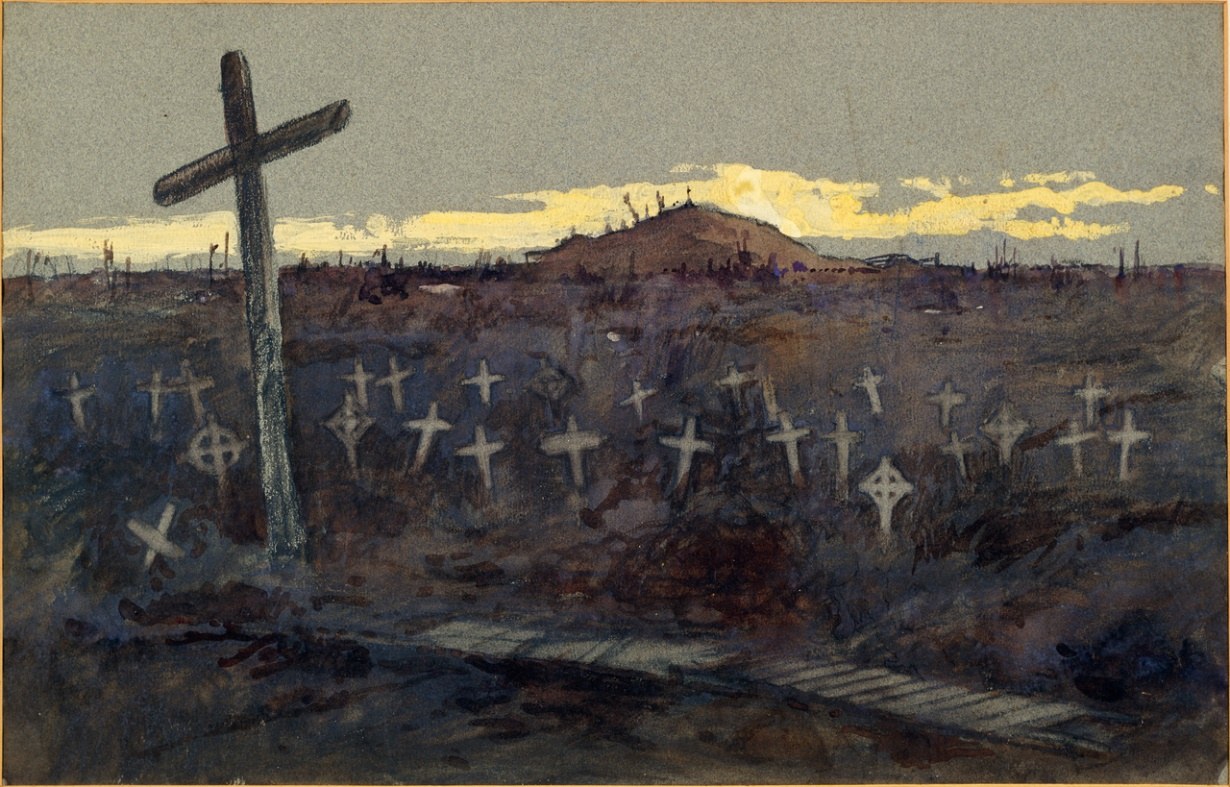
The British now moved to their own plan for a Flanders Offensive but the Germans, with the French weakened, could afford to concentrate their troops in this area. The result was the Third Battle of Ypres.
To prepare the way there was an attack on the strategically important Messines Ridge on the 7th to 14th June 1917. There was a four-day barrage followed by the detonation of twenty-one mines containing a million pounds of high explosive that the Royal Engineers had been laying in mines underneath the German positions.
The long preparations and the devastating explosions proved successful and the Messines Ridge was gained. But time was lost as the troops and artillery were made ready for the second phase. The 3rd Division entered the offensive at the Battle of the Menin Road Ridge on the 20th to 25th September 1917, leading onto the Battle of Polygon Wood which finished on the 3rd October. The “wood” had been fought over through the war and now only had the burnt stubs of trees.
The later phases of the 3rd Battle of Ypres are often known as the Battle of Passchendaele, a name that has come to stand for all that was terrible about the Great War, with its misery and death but particularly for its mud.
The final engagement of 1917 for the 9th Company was the Battle of Cambrai which ran from the 20th November to the 7th December 1917. It is now most remembered for being the first Allied mass tank attack. The 450 Allied tanks led a surprise attack, not heralded by the usual artillery barrage. Ground was quickly gained but over the next days, in a familiar pattern, most of it was lost to German counter-attacks.
The final year of the war came, and, on the 18th February, Percy accompanied an officer, as his servant, when he was sent to a training course with the 43rd Wing of the RFC. He re-joined the 9th Company three days later. This was just two days before the Machine Gun Companies of the 3rd Division became the 3rd Battalion of the Machine Gun Corps. He was then allowed to take 14 days leave in England from the 2nd to the 16th March 1918, rejoining the Battalion in the field on the 18th.
He had returned to the comparative quiet before the storm because, on the 21st March, the Germans launched a long planned onslaught on the Allied lines in a last desperate attempt to win the war before their own men and supply lines collapsed and the American might joined the frontline war. In the 3rd Battalion Machine Gun Corps Journal, William Cranston wrote:
Furious bombardments covering the entire system took place at 2.50 a.m. and 3.20 a.m., each bombardment lasting half an hour and was succeeded by utter stillness. Few barrages were so accurately synchronised as that which rang up the curtain on the great offensive. At 5.00 a.m. with one reverberating and tremendous crash every gun, mortar and projector the enemy possessed threw off its winter guise of idleness. Large number of heavy howitzers which had only moved in that night came into action.
The inception was like an unexpected peal of thunder overhead, so incisive and deafening was it, nothing escaped this annihilating barrage; front trenches and rear, roads and all headquarters were heavily barraged, chiefly with gas, while, during lulls one could hear H.V. shells travelling to the distant rear.
The Division had to resist and retreat, trying to keep some order in the desperate flight. For Percy, it must have seemed unreal after the normality of his time at home. By the 28th, the Battalion was continuing to move backwards, still inflicting heavy losses on the enemy, but also suffering many casualties themselves. The same Lieutenant-Colonel William Cranston, Commander of the 3rd Battalion, who wrote the piece above, spoke proudly in the War Diary of his men in this action.
Our line was penetrated at various points where the barrages had fallen with most accuracy and either annihilated or disorganised the garrison. There were many parts left who fought in a most heroic fashion with the enemy on every side of them, until at last were all wiped out in some cases, dying to a man or as a last desperate remedy, cut their way to the rear. Our machine guns in most cases were not in the same trench as the Infantry and their intentness in engaging targets prevented them noticing our Infantry was withdrawing. Other guns which had an Infantry garrison in the vicinity were ordered by the Infantry Commanders to stay and cover their retirement. Very few of these guns were got back to consolidate in the rear. Some fought to the death, some fought rear-guard actions, some withdrew what remained to them of equipment and fought with the Infantry. Not one withdrew until he was driven.
The tide would soon begin to turn and the exhausted Germans would be rolled back until the Armistice in November. Percy was not to see this for, on the 28th March 1918, he was one of the many men who were killed in this action.
He does not have a grave but is remembered on the Arras Memorial in Bay 10. He was entitled to the British War and Victory Medals and his mother to a small pension. He is also remembered on the Ringstead War Memorial, which was erected in the churchyard in 1924, paid for as a “humble offering of Herbert Billson who loved the village”. There is, on the back cover of the first volume of these biographies, a photograph of the quiet crowd at its dedication and one imagines his parents were there with the other relatives in their Sunday best.
Herbert and Amelia continued to live in Denford Road in Ringstead. A 1919 military form, unusually, lists all his immediate family. Besides his parents we see some of the family continued to live in Ringstead but four had moved to Finedon. In the 1939 Register of England and Wales we see Herbert is a “retired wheelwright” and “Emilia” are still in Denford Road and, as we have said, are shown as single. Had they been some fifty years together, single?