The Great War: N–Z · Story 15
George Slack (1870-1942)
We have come across the Slack family before, when we told the story of the Dainty brothers. Walter and Charles. The two families interlink, moving between the counties of Yorkshire and Northamptonshire. The Dainty family had originally come from Titchmarsh but George William had moved north to Brightside Bierlow, near Sheffield where he had married Sarah Ann Schofield. He had been working as a stone quarryman and in the early 1900s they had moved back to Northamptonshire, living in Thrapston but still working as a quarryman. His father, William who had also moved north, had remained in Sheffield.
One of the children of George and Sarah was Jane Elizabeth Dainty and, aged 22, in the 1891 Census she was a domestic servant for Thomas Garbutt. He was a sixty-six-year-old Turkish Bath Proprietor, living at 8 Armstead Road in Attercliffe. Later that year she married George Slack. George had been born in Wirksworth in Derbyshire on 4th May 1870.
In the 1911 Census, we see that twelve children had followed, of whom eight survived childhood. When we look at their birth places, we see that they had moved around the south Yorkshire area, from Grimethorpe to Darnell and Masbrough. We also see that two of the children Rose (Titchmarsh) and Arthur (Woodford) had been born in Northamptonshire so probably the family had moved south for a few years before returning to Yorkshire. The family were living at 73 Titterton Street in Attercliffe with seven of their children, Ernest Edward (17), Lily (12), Beatrice (11), Willis (10), Rose (8), Arthur (5) and Bernard (2), and Jane’s elderly parents, William and Maria Dainty. William Dainty is shown as blind and he was killed in a tramcar incident soon after the Census.
At some point in the next few years George and Jane Elizabeth moved back to Ringstead and certainly, by 1918, they were living there.
Two of their sons joined the services. Their eldest son, George William Slack, had left home in 1911 and was boarding in Attercliffe and working as a miner in a colliery. The following year he joined the Royal Navy and served throughout the war. The second eldest son, Ernest Edward, was still living with his parents in 1911 and, aged seventeen, he was working as a pony driver at a colliery. He seems to have been into mischief as a young man for, in 1913, he was in Wakefield Prison accused of stealing a jacket on 28th March 1912 and the following year of trying to obtain money with a forged document. He had been “received into custody” on 11th July 1913 but, when tried, he was found not guilty and discharged.
Ernest may have first enlisted in 1912 with the 4th (Hallamshire) Battalion of the York and Lancaster Regiment but was then (it seems) transferred to the Northumberland Fusiliers. It may be that he was discharged when accused of the crimes and then re-enlisted at the start of the war. I have not managed to sort out his army career. By December 1914 he was home on sick leave and on December 18th he was staying in Ringstead with his aunt, Sarah Ann Dainty. While there, he stole a ten-shilling money order from her, which he used, first to buy a pint of beer and some bread, and cheese at the Red Lion Inn in Raunds. He was tried, found guilty, and sentenced to one month’s prison with hard labour. Was it preferable to the army?
If we return to George Slack, the father, most of his military records have been lost but we know from his pension card that after the war he was living in Chapel Lane in Ringstead and this is confirmed by the 1918 Register of Electors. The card has his date of birth as 1873 and there may have been a reason for this discrepancy. Until April 1918 the official upper age limit for enlistment was 41 and George would have been nearer 45 years old. Nevertheless, we can find other men in the 270th who were older than George.
He enlisted as a Pioneer in the 270th Railway Labour Company of the Royal Engineers. The Pioneer rank or appointment was used in a number of ways but here it probably denotes a labourer working for the Sappers who were the more skilled men. His medal card has him entering a war zone on 25th November 1915. The list of Railway Companies on the Long Long Trail website has the 270th in Egypt and it may be that after being formed in Cheltenham, they first sailed to Egypt before moving on to Salonika (sometimes Salonica). A man from Leeds in Yorkshire wrote to his brother, Frank Hayes, of his experiences with the Royal Engineers. In his letter, published in the Leeds Mercury on the 7th February 1916, he wrote:
My stay in Egypt was a fine experience. We had late passes in Alexandria nearly every night, and we had some good fun.
In Egypt we had not much work to do; we were generally done by one o’clock in the afternoon, and it was too hot for parade. At four o’clock went into the sea to have a dip. I can tell you I enjoyed it. We were to have gone to the Pyramids at Cairo, but it did not come off, as we left the country so soon. I was very sorry. . .
[In Salonika]. We have moved up now nearer to our work, and at night, when all the ships light up, and with the mountains behind, it is indeed, a grand sight. We generally find time to have a song and a bit of chat. Some begin talking about home, and what everyone will be doing in their respective homes. In that way we always put a good night in when the letters and parcels come. We always tell each other what is going on at home. We have a tent full of good company. Parcels are always shared round.
The initial campaign against the Bulgarians by the Allies had been a chastening experience and they retreated back to Salonika to lick their wounds. The Royal Engineers would have been working around Salonika building defences and stringing barbed wire, giving the city the nickname, “The Birdcage”. In 1916 the Allies took over control of the railways from the Greek government. Railheads were established, allowing them to have headquarters “up country”. A large marshalling yard was constructed at Dudular near Salonika to allow the fast movement of stores away from the congested port to secure places where they could be sorted and protected. There was also the construction of several narrow-gauge light railways to help the supply of troops to the front lines.
The Balkans campaign, although often ignored in commemorations, had many British casualties. It was also a very unhealthy place, especially for troops unused to the conditions. It often had hot humid weather but could also be very cold. The areas to the north of Salonika were marshy and Malaria was endemic. It was hard work in these conditions for the men in the 270th who were often middle aged, the younger fitter men being taken for the fighting units. Sickness was prevalent and we see from the sickness forms that some of these older men also succumbed to rheumatism. One Royal Engineer humorously described the conditions in Salonika in a piece published in the Bath Chronicle in 1917.
The Macedonian Health Resort
Bright! Briny! Breezy! Balkans!
(For the holidays)
ATTRACTIONS
A war held daily (Wednesday early closing day).
Aeroplane and artillery exhibitions (no extra charge for night stunts).
No railway – but Shanks’s pony to all parts.
Big Game Hunting
Bulgars, Turks, snakes, mules, mosquitoes, wild dogs, flies, ants, creepers, crawlers, and jumpers of all species.
Fishing
All kinds of fever caught every day.
Mails
Delivered daily (one a month) unless otherwise disposed of
Bathing
Mixed, six or seven to every bucket.
Miles and miles from civilisation and from the influences and flirtations of the fair sex.
Temperature
Boiling point guaranteed. “Hotel Berrypole”* not five minutes from the front.
Menu
Biscuits or bread (G.S. mark cut) with bully beef or meat (fresh), jam issue, marmalade (every day sometimes), wine list, quinine nightly.
Our Motto – “Wot Opes”
Does this refer to a cemetery with wooden markers on the graves or to tent poles?
Like many other, George did not last long in these gruelling conditions. He was diagnosed with Rheumatoid Arthritis and on 18th October 1916 and was discharged from the army. He returned home and was awarded a Silver War Badge so that he could not be accused of shirking his duty by the White Feather brigade. He was awarded the 1915 Star as well as the British War and Victory Medals.
As we have said, he is shown in the 1918 Register of Electors, living in Chapel Lane in Ringstead and the Electoral Registers record that he and Jane were still living there in 1931, with, as they too had reached voting age (21), their sons, Arthur, Willis and Bernard being also recorded in the village.
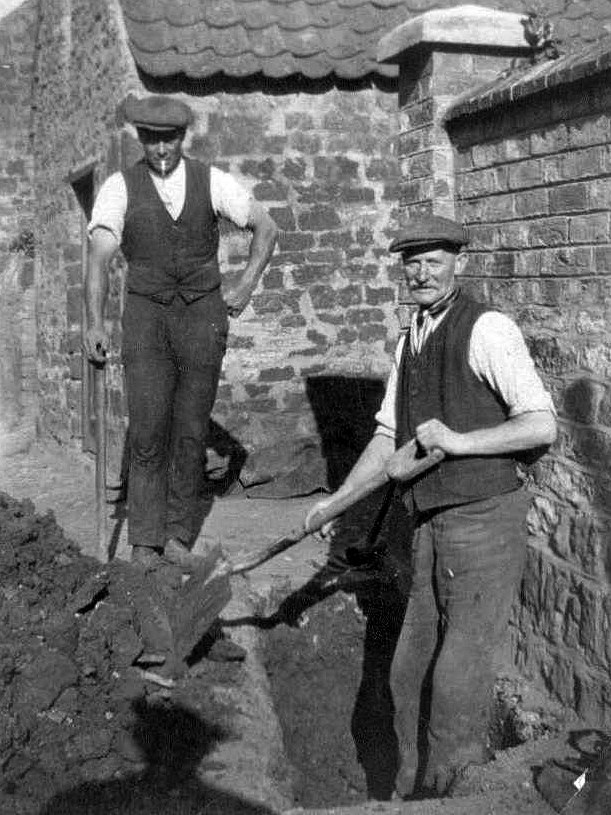
It seems likely that he continued labouring despite his arthritis and the 1939 Register of England & Wales has the couple, with unmarried son, Bernard, still living in Number One, Chapel Lane. George is shown as a “General Labourer, Retired”, for he was nearing seventy years old. He died early in 1942, aged 71. Jane Elizabeth Slack lived to be 88 years old and died in 1958.