Army & Navy · Story 1
William Pettitt: 1756 - ? (Served 1776 – 1788)
2nd Regiment (Coldstream) Foot Guards
The Pettitt (sometimes Pettit) family has a long history in the Ringstead and Great Addington area. A Lewis Pettitt, son of Eusebie, was buried in the Ringstead Parish churchyard on February 10th 1600. A century later, another Lewis Pettit, was baptised in Great Addington on 12th July 1706, the son of William and Jane. He married Elizabeth Sanderson on 11th May 1729 in Great Addington and a son William was christened on 8th December 1734 in Ringstead. Like many others they had crossed the Nene to the larger village.
On April 20th 1752 William Pettit “of Ringstead” married Mary Yeomans at Rushton, some fourteen miles north-west of Ringstead. They moved back to William’s home parish and had at least five children, two of whom died young. One of the surviving children was another William who had been baptised on 5th January 1757. We know from his military discharge that he had become a “cordwainer” (shoemaker) in Ringstead before his enlistment.
William joined the Second (Coldstream) Foot Guards in March or April 1776. Famously, the regiment was placed as the second senior regiment of Household Troops, as it entered the service of the Crown after the 1st Regiment of Foot Guards. It answered to that “insult” by adopting the motto Nulli Secundus (Second to None), alluding to the fact that the regiment was older than the senior regiment.
William served with them for twelve years three months, leaving on 27th July 1788. On his discharge paper it states that he was a soldier in Colonel Boscawen’s Company of the Regiment He was praised as having “served honestly and faithfully” and was “humbly recommended as a proper object of His Majesty’s Bounty of Chelsea Hospital”.
The real question is whether he was part of a section of the Coldstream Guards who joined a composite battalion of men made up from the three Guards regiments. This was commanded by Colonel Mathews of the Coldstreams, but it set sail from England in March 1776 so there is some doubt that he had enlisted in time to fight in the American War of Independence. There is, however, another clue in the official records, for William Pettitt appears in The Royal Hospital Chelsea Disability Admission Books (WO116). He is shown as starting his pension on 14th August 1788 and beside his entry it has been written, “Not upon the English Establishment.” Michael McGrady, from the National Archives has told me that this probably means that his payments were “not made from the home-based part of the War office, as distinct from the overseas branches of government”.
My assumption is that this implies that he was indeed in America for almost all his service career and took part in this ill-fated campaign (although this ended in 1783 so must be some doubt). Because there is uncertainty that William was in America I will only, for the moment, only deal with it briefly.
A unit of men and officers from all three existing Guards regiments was formed in 1776. This consisted of men from the First (Grenadier) Guards, 2nd (Coldstream) Guards and the 3rd (Scots) Guards. They were all dressed in a uniform of redcoats and white breeches but the three had different lace and other minor features. When they reached America, their uniform changed as they realised its unsuitability for the type of warfare with which they were now confronted and formed a light “skirmishing” company for the campaign.
By 1779 reinforcements were needed and The Ipswich Journal for 27th March of that year reported:
Saturday a draught was made in St. James’s-park from the Coldstream or 2nd regiment of foot guards, to be sent to complete the brigade of guards in America, the major part of which turned out volunteers.
There seems to have been a lack of officers in the Brigade and as a result they spent much of the rest of 1778 and 1779 garrisoned in New York and took part in skirmishes at Portsmouth (Virginia) and New Haven (Connecticut) in 1779 and Young’s House (New York) in 1780.
The first major battle that William would have seen was at Springfield in New Jersey in 1780. The British forces wanted to capture New Jersey but were met at the small village of Springfield by a smaller but determined American force. The British could not break through (although there seems some dispute about this) but burnt and looted the village and retreated across a boat bridge to Staten island. This battle really ended British ambition in the north and there were no further major engagements.
The brigade then sailed south to Portsmouth and then on to Charlestown joining up with the main British army in North Carolina in January 1781. On February 1st 1780 the Guards, with great gallantry, forced the crossing of the Catawba River while under heavy fire. The British commander, Cornwallis, was chasing the Americans and trying to bring them to battle. The Americans stopped and formed three battle lines at Guilford Courthouse. The Coldstream Guards were on the left of the British line but the whole line charged as one. They were met with volleys of fire from the first American line who then ran into the woods and their second line then let off another devastating volley and retreated. The third line, of battle-hardened Virginians, then opened fire and the Guards took the worst of these fusillades. 550 British soldiers, including 11 of the 19 officers, were killed or wounded which was about one third of the army. The Americans retreated but the British were short of manpower and supplies and Cornwallis and the remnants of the army, including the Guards who were reduced to one battalion, gave up the south and went in search of provisions for his army.
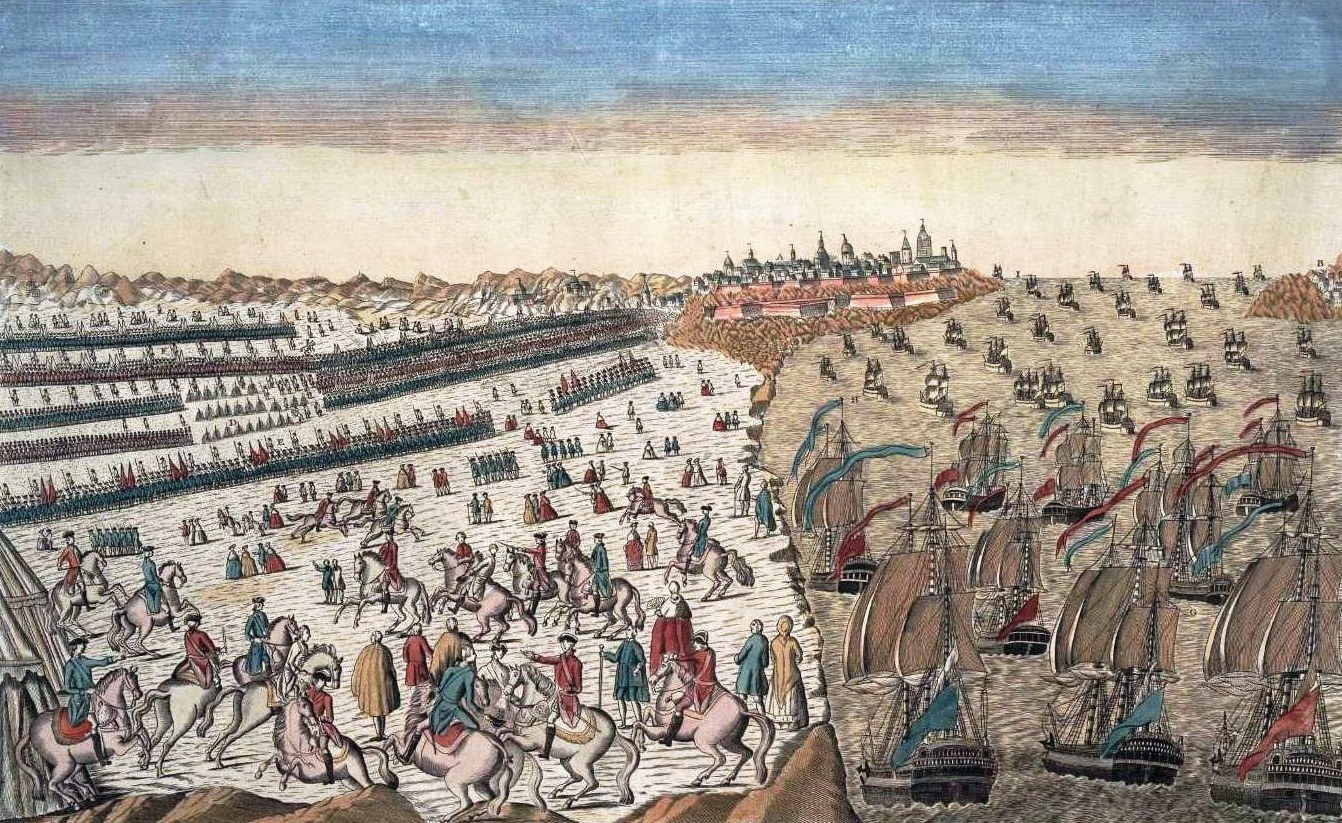
Eventually the army arrived at Yorktown which was in British hands and started to construct a “defensible deep-sea port”. The French fleet defeated the British and blockaded the port. Cornwallis, who had hoped for reinforcements had to abandon the outer defences as lacking the troops to defend so long a fortification. These redoubts were swiftly taken over by the French and Americans and the British were bombarded into defeat. A white flag was taken out and the British troops suffered the ignominy of surrendering to Washington’s and the French forces. They had to march to a field through the American and French soldiers lined up on either side and ceremoniously lay down their arms. Some 7,000 British soldiers were then marched to York in Pennsylvania where they were kept captive until 1783 when, with the war’s end, they returned to England and their respective regiments.
If we are correct in thinking that William Pettitt did go to America, he still had some five years left to serve. I have not managed yet to trace the movements of the Second Regiment of Foot Guards, but we do get a clear reminder that soldiers not at war get bored and sometimes fall into bad ways. The Oxford Journal of 10th September 1785 reported:
This Morning Captain H. of the second Regiment of Foot Guards, went into a Gunsmith’s Shop opposite Bedford Street, in the Strand and purchased a Pair of Pistols, one of which he immediately loaded with a Ball, turned round and shot himself through the Head, and dropped down dead in the Shop. – The Occasion of his committing this rash Action is said to be his losing last Night a capital sum of Money at a Gaming Table.
I also found that the same newspaper on the 19th March 1785 gave the important news that:
The Duke of York has ordered his Regiment, the Coldstream or second of Foot Guards, to have blue Coats, Waistcoats, and Breeches, with red Capes, Lappels [sic], and Cuffs, at the next Clothing.
In this comparatively quiet period before the explosion of the Anglo-French and Napoleonic Wars it seems that the British Army had fallen into a dangerous lethargy.
William Pettit, by the summer of 1788, had become unfit for service. The reason for his discharge was that he had developed asthma. The Admissions Book for Invalid Soldiers of the Royal Chelsea Hospital, (No. 1274) shows that he was examined on Thursday 7th August 1788. As a result, he became a Chelsea Hospital out-patient, receiving a small pension based on his 12 years 3 months of service. He was still only 32 years of age.
Although some Ancestry family trees link him to a marriage and family in Suffolk I have not managed to find any proof to identify him after he left the army although there are many possibilities.
References
Discharge Document for William Pettitt. National Archives Ref WO 121/5/5. On .
Royal Chelsea Hospital Admissions Book showing the Examination of Invalid Soldiers. National Archives. (Ref WO 116-9).
Oxford Journal 19th March & 10th September 1785.
British Brigade of Guards. ().
First Foot Guards. ().
The battle of Springfield. ().
.
The Siege of Yorktown. ().