Army & Navy · Story 6
John Percival 1799 – 1868 (Served 1819 – 1843)
4th (Royal Irish) Dragoon Guards
Of all the ordinary soldiers from Ringstead that we have looked at, John Percival was the one who reached as high in the British Army that a working-class man could hope to achieve. We, again, have the problem of finding him in the Ringstead Parish Registers before his enlistment. The reason for this constant problem may be that the soldiers tended to come from a gypsy or travelling background, a significant number of the poorer villagers did not christen their children, or they tended to come from the Baptist community.
If we look for the name Percival in the Registers we find many with this surname but, perhaps significantly, only ten of the 48 entries (up to 1837) are after 1770. None of these are christenings, four are burials but six are marriages. In this period only, the parish church could conduct marriages so local nonconformists had to marry there. Later, a Ringstead vicar refused to marry a Baptist groom and so the local chapel was licensed for marriages too. Further, if we look in the “Brief History of the Ringstead Baptist Church” there is a list of the allocation of pews carried out in 1763. It includes a Sarah Percival of Ringstead who had four places. Perhaps this explains the lack of birth evidence for John.
It was at Nottingham, that, on 6th May 1819, John Percival took the King’s shilling and enlisted in the 4th (Royal Irish) Dragoon Guards for the bounty of two pounds. The Dragoons had left Ireland for Bristol in July 1818 but from the Autumn the headquarters were based in Nottingham with detached troops in Northampton and Leicester. It seems likely that he attested in Northampton and went with the troop to Nottingham. He initially enlisted for ten years only, although there were a number of caveats, and ways of extending this time, by the crown. He was twenty years old and a labourer.
Through a history of the regiment published in 1837 and the local newspaper reports we can try to trace John’s movements but it is important to realise that a regiment was often split into smaller troops or groupings, so we can rarely be certain that he was actually at a particular incident.
In June and July 1819 the regiment marched to York and were stationed there as well as at Sheffield, Leeds and Huddersfield. In the middle of August five troops suppressed riots in Leeds and again in September one troop marched to Durham to quell further disturbances. While stationed at York the death of George III was announced and the accession of George IV proclaimed. The regiment was part of the procession into the castle. The Yorkshire Gazette reported that:
When the Writ was finished reading, the union Flag was hoisted on the Castel Walls. The band of the 4th Dragoon Guards struck up, “God save the King”, three cheers were given, and the Minster Bells rung a merry peal....
Each of the prisoners in the Gaol as well as debtors as felons, 240 in number, had an allowance of ale from the High Sheriff to drink his Majesty’s health; and each felon had a loaf of bread.
A similar ceremony, again attended by the 4th Dragoons, happened on the next day, at Leeds. But this ceremonial could not mask the fact that there was anger and civil unrest in Yorkshire. On 11th April 1820 a large force of protesters was planned to assemble from Barnsley, Bradford, Keighley, Halifax, Dewsbury and Mirfield. The march from some areas stalled but the Barnsley contingent, armed with muskets and pikes pressed on. When, however, they realised that the other expected groups had not arrived, and they were confronted by the 4th Dragoons and the Huddersfield Yeomanry, the protestors threw away their arms and fled. Seventeen of the marchers were arrested. Other troops of the 4th Dragoons arrived but were not needed. Nevertheless, they were in action again in Sheffield and one sergeant, one private and two horses were wounded with pikes.
John was to spend his military career keeping law and order as well as providing ceremonial security to state occasions.
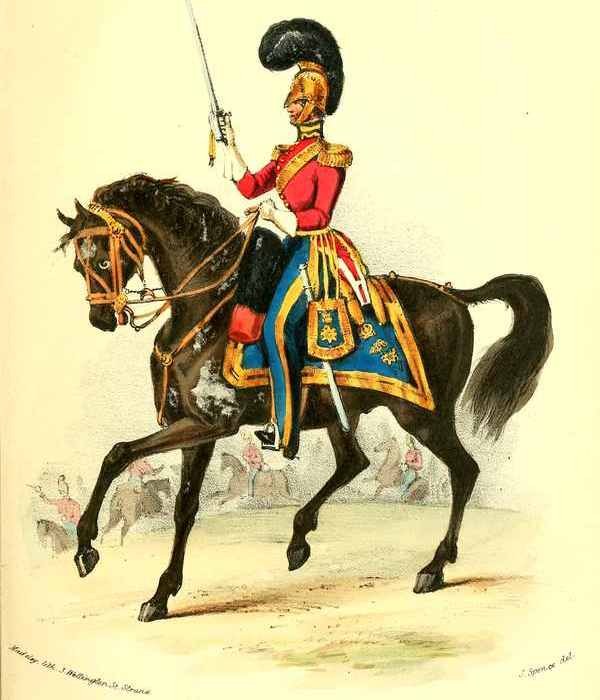
In August 1820 the regiment was stationed at Newcastle-upon-Tyne, Carlisle, Penrith and Whitehaven and, in the following March, it marched to Scotland where it was stationed at Piershill Barracks in Edinburgh but also a Greenock, Irvine and Ayr. Before this time, the eight troops of the 4th Dragoons were classed according to the colours of their horses;; two black; two brown; two bay; one bright bay and one chestnut. In August 1821 the regiment was reduced to six troops and the colours of the horses were mixed in each troop. There were then 27 officers, 24 sergeants, 18 corporals, 6 trumpeters, 6 farriers, 281 privates and 253 troop horses.
In July 1822 the regiment marched to Port Patrick and embarked for Ireland. The headquarters were established at Dundalk but the troops continued to move around the country until proceeding to Dublin in March 1826. It had one of its regular inspections there before sailing to Liverpool, arriving there on 29th March. On the 31st it set off again for Coventry, Birmingham and Abergavenny. The trouble in the country over the New Poor Law was still rumbling around and the Dragoons had to deal with protests in Dudley and Wolverhampton where some of the protesters were wounded.
In April 1827 the regiment marched to Dorchester and were also posted in some of the nearby towns. In May 1827 its quarters were moved to Exeter and Topsham Barracks but Sergeant John Percival had met his future wife by then. John had been promoted to Corporal on 13th October 1822 and, some five years later, on 31st August 1827, was made up to Sergeant. Later in that same year, on 9th, 16th and 23rd December the banns were read for the marriage of John and Mary Mitchell at St George’s Church in Fordington in Dorset. Fordington was a village near, and now part of, Dorchester. A fellow sergeant in the 4th Dragoons was one of the witnesses. We learn later that Mary had been born in Manchester so whether they met there and she followed him to Dorset. In the 1861 census we find a Christiana Mitchell who is a niece of the couple. In the 1851 Census we find Christiana in Brecon Barracks with her mother, Elizabeth who is the “wife of a farrier”. A detachment of the 4th Dragoons were in the barracks at the time. Perhaps the most likely explanation of their meeting is that Mary’s father was in the 4th Dragoons, but more research is needed.
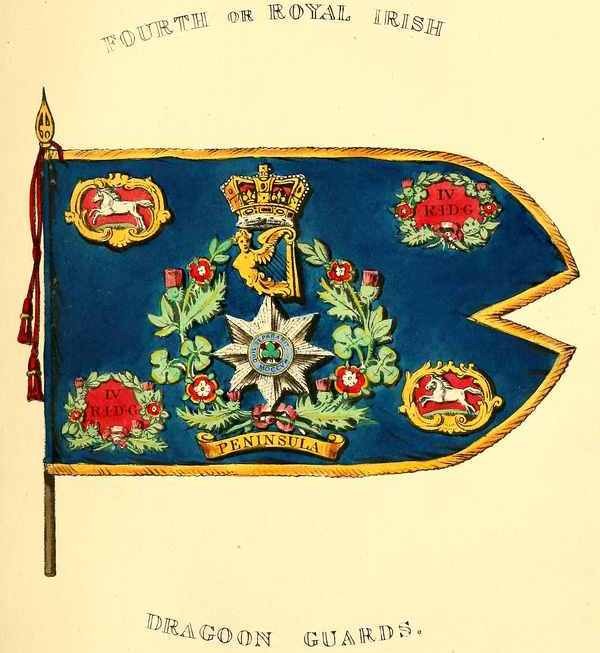
The job of the army at home in peacetime was to keep law and order, at a time when there was no national police force, in a, sometimes volatile, country. The constant movement and drilling was also a way of keeping soldiers of all ranks occupied. Bored soldiers kept in one place could become fractious and, coupled with drink, could cause trouble. The Exeter and Plymouth Gazette of Saturday 12th July 1828 reported:
On Monday morning, a duel took place between two of the Officers of the 4th Dragoon Guards quartered in Exeter. The meeting was at 6 o’clock in the morning, in a field behind the late Artillery Barracks. After an exchange of shots, without either taking effect, the seconds interfered, when a most perfect reconciliation took place, and the parties quitted the ground; the differences of opinion arose in one of the Officer’s rooms.
John’s new wife, Mary, had a daughter who was baptised Elizabeth on 2nd November 1828 in St David’s Church in Exeter
In April 1829 the regiment marched to York and then, the following March onto Edinburgh. The Woolmer’s Exeter and Plymouth Gazette for Saturday April 18th 1829 printed a “Lament for the 4th Dragoons on their Leaving Exeter”.
“O Weep for the hour”,
When in an April shower,
The Royal 4th Dragoons left fair Exeter’s walls;
The ladies sobb’d outright,
One long day and one long night,
To think those gay gallants must march where honor calls.
Full many a lovely dame
To the Ball for their sakes came,
Who never in their lives had been at Balls before,
And Matrimony still,
Their pretty heads would fill,
Alas! That all these brilliant dreams should now be o’er.
Yet ah! Would you believe
These warriors do not grieve,
And that all the admiration’s on the ladies side?
They boast that they can flirt,
And escape without a hurt,
Nor do they bear from Exeter one lovely bride!*
But grieve not ladies dear,
Your drooping spirits cheer,
And from those sparkling eyes wipe the falling tear;
O throw aside your grief,
And in change obtain relief,
For the dashing Third Dragoons will soon be here.
*i.e. more than one
Was Mary Percival one of the “lovely brides”? She, and her baby daughter would have followed her husband on his travels with the regiment. There was continuing work for the troops with unrest seething around the country. In April and May 1831 there were riots during new parliamentary elections. The Regimental History records:
Escorts were required for the voters, and so violent were the rioters, that one man was killed by a brick while proceeding to vote in charge of a party of the military. Many of the soldiers were knocked off their horses with stones and others had their helmets broken; yet such was the exemplary patience and forbearance of the soldiers of the FOURTH DRAGOON GUARDS under these trying and painful circumstances, that not a single civilian was hurt by them during the whole period. During the riots at Ayr the prisoners in the gaol rose against the turnkeys whom they overpowered; but a few men of the FOURTH DRAGOON GUARDS arriving, they dismounted, entered the gaol with loaded carbines, secured the prisoners before they could effect their escape and restored order.
Again, the following year, in March 1832 there were riots in Paisley which the regiment had to pacify before it embarked at Glasgow in steam vessels for Belfast. It seems that the army had turned to steamships for the rapid movement of troops, perhaps so that adverse wind conditions did not leave them in limbo.
But this was not an escape from trouble, for Ireland too was in turmoil. In the autumn of 1832 the Dragoons had to split into smaller units to deal with election, and tithe collecting riots as well as other disturbances across Ireland so that they were constantly on the move. They were based at Cahir for a time before, on 28th April 1834, marching to Cork to deal with the violent resistance to the collection of tithes. They were met with sticks and stones and this time they did fire on the protesters, leaving some ten of them dead at Gortroe, a village north of Cork.
This was the last real battle in the “Tithe War” and is sometimes referred to as the Gortroe or Rathcormac massacre. And we know that two companies (100) dragoons were involved as well as the 29th Regiment of Foot. There were about 250 locals opposing the collection of the tithes (payment to the vicar of the Anglican Church of Ireland parish). They retreated to a prepared barricade on the land of Widow Ryan who was 40 shillings in arrears with her tithe. The troops were pelted with stone and sticks and sustained injuries for 45 minutes before the order to fire was given. The number who died is a matter of dispute but there were up to 20 dead it has been claimed. After this Widow Ryan paid her tithe and the crowd dispersed.
There were elections again in January 1835 and, once more, there were the inevitable riots which were “policed” by the 4th Dragoons.
The regiment completed three years’ service in Ireland and in May 1835 sailed from Cork on steamships for Bristol and then on to Brighton. The same story of civil unrest continued, mainly centred around the New Poor Law, and in September a troop of the regiment had to rescue magistrates and the relieving officer from a mob at Steyning and it was involved in similar incidents at Horsham and Bath. The opposition to the Poor Laws did not abate.
In February 1837 we can be certain, perhaps for the only time definitively, that John Percival was at Exeter with the Royal Irish Dragoons. A barracks could be a claustrophobic environment, as we have seen with the duel in 1828, and small matters could quickly escalate, especially if fuelled by alcohol.
A Private Pitt of the 4th Dragoon Guards had absented himself without leave from the Exeter barracks. When he returned it was decided that he and his room should be searched to make sure, it seems, that he had not sold any of his kit. Sergeant Henry carried out the search and returned to his own room which was opposite Pitt’s. He was joined there by Sergeant John Percival. The two of them heard the click of a pistol, held by Pitt, which had misfired. He then seized his loaded carbine and, as the Exeter and Plymouth Gazette reported on 18th February 1837:
. . . fired in the direction of Sergeant Henry’s room, the ball passing across the back of Sergeant Henry but without doing him any mischief and closely over the breast of Sergeant Percival who had reclined on a bed, its progress stopped by the brick wall of the building.
Pitt was tried at a General Court Martial and sentenced to be transported for fourteen years. It is a story where you feel that much of the reason for the flashpoint is not reported.
On 29th May 1837 the regiment marched north to a new station in Hulme barracks and took part in the grand procession and spectacle in Manchester in honour of William IV’s birthday. Less than a month later, the king was dead and on 23rd June they were at the proclamation of the accession of the young Queen Victoria.
Some things did not change, and new elections caused troubles in some of the towns around Manchester and later, in October 1837 they had to deal with protests in Halifax and Bradford. By July of the following year they had to perform formal duties in London before marching to Ipswich and Norwich. There were riots here too against the Poor Laws and at Stanfield Hall the 4th Dragoons arrested some 84 protesters.
The History of the Regiment which was published in 1837 finished with a eulogy to the patience and professionalism of the regiment in the face of provocation and personal danger. It is, of course, a biased commendation but it does seem that John Percival was a part of a well-organised regiment asked to do the unpleasant task of subduing its own countrymen. In June 1838, by contrast, the regiment was quartered in Isllington and Clerkenwell and, on 28th June, was stationed near Westminster Abbey for the coronation of the young Queen Victoria.
John must have distinguished himself, both in the ceremony and pomp, and in the difficult task of dealing with civil unrest in as disciplined way as possible. On 9th January 1840 he was promoted to Troop Sergeant Major. Without the Regimental History, we now have to rely on the local newspapers almost entirely for the movements of the 4th Dragoons. We do know, however, from the British Worldwide Index that in 1841 he was in Edinburgh. Later that year he regiment were sent to deal with the Rebecca Riots again in Wales.
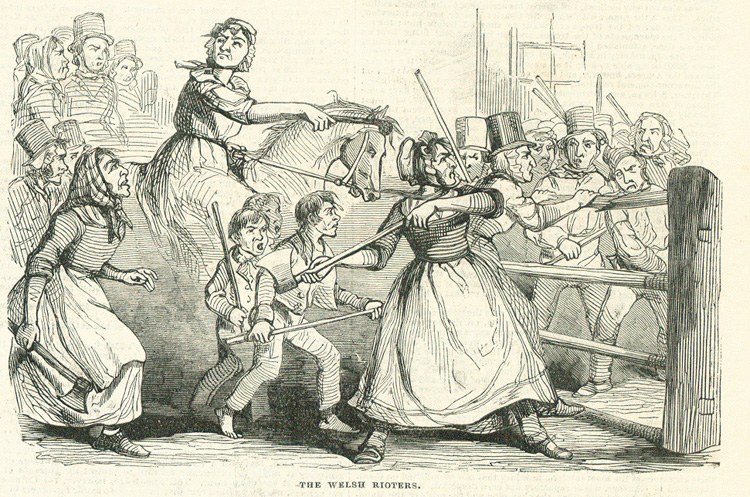
These riots took place in rural west Wales, between 1839 and 1843, where, small tenant farmers were protesting about the payment of tolls charged by the Turnpike Trusts or groups of businessmen who owned most of the main roads. Small farmers feared that the cost of journeys to and from market could take away all their profits. The protesters took a text from the Bible where Rebecca tells of the need to “possess the gates of those who hate them.” They called themselves “Rebecca and her daughters” and, dressed in women’s clothes, they tore down the toll gates. The protest was also exacerbated by poverty caused by poor harvests, the tithes they had to pay to the Anglican vicars, and the 1834 Poor Law Act which stopped the payment of poor relief to the able-bodied. Instead they were forced to go into the new Union Workhouses. Finally, the gentry, the J.P.s, and the clergy were Church of England and spoke English, while the working people were Welsh-speaking chapel goers.
The regiment went to Carmarthen but were then sent to Newcastle Emlyn where they were confronted by up to 20,000 protesters, many of then carrying rudimentary arms. The Illustrated London News of 1st July 1843 reported:
The mob were so well armed and ready for action, that the dragoons could not enter the town until Monday morning, and the conflict that took place on Newcastle bridge is beyond description. The soldiers were thrown of their horses, their arms taken from them, and were afterwards thrown into the river Tivey, when one of the men, named Kearns, the roughrider, met a watery grave, and the others are so bruised from having fallen on the rocks below the bridge pool, that they are no more fit for service. The union workhouse has been entirely destroyed by fire and it is feared that a great many gentlemen’s houses will be destroyed in the course of the night.
Other troops poured into the area and the 4th Dragoons, with other regiments, eventually order was restored and not all reports were condemnatory of the rioters. A reporter in the Evening Mail on 26th July 1843 wrote:
On my reaching this place [Newcastle Emlyn] I made the best enquiries that I could as to the alleged general grievances, and as to the working of the New Poor Law, and I found without exception that the opinion of the whole country is that the law is most arbitrary, partial and cruel in its operation. A respectable farmer told me that one of the cruel provisions was that which prohibited the guardians from giving out-door relief to the able bodied. “The state of agriculture,” said he, “here is not like in England, the farms are small; and the farmers as well as the labourers are very poor. When the harvest is in the course of being gathered in we do not, as they do in England, have an influx of Irish and other labourers, who at the end of the harvest leave, and are no longer burdensome; but our own people only are employed as agricultural labourers, and they reside in the parish. During the summer they receive 1s. or 9d. per day, but in the winter they are perhaps not employed for many weeks, and when employed have only 6d. a-day. These people have a small cottage each to reside in, and a little garden, and many of them arrive actually at almost starvation point with their wives and children, rather than apply for poor relief, knowing that if they do so they will be dragged into the union-house, where they will be placed, themselves in one yard, their wives in another, their male children in another and their daughters in a fourth; and thus completely separated, they cannot see one another, except through the kindness of the governor of the union-house, who perhaps would get reprimanded for allowing the indulgence, and in the meanwhile their little furniture, their cottage and their garden fall into hopeless ruin.
Throughout the summer the “Rebeccaites” were meeting and dispersing before the Dragoons but 1843 saw the end of their activities. Some old soldiers would later end up in the workhouse or begging for a living and many of the regiment must have found that the work they were asked to do was not what they had signed up for. John Percival himself had been a labourer in a poor family although in a community not reduced to the dire straits found in many Welsh and Irish communities where the poor regularly faced starvation. We do know that a number of officers were criticised for not dealing more harshly with the food rioters. In the Limerick Food Riots in 1830 Captain Drought was accused of being on the side of the rioters and he replied:
. . . as a Christian, he does not think it was his duty to fire on a multitude of starving people.
After the 1831 Bristol Food Riots, Lieutenant Colonel Thomas Brereton of the 14th Light Dragoons was tried for negligence after he refused to fire on the protesters.
We cannot know what John’s feelings were about having to subdue the poor and the starving but we do know that all the drilling and riding had begun to take its toll on his body. The regiment returned to Ireland in the autumn of 1843 and John was assessed for discharge from the army at Longford, some 75 miles north-west of Dublin, on 22nd November 1843. He was found to be suffering from lumbago and varicose veins in both legs, both almost certainly due to his horse riding. He was granted his discharge and given a pension. He had been in the 4th Dragoons for 24 years and 236 days, all of it in “home service”.
Unlike some of the other soldiers of this period this was not the end of our knowledge of John Percival in the official records, mainly because he lived to feature in a number of British Censuses so that we can trace him with certainty.
In 1851 John Percival was 50 years old, a Chelsea Out Pensioner, born in Ringstead. Living with him at 2 St John Lane, Halifax home is his wife Mary (42) born in Manchester and daughter Elizabeth (22) who was born in Exeter. A year later Elizabeth married Seth Gray, a widower, and her father is shown as John Percival, “Late Sergeant Major in the 4th Dragoon Guards”. By the following Census in 1861 John (59) and now strangely born in Raunds, and Mary (52) are living at 3, St. John Lane in Halifax. With them is Christiana, a niece, who may be a child of Mary’s brother. This terraced stone-built cottage is still there today (2018) although much around it has gone.
I believe that John died, aged 70, in early 1868 and in the 1871 Census Mary, aged 62, is living with her daughter Elizabeth and husband Seth Gray at 42, Craven Terrace in Leeds.
As always, there are many gaps in our knowledge of John Percival but in following him round the British Isles we do get a glimpse into a far more volatile and divided rural community than we sometimes imagine for this time. Did John ever return to Ringstead to tell of his life and the life he had seen policing the four countries of the union. It seems unlikely. Nor do we know how he coped after retirement after being a man of importance in the regiment.
References
Ringstead Parish Registers.( and ).
Fordington St George and Exeter St. David Registers ( and ).
Censuses ().
National Archives WO/107/60, WO23 & Wo97. (John Percival’s Army and Chelsea Pensioner Records).
Historical Records of the British Army : The Fourth or Royal Irish Regiment of Dragoon Guards 1837 ().
Yorkshire Gazette 5th Feb 1820; Public Ledger & Daily Advertiser 11th Feb 1820; Leeds mercury 12th Feb 1820; Caledonian Mercury 24th April 1820; Dublin news 8th Nov 1824; Saunders’s News-Letter 7th June 1825; Morning Post 14th March 1827; Exeter & Plymouth Gazette 12th July 1828, 18th April 1829, 18th Feb 1837; Worcester Journal 23rd April 1829; Southern Reporter and Cork Commercial Courier 13th June 1833; Morning Advertiser 25th Sept 1833; Limerick Chronicle 1th Feb 1837; Illustrated London News 25th March 1843, 24th June 1843; 1st July 1843; Evening Mail 24th July 1843; Dublin Evening News 26th July 1843; Dublin Evening Packet and Correspondent 5th August 1843.
Rathcormac Massacre; 4th Royal Irish Dragoons. ().
The 1830 Limerick Food Riots by Liam Hogan ().