Army & Navy · Story 7
Joseph Edwards 1851 - ? (Served 1866 – 1874)
Royal Navy
Joseph is yet again, another military man whose civilian life had proved impossible to uncover. We know from official records that his birthday was 12th November 1851 and that he was born in Ringstead in Northamptonshire. All this information is in his “Continuous Service Engagement” document which he signed on 31st July 1866. He was to become a “Boy 2nd Class” on HMS St Vincent, when he would be eighteen years of age and then do ten years’ service in the Royal Navy.
He was only 4ft. 9 inches tall with a fresh complexion, light hair, brown eyes and with a scar over his right eye.
The ship on which he had “volunteered to serve, the HMS St Vincent, was a training ship for boys which was moored in Portsmouth harbour. When we look for the adult who signed to agree that “my son has my full consent (being himself willing) to enter Her Majesty’s navy for a period of Ten Years and General Service from the age of 18” we see that “son” has been crossed out and replaced with “charge”. The chargé (the person having the charge of Joseph) has signed and I think the signature is of John Miller who was the Master of the Union Workhouse in Portsea. He was a local man, who unusually, was also a bookbinder and printer.
The signature appears to be Joseph’s and appears clear and confident. We do not know how long Joseph had been in the Union Workhouse but he seems to have received a good basic education. As I have said I have not found any link to Ringstead. The most likely Joseph is 10 years’ old in the 1861 Census. He is living with his mother, Ann, and her recent husband William Peters at 10 Hampton Court, Portsea. William is a retired seaman and is 71 years’ old and Ann is 39, a corset-maker. They were married locally in the last quarter of 1859. Joseph Edwards is shown as William’s stepson.
William Peters died in October – December 1864 so it may be that Ann’s precarious financial security died with him. Was this the trigger that sent her to the Workhouse and her son then to become a boy sailor? By 1871 she is living with her 65-year-old sister, Elizabeth Edwards at 16 Moore Square. They are both domestic servants and born in Portsmouth. This still does not explain the Ringstead connection. There are a number of stories we could invent to explain how this happened, but all would lack evidence.
There is a small sheet of paper attached to Joseph’s file which has written on it, “Mrs. Wafer, R.N. Rendezvous, Near the Dockgates, Portsea”. Mrs. Wafer was a remarkable woman who was well regarded in high places and was praised in Parliament. Louise Moon, in a thesis written for her Ph.D. for the University of Portsmouth, has written of “Sailortown” between 1850 and 1900. In this she quotes from the “Adjourned Annual Licensing Session” of 1868, where it was stated:
. . . “no person in the borough was better known than Mrs Wafer . . . there was scarcely a captain who entered the port of Portsmouth who did not know [her].”
She had formed a close relationship with the Royal Navy, finding recruits for them, when their own attempts had largely failed. At first, she kept drinking establishments with her Scottish-born husband. They started with the Three Crowns, then the Earl St Vincent. On her husband’s death she took over the licence, helped by her widowed sister. Portsmouth, like most ports, was a magnet for prostitutes and other people wanting to relieve the sailors of their money. Mrs Wafer, however allowed no working girls in or near her premises and she did her best to look after the interests of the sailors. She often gave sailors free lodging or directed them where to go.
She claimed that she had “raised for the Navy 88,000 men and boys. This may be an exaggeration but the admiralty, supporting her application for a licence stated that she had found, “no less than 26,572 men and boys to join the Royal Navy”.
The 1865 Harrod’s Directory for Portsmouth recorded that Mrs. Louise Wafer was the licensee of the Royal Naval Rendezvous in Half Moon Street. Unfortunately, only a stub of this street remains and it is now flanked by modern blocks of flats.
We cannot be sure, but it may be that John Miller Jnr. Master of the Union Workhouse, or his wife, Ann, had contacted Louise Wafer about Joseph and she had made the necessary arrangements.
Certainly, the workhouse would be a ready source of recruits. The Poor Law Amendment Act of 1834 meant that paupers could not receive out-payments if they were able-bodied and so they were forced to enter the Union Workhouse. This was meant as a deterrent, but the workhouses soon filled up to overflowing. The training ships were one way of keeping boys out of the workhouse and also off the streets and providing them with a future in the Merchant or Royal Navy.
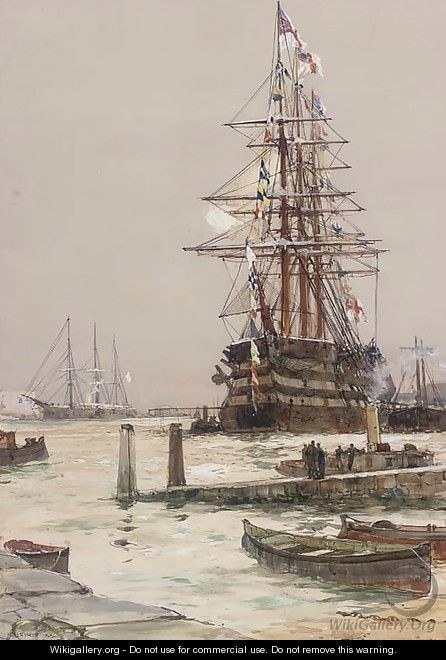
Young Joseph joined the St. Vincent. It had been commissioned in 1815 and, after service, including the Crimea, it had first become a depot ship at Portsmouth before being used as a training ship for boys and being moored permanently at Hasler (part of Portsmouth harbour). She retained her 26 guns and continued in this training role until 1905.
Discipline in the Royal Navy, although it had been cleansed of its worst excesses was still harsh. From the 1860s boy sailors were birched instead of being flogged with the cat-o-nine-tails. For lesser offences they could be caned “on the breech with clothes on” in front of all the boys. Nevertheless, the boys learnt how to wash and mend clothes and keep their personal area clean, to make ropes and make and repair sails. They also taught to row and other seamanship tasks as well as learning to swim. Alongside these tasks they had to continue with basic schoolwork unlike most working class boys of their age.
On 12th November 1869 Joseph was eighteen years old so, as part of his initial agreement, he was now enlisted as an “Ordinary Sailor” in the Royal Navy. He had now grown to 5ft, 8 inches tall with dark brown hair, brown eyes and a fair complexion. The scar over his eye had either gone or was no longer considered worthy of note. Not surprisingly, as he had been in the Navy all his life, he did not have a trade.
His first ship was HMS Bellerophon, but he was only there three months before, on 12th March 1873 moving to the Duke of Wellington. He was there another month and his conduct was said to be “very good”. Finally, he transferred to HMS Triumph which was a brand new “broadside ironclad battleship”. It had been built in 1870 but was not commissioned until 1873 so Joseph was part of its first crew. On the 1st August 1873 he had become an Able Seaman.
HMS Triumph became part of “Her Majesty’s Detached Squadron” and sailed for Portugal and Gibraltar. We know that they put into Lisbon, because Joseph, spent some time there with an unspecified illness. When they reached Gibraltar, it was used as a base form which the Triumph would patrol the seas around.
Hi career had hardly started, however, when it ended. On 13th February 1874 he was court-martialled for theft. He was sentenced to be put on “List 18/8” to await passage to England and there serve one year’s imprisonment and the discharge from the service.
When we examine the Courts Martial book for the Seamen and Marines of the Royal Navy we find that two men from the Triumph were tried for theft on February 13th and sentenced to the same punishment. Unfortunately, there are no further details of the theft or whether they were acting in collusion. It does, however, detail the conditions of their imprisonment which included the first week of each month in solitary confinement and the rest of the time doing hard labour.
HMS Triumph seems to have been a troubled ship. A new commander had come in and tightened up discipline. Whether this was essential change or bad man management we cannot tell. We do know that in the previous year, on 10th November 1873 a seaman was given one year for theft and another for insubordination. In February 1874 alongside Joseph’s sentence, another two were found guilty of desertion. It is important to realise that many on board did not wish to be there. A Lieutenant from a Royal Navy family was court-martialled in May 1875 for being “incapable of keeping his watch” (drunk).
It was, however, later that year, when the Triumph was in Devonport, that the trouble came to a head and the crew came close to mutiny. Privileges, such as the keeping of caged birds and having potted flowers decorating some portholes, were suddenly taken away. There was even a letter from some Petty Officers to the Times about the new regime and the matter was raised in Parliament.
An account in the Hampshire Telegraph on 7th August 1875 shows how the claustrophobic conditions of a warship could escalate small perceived wrongs into major problems.
DISAFFECTION ON BOARD HMS “TRIUMPH”.” – A disturbance of rather a serious character has (writes a correspondent) occurred on board the Triumph, one of the Channel Squadron hips, now at Devonport. Until the appointment of the present commander the men were permitted to congregate on the upper deck fro conversation prior to turning in for the night, but now the men have been peremptorily denied the privilege. The disaffection occasioned by this step increased when it became known that a seaman’s leave was stopped for ten days because he wore elastic-side boots, on the ground that in wearing them he was not in uniform. At first the men manifested their disaffection by chalking up in conspicuous parts of the ship uncomplimentary and threatening phrases to the commander and growling in an undertone at him as he walked his rounds. Eventually a spit-kettle was thrown at him by some of the crew and he was struck in the leg with considerable violence. The quartermaster was summoned on deck but he was unable to identify the offenders. Swabs [?] and other things have since been continually thrown about and a court of inquiry is regarded as certain. The seaman punished for wearing elastic-side boots has his grog stopped, stands two hours by himself on the upper-deck daily, and a sentry stands over him while he partakes of his rations.
For Joseph Edwards, it was an ignominious end to his career and, unfortunately, after that I have been unable to locate him, although there are many possibilities.
References
Joseph Edwards No, 59407 National Archives ADM 188/37/59407: ADM 139/783 (Discovery download): ADM 194/182 Courts Martial Register 1806-1930 ().
Various Censuses for Ringstead, Portsea etc. ().
“Sailorhoods”: Sailortown and Sailors in the Port of Portsmouth circa 1850 – 1900. Louise Moon. Thesis for University of Portsmouth (Sept 2015).
Harrods’ Directory Portsea 1865.
The English Poor Law and Training Ships in the Nineteenth Century. Julie Gilbert April 25 2016 .
Corporal punishment in the Royal Navy, C, Farrell .
HMS Triumph (1870); HMS St Vincent (1815); HMS Duke of Wellington (1852). .
Seamen and Mariners of the Royal Navy: Tried at Court Martial. 1873 – 1883. National Archives ADM 194/182.
Lloyds List: 16th October 1873; 31st October 1873; 113th January 1874: The Irish Times 17th September 1873; The Hampshire Advertiser County Newspaper 26th November 1873: Hampshire Telegraph 22nd November 1873; 24th February 1875; 19th May 1875; 7th & 18th August 1875. .