Army & Navy · Story 4
John Smith 1786 - ? (Served 1808 – 1814)
34th (Cumberland) Regiment of Foot
The 34th Regiment of Foot, like many others, raised a Second Battalion, on 25th April 1804, to prepare for the French threat of invasion. We know from his discharge document that John Smith, born in Ringstead joined this battalion on 25th February 1808. He was about twenty-one years of age when he enlisted. When we look at the Ringstead Baptismal Register there is no exact match. The closest is the John Smith who was christened on March 18th 1792, the son of William and Elizabeth. It was not unusual for late christenings but if his parents were Particular Baptists he would not have been baptised as a child. He was later described as being of “swarthy complexion” and (being stereotypical) we know that that there were gypsies in the area at this time (a memorial to Tabitha Boswell, “an old Gypsie” who died 5th January 1784 is in the church tower) so this is a possibility. We may never be sure of the truth.
Once he had enlisted John would have been kitted out and drilled and marched around the countryside. In July 1809 a 1000 strong battalion embarked for Portugal as part of the Peninsular Campaign against Napoleon. It became part of the Rowland’s Second Division in a brigade led by Catlin Crawford. Their first engagement was at Bussaco where the British and allied army made a stand after retreating before the French. The ridge there was a strong defensive position and when the battle began at dawn on 27th September 1810 the 34th were on the right of the line and saw little of the action.
Samuel Nicholls from Ringstead, now an experienced soldier, was with the 4th Battalion of the Royal Horse Artillery at Bussaco. Did their paths cross amid the chaos?
If John had been lulled into thinking that life in the army was as the recruiting sergeant had described it, the next engagement was to disabuse him. The Battle of Albuhera was one of the bloodiest, relative to the troops involved, in the history of the British Army. It took place on 16th May 1811 with the 34th in the Second Division, this time commanded by Stewart. It was a typically confused battle with the powder of the troops dampened by a hailstorm. This allowed the French Lancers to wreak terrible havoc on the foot soldiers, with one brigade almost wiped out. Then, with powder dry, the British, with their Spanish and Portuguese allies, exchanged fire with the French, only some twenty yards distant, for almost an hour. Eventually the French army retreated from the field but the British were not in a state to follow up their advantage. The 34th suffered terrible losses and any illusions that John Smith had about soldiery must have been shattered. Between them the armies lost nearly 14,000 lives that day.
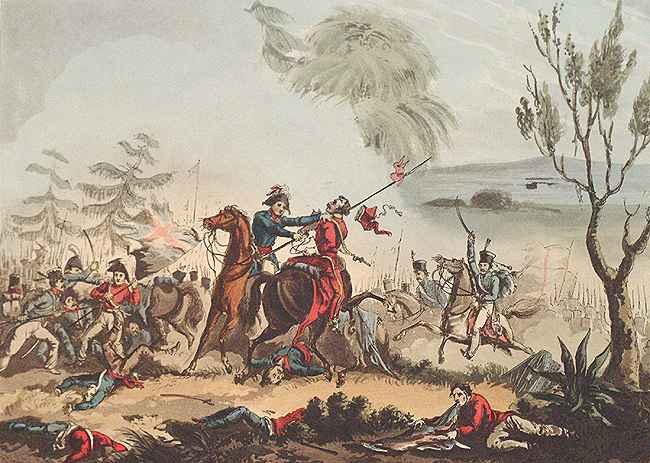
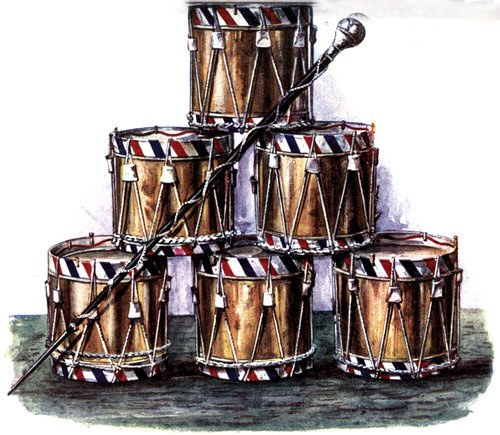
In general, warfare was conducted from Spring to Autumn and, towards the end of the 1811 “season”, at the end of October, they met the French at Arroyo dos Molinos. There was torrential rain and the Second Division, including the 34th had to march in terrible conditions through the night of the 27th but as a result took the French by surprise and won the day with the loss of only 100 men. The 34th were matched against the 34e Regiment d’Infanterie de Ligne and they crowned this coincidence by capturing their opponent’s drums and drum major’s mace, still treasured trophies of the regiment.
The following year the 34th were at the Battle of Vittoria which was a decisive victory for the British with their Spanish and Portuguese allies. The 34th were not at the centre of the battle but it was at Vittoria that John Smith received a musket shot in the head and this probably finished his active career. In 1847 a medal was struck for all those who had fought between 1793 and 1814 although they could only be claimed by the living and not by their families. A Peninsular Roll was prepared and it lists two John Smiths for the 34th. There were also additional clasps awarded for particular battles and these are shown in the list by their initial letter. We cannot be sure, but it appears that the John Smith who was entitled to A (Albuhera) and V (Vittoria) is our man (Arroyo dos Molinos did not merit a clasp). The 34th went on to further battles at Nivelle, Nive. Orthes and then Toulouse, by which time Napoleon had abdicated. I do not think that the badly injured John fought at these later battles. The Regiment embarked for Ireland in July 1814. Whether John managed to get back to Ireland early or if he followed the Regiment we cannot be sure. Certainly, we know that he was discharged because of his injury at Kilmainham on 30th November 1814. This would have been after the return of the Regiment.
The Second Battalion was disbanded in 1817. He had been a private for six years 279 days and was about 28 years of age. He was granted a pension and, to help prevent fraud, there was a description of his appearance. He was five feet seven inches tall with brown hair, grey eyes and swarthy complexion. Before enlisting he had been by trade a cordwainer (shoemaker).
His time after the army, like his time before enlistment, is also very uncertain. One would expect him to return to Ringstead and on 14th September 1815 a John Smith married Elizabeth Barber in Ringstead Church. Elizabeth was described as “Of This Parish” but was baptised at the Great Meeting House, a nonconformist chapel at Kettering, on 9th July 1798. I have not definitely found them again. Some Ancestry trees have the couple having a child, Martha Rachel Smith, born on 20th May 1820 in Thrapston. She went to London as a housemaid and married a John Stoyles on 10th May 1841 at St Giles in the Field in Middlesex and emigrated by assisted passage to Australia. Her father is given on the marriage certificate as John Smith but he was a gardener. Julianne Stoyles has notified me that, on her death certificate, Martha’s parents were given as John and Elizabeth and that she had been born in Thrapston. I have not yet managed to spin together the separate strands into one life.
It would be good to find that John did have a reasonable life after his time in the army. In 1824 the Vagrancy Act was passed to punish “incorrigible rogues”. It was directed particularly at soldiers who had returned from the French Wars and had become “idle and disorderly”. Up to one fifth of the army had been “recruited” from criminals but many ex-soldiers of all types found it difficult to reintegrate into society. They often could not find work in the post-war depression and carried with them the mental trauma of their experiences. Some fell into petty thieving and drunkenness and the disabled were often figures of fun or distaste.
Alice Parker has written that the Peninsular War, with its bitter, grinding sieges and the animosity of the Spanish (who were their allies), made worse the drunkenness, plundering, rape and murder that were associated with most military campaigns at the time. Suddenly, left alone in civilian life with an inadequate pension, and cut loose from the discipline and camaraderie of the regiment many men led short unhappy lives. Let us hope that John Smith was one of the fortunate ones.
Note: There is a John Smith, born in Castor (some 20 miles from Ringstead) in about 1786 and in the 1851 Census he is described as a Chelsea pensioner. Castor was a well-known meeting ground for the Gypsy and travelling community. Could he have been born in Castor but baptised, aged six, in Ringstead? It was not uncommon for people to give their baptismal parish as their place of birth. This is all conjecture.
References
My thanks to Julianne Stoyles for her help with the possible Australian connection.
John Smith. Born Ringstead. Served in 34th Foot Regiment. (National Archives WO 119/27/64). .
34th (Cumberland) Regiment of Foot (www.wikipedia.com).
Peninsular Medal Roll 1793-1814 ().
Peninsular War 1808-1814 ( In collaboration with Charles Griffin).
Battle of Vitoria order of battle ().
Battle of Vittoria 21st June 1813 ().
Ringstead Parish Registers ( and ).
“Incorrigible Rogues”. The Brutalisation of British Soldiers in the Peninsular War 1808 – 1814. Alice Parker. University of Liverpool. British Journal of Military History Vol.1 Issue 3 June 2015 ( )