Army & Navy · Story 11
Archibald Thomas Near 1884 – 1916 (Service 1902 – 1902)
Royal Navy
I have been following up the men recorded in the National Archives list of Ringstead military men. The last one, who just crept into the twentieth century, was Archibald Thomas Near. What I found was a very different life story than any of the other men who served and one full of twists and confusion.
Archibald was born in Ringstead on 8th July 1884, the son of Isaac and Eliza Near. Isaac Near was the Minister at the Ringstead Particular Baptist Church, He and his wife Eliza (née Goodson) had both been born in Coggeshall in Essex where his father, also Isaac, was a journeyman shoemaker.
Isaac junior by 1873 is 23 years old and had served an apprenticeship with William Balley Polley, a renowned carver. Isaac become a cabinet maker and carpenter while his wife Eliza was a tambour maker. Later, his eldest son, Isaac Lawrence Near was also apprenticed to Polley and worked at Westminster Abbey, Norwich cathedral and many other colleges and churches.
Coggeshall was famous for tambour lace which had been brought there by a French émigré, M. Drago and his two daughters, who, at the beginning of the nineteenth century, had taught the local women the craft. It was a quicker method than the bobbin lace produced in Ringstead and involved stretching a fine net onto a frame, into which patterns were chain stitched, using a tambour hook.
Isaac, however, had another calling. He was a committed Baptist and in 1872 he entered the Pastors’ College in Croydon set up by Charles Spurgeon in 1856 and which now bears his name. He completed a two-year course and, in 1874 he, with his family, moved to Stanwick in Northamptonshire, to take up his first pastorate. He already had a son, Isaac, and two daughters, Florence and Edith were born during the four years that the family was there. On 19th September 1878 he was appointed to the vacancy at Ringstead left by the brief but controversial incumbency of J.T. Collett (whose chaotic life I have written about elsewhere).
Isaac was a popular Minister, but the church had financial problems so, after six years he resigned although he continued to conduct services and live in the manse rent free with his salary paid by voluntary contributions.
In 1885 he secured another post as Pastor of Dormansland Baptist Church in Lingfield in Surrey. In the 1891 Census, Isaac and Eliza and their family are living at 40, The Street in the hamlet of Dormansland. Daughter, Florence, is 15 years old and a pupil teacher and Archibald is just six years old. This was only a brief stay, however, and soon after the Census Isaac moved the family back to Northamptonshire and became Pastor at Desborough and remained there for fifteen years. He was forced to step down because of ill health in 1907 and returned to Lingfield for his retirement , possibly to be nearer his eldest son. Isaac, who too had given up his craft to become a Baptist Minister, In March, Birmingham and finally in Penge. In 1911 he was living in Anerley, some twenty-five miles away from Lingfield.
Returning to the 1901 Census we find Archibald with his family at 20 King Street in Desborough. He is sixteen years old and a public school teacher or, perhaps, more accurately a pupil teacher. He was not to remain one for long for, in one of the strange twists of fate that were to punctuate his short life we next see him in the Royal Navy Register of Seamen’s Services and it was here that I first noticed him. He was 5ft 5 inches tall with light brown hair, grey eyes and a fresh complexion.
He had signed up on 6th March 1902 as a boy sailor 2nd Class on HMS Northampton This was an old armoured cruiser, built in 1876, that had been taken out of service and used as a boys’ training ship. On 16th August 1902 she took part in the fleet review for the Coronation of King Edward VII but Archibald was not on her deck.
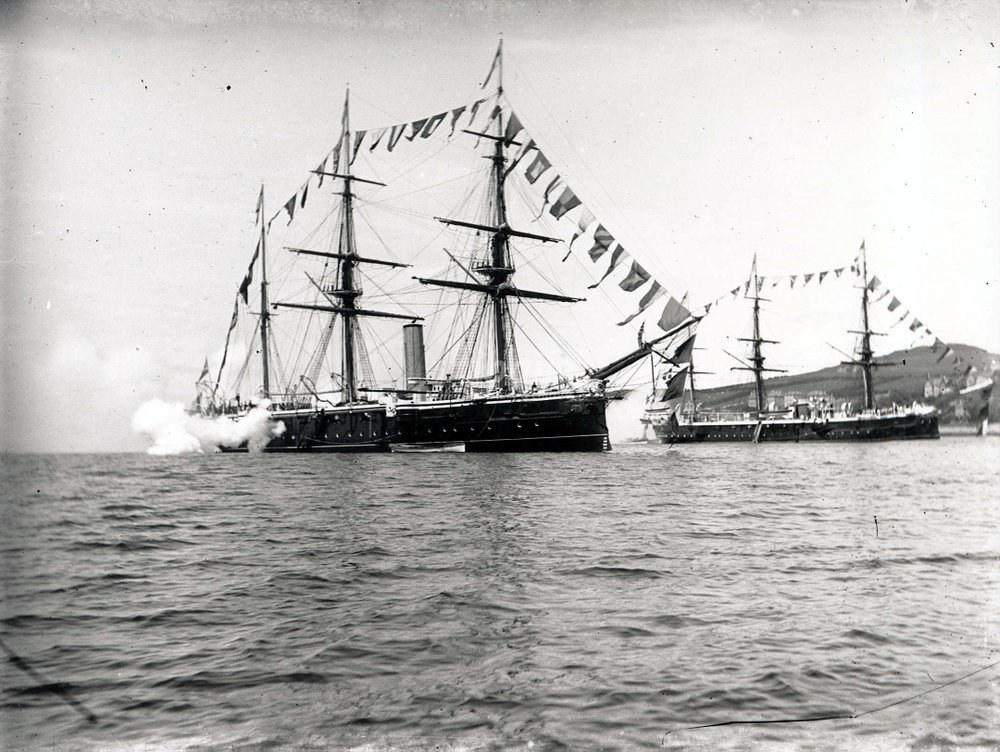
His character was said to have been “V G” and it seemed as if he might have a bright naval career ahead of him. He was seventeen years old and it looks as if he had signed up for two or twelve years but I cannot be sure because, scrawled across the entry it states, “Cancelled by purchase”. His last service date was 21st March 1902 so he had been in the Royal Navy for a fortnight. Had he run away to sea and his father paid ten pounds to bring him home or had he quickly decided that the naval life was not for him and appealed home for help?
This was the start of an extraordinary run of events and I was initially concerned that there were not two people with the name Archibald T Near who shared many similar characteristics.
On 26th May 1905 the SS Lake Manitoba, a Canadian Pacific steamship arrived in Montreal from Liverpool. On board was an A.T. Near who was a twenty-one-year-old male and a mason by trade. He was from Northamptonshire and was headed for Toronto.
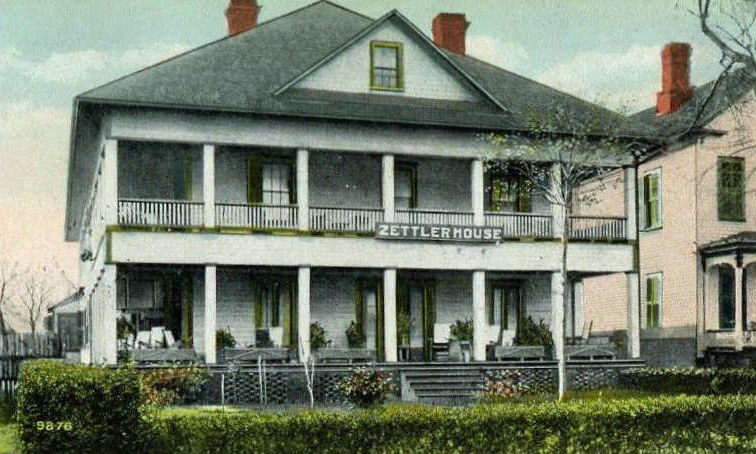
If this was our man, he made his way to Georgia on the east coast of the United States. On 2nd February 1907 Archibald T. Near and Estelle May Zettler obtained a “Marriage License” in Bibb County, Georgia. “Miss Stella” as she was always called was something of a celebrity in Macon, Bibb County, where she lived. Her parents ran a hotel in Macon, known as “Zettler House” which was famous in the state. After the death of her father, her mother Elmira (née Beecher) and Estelle ran the hotel together. In 1915 they built a new modern hotel premises with thirty-five rooms (some reports say twenty-five). After her mother’s death in 1918 Miss Stella ran the hotel herself. We also learn, from a later obituary, that she was an active member of the Tabernacle Baptist Church in Macon (which I think started in 1907). In the light of what happens later, it is perhaps significant that there is no Marriage Certificate to turn the legal permission to marry into a confirmed marriage.
It appears that Archibald returned to England briefly and Paul Fleetwood, a descendant of the Beechers, has informed me that his family were aware that Archibald had taken letters of authorization in order to claim for Estelle (or Elmira) an inheritance from her maternal grandparents. On 17th August 1907 Archibald Near, travelling first class, left Southampton bound for New York on the S.S. St. Paul. It arrived in New York on 24th August and we see from the Passenger List that Archibald was born in Ringstead in about 1884 and that he was a marble dealer and was last resident in America. It is also recorded that his wife was Mrs Near, Macon, Georgia and that this was his final destination. His entry was stamped, “NON-IMMIGRANT ALIEN”.
Hard Archibald visited his parents to tell them of the news of his marriage and good fortune? People would say that he had “fallen on his feet”, for Estelle was quite a wealthy woman.
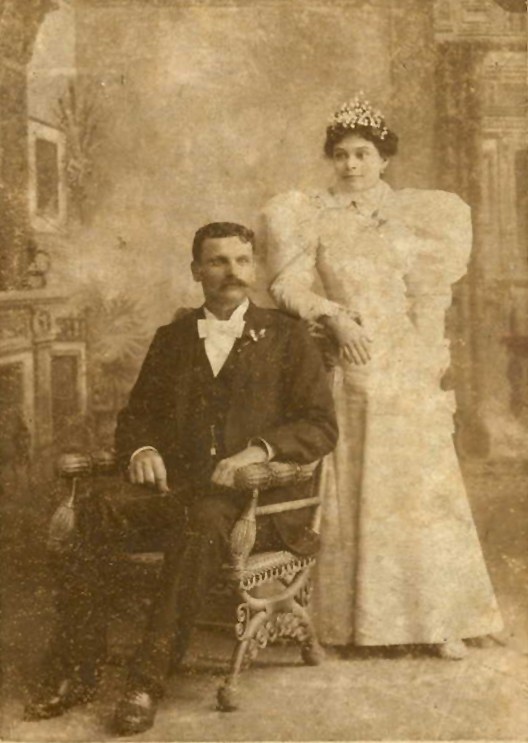
When, however, we look at the 1910 U.S. Federal Census we find Elmira Zettler, aged 57 and a widowed hotel proprietress, in her hotel. With her is her daughter Estelle Zettler aged 28 who is shown as divorced. There is no sign of Archibald but when we search for him in the Census we find an Archibald Near lodging in a hotel in Pine Street, King in Seattle in Washington State on the opposite side of the United States.
In fact, it is about as far away from Macon as you can get in the United States being some 2,750 miles or a three-day Greyhound Bus journey. He is recorded as 25 years old and a setter in marble. The Census states that he is single, and his birthplace is said to be Georgia and his father’s birthplace to be Virginia. This is obviously wrong and is possible that it is another Archibald Near but, looking at his occupation, his age and the unusual name it seems certain that he is our man. It is believed that Estelle and the family never knew what had happened to Archibald and the inheritance.
I have not found the divorce or the subsequent marriage of Estelle Zettler to Curtis Grady Hardy who is widely reported to be her husband in various newspaper reports and is declared to be so in Estelle’s Will. In this Will she leaves diamond rings and property. To her “beloved husband”, Curtis Hardy, she leaves the hotel. After her death, her husband and the family began to fight over the Will.
Meanwhile Archibald was living further down the west coast in Los Angeles. The Los Angeles Herald, on 19th July 1911, contained the brief notice:
Formal announcement is made of the marriage of Miss Jennie Larsen to Archibald Near. The ceremony was made by the Rev. J.M. Schaefle at the home of the bride’s parents. After a brief wedding trip Mr and Mrs Near will make their home at 756 East Fortieth Street.
This time we can be sure that is our Archibald for there is a Marriage License and Certificate of Marriage. These tell us that Archibald was 27 years old and was resident in Broxburn Hotel in Los Angeles. It also reveals that he was a marble cutter and setter and that his father was Isaac Near and his mother’s maiden name was Goodson.
For once in his life there is some certainty. His wife, Jennie Grace Brown Larsen was a divorcee from Elroy in Wisconsin. Their marriage took place on 15th July 1911.
Archibald’s life was to take one last unfortunate turn before his death. On the 14th August 1916 he died and was buried in Saint Peter State Hospital Cemetery in Nicollet County in Minnesota, The Saint Peter Hospital was opened in 1866 and we know that in 1911 it consisted of four separate institutions: a mental hospital, a detention hospital, a hospital for tuberculosis insane, and a hospital for the criminally insane.
We do not yet know in which section Archibald was committed but it is clear that his erratic behaviour had some mental illness as its cause.
When we look at the death certificate for Archibald the position becomes much clearer. Besides confirming his parents’ names, and that he was 31 years old, it also tells us that he was a marble setter by trade. The cause of death was “General Paralysis of the Insane”, for which he had been in the hospital for seven months and three days. It seems certain that there had been some signs of this illness for months or years before this date.
The disease of “General Paralysis of the Insane” had become something of a plague in asylums in the second half of the nineteenth century. Jennifer Wallis, writing on the British Psychological Society website, reports that most of those diagnosed were men in their 30s and 40s. They often had grandiose plans, a staggering gait, disturbed reflexes, asymmetrical pupils, tremulous voice, and muscular weakness. They also would become embroiled in financial or legal difficulties caused by their delusions of great wealth and would steal, believing everything belonged to them. Yet they were generally cheerful and optimistic.
It eventually became clear that “General Paralysis” was caused by the final stage of untreated syphilis, now called neurosyphilis. The disease finally attacked the brain and rendered its victims helpless. Most died within months of diagnosis.
When we look at Archibald’s life we see his apparent bigamy, the possible spending of Estelle Zettler’s “Beecher inheritance” as clear indications of this diagnosis. The only problem is the length of time this erratic behaviour had continued. When he was admitted to the St Peter Hospital it was stated that this was his first attack and it had lasted about a week. It also records that he was “delusional and exalted” which would accord with the neurosyphilis diagnosis.
We must also remember that there is a possibility that Archibald was not the instigator of his own downfall. Could his short time in the Navy been caused by child abuse? It can take one or two decades after the initial infection for the intreated syphilis to attack the brain. The disease can also show symptoms similar to Alzheimer’s. Nevertheless, it seems most likely that Archibald was suffering from a terminal stage of what was sometimes called “the Lady’s Disease” but it is important to realise the limitations of reconstructing the past.
It is also intriguing that his last place of residence had been Salt Lake City, the centre of the Mormon faith with its long history of polygamy (although officially banned by the Mormon Church at the beginning of the twentieth century). It may be, however, that Archibald was following his trade in that city when his behaviour became extreme and he was committed. The person who accompanied him to the hospital was Samuel Mork and he was “rooming” which seems to confirm this possibility of a travelling tradesman.
If further proof was needed that this was our Archibald Near, the Hospital Record gives his wife as living at 756 East Fortieth Street in Los Angeles. Initially he was a non-resident but it seems certain that he was soon kept within the hospital system. The record of his commital to the hospital in January 1916 records that he was 5ft 5 inches tall, with light brown hair and a fair complexion. This is identical to his description when he signed up as a boy sailor. Only his eyes had changed, from grey to blue, but I know that the majority of military enlisters had grey eyes so this is not surprising.
His “second wife”, Jennie, married again, to Fred Coach, an auto supplies salesman and in the 1920 Federal Census they are living with her 82-year-old father, Eben Brown at 756 East Fortieth Street in Los Angeles (where Archibald and Jennie had also said they were to make their home).
Back in England sister Edith had married a Welsh schoolteacher, and Florence the manager of a gents’ outfitters in Newark. As we have seen, eldest brother Isaac had married and become a Baptist Minister like his father. On Christmas Day 1919, Archibald’s father and mother, Isaac and Eliza, celebrated their golden wedding at Lingfield in Surrey. Just over two years later, aged 79, Isaac died at Lingfield but was buried in Desborough where, it seems, he had left his heart. Father and son had very different lives and deaths.
References
My thanks to Paul Fleetwood for allowing me to use photographs from his Ancestry Family Tree and for sharing his research on Archibald and Estelle.
Near Archibald Thomas 219810: Royal Navy Register of Seamen’s Services. National Archives Catalogue ADM 188/386/219810.
Ringstead Baptist Church: A Brief History. Evelyn Bull. Updated by Agnes Burton 2014 Various family trees; English and USA Censuses; Passenger Lists; Marriage License of Archibald T. Near and Estelle may Zettler; Marriage License and Certificate Archibald Near and Jennie Grace Brown Larsen; Estelle Zettler Death certificate; Various undated newspaper articles re Zettler House etc via Ancestry members’ postings. .
Spurgeon’s College; HMS Northampton (1786); S.S Lake Manitoba. .
Coggeshall Lace. Coggeshall Museum website .
Northampton Chronicle & Echo 11th August 1891; Northampton Mercury Friday 8th March 1907; Friday 14th April 1922; .
Georgia Probate Records 1742 – 1990. Bibb County 1923-1929
via .
Minnesota Deaths and Burials via .
Los Angeles Herald No. 291, 19th July 1911 .
St Peter State Hospital, St Peter, Minnesota Collection 1855 – 1974. Minnesota State University website .
St Peter Hospital Records (For Archibald Near) provided by the Minnesota Historical Society Library.
Looking back: This fascinating and fatal disease. Jennifer Wallis. British Psychological Society. .
Rev. Isaac Lawrence Near (1871 – 1952) Notes made by Archibald’s brother which were found “among the detritus of a South African deceased estate”. ().