Ringstead People · Story 26
INNKEEPERS & BEERSELLERS
Thomas (c1775 – 1837) & Mary Hill (c1777 – 1842): James (c1785 – 1856) & Ann (1787 – 1871) Hill.
We usually view the nineteenth century as the great time of the temperance movement. An era when the ‘demon drink’ was confronted and the Coffee Taverns, like the one in Marshalls Road, Raunds, were established to help save the working man. But it was not quite as clear-cut as that. For many reformers it was cheap gin that had been the ruin of mothers and fathers alike. For some, even in the temperance movement, beer was seen as a wholesome drink and part of the English labourers’ tradition.
As William Cobbett tells us, in Cottage Economy, which was written in 1821, up to the1780s almost every labourer, who had the space, would brew his own beer. Cobbett saw beer as a healthy and nutritious drink and was scathing about the new tea-drinking fashion.
I view the tea drinking as a destroyer of health, an enfeebler of the frame, an engenderer of effeminacy and laziness, a debaucher of youth and a maker of misery in old age.
He blamed the heavy taxation on malted barley and hops which had stopped the home brewer from producing, ‘the cheapest drink that a family can use except milk’. Instead, he alleged, the labourer tended to drink less beer, but it was the much more expensive ale sold at a public house where young men might be corrupted and the beer contaminated with chemicals. Of course we must remember that both beer and tea were ways of making water of uncertain purity, safer to drink and much of the home-brewed beer was very weak.
It was to encourage the small, ‘beer or cider only’, establishments that the 1830 Beer House Act was passed. This enabled anyone to brew and sell beer, ale or cider, whether from a public house or in their own homes, upon obtaining a moderately priced licence of just under £2 for beer and ale and £1 for cider. Nor did they have to go to the Justices of the Peace to obtain one. In the six months after it came into force nearly 25,000 excise licences were taken out. This is the reason that we see so many King William or King William IV public houses today.
We cannot be completely certain what impact the new law had on the local sellers of alcohol. It does seem likely, however, that until at least 1828 there were only two recognized alehouses in Ringstead and that they were the Axe & Compass and the Swan. The Ale House Keepers Recognizances had to be taken out every year until 1830 before the local Justices of the Peace. Unfortunately the Wellingborough Quarter Sessions did not record the name of the alehouse. Looking at the names of the people concerned it does seem most likely that the Black Horse came after the 1830 Act and the New Inn, as its name implies, came later still. There are, however, other sellers of beer who crop up in the Censuses and other sources which we cannot link directly to one of these four named houses. Some may have been innkeepers of the main houses who, because of missing details, we are unable to allocate. It may also be that some were beer-shops, which, after 1830, as we have heard, could be in somebody’s front room, had no name, and may have been short-lived.
In his eulogy to the English Inn, William Howitt makes a clear distinction between the two types.
There is nothing more characteristic in rural life than the village ale-house or inn. It is the centre of information, and the regular, or occasional rendezvous of almost every-body in the neighbourhood. You see all sorts of characters, or you hear of them. The where-about of every-body all around is there perfectly understood. I do not mean the low pot-house – the new beer-shop of the new Beer-bill, with LICENSED TO BE DRUNK ON THE PREMISES blazoned over the door in staring characters - the Tom-and-Jerry of the midland counties –the Kidley-Wink of the west of England. No, I mean the good old-fashioned country ale-house; the substantial well-to-do old country ale-house- situated by the village green or by the road-side, with a comfortable sweep out of the road itself for carriages or carts to come round to the door, and stand out of all harm’s way.
When we look at the records of the 1795 Ale House Keepers Recognizances for Ringstead there are only two names. One is John Green, almost certainly at the Axe & Compass who gave a surety of £10 and was supported by 'Richard Whiteman of Ringstead' who had to put up a similar amount. If the house was run properly during that year, the money was returned or taken forward into the next year. If the innkeeper was found to have allowed 'disorder or unlawful games', then the money could be forfeited. The other alehouse keeper, probably at the Swan, was John Mason, supported by Charles Chapman of Wellingborough.
In 1800, John Green is again there, with John Colby who is probably at the Swan. This time both are 'seconded' by John Mason of Rushden (presumably the Swan's innkeeper in 1795). Ten years later, it is still John Green at the Axe & Compass and John Mason is back at the Swan. (Of course we could have a father and son here).
John Green died in 1821 and when we look at the 1822 List of Licensed Victuallers for Ringstead it gives four licensees with Thomas Green, son of John, at the Axe & Compass and Thomas Hill at the Swan.
Thomas Green Axe & Compass
Thomas Hill Swan
Lot Green -
Thomas Lee -
The Hills and the Greens form a double helix of bloodlines in Ringstead. We have Lots of Green and Hill and, not far away a Green Hill. In this 1822 List, Lot Green is the brother of Thomas at the Axe & Compass and by 1841 is shown as ‘Independent’. It may be he was brewing for his brother or for his own needs. Thomas Lee was a baker and, again, brewing was probably something of a sideline.
The Justices met at the Hind Inn at Wellingborough and almost all the innkeepers seem to have attended the session because, occasionally, one is recorded as not present. One imagines that it was something of a social occasion with all the innkeepers, from across the district, having an annual get-together. In the early Recognizances the innkeepers had to agree to, 'suffer no disorder or unlawful games,' but by 1825 this had developed into a lengthy inventory of wrongdoings to be avoided. It authorizes the named persons to sell:
. . . Bread and other Victuals, Beer, Ale and other Liquors in his, her or their house and shall not fraudulently dilute or adulterate the same and shall not use in uttering or selling thereof any pots or other measures that are not of full size and shall not wilfully or knowingly permit drunkenness or tippling, nor get drunk in his, her or their house or other premises nor knowingly suffer any gaming with cards, draughts, dice, bagatelle, or any other sedentary games in his, her or their house or any outhouses, appurtenances, covernments [?] thereto belonging by Journeymen, Laborers, Servants or Apprentices, nor knowingly introduce, permit or suffer any Bull, Bear or Badger baiting, cock fighting or other such sport or amusement in any part of his, her or their premises, nor shall knowingly or designedly and with a view to harbor and intertain such, permit or suffer men or women of notoriously bad fame or dissolute girls and boys to assemble and meet together in his, her or their house or any of the premises thereto belonging, nor permit or suffer any drinking or tippling in any part of his, her or their premises, nor shall keep open his, her or their house during the usual hours of Divine Service on Sundays nor shall keep his, her or their house or other premises during late hours of the night or early in the morning for any other purpose than the reception of Travellers . . .
Much of this is humane and right but many suspected that the local J.P.'s were using their powers to create a cosy cartel and restrict the growth of beerhouses for working men. The reference to Journeymen, Laborers, Servants or Apprentices', may give some credence to this view. Notice also the lack of 'u's, in words such as’ labor’, which the emigrants to America retained. At first both versions were used and the divergence seems to have come partly from the different choices of the early dictionary writers (Samuel Johnson and Noah Webster), in the two countries.
As a small village, off the main turnpike roads, Ringstead did not have one of the larger coaching inns such as The George at Huntingdon. It seems, of the three main contenders, that the Axe and Compass was the nearest to the traditional alehouse that Howitt praised. Before the advent of the village hall, it was often in the inns that inquests took place, house and land auctions were held and Enclosure committees met. In the case of the Ringstead ‘Inclosure’ it was in a Thrapston Inn that the appointed Commissioner met claimants and decisions were made. A poster advertising an ‘Auction of the Freehold Property’ of John Green (occupied by Josiah Groom) is said to be happening at the Cross Keys Inn, Ringstead but I have not found any evidence that such a public house existed and I think it was a mistake and should have been the Axe & Compass. Later in the century, on 2nd December 1882, an inquest for the stillborn child of Rhoda Warren was held at the Black Horse and two years later an inquest into the sudden death of Mary Barker was held at the New Inn.
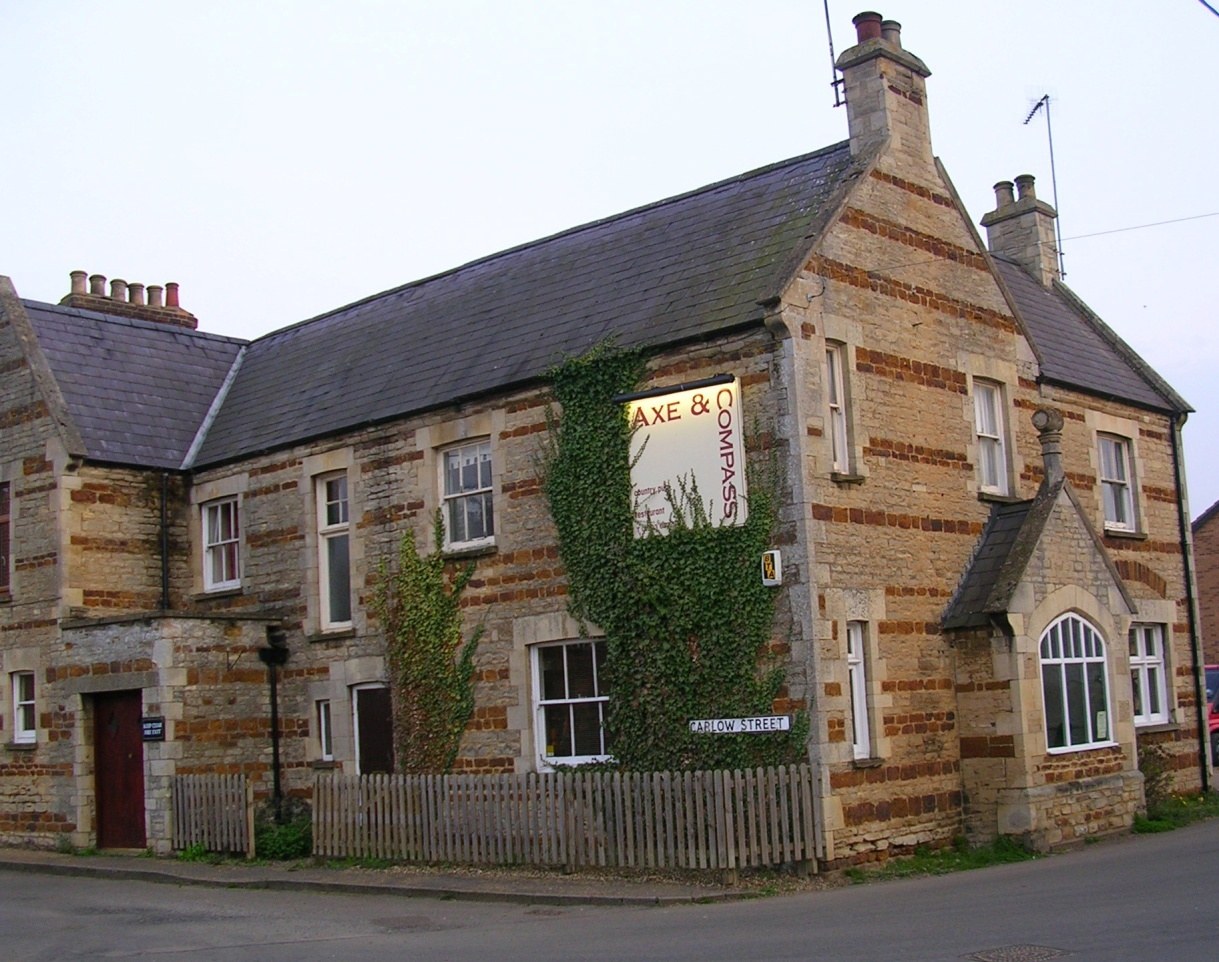
Photograph 29 March 2011 with the kind permission of the owner.
As we have seen, Thomas Green, born in about 1795 in Ringstead is the ’victualler’ of the Axe & Compass from before 1822, until at least 1871 where, in the Census, at the age of seventy-six he is still shown as the innkeeper. His wife Katherine died soon after, in 1872, and Thomas followed her some five years later. It is not the lives of Thomas and Katherine Green that we shall be looking at here but those of the Hill family to whom they are linked. We will also not be looking at the Figgis family, first landlords of the New Inn, which, as its name implies, was built later, probably in the 1860s. It is worth briefly showing here just how interrelated the innkeepers were. Samuel Figgis had married Maria, the daughter of James Hill (who kept the Black Horse) in 1852. James himself had married Ann Green who was the sister of Thomas Green (innkeeper of the Axe & Compass).It seems very likely that Thomas Hill of the Swan, born about 1775 and James Hill, born about 1785 were brothers or at least cousins.
Let us start with the Swan Inn in Carlow Lane, on the edge of the village but facing down the High Street and but a stone’s throw from the Axe and Compass. Its name may be derived from the arms of the Creed family of Oundle who were lords of the manor in Ringstead in the eighteenth century. Their shield showed, ‘Azure a cheveron between three swans argent’.
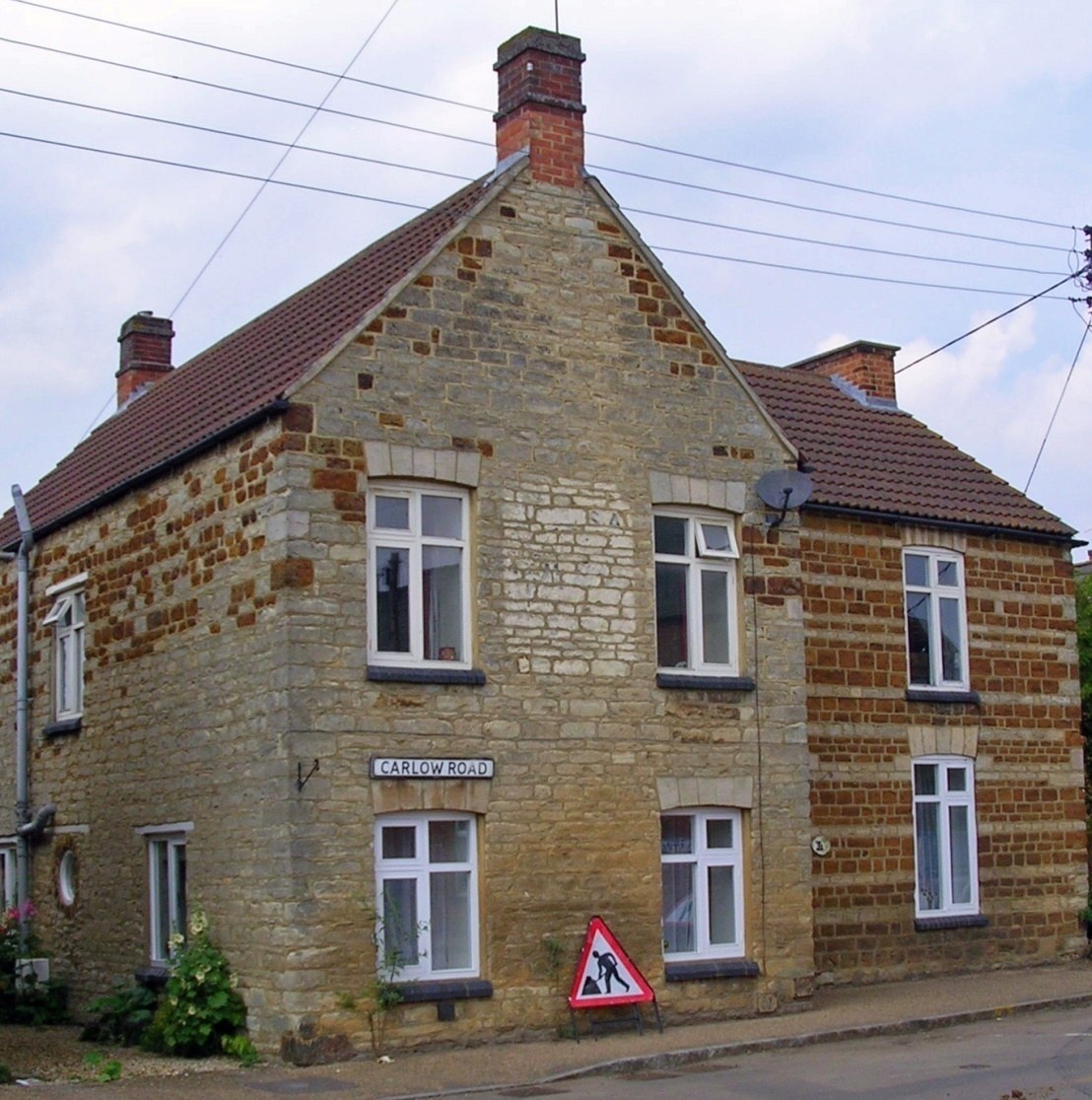
Thomas Hill was born in about 1775. We only know this from the Burial Register which gives his age. I have found no other sign of his birth and it may be that he was christened elsewhere. Perhaps surprisingly, for innkeepers, the Greens and Hills have Baptist connections and this may be the reason for them not appearing in the Parish Baptism Register. He married Mary Richards on 27th February 1797 in Ringstead Parish Church and it appears from the Register that they had four children: Lot (baptised 11 Sept 1798) – who later married Lydia Green (sister of Thomas Green of the Axe and Compass); Susannah who died in infancy; John; and Elizabeth.
At present, the first we hear of Thomas is in the Licensed Victuallers’ List of 1822 but he may have been the landlord there for many years before this date. Fifteen years later, on 9th September 1837 Thomas died and was buried in the churchyard. The 1841 Census records Mary Hill on her own at the Swan Inn with just a fifteen-year-old servant girl to help her. She would have walked up and down many stairs for, Alan Clipston remembers that, in the middle of the Twentieth Century, The Swan had no beer pumps and the landlady had to go down into the cellar every time to draw a pint from the barrel.
Also, in 1841, the Northampton Mercury records that William Barnard from Brampton in Huntingdonshire was sent to the House of Correction for two months for, ‘wilful damage and injury to certain windows in the house of Mary Hill, Ringstead. It may be that this was revenge for her not having paid a bill, for William was a carpenter, but the wording is ambiguous.
On 23rd March 1842, Mary too died aged sixty-five and within six months, her son, John, aged just forty years old also died. The Mercury writing of his death, records that John Hill of the Swan Inn, son of Mr Thomas Hill and Mary Hill, ‘died on Sunday last after a short illness’. The newspaper also states that this is the third death in the family in the last twelve months. Thomas had died some five years earlier so who is this third death? The Burial Register gives no obvious answer.
That is the end of the Hill family at the Swan. The inn does not appear again in the Trade Directories until 1861 when the landlord is Ekins Dickens. The Northampton Mercury, of 22nd August 1863, has a notice advertising The Swan for let with about seven acres of pasture land and three acres of arable land. Potential lessees are directed to’ Mr Woolston, Brewery, Wellingborough’, so it looks as if it was a tied house perhaps to Dulleys who started in 1840 and were taken over by Campbell Praed in 1920. Amos Mason and Samuel William Bull followed as landlords and the latter is there as the century draws to a close.
The Swan Inn is now a private house in Carlow Road but if you look carefully you can still see the square on the bricks where the pub sign once hung. Inside, the old beer cellar is now blocked up.
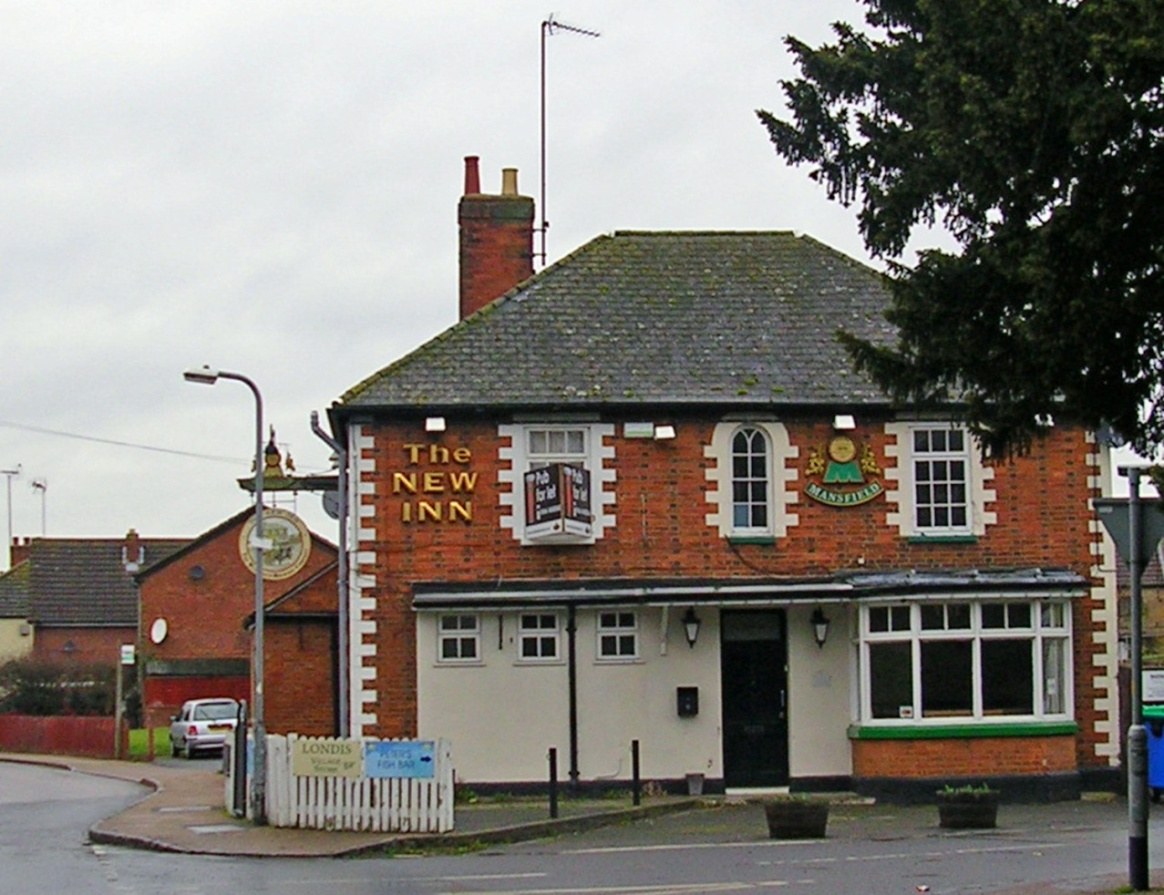
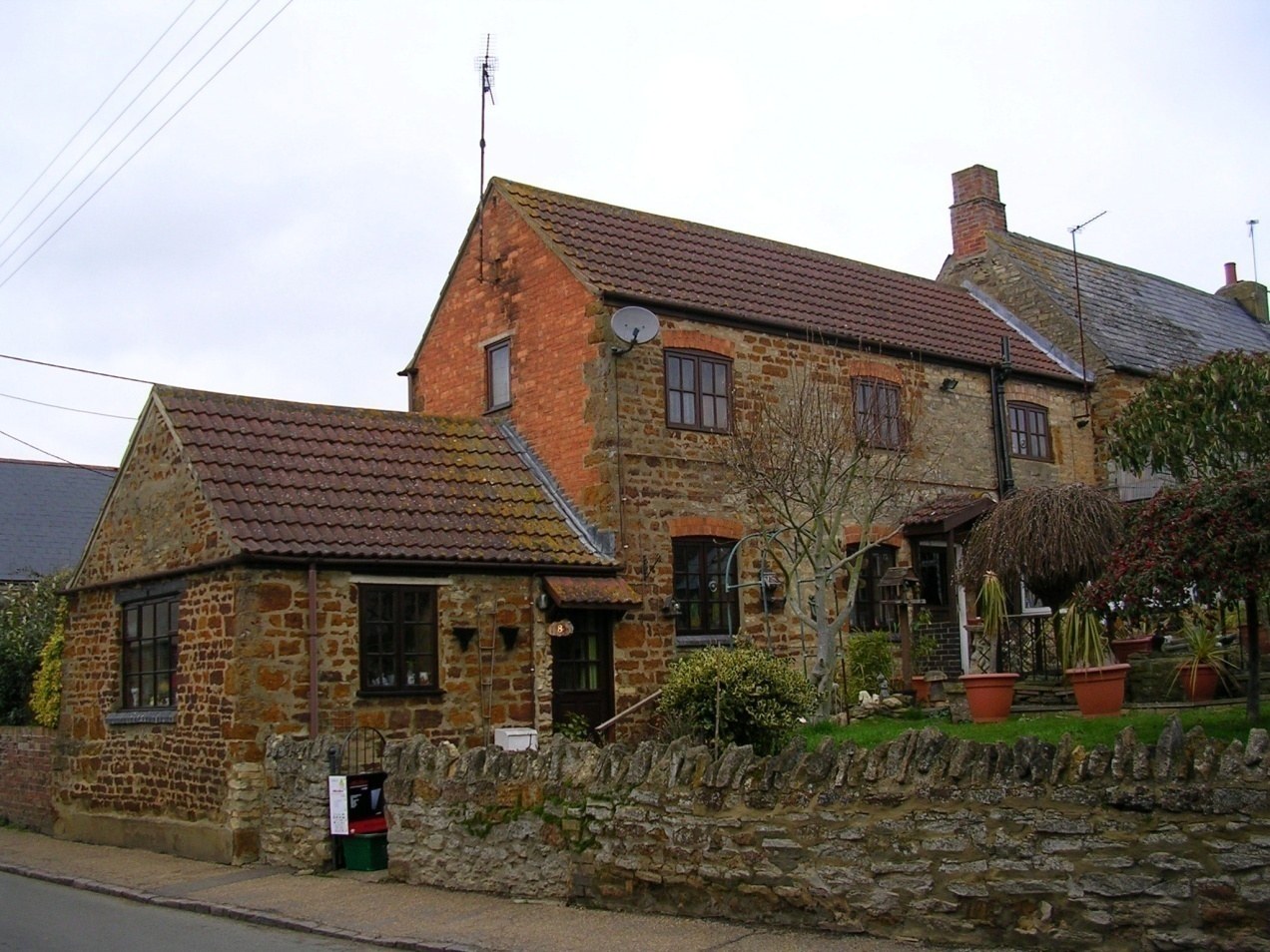
February 2011 (with the kind permission and assistance of Alan Clipston).
The Black Horse is also now a private house, towards the other end of the High Street, nearly opposite the Temperance Hall. It does not appear by name until an 1847 listing in the Post Office Directory. It is likely, however, that James Hill who is in the 1841 Census, aged 55, with his wife Ann, and described as a publican is living at the Black Horse.
James Hill had been born in 1785 and married Ann Green (sister of Thomas of the Axe & Compass) on 1st March 1810 in the Parish Church. It is likely that the Black Horse was always more of a Beer-House than a traditional inn and that James did other things as well as being a landlord, in order to make a living. His will describes him as a horse dealer and we know that, on some occasions at least, that it was Ann who ran the bar by herself.
The first time that the newspapers talk of James Hill, it is of a lucky escape. The Northampton Mercury of 13th May 1843 reports that, at Wellingborough Petty Sessions:
Mr. Hill, a beer shop keeper at Ringstead, was charged with keeping his house open after ten o’clock. It was proved that the church clock at Ringstead was not going on the night in question, and the magistrates gave Hill the benefit of the circumstance, and dismissed this charge.
The church clock must have been visible from the Black Horse window but it also implies that there was no clock in the house. It is likely that this incident was part of the new county police force flexing its muscles and we have also seen that it prosecuted a number of shopkeepers for having incorrect weights. James, perhaps, made overconfident by his clever defence, was caught once more. Superintendant Knight again charged him with ‘serving beer after the stipulated hour’, and this time he was found guilty and fined forty shillings.
One suspects that keeping a public house would, almost inevitably, lead you to minor skirmishes with the law. They may also arise from the publican’s problems with the customers. In an incident, a few years later, we learn a little about the strength of Mary’s character and also about her physique.
The Northampton Mercury for 5th July 1845 reports on the case of two young men, John Watts aged seventeen and James Allard, aged eighteen, who believed that they had discovered a foolproof scam to make some money while enjoying themselves.
They started off their travels at Islip on 28th April where James Allard went into the shop of a Mrs. Clark and asked for an ounce of tobacco. He paid with a half-crown piece and was given his change. At this point Watts came into the shop and asked Allard why he had used his half-crown, when he (Watts) had the coppers needed to pay for it and he put them on the counter. He asked Mrs Clark to give Allard back his half-crown who then returned her two shilling pieces and the rest of the change. She took up the coppers and all seemed fine.
It has some of the elements of a famous Abbott & Costello sketch of the twentieth century. It was, however, in the various movements of the coins that the trick was played, not in the amount of money which she received for the tobacco, which was correct. All this elaborate playacting was to confuse the shopkeeper so that, when Allard gave her back two shilling pieces, she did not notice that one of them was counterfeit. If they had given a single shilling at the beginning she might have realised that it was a dud coin.
They played the same convoluted trick on Abigail Talbot who kept a shop in Denford and, warming to their game, went to a public house there and bought a pint of beer each and went through the same routine. They must have been feeling more confident because this would have involved more time for the person behind the bar to discover the counterfeit coin. Continuing up the Nene they arrived in Ringstead and successfully played the same trick on Mrs Major who kept a beer shop there (I am not sure which one). The Mercury tells us, however, that, ‘their career was drawing to a close because they went to a second beer shop kept by a shrewd little old lady named Hill’. This must have been Ann Hill at the Black Horse who would have been about fifty-eight years old at the time. Here we will let the reporter tell the story:
. . . they had a pint of ale, gave the same half-crown, received the change, and repeated the request that the half-crown might be returned as on the former occasions. But Mrs Hill had taken a keen look at her customers. She had lived long enough in the world to know that all is not gold that glitters, nor all half crowns of silver. It was her custom therefore, to examine all monies offered to her carefully, and the habit of examination had so grown that she also examined those she had paid as well as those she received. In the present instance this habit stood her in good stead: she observed that the two shillings which she gave in change for the half-crown were coined, one in the reign of William IV., and the other in that of his successor, our present sovereign lady. Her parting glance at her coin had not escaped the notice of the prisoners, and it seems to have instantly struck them that a little variation of the patent name would be necessary. When, therefore the request to restore the half-crown was made, it was not deemed safe to substitute for one of the old lady’s well examined respectable shillings one of their own base coin, lest the exchange should be at once detected. Watts, therefore offered the bad shilling in place of the half-pence. Mrs. Hill, however, who evidently had her wits about her examined this shilling also, and when she had done she refused to alter the character of the dealing and give back the half-crown The prisoners grew angry and some altercation followed, which ended in Allard boldly charging Mrs Hill with having given him a bad shilling back. She admitted that the shilling was bad, but insisted that it was the one which the prisoner had given her, and that she had refused his request precisely for that cause. This renewed the altercation in the course of which Mrs Hill’s husband came home and having learnt of the quarrel expressed a wish that he had possession of the shilling as in that case he would transfer both the shilling and its owners into the presence of a magistrate.
The young men left but were later apprehended by the constable. He found some bad shillings on Watts but, when he tried to get the bad shilling from Allard, he:
. . . thought it more prudent to get rid of such a witness against him, so he swallowed it; at least so the constable presumed for he did not think it prudent to carry his search within the range of the prisoner’s well-armed jaws.
Allard and Watts were found guilty and were sentenced to twelve months imprisonment with hard labour.
It seem that Ann was nobody’s fool and perhaps her carefulness had been increased because, not long before, she had seen one of her children nearly robbed of some money. James and Ann had eight children. One of these was named Green Hill in honour of her maiden name and he was baptized on 10th January 1813. One gets the idea that he was, perhaps, a little simple-minded but this may be unfair.
What we know of the incident comes from The Times of 19th July 1844 which has a report on a Crown Court case. It appears that, on the 6th July, Green(e) was sent by his master to Bythorn, to take, to the wife of Mr Ashby, her Sunday bonnet. He carried out the errand and Mrs Ashby gave him some beef and ale before he set off home. She handed him some money in a sealed envelope which she told him to give to his master. She also gave him 2d to buy a pint of beer at the public house at Keyston on the way back. The report continues:
Thus furnished, he set out, and to be sure, he did not forget that part of Mrs. Ashby’s instructions which went to his procuring a pint of beer. At the public-house at Keyston it was his misfortune to meet the prisoner whom he had known in years gone by, and who offered to treat him to more beer than he seemed inclined to bestow upon himself. He, however, remembered the parcel wherewith he was intrusted, and, like a faithful messenger, declined to drink with the prisoner, but, like an imprudent one, told him the reason for declining – namely, that he was the bearer of a sum of money of which he must take especial care. The prisoner thereupon asked him some questions relative to the money, in which pocket he carried it and so forth; and not only got all the verbal information that he sought, but induced the simple man to show him the wondrous parcel; and soon afterwards the prosecutor[Green] took his leave. The sun had gone down o’er the lofty fir-trees of Keyston when the prosecutor left the public-house and, like a prudent and well-furnished traveller, he pursued a noiseless tenor as he continued his course towards Ringstead, fearing lest he might attract the attention of some thief. The prisoner accompanied him through one or two fields and bade him good night at a stile which parted two ‘lonesome’ closes. In a few minutes the prosecutor was aware of the approach of some person from behind, but before he could turn round the prisoner had come upon him and threw a handkerchief over his head, and effectually blinded him. The traveller struggled in vain to get free and presently felt one of the assailant’s hands at the pocket which contained Mrs. Ashby’s letter and money; and with the hope of saving the treasure, he threw himself on the ground, dragging the prisoner down with him. A struggle then ensued, and the prisoner took out his knife and ‘jabbed’ it into the face immediately under one of the eyes of his opponent. Fearing for his life, [Green] now exerted his utmost strength, threw the prisoner from him and wrenched the knife out of his hand receiving, however a severe cut on his own at the same time. The prisoner, finding that he was getting the worst of it, then ran away, leaving his knife and handkerchief in the possession of the true man, who in due time arrived at Ringstead and delivered into the hands of his master the letter it had cost him so much to preserve.
The attacker, who was called John Elliot was apprehended and at the trial was found guilty and sentenced to be transported for 15 years. Green Hill might have been a rather simple, trusting young man but he was also a brave one.
James and Ann Hill continue at the Black Horse and the 1851 Census shows them still there. James is now sixty-six years old and Ann is sixty-four. Living with them are their four unmarried children, Green is thirty-seven, Harriett is thirty, Lydia is twenty-eight and Maria, the youngest is twenty-four. There is also a visitor Elizabeth Sharman who may be the daughter of their married daughter, Elizabeth. Green is put down as a ‘publican’s son, Harriett and Lydia are straw-bonnet makers and Maria is a milliner. Is it possible that Green Hill’s delivery to Mrs Ashby was connected with the hats produced by his sisters?
On 16th May 1856 James Hill died, aged seventy-one years, and his will reveals that he was a horse-dealer. Perhaps surprisingly, by 1861 all the unmarried daughters have now left home and Green, still unmarried is working as an agricultural labourer. A sixteen-year-old girl is living in as a house servant to help Ann.
We know from an 1869 Directory that Ann is still selling beer then but just a few months before the next Census, on February 22nd 1871 she died. She was eighty-four years old and we can only surmise from what we have seen of her life that she was a tough, hard-working little woman.
The Northampton Mercury for 25th February 1871 advertised the Black Horse for sale, freehold, by auction at the New Inn on March 13th. We see from the details of the sale that James and Ann certainly were more than just publicans. Like many innkeepers they needed other income to survive or prosper. Besides the house containing: ‘Parlour, tap-room, kitchen, cellar, five chambers and private sitting room,’ there were also listed:
barns, stables, piggery and out-offices thereto belonging together with the Paddock adjoining, the same containing with the site of the building three roods and one pole, more or less.
A second lot contained’ three roods and one pole, more or less’, of arable land.
The son, Green Hill, by 1871, has become a drover, lodging with William Bull and his wife, Susannah. William is a shoemaker and grocer and the Bull family are dominating the High Street almost as the Greens and Hills controlled the public houses. Green too dies on 28th December 1878 aged sixty-five years.
The Black Horse is now run by the Robinson family. First it is Elijah and his wife Sarah Ann. He is a carrier, born in Denford, and at some time between 1871 and 1879 he becomes the innkeeper at the Black Horse. 1881 find him still there, publican, farmer and carrier, with his family. By 1891 he is just described as innkeeper and three years later his oldest son, William has taken over the business and Elijah has become a shepherd. He dies a year later.
We have taken the Ringstead public houses through to the end of the century. By the end of the next century, as with the local shop, the changing world was removing many of these village meeting places that help to make a collection of houses into a community.
Below is a list of Innkeepers and Beer Sellers. ( Note: Abbreviations – fuller title when first used). It is not complete.
References.
Ale House Keepers' Recognizances. Wellingborough Quarter Sessions. (NRO).
Northamptonshire Licensed Victuallers 1822. (Eureka Partnership 2009).
Beerhouse Act 1830 .
Directories: Post Office Directory 1847, 1854, 1869, 1877 Kelly’s Directory 1854, 1885, 1894, 1910: Slater’s Directory 1862.
Northampton Mercury 1841:1842: 13th May 1843: 5th July 1845.
Letter from and to James Braybrook from G Capron 1897. (Southwick Hall Archive).
The Times July 18th 1844. (Cambridgeshire Libraries online).
Wellingborough News 2nd December 1882; 15th March 1884. ( ).
Cottage Economy. William Cobbett. First published 1822 (Peter Davies 1926 Reprint 1966 Cedric Chivers).
The Rural Life of England. William Howitt. (Longman, Orme, Brown Green & Longmans 1838).
English Country Life 1780 – 1830. E. W Bovill. (Country Book Club 1964).
Northampton Mercury 22nd Aug 1863; 25th Feb 1871. (Northampton Central Library).