Final Stories · Story 2
Ivy Elizabeth Adams (1892-1979)
In my account of the people from Ringstead, I have told the stories of the men who served in the forces. There were a few women, besides the ones who took over the roles that these men had previously held in farms and factories, who served as nurses at home and abroad. So far, I have only found one woman from Ringstead but there may have been others. I have already written a little about her in the biography of Stuart Dimbleby Bates who she later married but she deserves a place of her own to represent these women who, often voluntarily served the war effort.
Ivy was born on the 21st August 1892 to Harry and Elizabeth (née Childs) who were both born in Ringstead. Harry was a shoe rivetter in one of the local factories. The 1901 Census finds the family at 13 Carlow Road. By 1911 Harry had become an Insurance Broker and Ivy Elizabeth, at 18 years old, was a Pupil Teacher in a local County Council school. They were now living in “Ferndale” a six-room house in Denford Road.
War came in 1914 and by the end of 1916 most of the younger men of the village had been taken to serve in the war. Many of the men who went out were killed or came back wounded, ill or broken in spirit. As in the present Covid 19 Pandemic, the hospitals were soon filled with the casualties. The Wartime Project website records that:
The nature of the fighting during the Great War led to a huge number of injured soldiers and the existing military medical facilities in the United Kingdom were soon overwhelmed. A solution had to be found quickly and many civilian hospitals were turned over to military use, a large number of asylums were also converted to military hospitals, with the asylum patients being sent home, often to unprepared families. As demand for beds grew, large buildings such as Universities and hotels were transformed into hospitals and wooden huts sprang up in hospital grounds and at army camps to cope with the huge numbers. Additional nursing staff were needed and this was met by a mixture of qualified nurses and volunteers.
The Red Cross and St John Ambulance had set up a Joint War Committee and they pooled resources under the Red Cross emblem which was internationally recognized. They set up V.A.D. (Voluntary Aid Detachment) hospitals, largely or entirely, staffed by volunteers. The Red Cross website describes how:
The buildings varied widely, ranging from town halls and schools to large and small private houses, both in the country and in cities. The most suitable ones were established as auxiliary hospitals. Auxiliary hospitals were attached to central Military Hospitals, which looked after patients who remained under military control. There were over 3,000 auxiliary hospitals administered by Red Cross county directors. In many cases, women in the local neighbourhood volunteered on a part-time basis.
The hospitals often needed to supplement voluntary work with paid roles, such as cooks. Local medics also volunteered, despite the extra strain that the medical profession was already under at that time. The patients at these hospitals were generally less seriously wounded than at other hospitals and they needed to convalesce. The servicemen preferred the auxiliary hospitals to military hospitals because they were not so strict, they were less crowded and the surroundings were more homely.
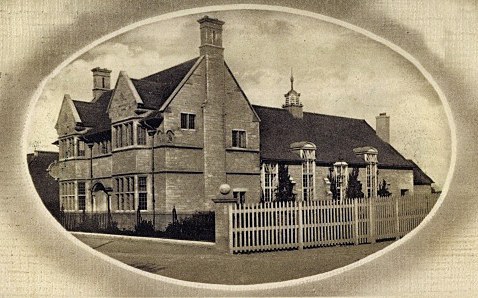
The local V.A.D. Hospitals mainly took the men after their initial treatment who still needed care and rehabilitation. These hospitals were set up in Northampton, Wellingborough, Higham Ferrers and across the county. The Auxiliary Hospital in Higham Ferrers had been set up in the Parish Rooms with initially 16 to 18 beds (later increased to 22). It began in March 1915 and was largely staffed by St John Ambulance volunteers under the leadership of “Commandant” and Matron, Mrs. Clara Patenhall, with a local doctor in attendance.
Ivy Adams joined the hospital, as a nursing sister, assisting in the ward, on the 1st of July 1916 and she worked there until the 31st December 1918. In all, she completed 1200 hours service which would be about ten hours a week. At the end of December 1918, like many others of these temporary units, the Higham Auxiliary Hospital closed.
As the war was ending, the great “Spanish Flu” Pandemic swept across the world. In November 1918, a sister in charge of the Wellingborough Auxiliary Hospital for the past two years, died. I have not found if she was a relation of Ivy, but she was simply referred to as “Nurse Adams”. She had been infected either with flu or pneumonia, the reports vary, from one of her patients who had later died. The esteem that the nurses were held in, is shown by her funeral which was held with full military honours and attended by great crowds.
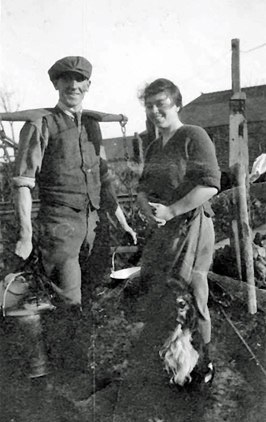
By this time many of the servicemen were returning home and among them was Ringstead man, Stuart Dimbleby Bates, son of the local Baptist Minister, John Bates. Stuart and Ivy married in the Spring of 1920 and lived at first with Ivy’s parents in Ferndale. Stuart’s mother died in 1924 and his father in 1928 and in 1931 the couple moved to Yew tree farm in Ringstead High Street. They ran a small farm with hens, pigs and a small dairy herd.
They sold milk around the village from churns which they ladled into customers’ jugs. Older villagers also remembered that Ivy sold home-made ice-cream at the back door of Yew Tree Farm and that airmen from USAF Chelveston were appreciative customers.
The couple had one child, Janet, born on the 8th of May 1932 and, besides looking after her and the house, Ivy also helped on the farm and was a dressmaker. Janet married Cyril Farr and later gave up her work as a School Meals Supervisor to help her parents with the milk business. It would have been a busy life for all of them. Stuart died in 1971 and Ivy, aged 86, in 1979.
References
Ringstead Censuses; 1939 Register of England & Wales; England & Wales Civil Registration of Births, Marriages and Deaths. .
British Red Cross Society Volunteers 1914-18 transcription. .
Northampton Chronicle & Echo 8th, 11th and 15th November 1918. www.Britishnewspaperarchive.co.uk.
Volunteers during the First World War. .
Various transcribed articles from the Rushden Argus and Rushden Echo on the Higham Ferrers V A D Hospital. .
The Great War: Ringstead men Who Served A-M. David Ball 2020.