Ringstead People 2 · Story 13
End of an Era?
Centuries do not in themselves define eras, nor do the reigns of kings and queens. Often it is the spread of new technology such as iron smelting or steam power and sometimes it is terrible wars which change the mindset of a nation. Usually it is a more gradual process than our old history text books would have us believe. We have seen that the Boer War was a terrible precursor of the First World War and that much of the new technology that would define the Twentieth Century was already being developed before the death of Queen Victoria. We have also seen the increasing political strength of working men (although not so obviously of women yet). We will end these accounts of Nineteenth Century Ringstead people with the Coronation of Edward VII in 1902.
Edward, like the present Prince of Wales, had to wait into old age to succeed his mother to the throne. Fat philanderer he may have been but he was popular in the country and after the austere Victoria of the final years Edward seemed to bring the hope of happier times. The Boer War was also in its final throes and communities across the country set up committees to celebrate the new king.
Victoria had died on 22nd January 1901 and Edward’s Coronation was set for 26th June 1902, The Northampton Mercury for 20th June carried advertisements and news of preparations for the great event. You could send off 2½d in stamps for the “Song of the Coronation” subtitled “Sons of England Raise Your Voices” which was a “good stirring song with telling chorus, giving utterance to feelings which are at present time uppermost in the heart of every loyal subject of the King”. There was also an advertisement from the Dorman Engineering Company of Northampton for:
A Coronation Gift. – The Minerva Lock-stitch Sewing Machine makes a right Royal present at a moderate price
The readers arealso asked to buy a new Coronation cycle from W. Harding and Company, Cycle manufacturers whose premises are opposite Marefair Post Office.
We also are told that Brice’s is the best place to hire or buy a flag and that they have rosettes from a penny each.
In Ringstead too all was set for the big day under the guidance of the “energetic hon. secretary” Thomas Johnson”, the schoolmaster. Then two days before the big day Edward was taken ill with appendicitis. The Mercury for the 27th June reported:
It would be difficult to put into words the effect produced on the nation by the ill news so suddenly sprung on them on Tuesday mid-day. Up to that time the enthusiasm of the approaching Coronation festivities and gathering farce as the day of the great event drew near, and then in a moment the nation fell from the summit of jubilant expectations to the deeps of anxious apprehensions and bitter disappointment. “The Coronation is indefinitely postponed” was the unwelcome announcement.
Up to this time appendicitis was not operated on generally and the mortality rate was high. There had been many improvements in antiseptics and anaesthetics in the last half of the Nineteenth Century and the royal doctor Sir Frederick Treves drained the infested abscess through a small incision. The next day Edward was sitting up in bed smoking a cigar. Appendicitis became a vogue operation and many people alive today carry the scars of its popularity.
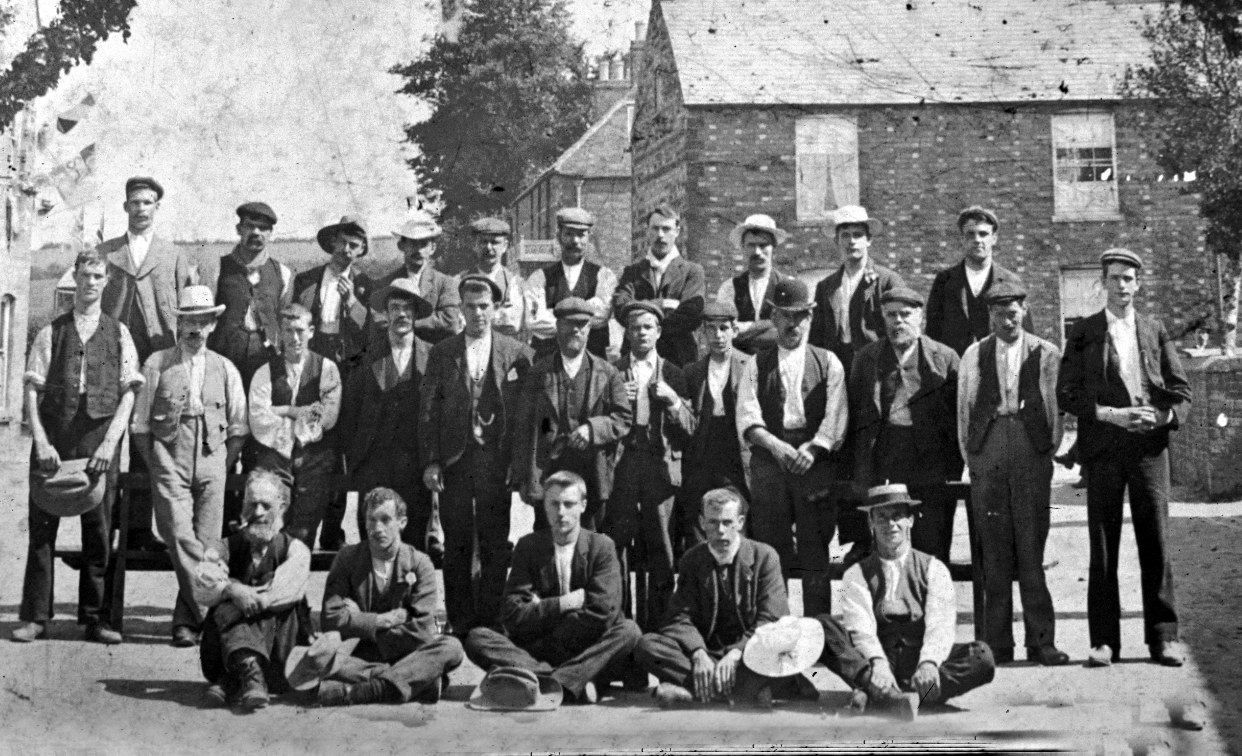
We see below a photograph of a group of men who have just set up a large garlanded arch across the road in Carlow between the Axe and Compass and the Swan. This area was often used for festivities. If we compare this photograph with the Ringstead Band picture on page 66 of Ringstead People we can pick out a number of familiar hats and faces. It seems likely that it was taken in the week before the cancelled June Coronation.
The Coronation went ahead, finally, on 9th August 1902 but we learn from the Mercury of the 15th August:
The Coronation festivities were continues on Saturday. The original programme was carried out on June 24th in its entirety. Leaving a balance in hand of £11, with which a free tea was again provided for all the children under 14 years of age, all persons over 60 and all the widows and poorer inhabitants. A public tea at 4d. was also provided. The weather was all that could be desired, but owing to the two days’ previous wet weather the teas were held indoors. The children assembled in the Schoolroom at three o’clock to the number of 200, and after tea each one was presented with a Coronation medal. Afterwards the elderly people and the general public assembled in the Schoolroom and Temperance Hall to the number of 400. Tea over, all adjourned to the paddock known as the Grove, kindly lent by Mr. W. Ratcliff. The Woodford Prize Band played selections. Various games and sports, principally for the youngsters, were provided and dancing took place. All seemed to enjoy themselves well.
We see that in Ringstead they had decided as all had been planned that the original celebrations should go ahead. We are not told what these “original celebrations” were but we have a report from the Mercury of the Diamond Jubilee celebrations, some five years earlier, in June 1897 which may give us some idea of what would have happened in 1902.
Proceedings commenced with a procession formed as follows:- Four horses gaily decorated, their riders representing sailors and soldiers; these were followed by a dozen cyclists; then came the band and the children numbering over 100, the boys having scarlet bands across the shoulders; wagonettes conveying members of the Parish Council and Jubilee Committee; and the infants brought up the rear. The first stoppage en route was made against Mr. Peny’s shop, where the band first played the National Anthem and the processionists then sang the verse. The Rev. J. Bates gave a brief address. The procession then wound its way through the streets stopping again opposite Mr C. Ratcliffe, where the anthem was again sung, and Mr. George Smith incidentally referred to the age of the Queen, stating that he was born in the same year and the same week. Having arrived at the New Inn, the company dispersed, the children going to the Temperance Hall for their tea. The adults proceeded to the Factory for a meat tea, which was done justice to by 350 people. An adjournment was afterwards made to a close, where the usual games were indulged in, the band enlivening the proceedings with their selections of music, and a very enjoyable and memorable day was brought to a close by again singing the National Anthem, and the children received as they left the field an orange and a bun each.
The people of Ringstead may have had two bites of the cherry but it was not the same throughout the county. In Daventry the Board of Guardians discussed the Workhouse food. The members were concerned that officers seemed to have special 9d. (pence) joints and they went on to discuss the extra food for the inmates:
Mr. Lucas gave notice that at the next meeting he should move that a committee be appointed to go into the whole matter of officers’ joints. – The Board resolved to postpone the extra out-relief granted for the Coronation and as far as possible stop the extra diet for the inmates until the Coronation actually takes place.
As we look at this wonderful photograph we can remember again the description by H. E. Bates of the Northamptonshire shoemakers:
The impression I really get is of a dry, droll, unshaven independence and it is not at all an unlikeable quality.
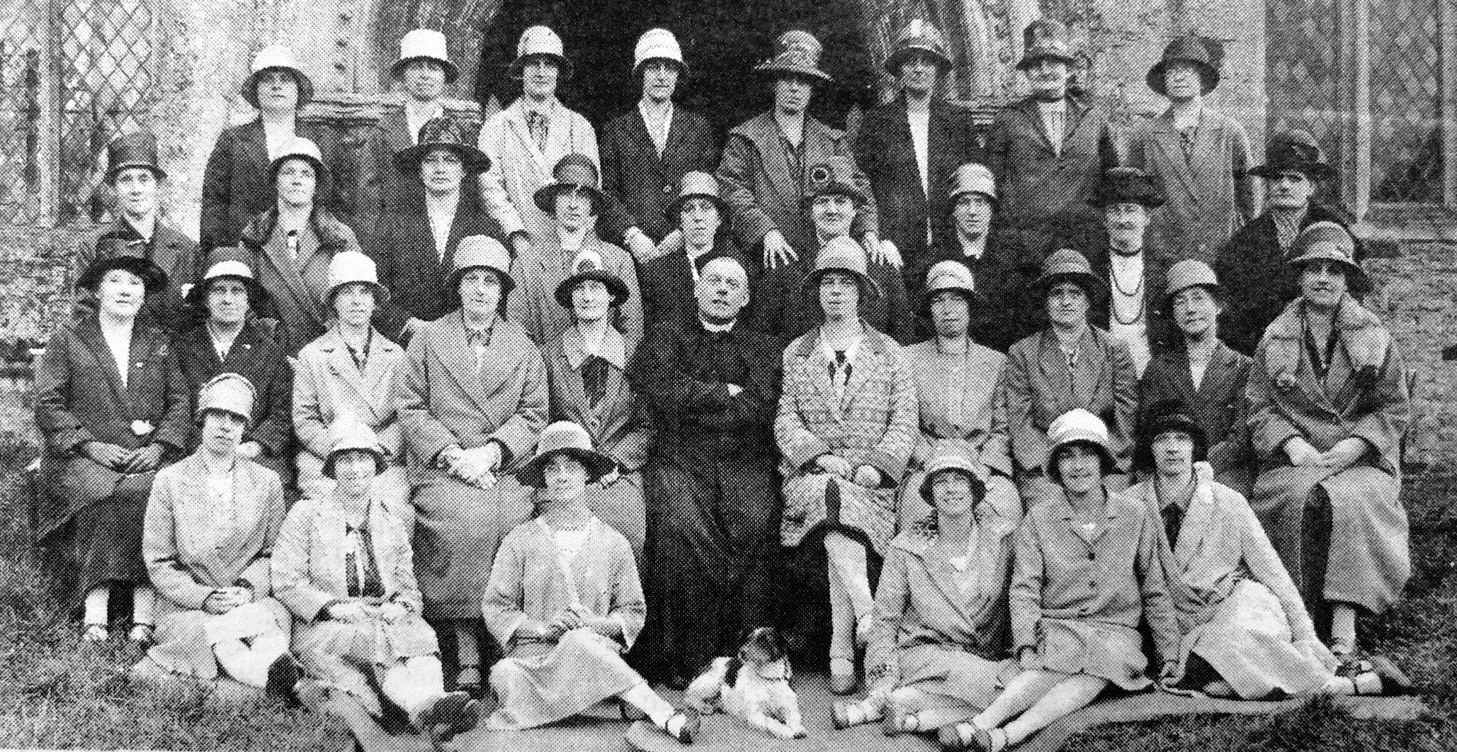
Although we do not see so much evidence of the women of Ringstead, and there is no similar photograph of them, we have seen from the accounts that they were in general a strong, independent group too who would not be easily cowed by authority. Perhaps this later photograph from the 1920s of the Mothers Union will give a hint of their character. One would not wish to cross them.
My time with the village of my father’s ancestors has now finished. I have come to admire many of those people for the qualities that Bates described. I hope that people today will not generalise the past of the village but see it for the place it really was and the people for the individuals that walked its streets. If you can stroll down to the river and picture the quarries by the path to Mallows Common or the often noisy station yard by the level crossing or the mill making paper or grinding corn on the Nene: If you can look at houses and imagine the real men and women and children who lived in them and see the families being waved off on their epic journeys across the world: If you can wander among the graves in the churchyard, old Baptist burial ground or the Cemetery and remember some of the personalities that lie beneath those stones, now sometimes crumbling into anonymity: If you can do just some of these things then I will feel that my time has not been wasted.
References
Northampton Mercury (britishnewspaperarchive.co.uk
Evening Telegraph