Appendix
Amendments and Additions to Ringstead People (Book 1)
I have found some extra information and also some errors in the Ringstead People book since publication and have put these amendments and additions in this section with the original chapters to which they refer. (In the Second Printing of the book I did manage to correct the error in the William Roberts chapter).
David Ball
October 2013
Chapter s One and Fourteen: Elisha Ball, Thomas Ball, Daniel, John and Sarah Ball
A number of the life stories deal with the children of Daniel and Phoebe Ball. Most of their large family left Ringstead to become emigrants to the New World or soldiers. Phoebe is, as many women of the time, rather hidden from public view by the records. The style of this report is of the Music Hall variety, that one Mercury reporter seemed to delight in for his court reports. This one from 11th August 1849 does show something of her feisty nature, an essential survival tool in such a large household in those tough times:
Elizabeth Jacques, who failed to appear to a summons, was brought up under a warrant charged with assaulting Phoebe Ball. Both of these amiable ladies are natives of Ringstead, and appear to have a knowledge of the stronger terms of the English language. After a few preparatory shots, the war of words thickened something after the manner of the Railway Overture. You're a fussick, said Phoebe calmly. You're a liar retorted Bess, sharply. You, a blowed up strollegar! said Phoebe sharper still. After a few more puffs, both of the human engines were fairly off, and all that could be distinguished was - Oh you nasty - don't say so - dirty drab - fat cat - penny-bustle - splay-foot - red-nose - beer-gin - brandy - Oh! oh! oh! oh! oh! oh! and then they softened down as though they had reached a station, to Oh Phoebe, for shame! Oh Bess, you may say so! - did you ever? - no never! - well, I declare! and then they stood and gazed at each other like exhausted first-class engines. After this process the case was heard, and Elizabeth fined 5s. and costs, which were increased on account of her refusing to appear to the summons, and in default she was committed for three weeks.
Unfortunately, although we know that Bess was summoned for assault we have no idea why, how or where the assault took place. The reporter was too pleased with himself to bother with such questions.
Note: I could not find fussick in books on local dialect words but the online Merriam-Webster Dictionary states that it was used in Australia from the 1850s to mean picking about for gold or gemstones in abandoned mining excavations but came from the United Kingdom meaning 'to ferret about'. Originally fussick meant to bustle about and fossack or fussock meant a troublesome person. Obviously the meanings seem linked but it is the latter meaning that is being used here.
I think that strollegar simply astrologer?
Chapter Six. The Butcher of Ringstead? William Weekley Ball
I have found two articles in the Northampton Mercury (British Newspaper Archive) which add to the story of the disappearance of Lydia Attley. The 2nd and 9th April 1859 issues of the newspaper report that on March 24th a skeleton, with the head placed between the legs, had been found by some men when ploughing Mr Passmore's field in Little Addington. It reports that the spot where it was discovered was about a mile from Ringstead and it was shallowly buried in a field that had not been ploughed for some years. The link to the disappearance of Lydia Hetley [sic] and William Wheatley [sic] Ball is made and it reports that , “The discovery has caused quite an excitement in the locality”. We see why there was some scepticism in 1864 when another body was found. We also see the belief in Ringstead that Lydia was buried somewhere in the area.
The other article is in the Saturday 6 September 1851 issue and throws some light on William's leaving of Ringstead for Ramsey. It tells of the 29 August Petty Sessions where Thomas Dunmore, a tailor from Ringstead, complained of an assault by William Peacock on 22nd July. It reports:
. . . Mr Ball, a butcher of Ringstead, was removing his household goods and furniture from thence; that a large concourse of persons followed the waggon to a considerable distance, insisting on Ball giving some account of the girl who was so mysteriously missing, before he left town. Whereupon the complainant, fearing the ropes of the waggon would be cut and the furniture injured, went up as a friend of Balls to protect him and his goods, when the defendant immediately struck him on the head with his fist. Fined 5s and costs £1. 8s. 6d.
We see that William had to face the angry crowds as he left but we also see that he had some friends who stood by him. It was almost exactly a year after the disappearance of Lydia that William, too, left Ringstead
Chapter Eleven. Clicker: John Ball (b.1882)
My father had told me that John (Jack) Ball had been summoned for playing football and there is confirmation in the Mercury on Friday 27th February, 1901. Under the heading, The Football Nuisance, it reports that:
John Ball, shoe hand, Raunds, was charged by Mr. Corby, Clerk to the Urban Council, with playing football in the Pleasure Ground, at Raunds. - The Bench decided not to convict and the case was dismissed on payment of 6s. costs.
[In my father's version it was for playing football there on a Sunday. I am not sure if this is a detail that has been missed out.]
Chapter Nineteen. Blood on the Stubble: William Roberts
Robin Stewart Bolton has alerted me to an error in this story. The baptisms of William's children are a little confusing and it seems that an unbaptised (as far as I can tell) daughter, Mary, was buried on 10th August 1804. William (born in 1805) survived and married Ann Maria Knight in Raunds in 1828. He did not die on 10th August 1806 as I have put in the book.
Chapter Twelve Papermakers William Mitchell and others
The mills of Ringstead are a little bewildering. Not only was Willy Watt sometimes called Ringstead Mill but some tenants moved from one to the other and both mills produced paper and ground corn at some time. It is also likely that both had two wheels operating on these different products at the same time. There are references to “Ringstead Mills” which seems to indicate that two wheels were operating, one of which seems to have always been for corn. The exact location of Ringstead Mill has also been difficult to define exactly although we know that it was on the Nene close to the Railway Station so we are talking of yards rather than miles when considering the alternative positions.
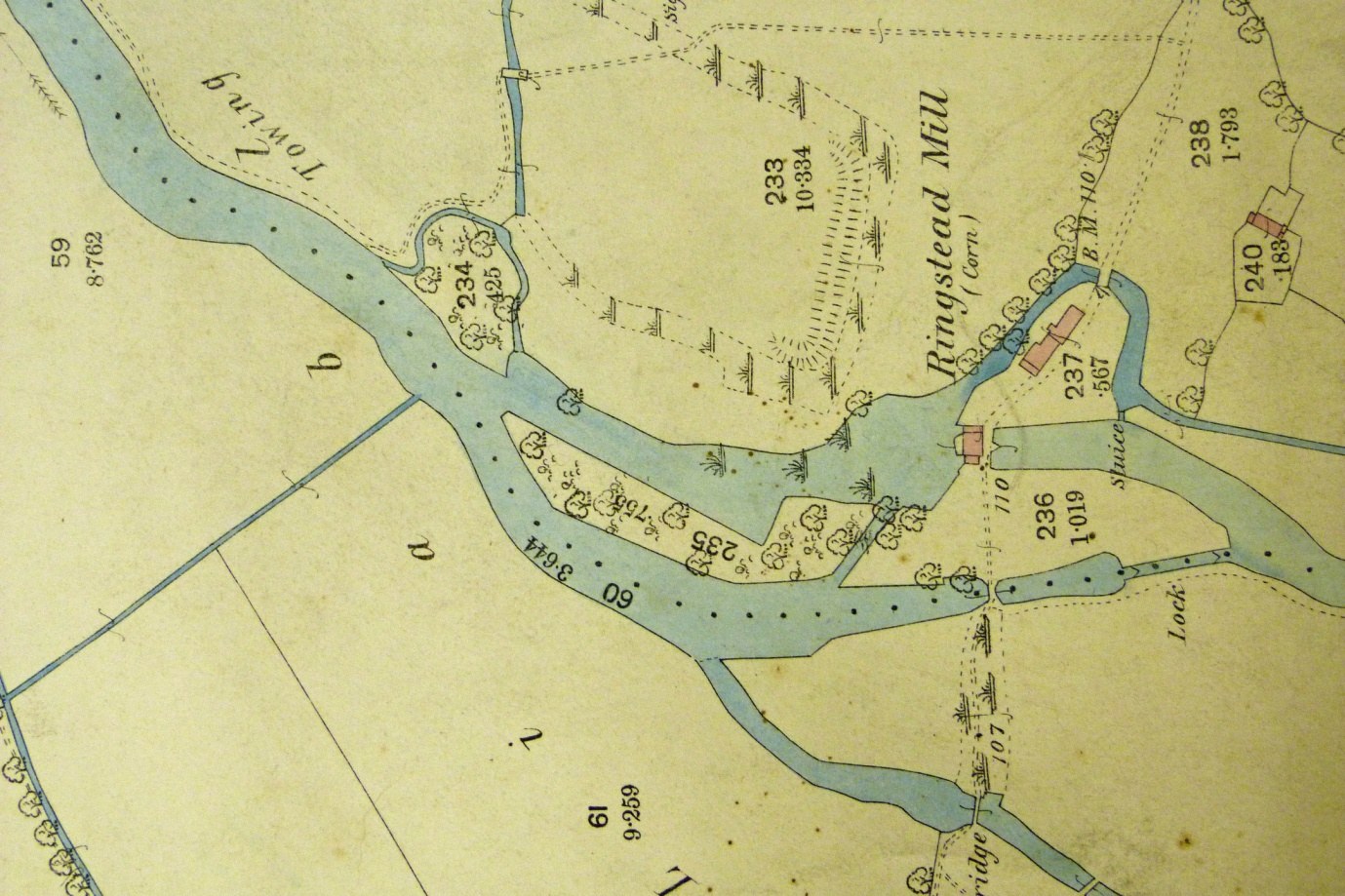
Looking at two pieces of evidence seems to confirm my belief that the mill was sited where the large modern sluice gate is now in place.
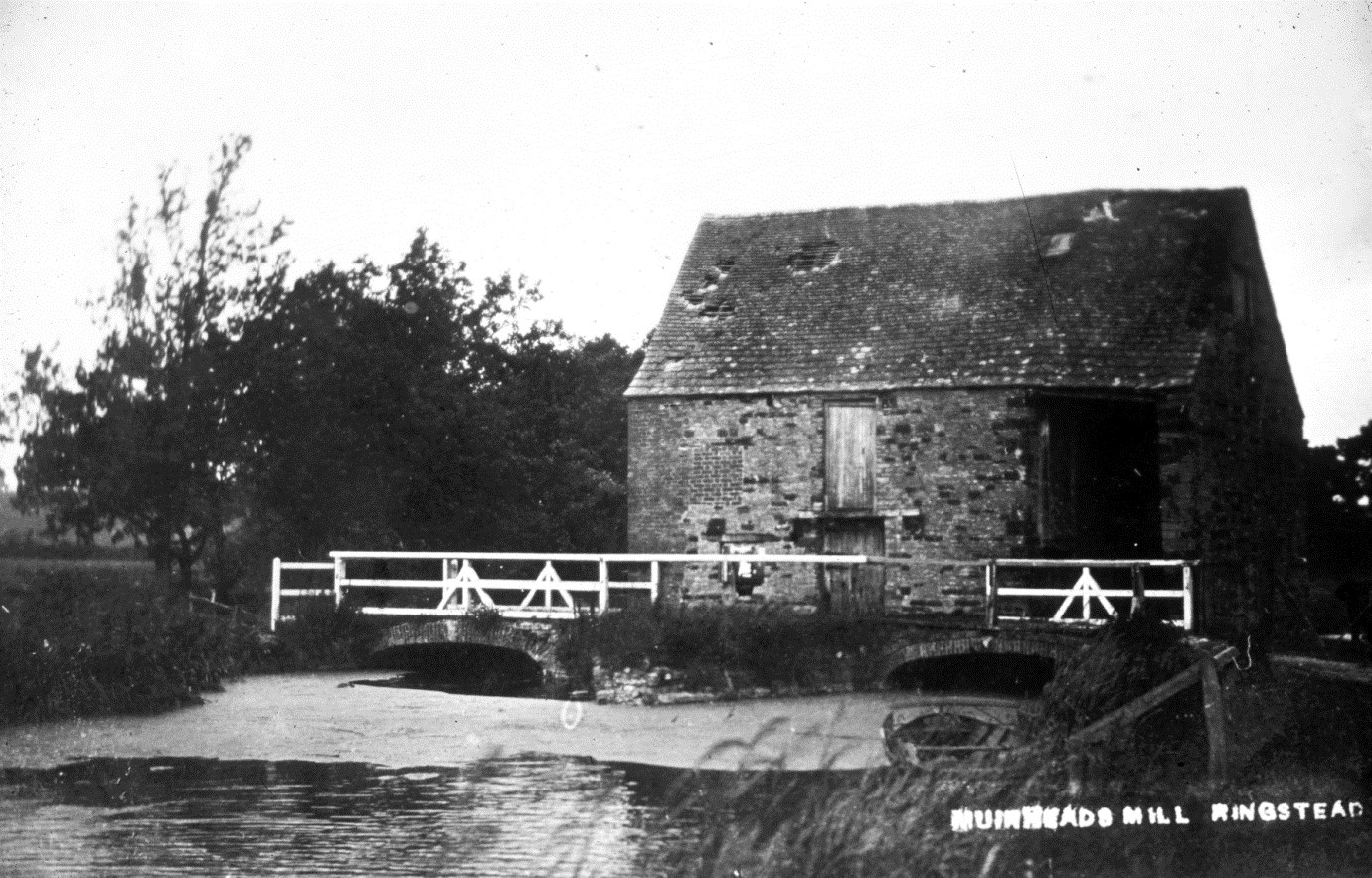
Firstly if you look at the photograph of the Mill in the early Twentieth Century when it was beginning to fall into disrepair it is clear that there are two arches possibly feeding two wheels. The building itself is square and does not appear to have ever provided living quarters.
If you look at the map, to the right of the number 110, you can see the division of the river shown. The long building to the east of this was a row of cottages in which the Muirheads were shown living in 1901 with a trade of shoemaking. There is a stream which curls around from a small sluice gate and around the cottages to the river but not near enough to them to power a wheel there. Was this an overflow stream in times of flood or was it perhaps a part of the process of papermaking. The rags would have to be washed and then stewed in water as part of the process of breaking the linen and cotton into its constituent fibres.
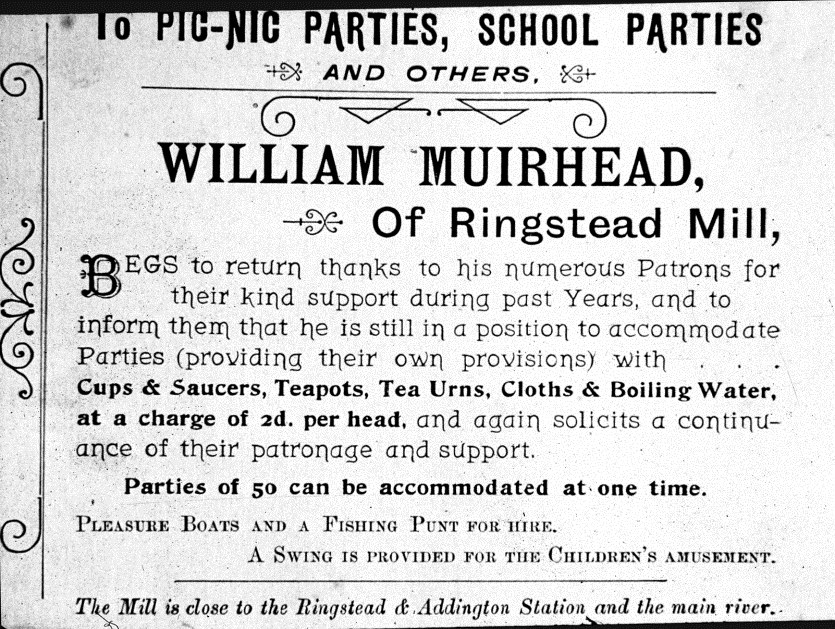
At the end of its life the mill became a part of the social life of the village although one suspects that the teas as well as the pleasure boats and fishing punts were organised form the cottages not from the mill building itself. William Muirhead had been born in Edinburgh and in 1901 he is living at No. 1 Mill Cottages with his wife. He is shown as a shoemaker. Next door at No. 1 Mill Cottages lives Ernest Holmes born in Chesterfield, and also a shoemaker, with his wife Elizabeth who was born in Birmingham. By 1911 William, now 65 is a widower living at “The Old Mill House” with his nephew, also William. William junior is 30 years old is an ironstone labourer from Norwich where his uncle had moved to with his parents before coming to Ringstead. His wife Eliza is a machinist in a boot factory and with them is their ten-year-old daughter Eliza. At some stage after this, as at Willy Watt, other businesses seem to have been tried. William Senior died in 1912 so it is the younger William who seems to have started the picnic and boating enterprise that a few older Ringstead people still remember. A swing was provided so it was hardly Wicksteed Park.
Chapter Twenty-one Wifebeater: Korah Dicks (Dix)
Brenda Hazel has found, through the Genes Re-united website some further brushes with the law of Korah Dicks and some of his sons.
In the Northampton Mercury for 12 July 1856 we learn that Korah Dicks was sentenced to six months hard labour for assaulting his wife again. It seems that this must have occurred soon after he was released from six months gaol for a similar offence. Korah's character did not improve with age for, on 20th February 1871, now an 'aged man', (although probably less than sixty years old), he was charged with assaulting a little girl called Catherine Phillips, six days earlier. Catherine alleged that:
. . . she was running past the defendant with a shoe in her hand when he raised a stick and struck her on the head as she passed him. - P.C. Balderson said that he was attracted to a crowd assembled round the parties just after the assault took place. The little girl was crying. Defendant said he would serve her ten times worse afterwards.
Catherine may not have been entirely innocent because, it was alleged that she had first spat at Korah. The report states that he had paid the £1 fine, but it seems not, for five days later he was committed to three weeks imprisonment, (the default sentence).
On 20th May 1871 he was again charged with stealing two handkerchiefs from Alice Brown but because of his 'great age', and his having been in prison for several days, he was discharged. [Korah died two years later and we gather from these reports that his drinking and, perhaps, the treadmill, which ruined the health of many prisoners, had taken their toll.]
Perhaps inevitably, some of Korah's sons also had trouble with the law. In September 1865 Odd Dicks was charged with stealing a mangold wurtzel, the property of Joseph Dearlove, who stated that he had taken him to court for him to be admonished, as thefts had been increasing. The Mercury also reports on:
Police Constable Packer, who caught the boy in the turnip field sitting underneath the hedge with the wurtzel beneath him.
Some two years later Odd was charged with assaulting Thomas Baker on the 10th June and had to pay a fine and costs amounting to £2 in all.
The Northampton Mercury of the 16th January 1969 reported that Hod [or Odd] Dicks, a lad of sixteen or seventeen, was charged with 'feloniously breaking into the house of William Major of Ringstead on 28th November'. William's son, Daniel had seen Hod escaping out of his father's window and found inside that the rooms in confusion and two watches taken out of the box in which they were kept, but still lying there. At the Quarter Sessions in March Hod was sentenced to three calendar months on gaol (he had already been in custody for two months). Hod had pleaded with the court:
'I hope you won't do much to me; I'll never do any more,' and then wept.
In the 19th November 1881 issue of the Northampton Mercury it reports that:
Lod Dicks and Hod Dicks, brothers, Ringstead, were summoned for being drunk at Irthlingborough on the 1st inst: - Neither Hod nor Lod appeared but the mother appeared for Hod but not for Lod. . . P.C. Brown gave evidence of seeing the brothers, Hod and Lod, on the evening of the 1st lying cheek by jowl on the road between Irthlingborough and Ringstead helplessly drunk and tried to put them on the right road home.
Their mother also paid Hod's fine but she left Lod to sort his own affairs out.
We should recognize that some of these were petty offences that many country boys and young men might have committed. I can certainly remember, when a small boy in a west Northamptonshire village, that the local children stole mangold wurzels from the fields to make lanterns for Halloween.
Chapter Twenty-four First Post: Noah Green and others
On the first page of the chapter Thomas Green is shown as being born in 1759 and married to Jane Meadows. This is a slip. It should be John Green. My thanks, again, to Robin Stewart Bolton for alerting me to this error.