Final Stories · Story 9
SHOEMAKERS NOT THATCHERS
Roberts, Benjamin Ebenezer (c1858 -1925) & Roberts, George Henry (c1865 - 1941)
In this revised biography I have written about some of the Roberts family, particularly Benjamin Ebenezer and his cousin, George Henry Roberts, the son of his father’s younger brother, Thomas. I have linked their stories to the shoemaking industry in Ringstead.
The Roberts family seem to have appeared in the Ringstead area in the late eighteenth century, probably from Wales. Our first sighting of the family in the village is when William Roberts married Ann Roberson on 12th October 1788. William’s first wife and baby daughter, Lydia, died in 1790. He married again some seven months later, on 1st February 1791, to Elizabeth Jacks who was eight years his senior. They had four children; John, Mary, Samuel and Hannah but in January 1799 the three youngest were buried in the churchyard. There is some confusion in that a second Hannah was born on 3rd December 1798, twenty days before the death of the first Hannah. It may be that, when she was baptised on July 1st of the following year, it was decided to give her the same name as the daughter buried in January of that year.
On 18th August 1801 William killed another villager, Matthew Teat, with a scythe in a harvest field fight and spent some months in Northampton Gaol for manslaughter. Later, in 1805, a son William was born and a year later another son Thomas who died aged just 13 months. We see that from the seven children born to William only three John, Hannah and William survived into adulthood.
It is his son John Roberts who is the next link in his chain. His baptism was missing from the Parish Baptismal Register but is in the Bishop’s Transcripts. He was born in about 1791 and baptised in Ringstead Parish Church on 15th June 1792. He too became an agricultural labourer. He married Rebecca Horsfield at Swineshead on 16th February 1818. It is possible that Rebecca had moved to Ringstead before the marriage, but they certainly settled in the village and had three daughters baptised in the local church. Mary was christened on March 18th 1821, Elizabeth, who died as an infant, on April 6th 1823, and Susan on April 29th 1826. Unfortunately, there were to be no others for Rebecca (or Rebekah) was buried on 13th March 1828. Looking at the timing of the other baptisms, it may be that her death was associated with a pregnancy.
As his father, like many widows and widowers with small children, had remarried two years after his wife’s death on 2nd August 1830. She was some fifteen years his junior and was born in Bythorn. At their wedding both John and Alice had signed the Register with an “X”. Nevertheless, in the 1851 Census Alice is described as a “Church Sunday School Mistress”.
This certainly implies some literacy skills and usually some basic musical ability which may have passed down the generations.
John soon had a second family of five sons between 1831 and 1842: William, who died at eight months old, John, William 2, Thomas and George. All are shown as shoemakers in the 1851 Census. George, the youngest is only nine years old but he is already learning his craft. John, at 17 the eldest, is not living with the family but is lodging with another shoemaker, John Pearson and his wife, presumably as an unofficial apprentice.
The younger John was married just two years later in 1853, at the age of nineteen to Letitia Phillips, who was a year younger. The children followed quickly with almost all working in the shoe trade. Elizabeth, born c1854; Owen, born c1856; Benjamin Ebenezer, born c1858; John, born c1860; Alice, born c1864; George born c 1866 and finally Herbert, born c 1868. All are in the shoe trade in the 1871 and 1881 censuses, including the girls, except for George who is in 1881 a “Railway Employee”. (In 1891 he is a Midland Railway Station Master at Asfordby in Leicestershire where, later, his nephew Alfred Roberts held property).
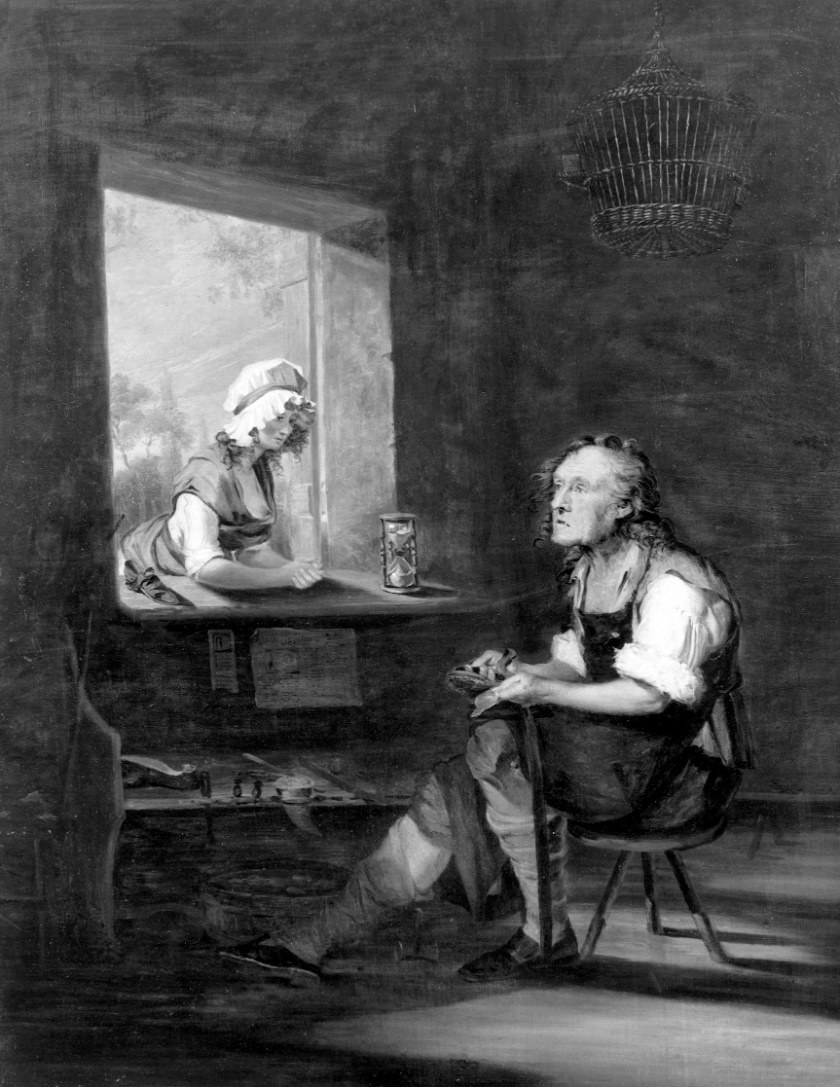
The shoemakers, like the tailors and miners, were always known as a radical, freethinking part of the working-class population. In the book Captain Swing which looks at the agricultural riots of 1830, the authors compare parishes with and without shoemakers and concludes: “The average riotous parish had from double to four times as many shoemakers as the average tranquil one”.
If we look at the figures from the Censuses for Ringstead we find that there were some 36 shoemakers in 1841, 79 in 1851, 145 in 1861 and 186 in 1871. We must be careful in overstating this doubling of shoe workers every ten years in the early Censuses. Some of the increase is due to the lack of information on those who were not heads of families in the 1841 Census. Certainly, some of it is due to the movement of women and girls from lacemaking, which declined very rapidly from 1851 to 1861, although only 35 female shoe workers are recorded in the 1871 Census. There was a great increase nevertheless mainly based on the production of army boots and shoes. Some of this increase seems to have been the result of the various strikes in Northampton culminating in the ones of 1857, 1858 and 1859. The introduction of machinery, especially in the closing process where a form of sewing machine was introduced in November 1857 led to workers fearing for their jobs and strikes were held. The shoemakers refused to work on any boots and shoes that had been "closed" by machinery. At first there was no trade union, but the men belonged to benefit clubs to help see them through hard times. In April 1858, the Northamptonshire Boot and Shoe Makers Mutual Protection Society was established with the main objective of preventing the introduction of machinery and to protect, equalise and raise wages, as far as possible.
The writer of an 1860 report on the strikes, coincidentally a man called John Ball, a common Ringstead name, criticised the action but did concede that:
It is, however, undeniable that the improvements in machinery, when rapidly introduced into any branch of trade, sometimes deprive workmen and those depending on them of their daily bread.
In this case “daily bread” must be taken literally. The strike ultimately failed and many men left Northampton seeking work. The writer of the report estimated some 1500, mainly young men, left the town. There was a movement of some of the shoe making production to the Leicester area which had accepted the new machinery, often in larger factories. There was also a movement of the “coarser” boots and shoe manufacture into the smaller towns and villages such as Raunds and Ringstead. In these cases much of the work was “outwork”, based on piece work with comparatively low rates.
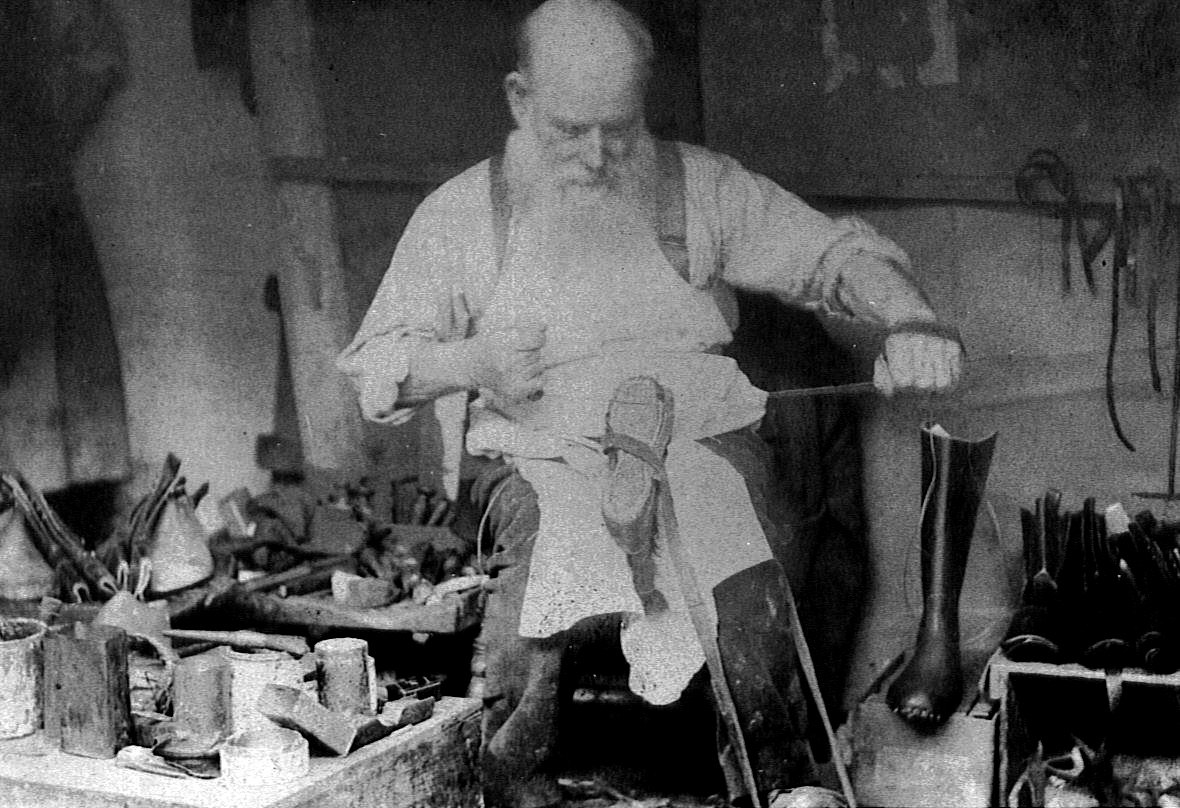
Well into the twentieth century much of the shoemaking in the Ringstead area was done either at home or in small workshops. In his novel, The Feast of July, H. E. Bates writing of the end of the nineteenth century, based mainly on the Higham Ferrers and Rushden area, talks of the two-storey sheds behind the cottages where the shoemakers worked. His heroine sees one such first-floor workshop for the first time.
She looked round the small oblong, white-washed shop, with its crowded benches under the cobwebbed leather-dusted windows; the rolls of kip and calf and belly leather and the untidy mess of tins and sprigs and eyelets and brass tacks and wax-end. A glue pot was cooling on its burner. You could smell the hot breath of it and with it the close dark odour, almost the stench, of leather.
We know that Ringstead had such workshops attached to cottages as can be seen from the various sales in the Northampton Mercury (e.g., 19th December 1868 "Sale of cottages with shoe-makers shops"). A few still can be seen today.
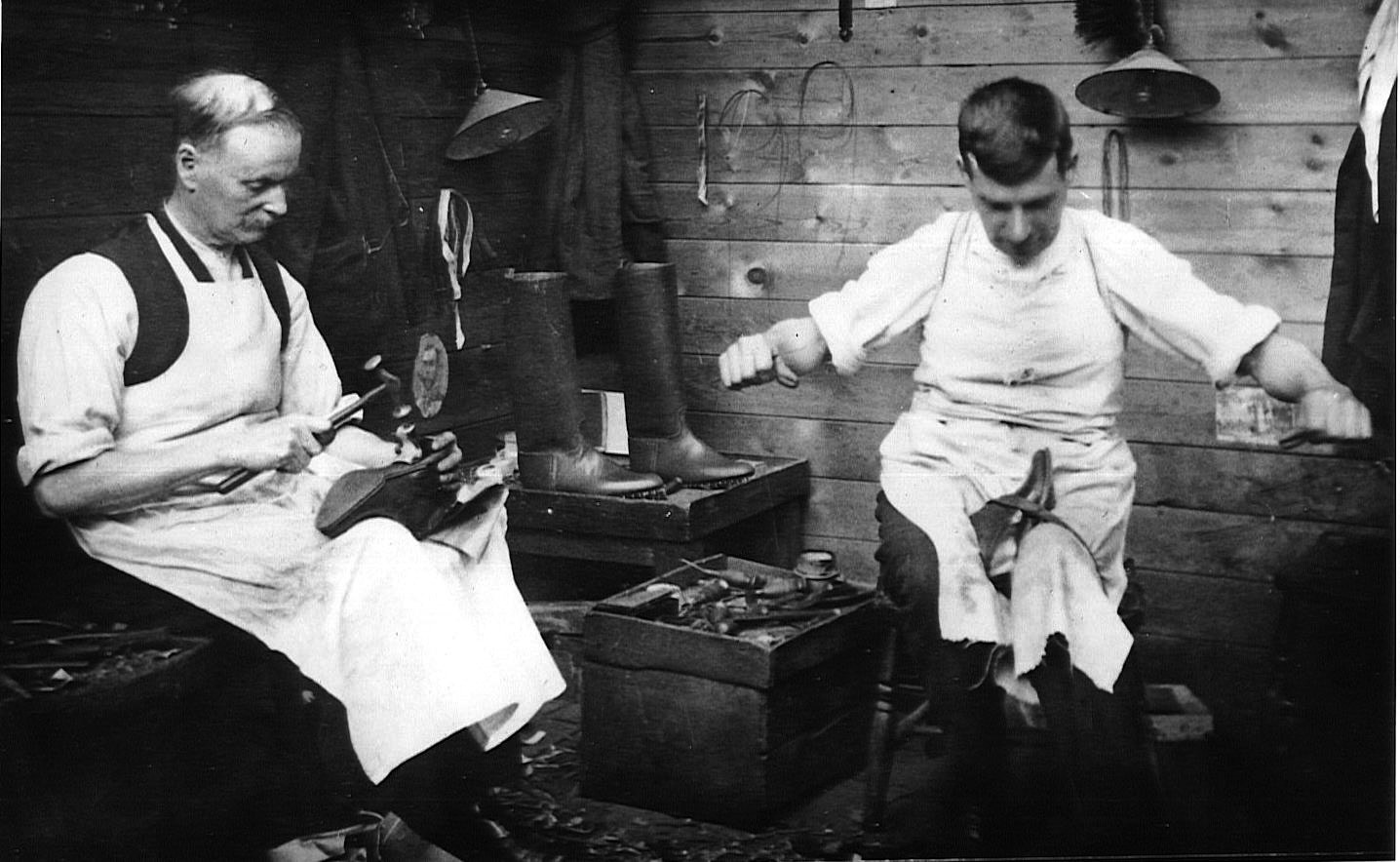
Others did not have that luxury and would work in the living room or in one of the bedrooms. This was particularly true for the women doing the “closing” which involved mainly sewing. Doris Watts speaking of the early years of the twentieth century in Rushden remembers:
Mother was a “boot finisher” and I can see her now in my mind’s eye in that little back room of our house in Cromwell Road finishing a boot that was strapped on one knee and with the other foot tapping the cradle that had a baby in it. It was a wicker cradle on rockers. Women in those days with boots and babies all in one small house had a very hard time. It was drudgery.
We must remember that in the Rushden area it was less likely to be the heavier, military boots that dominated the Raunds and Ringstead production. Incidentally Doris remembers her mother telling her of when her mother planned to marry her father, a Roberts.
When my parents planned to marry, Dad asked Mum where they should marry. The Roberts were brought up Ringstead Baptist but moving to Raunds became Wesleyans. The Raunds Baptists were known at Ringstead as a quarrelsome lot; in Raunds they were known as the “Chosen ones”. Mother said that they would like to be married at Rushden Church, where her mother had been christened. To mother’s surprise my father replied that he was broad minded himself “but had Grandfather been alive he would have forbidden it”.
In the early Nineteenth Century there had emerged entrepreneurs who acted as middlemen and they began to organise small workshops where the clicking (leather pattern cutting) was done and they put out most of the other processes to home workers. In Raunds and Ringstead it appears that the workers would go to the factory to collect the work and then also take it back when finished. The middlemen had in effect become the factory owners.
We do know that in 1867 there was only one major factory in Raunds, Wm. Nicholls & Son, because of a letter sent by a shoemaker to the Co-operator. Isaac Burton writes:
.... Raunds is a large village containing about 2,500 inhabitants, who are chiefly occupied in the shoe trade, but all under the control of one employer, who resides in the place. He keeps a grocer and draper's shop, and if you don't spend your money at his establishments, you must go and seek for work at another village about four miles distant.
Underneath the letter is an article, Serfdom in the Shoe Trade, by Daniel P. Foxwell who, as a result of this letter, went to Raunds and spoke at the Temperance Hall, trying to get the workers to form a Co-operative society. Isaac Burton may have expected that Mr Nicholls did not read the Co-operator but word got back and a few weeks later his indignant rebuttal of the accusations was printed, although he does not deny the statement about the "company shop". Incidentally I have found Isaac Burton, born about 1835 in Raunds in the earlier censuses but in 1871, the census after his letter appeared, his parents and siblings are there (his brothers wrongly transcribed as Barton), but Isaac has disappeared. I could not find Isaac but his descendant, Tracey Huff has informed me that, shortly before the 1871 Census, Isaac emigrated to the United States still working as a shoemaker.
It is important to remember that shoemaking was not a single, uniform craft. Some master shoemakers made bespoke shoes by hand and did all the processes in their own workshops. Increasingly, most only did part of the process with the clickers being the aristocrats of the workforce. Their skill in cutting out the leather to produce matched pairs and to get the maximum from a hide was vital to the quality and the profit from boots and shoes.
The clicking was the first to be organised into workshops and factories because of the space needed and the importance of it to the whole process.
An article in The Boot & Shoe Journal in 1887 described the factories in Raunds, some of which appear to have had all the shoemaking processes within their four walls. He describes the factory of Messers W. Nicholls, for example, as "admirably arranged....The machinery which is of the best description, is driven by a gas-engine. The firm also curries the upper leather required and the whole factory is noticeable for completeness in every respect." Nevertheless, he goes on to say:
Commenting on the army trade generally, I look upon Raunds as the centre of the army-boot-and-shoe making in Northamptonshire and the village of Raunds reminds me of the old days when scarcely anything but hand work was in vogue. The prices paid for closing and making are far from extravagant. The closing of army bluchers is done by hand throughout, and occupies the female workers in the village. For closing bluchers the sum of 3¼d., on an average is paid per pair. A man must work hard to make ten pairs of boots per week and there are many who do not make eight pairs, yet the inhabitants are generally an enterprising class of people, thrifty and industrious, comparing favourably with operatives in the trade elsewhere.
If we look in the Art of Boot and Shoemaking: A Practical Handbook, which was published in 1885, it describes many machines available for the shoemaking processes. These include the Upper Skiving Machine, The Rand Turning Machine, The Sole Moulding Machine, National Closing Machine, Welt or Forepart Stitching Machine, Mackay Heeling Machine, Inside Nailing Machine and Blake Buffing Machine. Many are like Victorian kitchen devices and are hand-powered mechanised processes. Raunds and Ringstead, however, tended to remain a cottage, outwork industry, reliant on the military's insistence on hand-sewn boots.
Our shoemaker, John Roberts, died on 27th December 1870 well before his fortieth birthday. His effects, which were less than £50, were granted to his widow. In the 1871 Census Letitia, was living at 36 is living on Shop (High) Street, on “Parish Relief”. Her oldest daughter, Elizabeth, now 17, was doing “shoework” and Owen (15) and Benjamin (13) were both apprentice shoemakers. She has four other children who are ten or under and are at school. It must have been a very difficult time for Letitia. Next door lives John Barritt and his wife Rebecca. He is a shoe maker and shoe agent. Perhaps after all there were still small middlemen who put out the work and collected it again for a commission. On the other side of her lives Sarah White who is fifty, also a widow, with two children, who is trying to make a living as a seamstress. All around are other shoemakers and their wives. We can only hope that she was helped and supported by the community in her hour of need.
By 1881 she was living in the High Street and is housekeeper for her family. Times are maybe a little better because Benjamin, John, and Herbert are all shoemakers and Alice is a shoe worker. Only George, at fifteen, is the exception and he is a railway employee. All her family will be bringing money into the house.
If she feels unwell, Emma Kitchen is only a few doors away and she can (possibly) help her because she is a vendor of patent medicines. Many would have had laudanum in them to dull the pain of what could not be cured.
Letitia married John Smith in 1884 and the1891 Census finds her living in Rushden with John who is a "Cemetery Caretaker" and by 1901 they are in Stanwick with John now a general labourer. Her children are all elsewhere. She dies in 1909 aged seventy-five.
We cannot follow all the Roberts family lines so we will select two, Benjamin Ebenezer, son of John and Letitia, and George Henry, not his brother, the railway worker, but the son of Thomas, John’s younger brother. These two cousins carried on as shoemakers as the industry went through increasingly difficult times as the nineteenth century drew to a close.
As we have seen, in 1871, Benjamin was thirteen years old and already a shoemaker living with his widowed mother, Letitia. Ten years later he is still in High Street, living with his mother and siblings. Nest door, now, lives another widow and her twenty-three-year-old daughter. Catherine Smith is sixty-four years-old, born in Ireland, and working as a laundress but her daughter, Ellen, is a shoe worker. Although she was never to realise it, Ellen would play a part in the forming of history a century later.
Because of where this family line leads it is worth taking a detour to look at Ellen Smith’s heritage. There is an isolated, ruined cottage, in a place called Dromanassig, some one hundred yards off the Kenmare to Glengariff road in County Kerry in Ireland. The windows have gone but the thick stone walls stand. Catherine Sullivan (or Selewin) was born in this cottage around the year 1811. It appears that she married a Thomas Smith and had two children in Kenmare; John in about 1840 and Mary some four years later. There are no records of the marriage, however, and some people assert that they were married in England. We do know that at some point between 1845 and 1853 they emigrated to England.
This part of Ireland was badly affected by the Irish Potato or Great Famine which began in 1845 and lasted until 1853. Estimates of deaths due to the famine vary between one and three million with a similar number emigrating. The main cause was the extreme poverty of much of the population, trying to survive on tiny plots of land. They grew potatoes as the staple of their diet and then the blight which, ironically came over from America, devastated much of the crop. The ineptitude and callous disregard of the British Government worsened the situation. Another name used in Ireland for this period is “The Great Hunger” because, as in many famines there was sufficient food but much of it was still exported and it did not get to those who were in desperate need.
An English Quaker called William Bennett, travelled round Ireland for six weeks to see the situation for himself. He wrote home to his sister who was a member of the Ladies’ Irish Clothing Committee of London.
These letters were published in book form and one letter written in April 1847 tells of his visit to Kenmare, a beautiful, mountainous region. He arrived late in the evening and found:
The sounds of woe and wailing resounded in the streets through the night. I felt extremely ill, and was almost overcome. In the morning I was credibly informed that nine deaths had taken place during the night, in the open streets, from sheer want and exhaustion. The poor people came in from the rural districts in such numbers, in the hope of getting some relief, that it was utterly impossible to meet their most urgent exigencies and therefore they came literally to die: and I might see several families lying about in the open streets, actually dying of starvation and fever, within a stone’s throw of the inn.
Lord Landsdowne had a large estate at Kenmare and his agent, W. S. Trench, wrote later in “Realities of Irish Life” of conditions in Kenmare in 1849:
When I first reached Kenmare in the winter of 1849-50, the form of destitution had changed in some degree, but it was still very great. It was true that people no longer died of starvation; but they were dying nearly as fast of fever, dysentery, and scurvy within the walls of the workhouse. Food there was in abundance; but to entitle the people to obtain it, they were compelled to go into the workhouse and “auxiliary sheds” until they were crowded almost to suffocation.
Trench persuaded Lord Landsdowne to offer free emigration to these paupers, who had to be in the workhouse, and some two hundred a week went via Cork to America, Canada and Australia. This could be seen as a humanitarian action, but Trench sold the idea to his master by pointing out how the scheme would quickly pay for itself by removing paupers from the parish rates immediately, and in future years.
Trench did admit that the people were a “motley type” who had tried to “break loose” from the ships not only in Cork but also in Liverpool where the ships called before leaving for the New World. The emigrants may have been volunteers but it seems that many went with heavy hearts.
It seems probable that Thomas and Catherine were part of this emigration, although we cannot be sure that they were in this scheme, for it seems they would have had to “break loose” at Liverpool in order to have remained in England. We cannot even be absolutely certain that Thomas was Irish, although it seems likely, as he has not been found in any Census. Could he have been an English soldier? Unfortunately, Catherine Sullivan and Thomas Smith are common name in Ireland and there are many Thomas and Catherine Smiths in England. There was even another couple with those names in Ringstead. On balance, however, it seems most likely that Thomas and Catherine, like millions of others, were forced by the famine to leave Ireland and seek a better life in England.
Tyler Anbinder, in an article in the American Historical Review, recounts that:
Landsdowne tenants were so desperately poor that they would often nail shut their cabins during the summer and walk a hundred miles or more through the counties of Cork, Limerick or Tipperary in search of work. “In autumn they go to the low country during the harvest” noted a Kerry resident, “and their wives then shut up their houses and go begging with their families until their husbands come home with their earnings” in time to harvest their own potatoes. After digging up the tubers some again went inland to find work before retiring home for Christmas.
Tramping the road, looking for work, was common in the Nineteenth Century but we can see that the people from Kenmare would have been unusually accustomed to, trying to survive until they could find a place with more permanent work so that they could settle. It is said that the Smith family may have come via Bristol. We do know that the Irish came into Cardiff and Liverpool and swelled the numbers of paupers and it is likely that many west coast ports received desperate immigrants. I have found no proof of Thomas and Catherine’s route, except that they came via Buckinghamshire. We do know that the family finally settled in Ringstead.
There is another family from Ireland shown in the 1861 Ringstead Census. The parents, Jeremiah Neal aged 44 and his wife Anne, 35, both were born in Kerry and the children were born in Cambridgeshire, Somerset and Kent before the youngest, who was born in Ringstead in about 1859. Both families seem to have wandered across England looking for work where they could find it.
Unfortunately, Thomas Smith died soon after reaching Ringstead and was buried in the churchyard on 27th August 1857 aged 47. Could it even be that it was his ill health and death and the imminent birth of Ellen that stopped the family’s wanderings at Ringstead? His certificate just records his cause of death as due to “decay of nature” which tells us little but may indicate the hardships of his life in Ireland and on the road. The death was notified by Ann Barker which may seem odd. A possible explanation is that Ann, a widow, who is recorded as a lacemaker and pauper in 1851 and a charwoman in 1861, may have been an unqualified nurse and layer-out of the dead that most villages possessed.
In the 1861 Ringstead Census Catherine Smith, aged fifty, is a washerwoman, one of the first options for a poor widow, and the eldest son, John, aged twenty-one is a labourer on the railway. The eldest daughter, Mary Ann at seventeen has married agricultural labourer Richard Gidding. They are living with Catherine as well as the other children. Twin sons, Jerry [Jeremiah] and Thomas are just eight years old and are shown as born in Newport Pagnell in Buckinghamshire. Checking Jeremiah’s birth certificate, we find that he was born at 3 pm on the 5th November 1852 at Moulsoe, a small village, now nearly swallowed up by Milton Keynes. Strangely there seems no sign of the registration of his twin brother Thomas. There are instances of twins being born weeks apart and the family may have moved in the meantime but, as yet, I have not found his birth. Of course, it may just be some discrepancy in the paperwork or my research.
There is also a daughter, Ellen, who is just three years old and was born in Ringstead. There is a large gap between Mary Ann and the twins, and it is possible that there were intermediate children who died in Ireland. Their long, hard time on the road from Kenmare, perhaps staying as casuals in workhouses, could have been another cause.
By 1871 the Smith family had moved into Church Street where Ellen, thirteen years old, is still a “scholar”. By 1881 Ellen, now twenty-three, is a shoe worker and the only child still at home with her mother. Mary Ann has moved away with her husband Richard Giddings. Jeremiah has moved to Thrapston where he was an ironworker and had married Lavinia Medlow from Little Staughton (he later re-marries). I have been unable to find Thomas, perhaps because of his more common first name and the Smith children tend to change their places of birth to delete any Irish connection.
As we have said, next door to the Smiths lived Benjamin Roberts, with his widowed mother and it would seem that the two young people were attracted to each other for they married two years later. There is a slight twist in that the marriage was held at the Church of the Holy Sepulchre in Northampton on 2nd May 1883. Benjamin is recorded as living at 17 Laburnum Terrace which was on the Kettering Road in Northampton, but Ellen’s place of residence appears to be Quinton which is a small village, some five miles south of Northampton. Benjamin is working as a shoemaker so may have gone in search of work but Ellen has no occupation shown. It is possible that she had been in service with one of the farmers or the rector in Quinton and had given up her place to get married.
Is it also possible that Ellen was a Catholic and she stayed with someone prior to the wedding in an Anglican church away from a disapproving mother? Certainly, it would have been unusual not to have married in their local Ringstead church. Once again, we have no evidence and there are many other possible explanations.
The witnesses to the marriage were Benjamin’s younger brother, John Roberts, and Sarah Lockie. The couple were also to marry in Northampton some two years later.
Benjamin and Ellen moved back to Ringstead soon after the wedding and the 1891 Census reveals that their four children have all been born there. The oldest, Eleanor is seven years old, so was born in 1883 or 1884 which means that their time in Northampton was brief. Ten years later we see the family at 8 Carlow Street. Benjamin, now 43 is still a handsewn shoemaker, working at home as are Helena (Eleanor in 1891) aged 17 years, Harold 15, and Frances 13. George, aged 11, is still at school and Alfred, 8, Jessie, 6, and Edward, 4, have been added to the family. In the same house but having two rooms of her own is Ellen’s mother, Catherine Smith now 82 years old. Benjamin’s brother John and his wife Sarah are also back in the village with two children, Florence, 5, and John Owen, 3, both born in Ringstead. Perhaps as a portent, John’s wife, Sarah Lockie had been the daughter of a grocer from Denford.
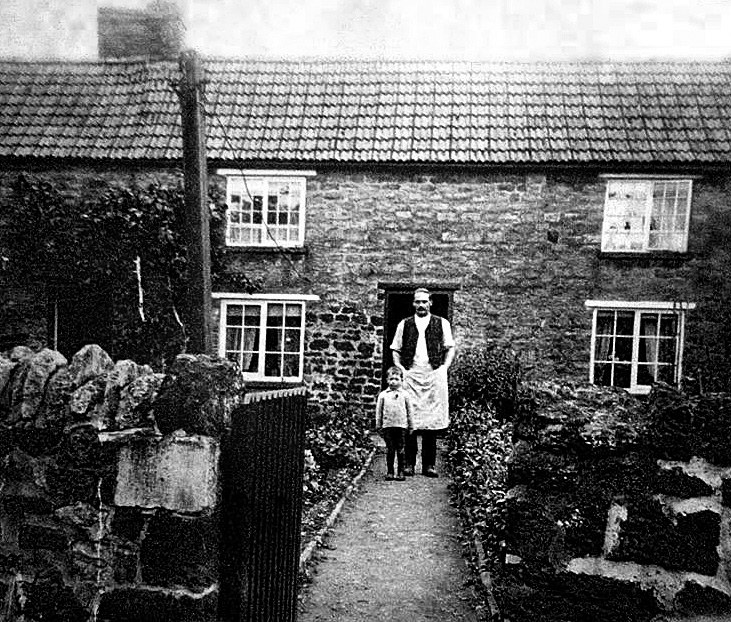
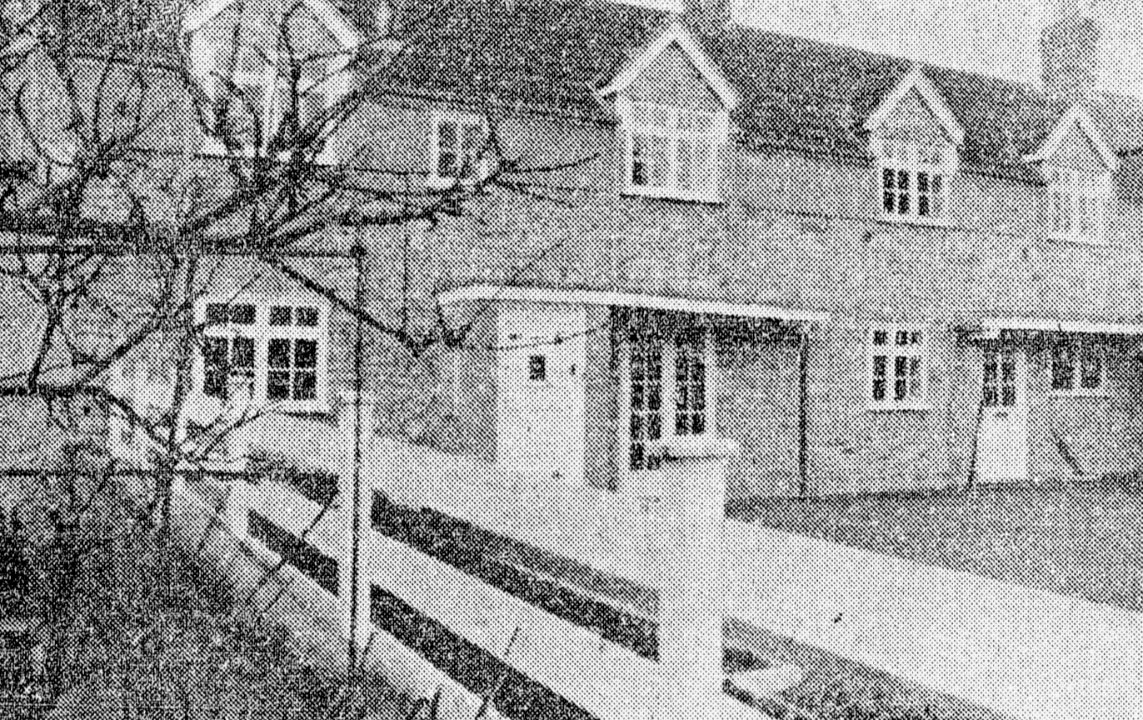
My thanks to Jon Abbott and the Ringstead Heritage group for the use of this photograph.
Ellen’s mother, Catherine, died in Ringstead on February 15th 1904 at the age of eighty-three and the 1911 Census reveals that Benjamin and Ellen had had eight children, one of whom had died. Four children are still at home; the three boys are in the shoe trade and Jessie aged 16 is an assistant dressmaker. It seems from the uncompleted column on homeworking that they all now working in local factories. The youngest child, Edward at 14, is a “Leather chopper in a Leather Lift Factory. A Heel (or “Lift”) works had taken over one of the Ringstead boot and shoe factories, possibly the old Britannia Co-operative building. Eleanor, aged 27, and Frances, aged 23, are still single and working as Parlour Maid and Housemaid respectively, at Upton Hall in Northampton.
It is believed that Benjamin began married life in 18 Carlow Street and moved down the row to a larger house later. We know that the residents complained to the Sanitary Authority in 1880 about the state of the sewers. Two members of the authority had inspected the problem and reported. They found:
. . . a depression in the road immediately in front of the cottages, where, in all probability, after a heavy rain a body of water would accumulate and become stagnant, there being no sewer or drain to take it off. {Northampton Mercury 4th September 1880).
They found the old sewer from the cottages blocked and proposed a new one emptying into a cess pool and then emptying into Agutter Dyke which they recommended the parish should clean out. The “brook”, which ran along the back of the cottages, was later culverted so it is difficult today to imagine the conditions at the time of Benjamin and Ellen.
Returning to the hand-sewn men they were in a difficult position, liking the control they had of their own lives and work but needing mutual support as the Government, via the employers, turned the screw on piecework rates.
Initially, many Raunds and Ringstead workers resisted unionisation because they had always made their own rules as to when they worked. Most would have initially echoed the words of an Irthlingborough shoe worker on the union's policy of speeding up the move from hand outwork to mechanised factory production:
The men do not thank the Union for doing so, they do not want their liberty meddled with, as they have shops to work in, and leading men will not go with their sons into such places as they know they will be. Some will leave the Union if they do not stop such interference.
(Boot & Shoe Journal 10th December 1892)
The shoeworkers and their families would also take time off to help with the harvest and earn some extra money for the family, especially when the trade was slack. The Northampton Mercury of 16th September 1882 reported in the Raunds section:
HARVEST OPERATIONS have been greatly facilitated by the brilliant weather of the past week. Most of the corn has been got in, stacked, and garnered. Gleaning is now almost entirely confined to the wives and families of agricultural labourers. The shoe trade being good this year, but few shoemakers’ wives and families have turned out for gleaning purposes.
It was also a common practice to drink heavily at the weekend (“fuddling”) and then take Monday off. It was known as Saint or Snobs Monday. It is no coincidence that Raunds had a Coffee Tavern a Temperance Band and a strong Rechabite movement.
It was recounted, many years later, by Major Henry Attley that the Roberts were a musical family and Benjamin played the flute and had a fine baritone voice. They were also staunch non-conformists and his younger brother. John was a well-known local organist. He also built organs in some of the local chapels. Mr Attley remembered "blowing the organ" for John and particularly one occasion, when his attention wandered, the pressure dropped. "Blow, boy, blow!" John hissed at him as loud as he dared without the congregation hearing.
The new unions saw the outworkers as undermining the rights, conditions and wages of workers in the factories. At the 1894 Conference of The National Union of the Boot and Shoe Operatives, a Stafford delegate complained about a navy contract being given to Raunds because non-union workers undercut the rates.
Nevertheless, more shoemakers were joining the Amalgamated Society of Boot & Shoe Makers and on the 10th October 1890 the Northampton Mercury reported that at the monthly meeting that the secretary had said that although a new section thirty more members had joined in the last month.
The Reverend A. C. Neely, who was the vicar of Denford-cum-Ringstead, writes a poem some thirty years later about the Hand-sewn Boot makers of Ringstead in 1896. He tells of the first-floor workshop, reached by a ladder and of their disdain for "machine-mades". he also tells of the hard work of making the boots:
“Hard work?” Why, yes, of course it is. Just try to pull this thread.
Can’t manage it? I thought not. Try something else instead.
Hammer this bit of leather, on this iron, on your knee,
It don’t hurt me a blessed bit – but you just try and see!
“Don’t want much of that” you say? Ah! You haven’t learnt the trick,
I’ll tell you about it sometime. Can’t learn it all so quick.
You’re right, it is hard work, sir and more than that, it’s Art
To do it all yourself like, and fit in every part.
The missus sews the tops, of course, but then that’s not so tough,
But if you had a day at that, you’d say you’d had enough.
.
Ironically, in view of what was to follow some ten years later the shoemaker is against strikes, although Neely gives a hint of what is to come:
“Did we go on strike last summer, when the chaps in town were out?”
No bless you, we don’t want to strike; we get on best without.
I’m not going to say, though, that many would refuse
(If they chanced to get the offer) sixpence more a pair of shoes.
We also hear that any boots which were rejected by the War Office for minor defects were sold locally very cheaply and the good vicar had invested in a couple of pairs himself. He also liked to go to the workshop and sit and talk to the shoeworkers about "all sorts of things".
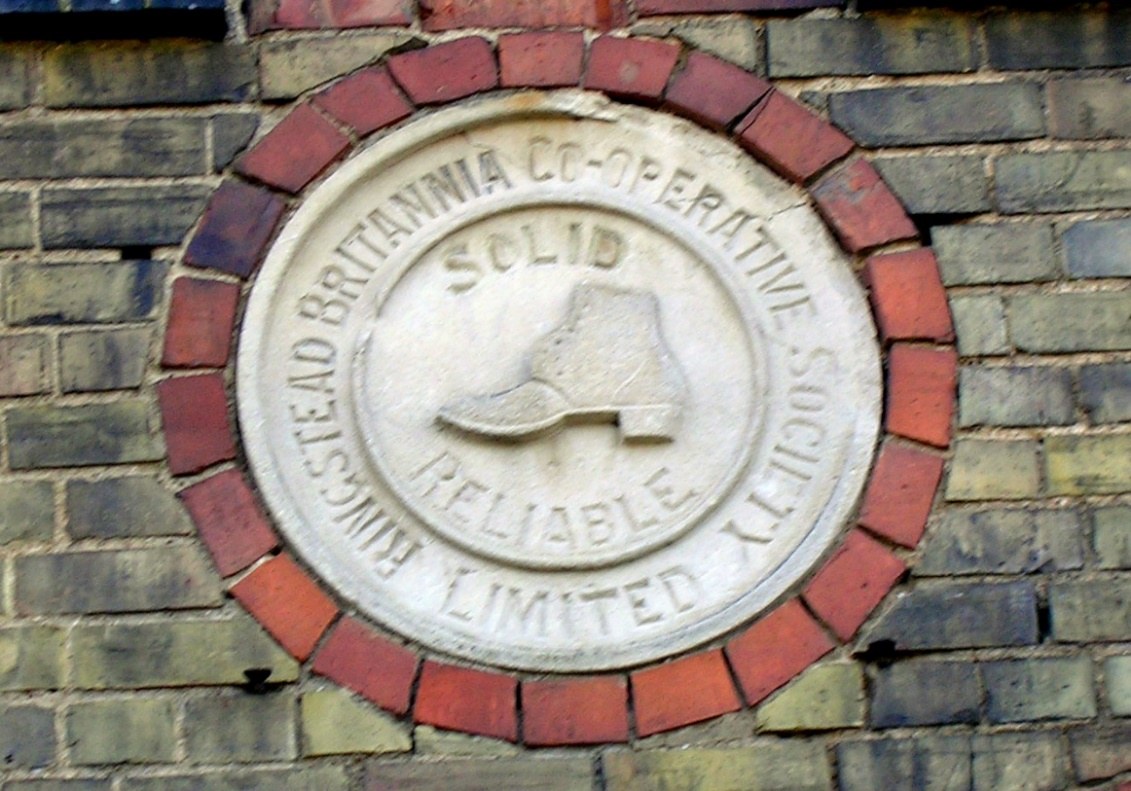
The Ringstead Britannia Co-operative Society was possibly formed in 1891 according to some sources but moved into its new building in Denford Road in 1895. It was hoped that it would help the local shoemakers survive the industrialisation of shoemaking and poor prices for their work by sharing the profits. Unfortunately, the venture folded in 1897 and all its equipment and machines were sold off and it was only the later formed Ringstead Unity Co-operative Society that survived into the 1920s.
At this time, it was a campaign in Egypt which they had made boots for, but it was the larger conflict of The Boer War at the turn of the century (1899 – 1902) which came to the temporary rescue of the industry, especially in the Raunds area which was heavily dependent on military footwear. The orders flowed in and the agreed price for making a pair of boots was met by the War Office and the factory owners. Once the war finished, however, the orders dried up and the contractors tried to undercut each other to secure the diminishing orders. Suddenly the shoemakers’ income dropped again.
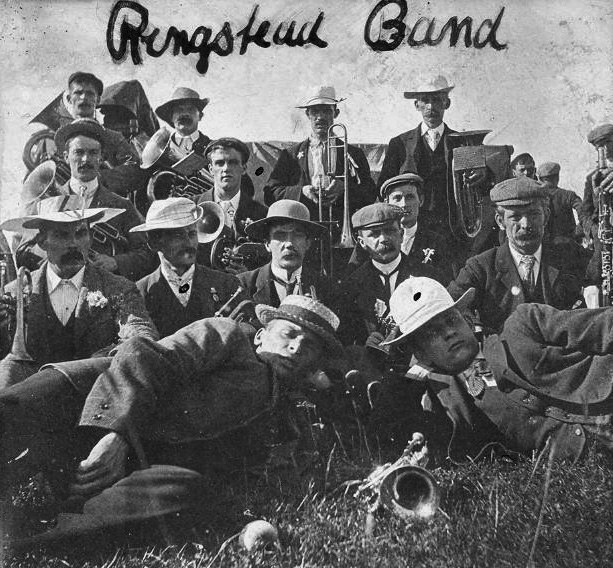
Queen Victoria died in 1901 and there followed the Edwardian postscript before the modern age blasted the world apart. In 1902 the Ringstead Band played for the celebrations in the village for the coronation of Edward VII. Below is a picture of the band, many of whom, three years later, were on that hi9storic march.
Perhaps as we look at Benjamin, and the others in the photograph above, we can see something of what H. E Bates was describing in his autobiography:
The impression I chiefly gain from the recollection of those shoemaking men is not exactly one of coarseness; they lack the sheer belted belching muscle and guts of what used to be known as labouring men; they do not exhibit the beer-spitting swagger I remember of navvies, bricklayers or those wild-eyed drovers of cattle I sometimes used to see drunk and rosy-eyed, on Midland market days. Their roughness is of rather different order, and I find it difficult to describe. If I use the word rude, in the sense of uncouth, the impression will be a shade too strong.
Nor are they loud; nor, in Rupert Brooke’s words, excessively “black of mouth”.
Nor are they as forthright, or as blunt or as self-opinionated as Northern men. The impression I really get is of a dry, droll, unshaven independence and it is not at all an unlikeable quality.
The reduction in the piece-work rate led to a strike of the army boot and shoe makers and to the Raunds March of 1905 where 115 men (selected from the 300 who volunteered) marched to London to petition the War Office and Parliament. The views of the Union and the local workers were as one. Well nearly! All this is covered in J. Betts’ excellent book which anyone interested should read. I will just quote, from The Times of May 15th 1905, to show what a considerable event this was at the time:
THE RAUNDS STRIKERS IN LONDON
A demonstration organised by the Social Democratic Federation in support of the Raunds bootmakers who are on strike, was held in Trafalgar-square yesterday afternoon; and an audience of between 8,000 and 10,000 persons was addressed by Socialist and Labour leaders from three sides of the plinth of the Nelson column. The deputation of strikers assembled under the Charing-cross railway arch about half-past 2 and were there joined by contingents from Socialist and Labour organisations. A procession was formed and, headed by a brass band with twenty or thirty banners unfurled, the men marched to the square, where they met with an enthusiastic reception from the crowd. One of the 115 men who have marched from Raunds, a cripple who walks with a crutch, headed the strikers as they marched into the square to the strains of the “Marseillaise,” and was loudly cheered............ The crowd was the largest which has been seen in Trafalgar-square for some years and it showed its practical sympathy with the strikers by throwing coins, not unmixed with silver, upon the plinth for their benefit. In this way a sum of about £10 was collected.
But what of our two Roberts’ cousins? Some twenty of the marchers were from Ringstead including over half the brass band that accompanied them on the journey. Most were young men but Edward Bird from Ringstead at 59 was the oldest marcher. There were no Roberts on the march, but the conflict split the family. As we have seen from the more recent Miner’s Strike of the 1980s bitterness can brew up in communities when some go hungry and others continue to work. Some, including George Henry tried to carry on collecting work from the factory in Raunds in defiance of the strikers and violence ensued.
It appears, although as yet I have no proof, that George Henry Roberts was the only one in his family who was a strike breaker. Certainly, his own younger brother, William, appeared on behalf of one of those accused of violence against George. Was it all quickly forgotten after the march or did it make George a pariah in the community? David Saint has reported that George was a church man unlike the rest of the Roberts clan who were non-conformists. He also says that George ran a welfare club to help members get health care but that his great nephew, Paul, insisted that he was a narrow-minded bigot and he had never heard anyone say a good word about him.
There is no real evidence in the official records except, perhaps, a hint in the 1911 Census in that Benjamin's children are all put down with one Christian name but George and Mary's all have two listed. Does it mean nothing at all, is it Mary's influence, or is it evidence of someone the locals would see as "putting on airs and graces".
All we can be sure of, is that in the 1911 Census, Benjamin is described as a “Handsewn Army Bootmaker” and George Henry is also a “Handsewn Army Shoemaker.” After George, however, is added the word, “Unemployed” Was this an indication that George was frozen out by the community. On the other hand, Benjamin has a son, called George too, who was a shoe hand and also unemployed.
When we look at the Valuer’s Field Book from the early Twentieth Century, which valued property and land for tax purposes, we see that in 1914 Benjamin owned a house in Carlow Street and in 1902 had bought freehold land in Denford Road which he had as grassland and allotment. He also had some 30 young fruit trees planted there. We see that although not a rich man he was by now comfortably off for a handsewn man.
Perhaps, for George Henry, like many others, it was just the difficult times in the shoe industry a few years before some help came from a terrible source. Jeremiah Smith, Ellen’s brother had been in the Northamptonshire Regiment since about 1904 and had served five years in India. He left the army but remained as a reservist and signed up again at the outbreak of the First World War. He was shot in the jaw at Contalmaison on 22nd July 1916 and died in the Queen Alexandra Military Extension Hospital in London and was buried in Thrapston. Many Ringstead families were to see their young men killed or wounded but it was the First World War that gave the hand-sewn men a little respite. Millions of military boots were needed, although the Government announced that for the first time men would be going to war in the cheaper machine-made boots. Although it gave them temporary respite, it was to be a mortal blow to the handsewn men of Raunds and Ringstead and shoemaking of all types in the area suffered a slow decline and death.
In 1922 the local papers told of their plight. In the Northampton Mercury of 5th May the monthly report of the Shoe Operatives Union stated that there had been a slight improvement in the shoe trade in March but:
At Ringstead employment was very bad owing to the completion of Government contracts.
The industrialisation of the shoe industry and the dependence on the Government’s need for military boots and shoes was to see the end of the hand-sewn men and the death of a way of life that had sustained the village for a century.
We see the evidence of the effect on the handsewn men in the life of Benjamin Roberts foreshadowing in a small way the blight on the mining communities after the destruction of the industry in the 1980s. The Northampton Mercury of Friday 10th April 1925 reported that:
A dangerous accident occurred at Irthlingborough Station (L.M. and S.R.) on Tuesday afternoon when Benjamin Roberts, an elderly man whose home is at Ringstead apparently fell on the line in front of the Northampton-Peterborough passenger train which was drawing slowly into the station.
In a later edition, on the 29th May, we discover, however, that it was no accident. At the Wellingborough Police Court, Benjamin was charged with trying to commit suicide by throwing himself in front of a moving train at Chelveston (there was a one-field wide strip of the Chelveston parish in which the Irthlingborough Station was situated). It tells us that:
Roberts, an elderly man, crippled, and evidently very ill, was accommodated with a seat.
Walter Sydney Hern a railway porter gave evidence that he saw:
Roberts come from behind an oil shed on his hands and knees and place his head on the rail in front of a train travelling from Peterborough to Northampton. The engine at that time was about 15 yards away and was slowing down preparatory to stopping at the station. The lifeguard in front of the wheel of the engine caught him and dragged him along the road for some yards. Witness as soon as he saw the man going to the line gave a signal to the driver, who pulled up immediately. Roberts, who was severely injured was taken to Northampton Hospital by ambulance.
We hear from John Roberts, Benjamin’s brother, that he was a skilled handsewn bootmaker and that there was little work for him. He had been suffering with a septic hand and this had caused lack of sleep and a severe nervous depression. He had tried to get his brother treated at St Andrews Hospital, a charitable institution opened in Northampton in 1838 for the “humane care of the mentally ill”. John Clare, the poet, had spent the last twenty-three years of his life there. Only one doctor would certify Benjamin, however, so he could not be admitted.
Benjamin, who at first tried to say he was not aware what he was doing now admitted that, “he was irresistibly impelled to take his life because of his state of mind”. The Baptist Minister, the Reverend Bates, gave him a good character reference as a “steady, religious, honest man” who was a “most useful member of the church and choir”. Benjamin’s wife, who was a St John Ambulance nurse, appealed to the Bench to let her take her husband home. They agreed and he was put into the care of his wife and his brother, John.
Benjamin had not long to live. He died on 17th September 1925, aged 67, and was buried four days later in Ringstead Cemetery. He left all his assets of £237 7s 5d to his widow, Ellen. George Henry lived to be 76 and was also buried in the Cemetery on May 1st 1941. That part of the cemetery has been levelled into green anonymity and no headstone marks either grave.
One of Benjamin’s sons, Alfred, was not able to follow his father into the craft. He was too short-sighted to do the work and was later said to have worked in Palmer's Grocery Stores in Raunds.
In 1911, aged 19, he was a grocery assistant in Oundle, boarding with a widow and her elderly sister. He moved on to Grantham, married and had two daughters. A few weeks after the death of Benjamin, Alfred’s wife gave birth to a girl in a room over a small grocer’s shop in Grantham.
She was a clever girl called Margaret Hilda Roberts who made Alfred one of the most famous shopkeepers in England. My Uncle, Dennis Ball, told me that he saw her, a very well-dressed little girl, visit her uncle “Barrel Roberts” in Marshalls Road, Raunds. Terry Collins has confirmed that "Barrell" was Harold Roberts, brother of Alfred and that he lived on the opposite side of Marshalls Road at number 58. One wonders if her Great Uncle George’s views and his experiences in 1905 had some effect on Margaret Thatcher's attitude to unions nearly 80 years later. Certainly, it was not that of her grandfather.
Benjamin’s brother, John, had been shown in the 1911 Census as living in Mozart House in the High Street. He had begun his working life as an army boot maker but had saved up and bought a second-hand piano, and later a harmonium, and took them apart to see how they were constructed. He began his business and. by his death, in 1933, was a well-known local businessman who had tuned, repaired, made, sold and installed organs of many types in churches and chapels across the country. The house is shown as having seven rooms. Ellen’s granddaughter, Margaret Roberts, seems to have rarely visited her grandmother during those ten years but, in her autobiography, she tells of being thrilled to be allowed to play on one of the two organs that John had in his barn. She remembered her grandmother as a “bustling active little old lady who kept a fine garden”. She also remembered how large John’s house seemed, compared to Ellen’s humble cottage.
Ten years after Benjamin, on 1st May 1935, Ellen, aged seventy-six, died. Judging by the churchmen officiating at their funerals, whereas Benjamin was a Baptist, Ellen was a Wesleyan, like Alfred her son, perhaps a compromise with her Catholic heritage. On her death the Grantham Journal of 4th May reported:
Councillor A. Roberts, a much-respected townsman of North-parade, has suffered a severe loss by the death of his mother, which occurred at Ringstead, Northamptonshire on Wednesday.
Mrs. Ellen Roberts, who was 76 years of age, had she lived another day would have celebrated the 52nd anniversary of her wedding. She was the widow of Mr. Benjamin Roberts, well known as a singer.
Mrs Roberts was never actively identified with public work but took a keen and lasting interest in the affairs of the Wesleyan Church.
St. John Ambulance Brigade work claimed much of her time, and she had gained all the certificates. She was the first in the village of Ringstead of which she was a native, to take up the work.
She had brought up a family of seven.
Benjamin had not received an obituary in the Grantham Journal.
References
My thanks to: Rebecca Shawcross, Shoe Resources Officer at Northampton Museums and Art Gallery for her help with research and the illustrations: Sara Sharman and Nicki Phillips for checking in the Ringstead Cemetery Register; Martin Curley in Ireland and Agnes Burton in Raunds for alerting me to Ellen’s story; Jon Abbott for the newspaper references to Benjamin’s attempted suicide.
Censuses 1841, 1851, 1861, 1871, 1881, 1891, 1901, 1911
Ringstead Parish Registers.
Captain Swing. E.J. Hobsbawm and George Rude Lawrence and Wishart 1969 pps 181-182
The Art of Boot and Shoemaking: A Practical Handbook. John Bedford Leno (Crosby Lockwood and Co. 1885. Reprinted in Kessinger Publishing's Legacy Reprints)
The Location of the English Shoe Industry. Harald Rydberg. Geografika Annaler SeriesB vol47 part1 1965
Raunds Bootmakers March to London Centenary 1905 – 2005. J. R. Betts. Pub Graham J Underwood
Account of the Strike of the Northamptonshire Boot & Shoe Makers in 1857-8-9 by John Ball (Report of the Committee on Trades’ Societies appointed by the National Association for the Promotion of Social Science 1860. (John W. Parker and Son, West Strand)
Shoemakers in Northamptonshire 1762 – 1911: A Statistical Survey. Hatley, Victor A. & Rajczonek, Joseph (Northampton Historical Series No. 6 1971 (Northampton Central Library)
Shoemakers in Northamptonshire. 1871 Authors as above. (Reprint from Northampton History News June 1983 with 1871 Census figures) (Northampton Central Library)
"Some Northamptonshire Villages. Raunds." The Boot & Shoe Trades Journal 21st May 1887 (Northampton Museum)
Saint Crispin's Men. A history of Northamptonshire's shoemakers. Albert V. Eason (Park Lane Publishing 1994)
The Times. May 15th 1905
The Co-operator 1st June 1867 page 394 (also reply of 15th July 1867 printed in Rance Reviewed Summer 2004)
The Feast of July. H. E. Bates (Michael Joseph 1954)
The Vanished World; An Autobiography. H. E. Bates (Michael Joseph 1969)
Shoe making terms explained.
Boots on the March. David Saint
Various Northampton Mercury editions .
Chronicle & Echo 8th February 1975 "Northants Roots of Mrs Thatcher" by Stanley Worker
Valuer’s Field Book for Ringstead (National Archives) My thanks to Jon Abbott for sending me the relevant pages.
The Papers of Baroness Thatcher LG., OM., FRS. Ref THCR 1/9
Ireland
Birth Certificate for Jeremiah Smith.
Death Certificate of Thomas Smith.
Marriage Certificate for Benjamin Roberts and Ellen Smith.
Landsdowne’s Estates in Kenmare Assisted Emigration Plan. .
Margaret Thatcher, the Grocer’s daughter. John Campbell (Random House 2007).
Irish Examiner 18th April 2013. .
From Famine to Five Points. Tyler Anbinder (American Historical Review April 2002)
Narrative of a Recent Journey of Six Weeks in Ireland. William Bennett. (London 1847) .
Private John Samuel Smith. .